Ainsa Spain: Medieval Pyrenees Day Trip From Zaragoza
Ainsa sits on a rock above the confluence of the Ara and Cinca rivers in the Aragonese Pyrenees, a short, dramatic world away from Zaragoza, the capital of Aragon on the Ebro, and one of the finest medieval day trips the region offers.
Short answer
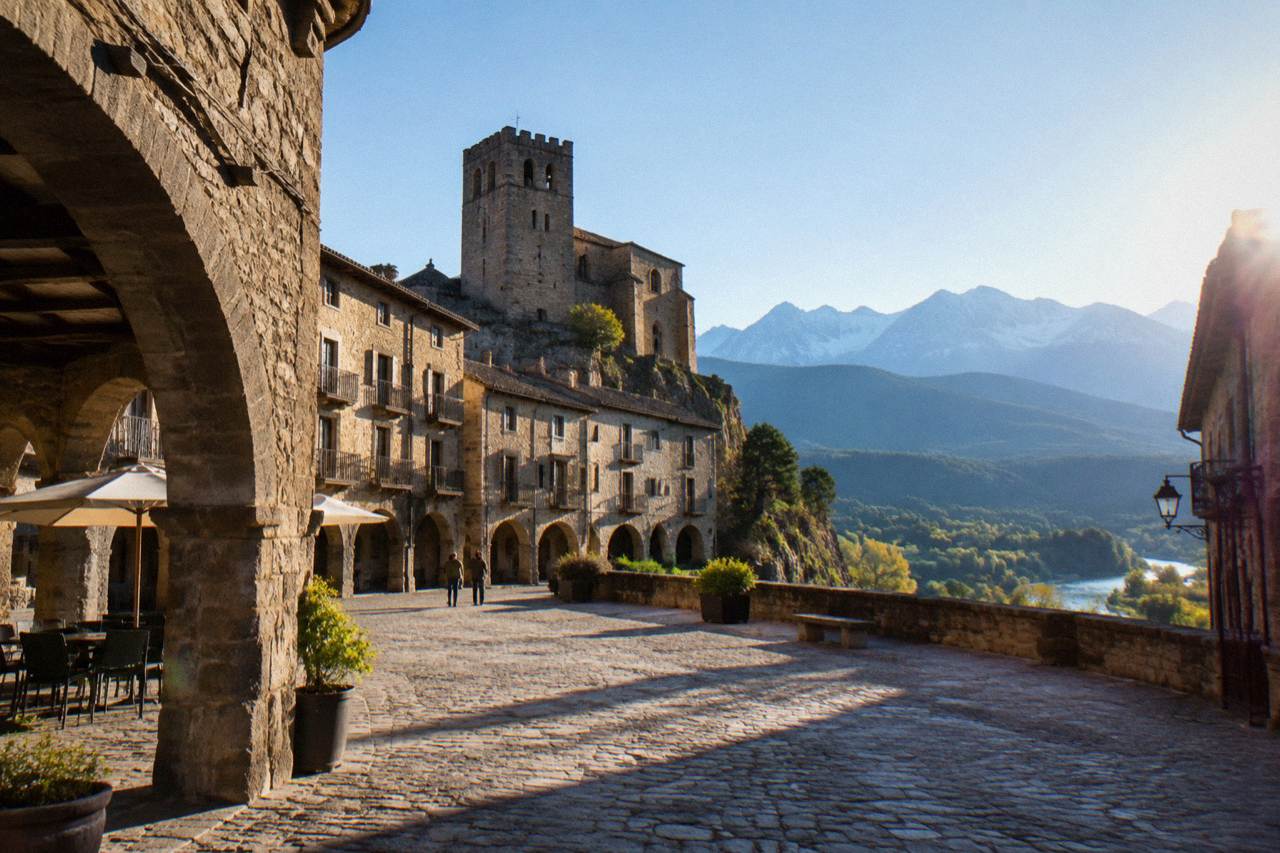
Ainsa is a small, beautifully preserved medieval hill town in the Sobrarbe region of the Aragonese Pyrenees, north of Zaragoza. Its arcaded Plaza Mayor, historic church and castle make it a rewarding day trip, most easily done from Zaragoza on a guided Pyrenees excursion.
Ainsa, usually written Aínsa, is the stone heart of the Sobrarbe region in the Aragonese Pyrenees, and it is one of the best day trips you can build out of Zaragoza, the capital of Aragon on the Ebro. The town rises on a rocky spur above the meeting of the Ara and Cinca rivers, its church and castle keeping watch over a huddle of golden-stone houses that have barely changed shape in centuries. Zaragoza itself sits on the dry inland plain; Aínsa sits in the first real folds of the mountains. The contrast between the two, in a single day, is the whole point of the trip.
This page covers what Aínsa is, what the old town holds, how the guided day trips from Zaragoza work, what to combine it with and when to go. It also links the site's wider Pyrenees coverage, including the Ordesa National Park day trip guide and the Jaca day trip page, for readers building a longer northern itinerary.
What Is Ainsa And Why Go There From Zaragoza?
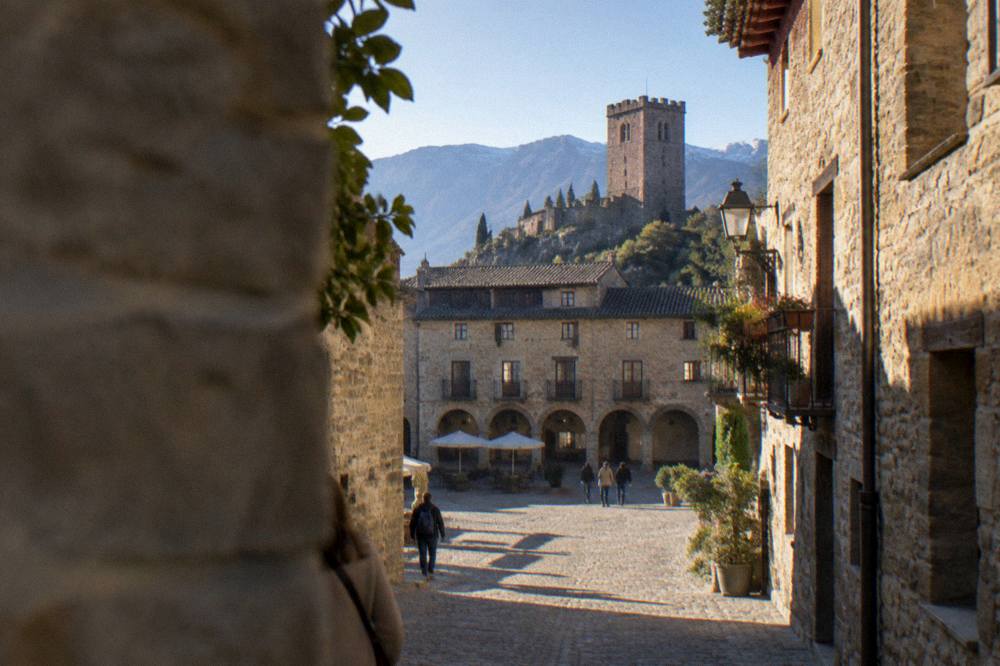
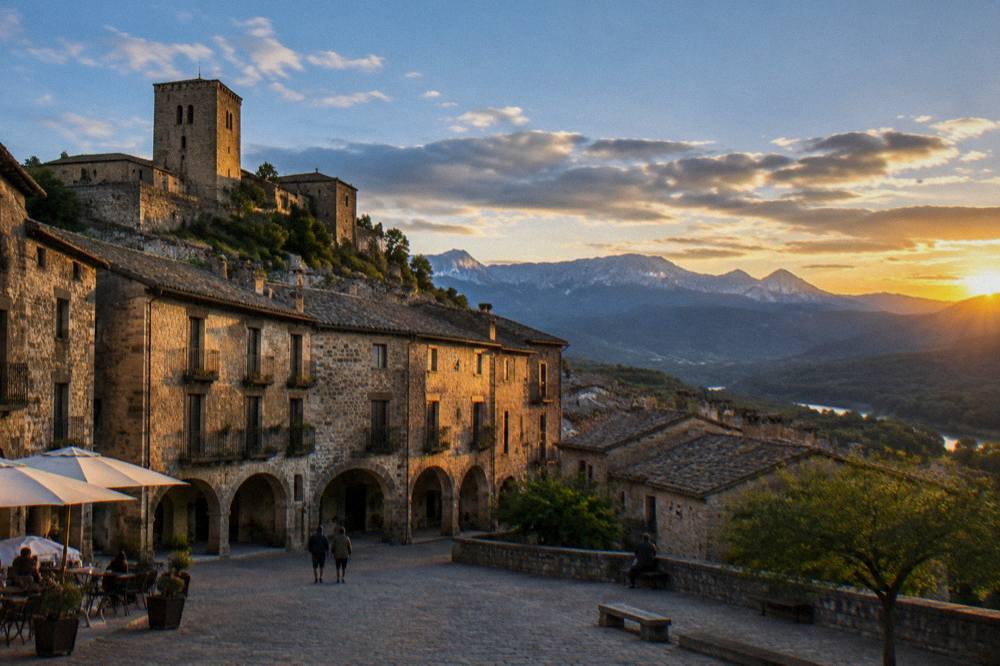
Aínsa is the historic capital of Sobrarbe, one of the old mountain counties that made up the Kingdom of Aragon, and its old town survives almost intact: an arcaded Plaza Mayor, the church of Santa María, a castle complex and a street plan of stone and timber laid out in the medieval period. It lies north of Zaragoza in the Pyrenees, and its setting above two rivers makes it one of the most photogenic small towns in the region.
The legend of Sobrarbe says the first Aragonese king was chosen here after a battle marked by a great oak and a red cross, and the oak and cross still appear on the town's coat of arms and in carvings around the old quarter. Legend aside, the documented history is real enough: the town's grid of streets was laid out as a medieval frontier settlement, and the castle at the top end grew into the bulky fortification you walk through today, much rebuilt when the Spanish crown fortified the Pyrenean frontier against France.
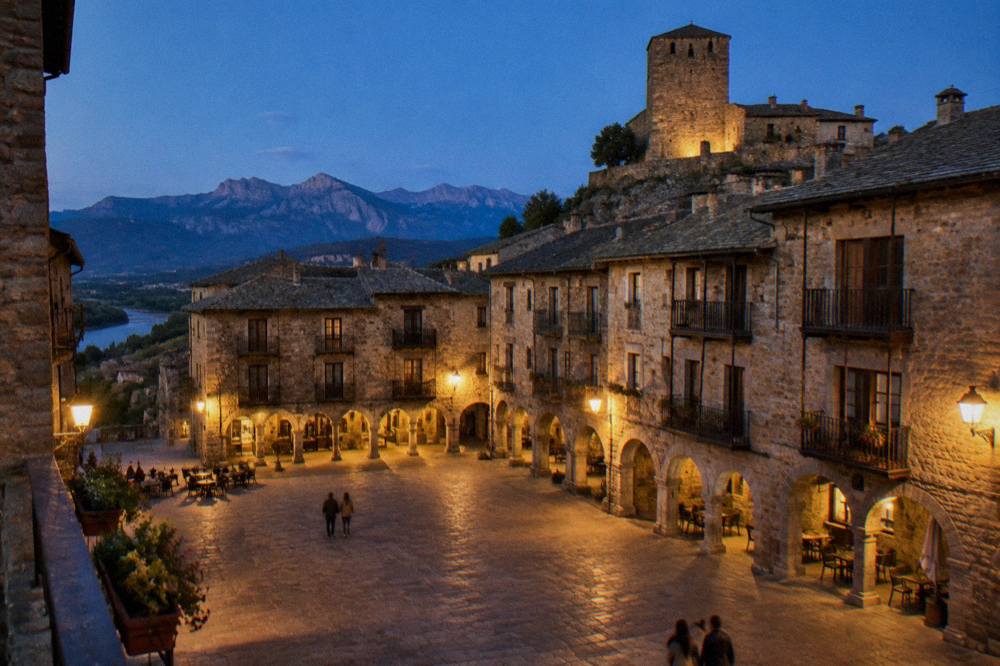
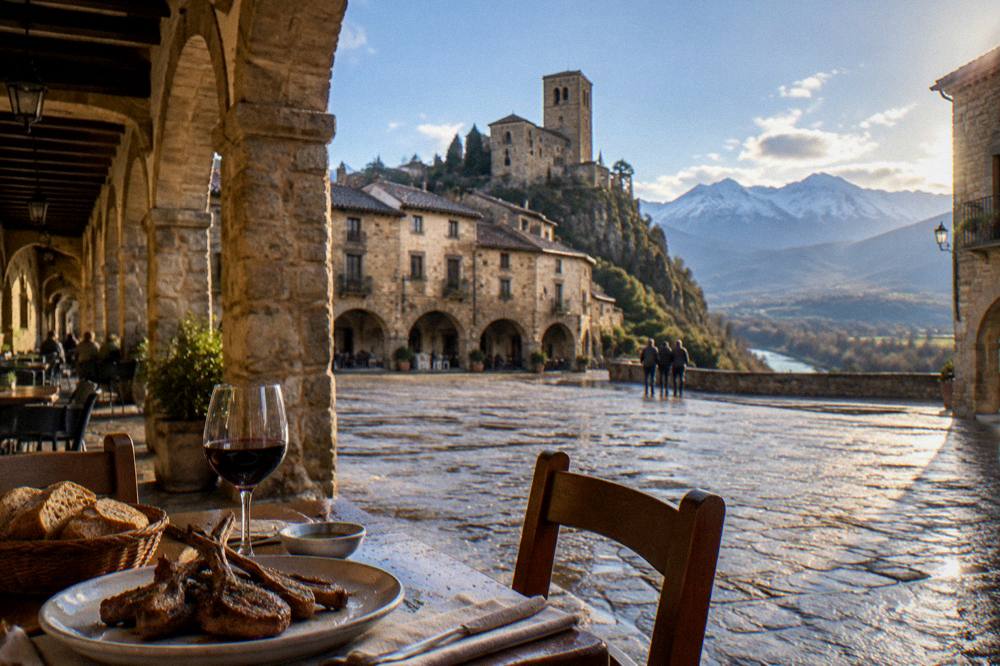
What surprises many visitors from Zaragoza is the completeness of it. There is no modern suburb cluttering the approach, no strip of holiday apartments inside the walls. The old town is a compact, walkable ensemble: you enter under a gateway, climb one street to the Plaza Mayor, and everything of note sits within a few minutes' stroll. The plaza itself is the signature image, ringed by arcades with timber and stone balconies stacked above them, and it fills with market stalls and festivals through the year.
For a traveller based in Zaragoza, Aínsa answers a specific question: where do you go when the plain feels too flat and the city too warm? The mountains begin in earnest north of Huesca, and Aínsa is one of the first towns where the landscape changes from cereal fields to rock, forest and fast water.
How Do You Get From Zaragoza To Ainsa?
The practical route runs north from Zaragoza through Huesca province into the Pyrenean valleys, and no verified public-transport timetable or drive time for that exact journey can be printed here, so the honest answer has two parts: drive it yourself as a mountain route with no fixed schedule, or take a guided excursion from Zaragoza that handles the road entirely, including an Ordesa sightseeing tour that names Aínsa in its title.
Driving gives you full control of the day, and the roads into the Pyrenees are part of the pleasure rather than a chore. What the site can say with confidence is directional: Aínsa lies north of Zaragoza, in the same broad sweep of country as Huesca, Jaca and the Ordesa valley. What it cannot honestly print is a kilometre count or a minute count for the run, because no verified figure for that exact journey sits in the site's fact base, and a guessed figure is worse than none.
The guided alternative removes the guesswork completely. The guided options from Zaragoza include a dedicated Ordesa day sightseeing tour covering Aínsa, Torla and the Sorrosal waterfall, an 11-hour excursion from $66.40 per person, rated 5 from 3 reviews. You are collected in Zaragoza, driven into the mountains, and returned in the evening, with Aínsa written into the itinerary by name.
There is also a self-drive planning reality worth naming: mountain parking in small towns fills early in high season and on festival weekends, and a guided excursion simply deletes that problem. If you do drive, plan to arrive with the whole morning ahead of you rather than at midday.
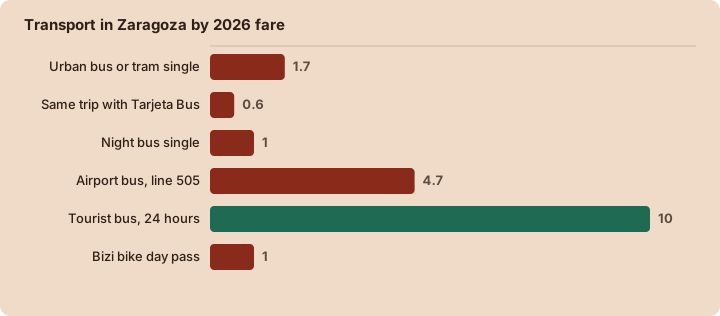
Before leaving Zaragoza itself, the city transport is cheap and simple: the urban bus and tram single is 1.70 EUR, or 0.55 EUR with a Tarjeta Bus, per the 2026 Avanza fare table. If you are flying in and starting the trip from the airport, the airport bus is line 505, never 44 or 501, at 4.65 EUR single.
| Transport in Zaragoza | 2026 fare | Notes |
|---|---|---|
| Urban bus or tram single | 1.70 EUR | No transfer, per the Avanza fare table |
| Same trip with Tarjeta Bus | 0.55 EUR | Card costs 7 EUR, valid on bus and tram |
| Night bus single | 1.00 EUR | Night lines only |
| Airport bus, line 505 | 4.65 EUR single | Timed to flights, roughly 25 to 35 minutes |
| Tourist bus, 24 hours | 10 EUR | 16 stops, 90-minute loop, cash on the bus |
| Bizi bike day pass | 1 EUR plus per-trip | 0.50 EUR for the first 30 minutes |
What Should You See In Ainsa'S Old Town?
The old town of Aínsa holds four things that justify the trip on their own: the arcaded Plaza Mayor, the church of Santa María, the castle complex at the top of the hill, and the viewpoint over the Ara and Cinca river confluence. Everything sits inside a five-minute walk of everything else, so the visit is about atmosphere rather than logistics, and a slow loop of the whole quarter takes an unhurried morning rather than a full day.
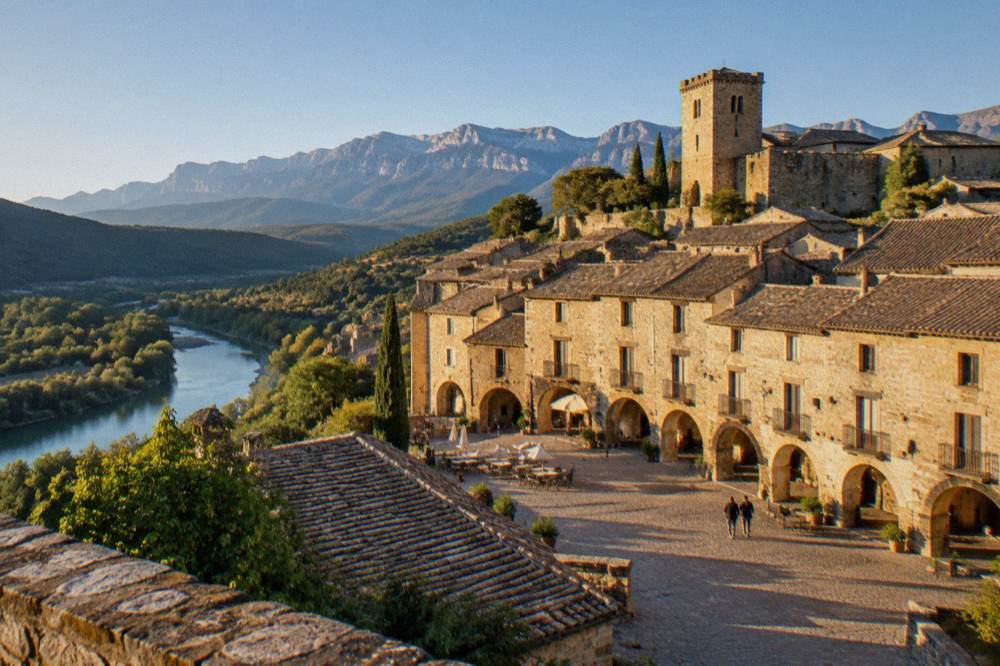
The Plaza Mayor is the centrepiece. Arcaded on all sides, with rough stone columns supporting timber-framed upper floors, it is one of the great medieval squares of Aragon and it still functions as the town's living room: cafés under the arches, children playing football against the pillars, festival events spilling across the stones. The tourist office for the area sits on this square, and the town's small shops cluster on the streets running off it.
The church of Santa María rises at the plaza's north-eastern corner, a sturdy Romanesque building whose tower defines the skyline in every photograph of the town. The castle beyond it, much rebuilt in the era when the Spanish crown fortified the Pyrenean frontier against France, now houses a cultural centre and gives you the widest views over the river confluence and the reservoir that spreads below the hill.
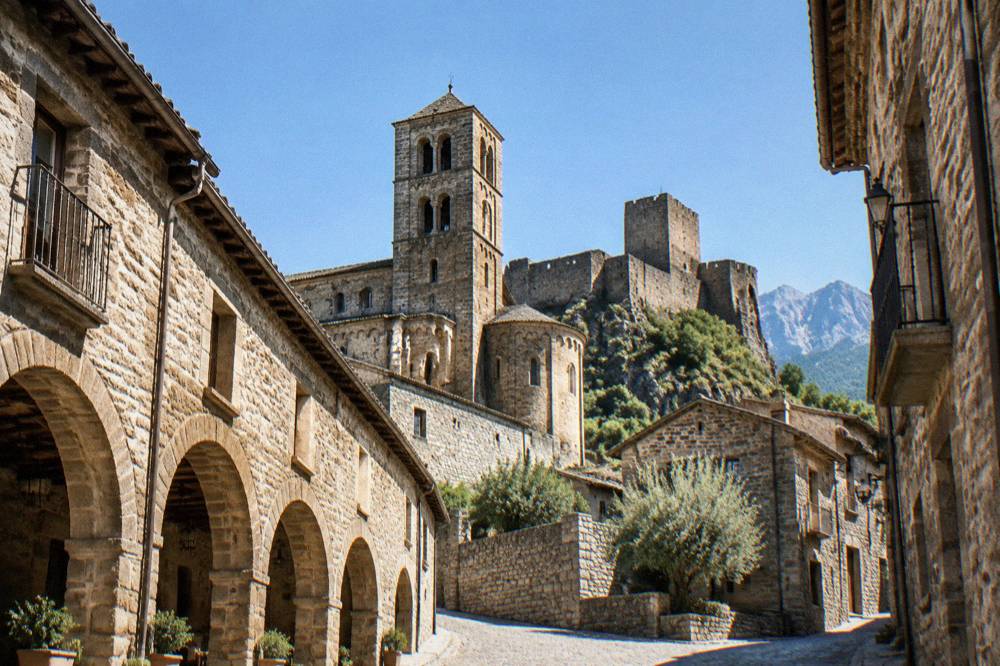
Walk the walls at the edge of the old town and the geography explains itself: the Ara comes down from the north through the Ordesa country, the Cinca arrives from deeper Sobrarbe, and the two rivers meet almost directly under the town. The medieval builders chose the spot precisely because the spur commands both valleys.
Two smaller pleasures complete the visit. First, the old town's streets are full of carved details, including the legendary cross of Sobrarbe set into the plaza's paving, so look down as well as up. Second, the town has a modest but genuine food culture: this is lamb and river-trout country, and the restaurants under the arcades serve the same Aragonese mountain cooking you find across the Sobrarbe region, kin to the dishes described in the site's Zaragoza food guide coverage of the wider region.
What Can You Combine With Ainsa On The Same Day?
The classic pairing is Aínsa with the Ordesa valley: the Ordesa y Monte Perdido National Park lies in the same river country, and the guided excursion from Zaragoza that names Aínsa in its title also covers Torla and the Sorrosal waterfall in a single 11-hour day. Independent travellers can pair Aínsa with Jaca, with the Canfranc international station or with the Alquezar canyon country, all of which lie in the same northern arc from Zaragoza.
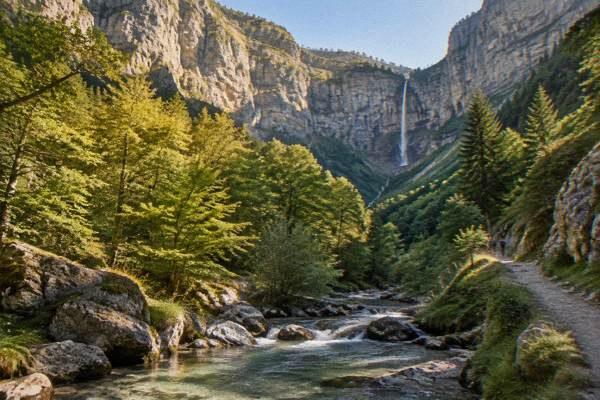
The Ordesa pairing is the strongest because the two places answer different needs. Aínsa is stone, history and a flat plaza to sit in; Ordesa is rock walls, forest and a river running through a glacial canyon. The site's Ordesa National Park day trip guide covers the park in detail, and the guided tour that stitches the two together is the natural choice for anyone who wants both without a second night in the mountains.
The Sorrosal waterfall, on the Ara just outside Broto, is the third stop on that same itinerary, and it is the kind of sight that rewards a tour's fixed timing: the viewing path is short, but the falls run hardest in spring with the snowmelt, and a guide who knows the season will tell you whether the water is thundering or trickling before you commit the day.
For a different flavour of the same north, the Jaca day trip page describes the old capital of Aragon with its Romanesque cathedral, and the Canfranc station guide covers the monumental abandoned international railway station in the high pass. Both sit on the western side of the same mountain arc, and the excursion that is this page's featured tour, Canfranc, Jaca and Sallent de Gállego from Zaragoza, covers that western circuit in one guided day, from $66.40 per person and rated 4.7 from 10 reviews.
To the east of Aínsa, the canyon country around Alquezar and the Sierra de Guara offers ravines and vultures where the Pyrenees drop toward the plain, and the site's Alquezar day trip page covers it, including the full-day Somontano wine excursion that pairs the village with regional wine. The Huesca guide covers the provincial capital you pass on the way north.
Guided Tour Or Independent Trip: Which Works Better For Ainsa?
A guided excursion suits most Zaragoza-based visitors better, because the day is long by design, the drive is entirely mountain road, and the tours that cover the area run 11 hours with pickup in Zaragoza, from $66.40 per person. Independent travel suits visitors who want to linger in the plaza for a long lunch, who are already touring the Pyrenees with a car, or who want to add a second town on their own schedule.
The honest case for the tour is arithmetic. A day trip from Zaragoza into the central Pyrenees spends most of its hours on wheels, and a guided coach turns that into rest, commentary and scenery instead of navigation. The Ordesa excursion that includes Aínsa, Torla and the Sorrosal waterfall runs 11 hours and carries a 5 rating from 3 reviews; the Canfranc, Jaca and Sallent de Gállego tour runs 11 hours at 4.7 from 10 reviews. Both are priced from $66.40 and $67.66 respectively, and both handle the timing so you are not descending mountain roads in the dark.
The honest case for independent travel is pace. Aínsa rewards sitting still: a second coffee under the arcades, an hour at the viewpoint, a slow lunch. A tour gives you a fixed slice of the town, which is enough to see everything but not enough to dissolve into it. If you have a car and one night to spare, the calculus changes completely, and the town makes a fine base for a two-day northern loop combining it with Ordesa or Alquezar.
There is also a middle path worth naming: travel independently but book a single guided excursion for the hardest day. Many visitors drive to the area, then join the local infrastructure around the national park, where parking and shuttle logistics in high season genuinely favour organised transport.
| Guided Pyrenees day trip from Zaragoza | Duration | From (per person) | Rating |
|---|---|---|---|
| Ordesa Day Sightseeing Tour: Aínsa, Torla and Sorrosal Waterfall | 11 hours | $66.40 | 5 from 3 reviews |
| Excursion to Canfranc, Jaca and Sallent de Gállego | 11 hours | $66.40 | 4.7 from 10 reviews |
| Canfranc, Jaca and Sallent de Gallego Tour | Not stated | $67.66 | 5 from 2 reviews |
When Is The Best Time Of Year To Visit Ainsa?
Late spring through early autumn is the comfortable window for a Pyrenees day trip from Zaragoza: AEMET's 1981 to 2010 normals for the Zaragoza Aeropuerto station show the departure city running mean maximums of 24.1 C in May, 29.3 C in June and 32.4 C in July, while the mountains you are heading toward run cooler, and May is the wettest month of the Zaragoza year at 44 mm, so pack for sun on the plain and possible showers in the valleys.
The climate data this site can print is measured at Zaragoza Aeropuerto, on the plain, and it describes your departure point rather than the mountain weather at Aínsa itself. It is still useful, because the whole logic of the trip is escaping the plain's summer heat. July and August, the two driest months of the Zaragoza year at 17 mm each and the sunniest at 348 and 315 hours, are exactly when the stone streets of Aínsa feel best.
| Season in Zaragoza (AEMET 1981-2010 normals, Zaragoza Aeropuerto station) | Mean max C | Rain mm | Sun hours |
|---|---|---|---|
| March | 17.3 | 19 | 217 |
| May | 24.1 | 44 | 274 |
| July | 32.4 | 17 | 348 |
| September | 27.1 | 30 | 243 |
| October | 21.4 | 36 | 195 |
Spring brings the water: the Sorrosal waterfall and the Ordesa river run hardest with the snowmelt, which is the season photographers choose. Autumn brings colour to the beech and pine slopes of the Ordesa country and thinner crowds in the plaza. Winter is quiet and beautiful, but mountain roads can carry snow and the tour calendar thins out, so check the operator's live listing for winter departures before planning.
One timing note that belongs to Zaragoza rather than the mountains: if your trip overlaps the Fiestas del Pilar, running 10 to 18 October 2026 with the Ofrenda de Flores on 12 October, the city will be full and transport busy, and many travellers choose to see the fiestas and postpone the Pyrenees day to the days after.
Where Does Ainsa Fit In A Longer Aragon Itinerary?
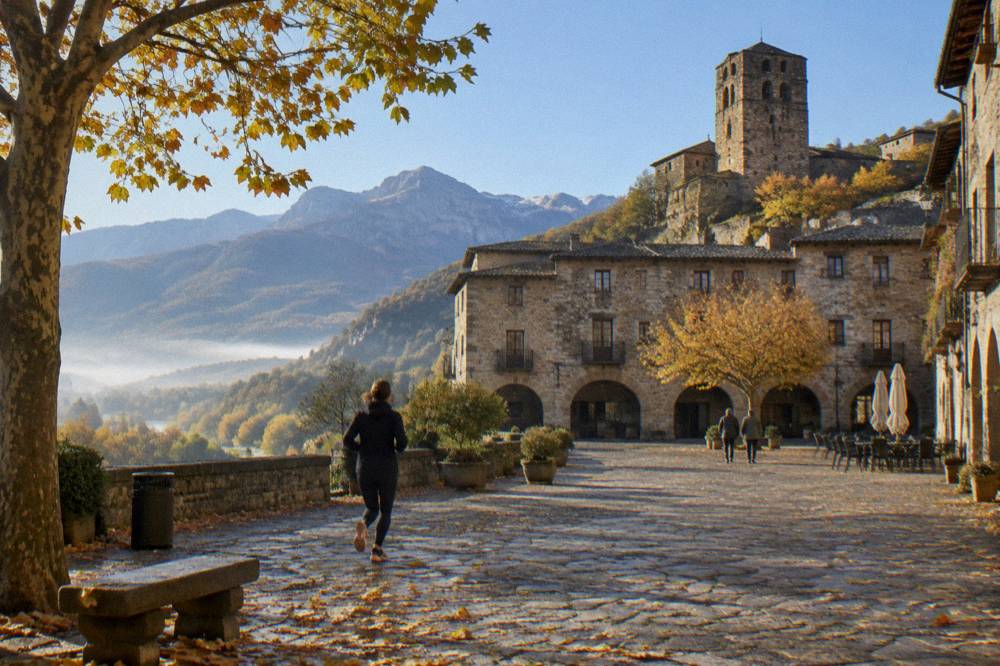
Aínsa is the natural hinge of a northern Aragon loop: pair it with Ordesa for mountains, Jaca and Canfranc for history and railways, Alquezar for canyon country, and Huesca as the provincial gateway, with Zaragoza itself as the base holding the Basílica del Pilar, La Seo, the Aljafería and the Roman Caesaraugusta sites. Two or three days based in Zaragoza with one or two guided mountain days makes a complete regional trip.
The site's itinerary pages cover the sequencing in detail, including the Zaragoza travel planning guide for the city itself. The logic is simple: Zaragoza carries the weight of the monuments, the Mudéjar towers, the Roman ruins and the food, while the northern day trips supply the landscape. Aínsa is the town where those two halves of Aragon feel closest together, stone architecture of the same golden material as the capital's, set against peaks the capital never sees.
| Northern day trip from Zaragoza | What it adds | Site guide |
|---|---|---|
| Aínsa | Medieval plaza, castle, river confluence | This page |
| Ordesa y Monte Perdido | Glacial canyon, forest trails, waterfall | Ordesa National Park guide |
| Jaca | Romanesque cathedral, old fortress town | Jaca guide |
| Canfranc | Monumental abandoned international station | Canfranc station guide |
| Alquezar | Canyon village, vultures, wine country | Alquezar guide |
| Huesca | Provincial capital, gateway to the mountains | Huesca guide |
For travellers arriving from further afield, the site's pages on how to reach Zaragoza and the Delicias station explain the rail hub: high-speed trains connect the city to Madrid and Barcelona in about 1.5 to 2 hours, making a Zaragoza base with Pyrenees day trips a realistic alternative to staying in the mountains.
What Should You Eat In And Around Ainsa?
Mountain Aragon cooking dominates the plaza's restaurants: lamb raised on the same hills, river trout from the Ara and Cinca, and the hearty stews and cured meats of the Sobrarbe region, all closer in spirit to the ternasco and migas traditions of the wider region than to coastal Spanish food. A long lunch under the arcades is the single best hour many visitors spend in the town.
The region's signature dish, ternasco lamb, is the same celebrated product covered in the site's Zaragoza food guide pages, and the mountain version is arguably the most authentic. Trout appears on menus because the town literally sits above two trout rivers, and the local cured meats and cheeses come down from the high Sobrarbe valleys.
The site's Carinena wine region page covers the closer, plain-side alternative.
Common Questions About Ainsa
Is Ainsa worth a day trip from Zaragoza?
Yes, for most travellers. The old town is one of the best-preserved medieval ensembles in Aragon, the drive into the Pyrenees is scenic, and the town pairs naturally with Ordesa, the Sorrosal waterfall or the Jaca and Canfranc circuit. The main trade-off is the length of the day, since guided excursions run around 11 hours door to door.
How do you get to Ainsa from Zaragoza without a car?
The realistic no-car option is a guided excursion: the Ordesa Day Sightseeing Tour from Zaragoza includes Aínsa, Torla and the Sorrosal waterfall in one 11-hour itinerary from $66.40 per person, with pickup in the city. No verified public-transport timetable for the direct journey can be printed here, so a tour is the dependable choice.
What is there to see in Ainsa's old town?
The arcaded Plaza Mayor, the church of Santa María, the castle complex with its views over the Ara and Cinca confluence, and the network of stone streets inside the walls. The whole quarter is walkable in a slow morning, and the cross of Sobrarbe set into the plaza paving is the detail most visitors miss.
Can you combine Ainsa and Ordesa National Park in one day?
Yes, and the guided excursion from Zaragoza does exactly that: the Ordesa Day Sightseeing Tour covers Aínsa, Torla and the Sorrosal waterfall in a single 11-hour day, rated 5 from 3 reviews. Doing both independently in one day is possible by car but makes for a long, tightly scheduled run.
When is the best time of year to visit Ainsa?
Late spring through early autumn. AEMET's 1981 to 2010 normals for the Zaragoza Aeropuerto station show the plain hitting mean maximums of 32.4 C in July, which is exactly when the cooler mountain air feels best. Spring brings the strongest water in the falls and rivers; autumn brings colour and thinner crowds.
Is Ainsa the same place as the Ainsa in the Ordesa tour name?
Yes. The Ordesa Day Sightseeing Tour from Zaragoza names Aínsa in its title, and it is the same medieval town described on this page, used as the gateway stop for the Ordesa valley and the Sorrosal waterfall on the same itinerary.
The Short Version
Aínsa is the medieval hinge of the Aragonese Pyrenees, a complete stone town on a rock above two rivers, and the best northern day trip most Zaragoza visitors can book. The guided Ordesa excursion that names the town in its title covers it in one 11-hour day from $66.40 per person, and it slots into any longer loop alongside Ordesa, Jaca and Alquezar.
Whether you sit for an hour in the Plaza Mayor or ride through on a mountain itinerary, it is the single best answer to the question of where Zaragoza goes when it looks north. More ideas for the city end of the trip sit in the Zaragoza Travel Guide planning pages, and the Ordesa National Park guide covers the valley country that completes the northern day.