What Is A Good One-Day Itinerary For Zaragoza?
A practical one-day itinerary for Zaragoza, Spain: the Basílica del Pilar, La Seo, the Aljafería, tapas in the old town, with verified opening hours, prices and transport tips.
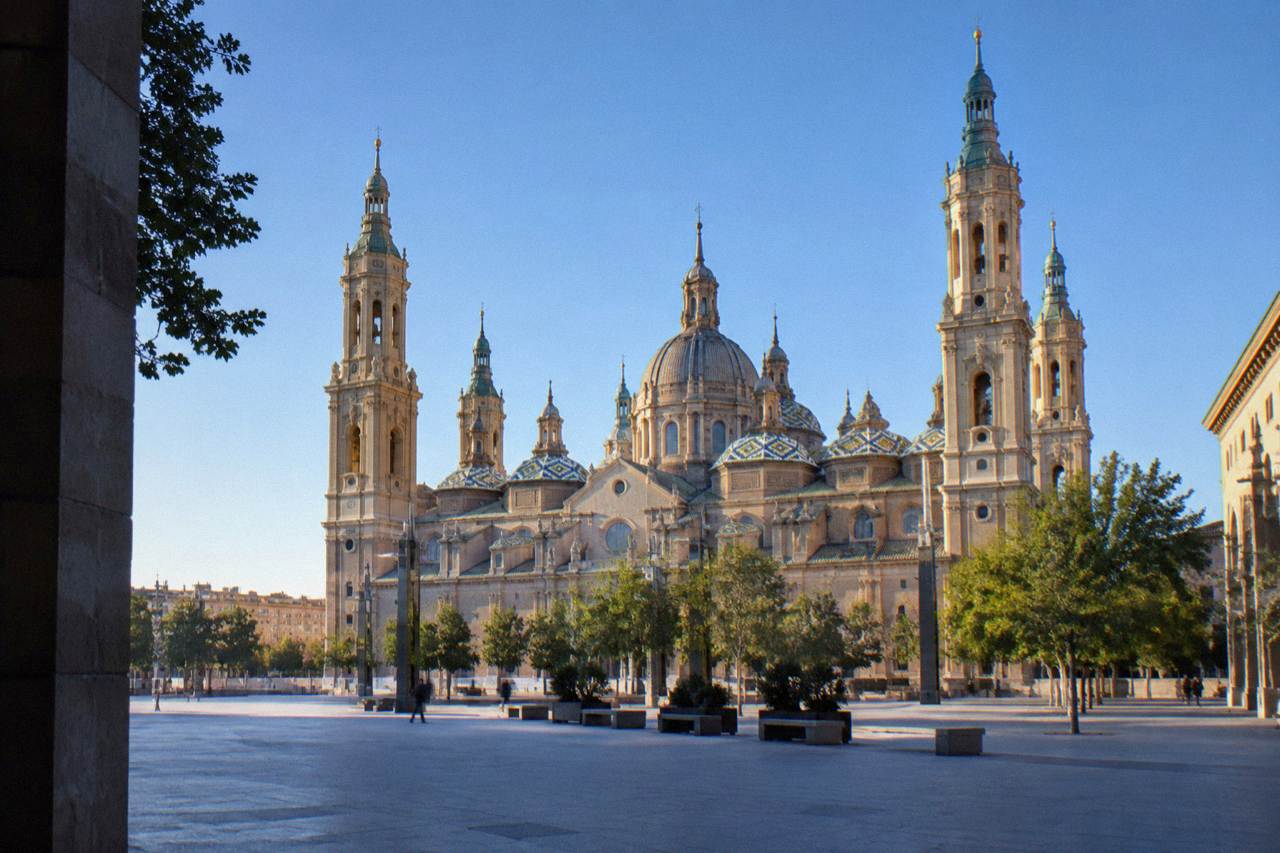
Zaragoza, the capital of Aragon, sits inland on the Ebro, roughly equidistant by high-speed rail from Madrid and Barcelona, each about 1.5 to 2 hours away. That position makes it one of the most practical city stops in Spain, and its monumental core is compact enough that a single well-planned day covers the essentials: the Basílica del Pilar, La Seo, the Aljafería palace, Roman Caesaraugusta underneath the modern streets, and an evening of tapas in the old town. For a fuller version of the same idea, see the site's one-day itinerary guide.
What Is A Good One-Day Itinerary For Zaragoza?
A good one-day itinerary for Zaragoza starts at the Basílica del Pilar in the morning, crosses the Puente de Piedra for the river view, continues to La Seo and the Roman Forum before lunch, spends the mid-afternoon at the Aljafería palace, and finishes with tapas in the old town after dark. Entry to the Pilar is free, La Seo costs EUR 10, and the Aljafería is EUR 7 unguided, so the sightseeing day costs under EUR 30 per person before food.
The logic of the order is simple. The Pilar, La Seo and the Forum museums sit within a few minutes' walk of one another around Plaza del Pilar and Plaza de la Seo, while the Aljafería stands further west, so it makes sense to finish the palace by late afternoon and walk or tram back into the old town for the evening. The municipal October timetable lists the Pilar's main altar zone open Monday to Saturday from 7:30 to 13:30 and again from 16:30, so an early start is rewarded with the basilica almost to yourself.
Zaragoza's old town is small enough that none of this requires a car. The urban tram and bus single fare is EUR 1.70, or EUR 0.55 with a Tarjeta Bus, and the Aljafería has its own tram stop a short walk from the palace gates. If you are arriving the night before, the guide to where Zaragoza is and what it is famous for covers which districts put you closest to this walk.
Morning: Basílica Del Pilar, Puente De Piedra And La Seo
Begin at the Basílica del Pilar around 9:00, when entry to the temple is free and the tower viewpoint opens at 10:00 on weekdays, then walk two minutes to the Puente de Piedra for the classic river view of all four basilica towers, and reach La Seo by 11:00, where the EUR 10 general ticket also covers the Museo de Tapices, the Museo Pilarista and the Rosario de Cristal. Allow ninety minutes for the basilica and the bridge, and another hour for La Seo.
Entering the Pilar costs nothing, which surprises many visitors who assume Spain's grandest baroque church charges. The tower viewpoint, the Torre Mirador, is the paid part: EUR 6 for an adult, EUR 5 for over-65s and residents, EUR 4 for ages 13 to 18, students and groups of 20 or more, and free under 12. On the municipal October timetable the tower runs Monday to Thursday 10:30 to 14:30 and 16:00 to 20:00, and Friday to Sunday 10:00 to 20:00, with last access 30 minutes before closing. One thing to know before you plan the skyline photographs: the basilica's dome, the Regina Patriarcharum, has been under restoration since an agreement signed on 23 January 2026, funded by Fundación Ibercaja, and its completion is not confirmed, so check the basilica's own notices if an unobstructed dome matters to your photos.
The Puente de Piedra, the stone bridge over the Ebro, is the best free viewpoint in the city. The current bridge was built from 1401 and opened in 1440 on the line of a Roman-era crossing, and its four bronze lions have guarded it since 1991. Napoleonic troops blew up one of its arches in 1813, which is why the bridge you photograph today is partly a reconstruction. Cross it, look back at the Pilar, then double back to Plaza de la Seo.
La Seo, the Cathedral of San Salvador, is the city's other great church and most visitors' favourite interior. The EUR 10 general ticket is genuinely good value because it bundles the Museo de Tapices inside the cathedral, the Museo Pilarista across the square, and the Rosario de Cristal; over-65s pay EUR 9, students and 13 to 18-year-olds EUR 7, under-12s free, and a combined ticket with the Pilar tower is EUR 12. October hours are Monday to Saturday 10:00 to 14:30 and 16:00 to 20:00, Sunday mornings 10:00 to 12:00. Aragon residents enter free on the 6th, 12th, 23rd and 27th of each month.
| Stop | Entry cost | October hours | Time to allow |
|---|---|---|---|
| Basílica del Pilar (temple) | Free | Main altar Mon-Sat 7:30-13:30 / 16:30-20:15 | 45-60 min |
| Pilar tower viewpoint | EUR 6 adult | Mon-Thu 10:30-14:30 / 16:00-20:00, Fri-Sun 10:00-20:00 | 30-45 min |
| Puente de Piedra | Free | Public bridge, always open | 20-30 min |
| La Seo + Museo de Tapices | EUR 10 general | Mon-Sat 10:00-14:30 / 16:00-20:00 | 60-75 min |
How Do You Spend A Day In Zaragoza?
You spend the middle of the day in Zaragoza's Roman layer, the Caesaraugusta Forum museum on Plaza de la Seo, followed by a long Aragonese lunch, then take the tram west for the Aljafería palace in the mid-afternoon when its guided Spanish tours run at 15:00 and 16:00. The Forum costs EUR 4, the four-museum Roman bono costs EUR 7, and the Aljafería charges EUR 7 unguided or EUR 9 with a guide, all on the published October timetable.
Zaragoza was Roman Caesaraugusta, and the city has four museums over its remains: the Forum, the River Port, the Baths and the Theatre. With one day, the Forum museum is the one to pick because it sits directly on Plaza de la Seo, seconds from La Seo's door, so it costs you no travel time at all. Entry is EUR 4, or EUR 3 for the River Port and Baths, and the four-museum bono at EUR 7 (EUR 5 reduced) is worth it only if you will genuinely visit a second site. All four museums open Tuesday to Saturday 10:00 to 14:00 and 17:00 to 21:00, Sunday and holidays 10:00 to 14:30, and the first Sunday of the month is free. Other pages covering the same trip are gathered on Zaragoza Travel Guide.
Lunch in Aragon is not a pause, it is an event. Ternasco de Aragon, roast lamb with potatoes, and migas aragonesas, fried breadcrumbs with grapes and pork, are the two dishes the region is known for, and the old town's restaurants around Plaza de la Seo and Calle Estudios serve both at midday. The site's food coverage explains what food Zaragoza is famous for in detail; for one day, book or arrive by 14:00, because kitchens close mid-afternoon and the evening shift is tapas, not full menus.
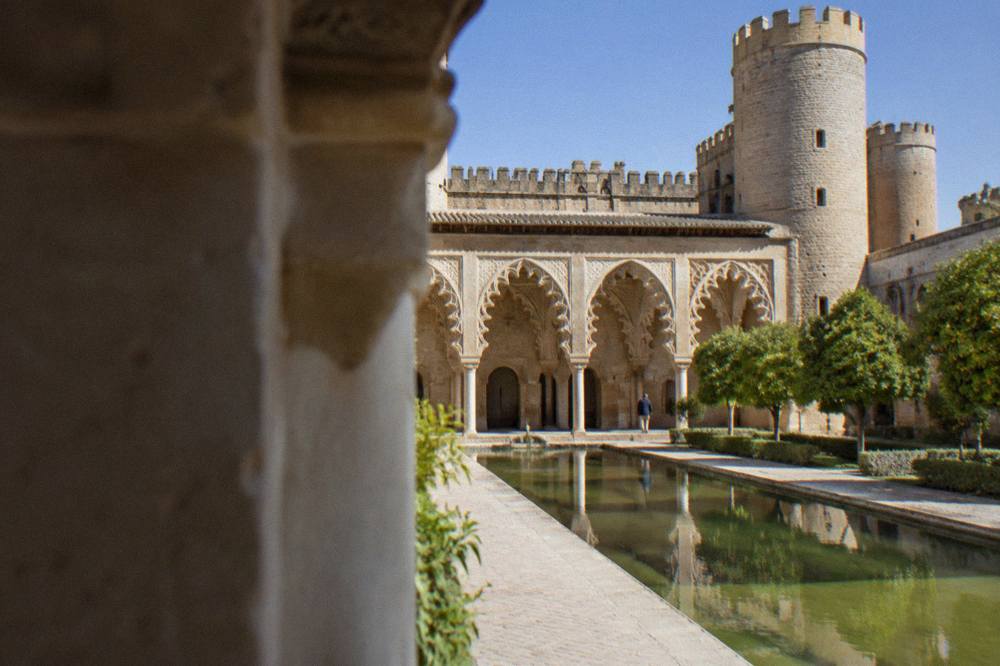
The Aljafería is the finest Islamic palace in Spain outside Andalusia and the single most underrated stop on this itinerary. October hours are daily 10:00 to 18:00, entry EUR 7 general or EUR 9 with a guided visit, EUR 4 if you show a tourist bus ticket, EUR 2 for students, over-65s and Carnet Joven holders, and free for under-12s. The palace also opens free on the first and third Sunday and Monday of each month. Spanish-language guided tours run at 10:30, 12:30, 13:30, 15:00 and 16:00, and last access is 45 minutes before closing. If your Spanish is not up to a guided tour, go unguided and read the room: the courtyard arcades, the oratory mihrab and the ceiling of the throne room need no narration.
A 105-minute guided introduction, the Zaragoza Monumental Sightseeing Tour, costs from $10.41 per person and is rated 4.4 from 36 reviews, a cheap way to anchor the morning's walk with a guide's context. Check availability if you want the orientation before you set off on your own.
Evening: Tapas In The Old Town And The Pilar After Dark
End the day back in the old town: Zaragoza's tapas bars open from around 20:00, and the Basílica del Pilar's main altar zone stays open until 20:15 on weekdays and 21:30 on Sunday evenings, so the illuminated basilica is a genuine after-dinner stop rather than a photograph you miss. A tram or bus back from the Aljafería costs EUR 1.70 single, and the whole evening can run on tapas alone without a sit-down restaurant.
The evening is when Zaragoza stops feeling like a museum and starts feeling like a lived-in Spanish city. The old town's bar streets fill from 20:00 onward, and the classic move is a crawl of three or four bars, one or two tapas each, standing at the counter. For structure, a guided tapas walk takes the guesswork out: the Evening Tapas Walking Tour in the Old Town runs three hours from $106.92 per person and is rated 4.9 from 62 reviews. Do the maths either way: a self-guided crawl of four bars at typical counter prices is cheaper, but a guided one guarantees you land the bars a first-time visitor would never find.
After dinner, walk back toward Plaza del Pilar. The basilica floodlit against the night sky is the city's signature image, and the square itself stays open and lively late. If you still have legs, the Ebro riverbank path beside the Puente de Piedra gives the night version of the morning's view, with the four towers reflected in the water.
One timing note that matters if your day falls in mid-October: the Fiestas del Pilar run from 10 to 18 October 2026, with the Ofrenda de Flores on 12 October bringing close to a hundred thousand participants in a flower parade from Paseo de la Independencia to Plaza del Pilar. A visit inside those dates is spectacular, but the old town will be crowded from early morning, and the calm one-day plan on this page becomes a festival plan instead. The site's is Zaragoza worth visiting page weighs both experiences.
What Does One Day In Zaragoza Cost?
A one-day Zaragoza sightseeing budget runs to roughly EUR 23 per person for the paid sights on this itinerary: EUR 6 for the Pilar tower, EUR 10 for La Seo with its bundled museums, EUR 4 for the Roman Forum museum and EUR 7 for the Aljafería, plus EUR 3.40 for two tram or bus rides and free entry to the Pilar, the Puente de Piedra and every viewpoint. Add lunch and tapas on top; the sights themselves are cheap by Spanish city standards.
There are also honest ways to cut that figure further. The Aljafería is free on the first and third Sunday and Monday of the month, and the Caesaraugusta museums are free on the first Sunday. The IAACC Pablo Serrano, the Torreón de la Zuda viewpoint and the Centro de Historias are all free on the municipal timetable, so a visitor with more time than money can build a second half-day around free entries alone. The site's roundup of free things to do in Zaragoza expands on this.
| Item | Price | Notes |
|---|---|---|
| Pilar tower viewpoint | EUR 6 adult | Free under 12; EUR 5 over-65 / resident |
| La Seo general ticket | EUR 10 | Includes Museo de Tapices, Museo Pilarista, Rosario de Cristal |
| Caesaraugusta Forum museum | EUR 4 | 4-museum bono EUR 7 |
| Aljafería palace | EUR 7 general / EUR 9 guided | Free 1st and 3rd Sunday and Monday |
| Tram or bus single | EUR 1.70 | EUR 0.55 with Tarjeta Bus |
| Basílica del Pilar entry | Free | Tower is the only paid part |
Common Questions About One Day In Zaragoza
What is a good one-day itinerary for Zaragoza?
Morning at the Basílica del Pilar and the Puente de Piedra, then La Seo and the Roman Forum museum before lunch, the Aljafería palace by mid-afternoon, and tapas in the old town from 20:00, finishing with the floodlit basilica in Plaza del Pilar.
How do you spend a day in Zaragoza?
Start early at the Pilar while entry is free and quiet, cross the stone bridge for the river view, do La Seo and the Forum museum around Plaza de la Seo, eat a long Aragonese lunch of ternasco or migas, tram west to the Aljafería for the 15:00 or 16:00 guided slot, then return for an evening tapas crawl.
Can you see Zaragoza without a guide?
Yes. All four headline sights have published hours and tickets you can buy on site or online, and the monumental core is a walkable cluster. A 105-minute guided introduction from $10.41 per person adds context cheaply if you prefer a guide's framing on day one.
Is one day enough for Zaragoza?
One day covers the Pilar, La Seo, the Aljafería and the Roman Forum museum comfortably. A second day is needed for the Caesaraugusta Theatre and Baths, the Parque del Agua and a proper tapas crawl at leisure, which is why the site's guide to how many days you need recommends at least two for most travellers.
What is the best time of day to visit the Basílica del Pilar?
Early morning, when the temple is free, quiet and open from 7:30 on the main altar zone. The tower viewpoint does not open until 10:00 on weekdays, so visit the church first and climb the tower afterwards.
Follow this plan and Zaragoza repays a single day better than almost any city of its size in Spain: two cathedrals, a caliph's palace, a Roman forum and a river of tapas, all inside a walkable old town on the Ebro.