Is Zaragoza Worth Visiting?
Zaragoza, the capital of Aragon on the Ebro, is worth visiting for the Basílica del Pilar, La Seo, the Aljafería, Roman Caesaraugusta and some of the cheapest city sightseeing in Spain.
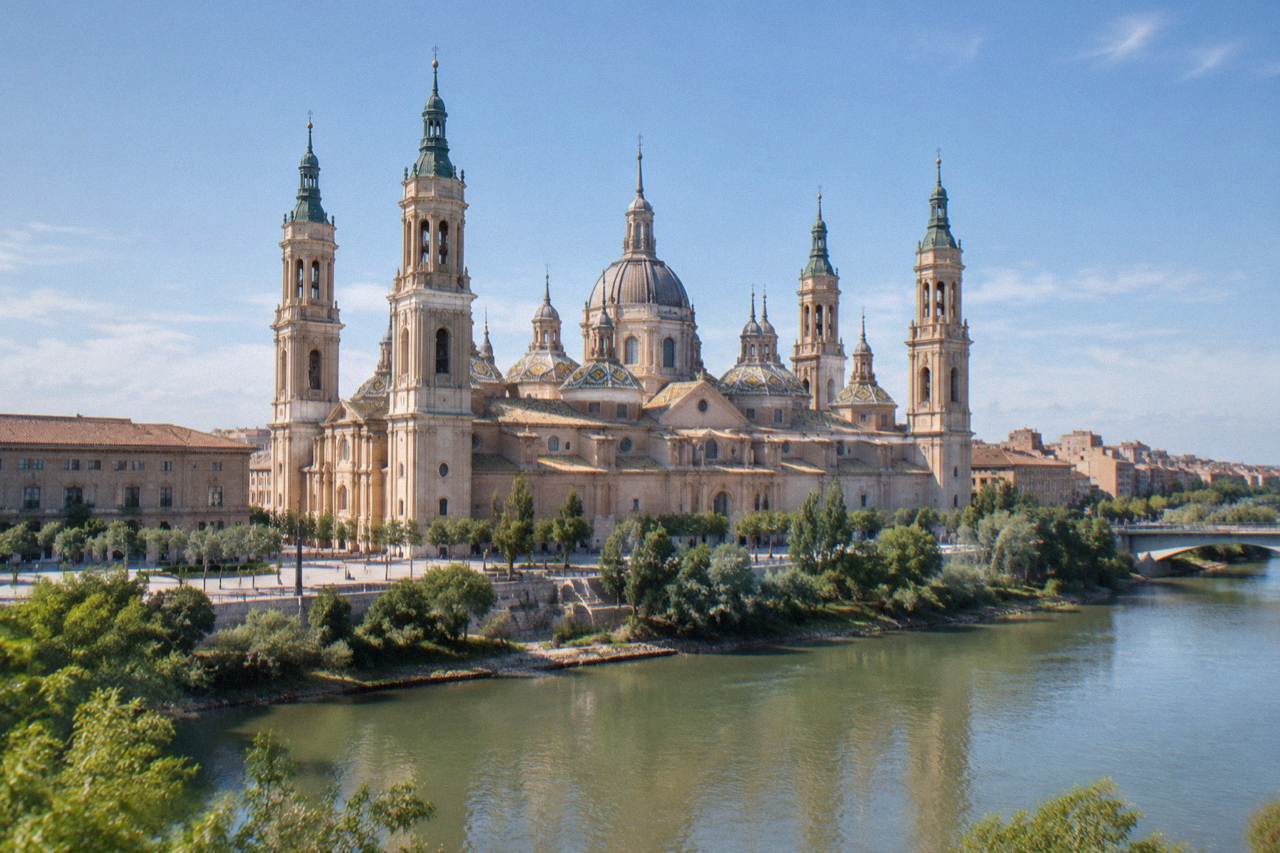
Zaragoza, the capital of Aragon, sits inland on the Ebro roughly halfway between Madrid and Barcelona, and the honest answer to whether it deserves your time is yes, with a caveat about pace. The city holds two cathedrals facing each other across one square, a Moorish palace, the buried remains of Roman Caesaraugusta under the streets, and a food culture built on Aragonese lamb and river-valley wine. Entering the Basílica del Pilar is free, the Aljafería charges EUR 7 general, and a bus or tram ride anywhere in the city costs EUR 1.70. It is not a beach city, because there is no sea within reach, and it is not a place that reveals itself in one photo. What it offers instead is density: more standing history per square metre than almost any city in Spain, at prices the coastal capitals abandoned years ago. For a fuller rundown of what the city is known for, see what Zaragoza is famous for.
Is Zaragoza Worth Visiting?
Yes, Zaragoza is worth visiting, and the case rests on three things: the monumental core around Plaza del Pilar packs a basilica, a Gothic-Mudéjar cathedral, a Roman forum and a Renaissance exchange into a few walkable blocks; the Aljafería is one of the best-preserved Islamic palaces in Spain at EUR 7 general entry; and the city costs far less than Madrid or Barcelona, with a bus or tram single at EUR 1.70 and free entry to the basilica itself.
The municipality's own monument timetable, the October sheet the city publishes, lists the headline openings, and they are generous. The Basílica del Pilar is free to enter, with the Torre Mirador viewpoint at EUR 6 for an adult. La Seo charges EUR 10 general, a ticket that also covers the Museo de Tapices, the Museo Pilarista and the Rosario de Cristal. The Aljafería runs daily from 10:00 to 18:00 in October, EUR 7 general or EUR 9 with a guided tour, and free on the first and third Sunday and Monday of each month.
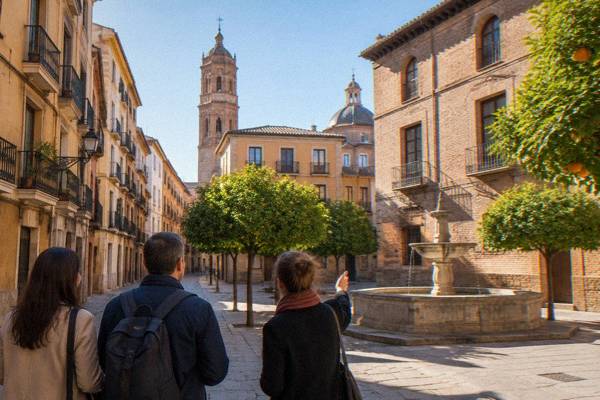
What the numbers do not show is the variety. In a single afternoon you can stand in a Roman forum excavated beneath the plaza, walk ten minutes to a Moorish palace with carved plasterwork that influenced Goya's city, and finish on a stone bridge whose central arch the Napoleonic troops blew up in 1813 and which still carries four bronze lions cast in 1991. Very few Spanish cities compress four cultures, Roman, Islamic, Jewish and Christian, into one continuous old town. The old town guide covers how to sequence them.
The strongest argument for a first visit is the price of a first orientation. The 105-minute Zaragoza Monumental Sightseeing Tour, this page's featured walk, runs from $10.41 per person and is rated 4.4 from 36 reviews on the operator's live listing. It exists precisely for the traveller who has just stepped off the AVE at Zaragoza-Delicias and wants the monumental core explained before deciding what to spend the rest of the day on.
What Do You Actually Get For Your Time In Zaragoza?
You get five monument clusters within walking distance of Plaza del Pilar: the basilica and its tower, La Seo and its Museo de Tapices, the Aljafería palace, the four Caesaraugusta Roman sites at EUR 7 combined with the bono, and the Ebro riverfront with the Puente de Piedra, and all of them are real, standing, visitable sights rather than fragments behind glass.
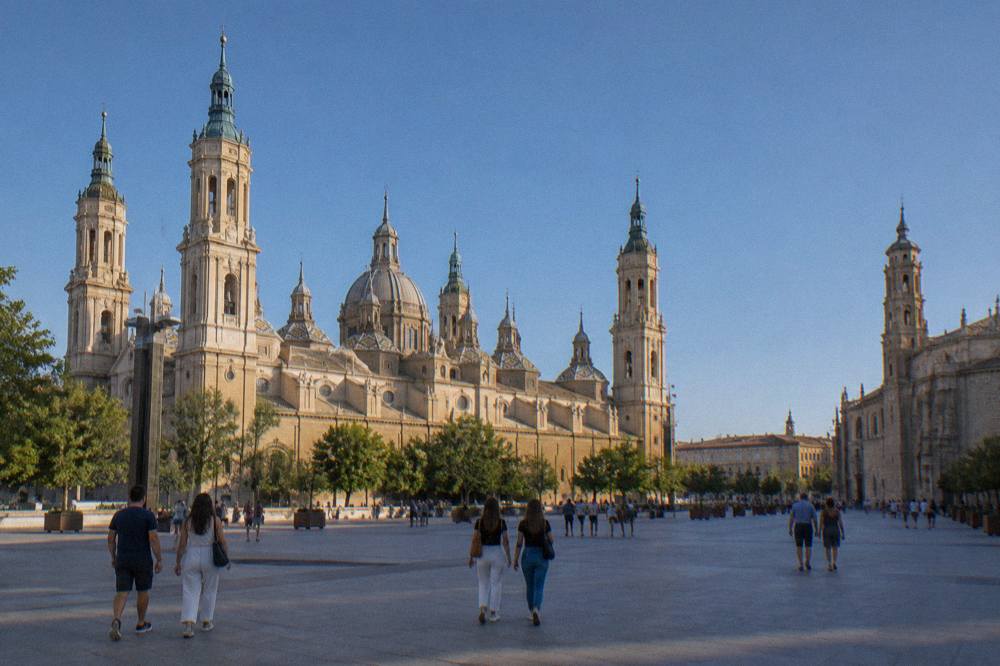
Start with the square itself. Plaza del Pilar holds the Basílica del Pilar and La Seo, the cathedral of San Salvador, side by side, an arrangement unique in Spain. The basilica's tower viewpoint costs EUR 6 for an adult, EUR 5 for over-65s and residents, EUR 4 for ages 13 to 18, students and groups of 20 or more, and is free for under-12s, with last access 30 minutes before closing. The basilica's own page states that entering the temple is free and that the Holy Chapel zone opens at 8:00.
The Roman layer is the city's quietest asset. Caesaraugusta, the colony founded on the Roman camp that gave the city its name, left a forum, a river port museum, baths and a theatre, all now municipal museums. The October timetable lists the Foro at EUR 4, the Termas and the Puerto Fluvial at EUR 3 each, and a four-museum bono at EUR 7, EUR 5 reduced, with free entry the first Sunday of the month. The Roman sites run Tuesday to Saturday 10:00-14:00 and 17:00-21:00, Sunday and holidays 10:00-14:30.
Here is what a sightseeing budget actually looks like, using only the municipality's published October figures:
| Sight | Adult entry | Hours (October) | Free days |
|---|---|---|---|
| Basílica del Pilar (temple) | Free | Holy Chapel 8:00-20:30 | Always free |
| Basílica del Pilar, Torre Mirador | EUR 6 | Mon-Thu 10:30-14:30 / 16:00-20:00, Fri-Sun 10:00-20:00 | Under 12 free |
| La Seo (includes Museo de Tapices, Museo Pilarista, Rosario de Cristal) | EUR 10 | Mon-Sat 10:00-14:30 / 16:00-20:00 | Aragon residents on the 6th, 12th, 23rd, 27th |
| Aljafería | EUR 7 (EUR 9 guided) | Daily 10:00-18:00 | 1st and 3rd Sunday and Monday |
| Caesaraugusta four-museum bono | EUR 7 | Tue-Sat 10:00-14:00 / 17:00-21:00 | 1st Sunday of month |
One caution the timetable makes plain: not everything is open. The Museo de Zaragoza's central building on Plaza de los Sitios is closed for Ministry of Culture works with no reopening date, the Palacio de Sastago is closed in October, and the Museo Pablo Gargallo is temporarily closed. The Museo Goya, the Fundación Ibercaja collection, reopens on 9 October 2026 with Tuesday-to-Saturday hours of 10:00 to 20:00 and no published admission price. Plan around the closures rather than discovering them at the door.
Is Zaragoza Worth Visiting Compared With Madrid Or Barcelona?
Zaragoza is worth visiting as a cheaper, faster, less crowded alternative to Spain's two biggest cities: high-speed trains reach it from both in about 1.5 to 2 hours, the monumental core is walkable in a way neither capital's is, and entry prices run at roughly half of what the coastal cities charge, with free entry to the main basilica and EUR 7 palace and bono tickets.
The comparison question is really a budget question. A single bus or tram journey in Zaragoza costs EUR 1.70, or EUR 0.55 with the Tarjeta Bus, and the card itself costs EUR 7 and works on both networks. The tourist bus, the Zaragoza Bus Turístico, costs EUR 10 for a 24-hour hop-on hop-off ticket over 16 stops on a 90-minute loop. There is no tourist tax in Aragon, and the regional government explicitly discarded the idea in September 2026 because of its effect on visitor numbers.
Crowding is the other half of the answer. Zaragoza receives a fraction of the tourism that floods Barcelona's Gothic Quarter or Madrid's Prado area, which means the Aljafería's courtyards and the Caesaraugusta forum can be visited without timed-entry pressure for most of the year. The exception is the Fiestas del Pilar, which run 10 to 18 October 2026, with the Ofrenda de Flores on 12 October drawing enormous crowds along the route from Paseo de la Independencia to Plaza del Pilar. If you want the city quiet, avoid that week; if you want Spain's biggest festival of its kind, aim straight for it. The Valencia or Zaragoza comparison goes deeper on the trade-offs.
The distance question matters for planning, and so does the language one: English is less universally spoken here than in the big two, which is covered in do they speak English in Zaragoza. Neither is a reason to skip the city, but both are reasons to book a guide for at least the first morning.
How Many Days Does Zaragoza Need To Feel Worth It?
One long day covers the Plaza del Pilar cluster, the Aljafería and one or two Roman museums; two days adds the Ebro river walk, the Parque del Agua and a proper tapas evening; and a third day opens up day trips to Monasterio de Piedra, the Pyrenees or the wine country of Somontano, so the city rewards two days for most travellers and three for anyone using it as a base.
The pacing question is answered in detail on how many days you need in Zaragoza, but the shape is simple. Day one is the monumental core: basilica, La Seo, Puente de Piedra, the Roman forum, and the Aljafería, which sits a tram ride west of the centre. Day two is the river and the parks: the Parque del Agua Luis Buñuel, more than 120 hectares in the Ranillas meander beside the Expo 2008 site with running circuits of 5 and 10 km, plus the museums that survive the current closures, the IAACC Pablo Serrano among them, which is free.
Food deserves its own evening. Aragonese cooking runs to ternasco lamb, migas and river-valley produce, and the city's tapas culture is covered in the Zaragoza food guide. A guided tapas or wine evening solves the problem of picking bars in an unfamiliar city, and the guided options below include both.
These are not consolation prizes, they are the reason some travellers base themselves in Zaragoza rather than Madrid.
When Is Zaragoza At Its Best?
AEMET's 1981 to 2010 normals for the Zaragoza Aeropuerto station show the sweet spots are May, at a 24.1 C mean maximum with 44 mm of rain, and late September to October, at 27.1 C and 21.4 C mean maximums respectively, while July is the hottest month at a 32.4 C mean maximum and the sunniest at 348 hours, and the Fiestas del Pilar from 10 to 18 October add the year's biggest events to the mildest weather.
The climate table deserves a careful read, because the city's dry continental semi-arid character surprises visitors expecting Mediterranean softness. May, not winter, is the wettest month at 44 mm over 6.4 days of 1 mm or more, and July and August are the driest at 17 mm each. The year totals just 322 mm of rain over 51.1 days, which is to say: this is a dry, sunny city, with 2,693 hours of sun in the average year. Winter is real, with a January mean minimum of 2.7 C and 23.1 frost days across the year at the airport station.
| Month | Mean max C | Mean C | Rain mm | Sun hours |
|---|---|---|---|---|
| January | 10.5 | 6.6 | 21 | 131 |
| April | 19.6 | 13.8 | 39 | 226 |
| May | 24.1 | 18.0 | 44 | 274 |
| July | 32.4 | 25.3 | 17 | 348 |
| October | 21.4 | 16.2 | 36 | 195 |
All figures are the 1981 to 2010 averages for the Zaragoza Aeropuerto station, the only window the station page publishes. One qualitative note the numbers cannot carry: the cierzo, the cold, dry north-westerly wind that funnels down the Ebro valley, can make a 15 C day feel several degrees colder on the riverbank. AEMET issues Aragon wind warnings when it strengthens, and the is Zaragoza a windy city page covers what it means for visitors.
Timing around the calendar matters more than the thermometer. The Fiestas del Pilar, 10 to 18 October 2026, with the pregón from the Ayuntamiento balcony on 10 October at 21:00 and the Ofrenda de Flores on 12 October, transform the city: fireworks after the pregón, at Parque Pignatelli and at the closing beside the Ebro on 18 October, plus concerts and jota contests across the nine days. Venezuela is the guest country for 2026. Book accommodation early for those dates, and expect crowds the rest of the year never approaches.
Common Questions About Visiting Zaragoza
Is Zaragoza, Spain worth visiting?
Yes. The city offers two cathedrals on one square, the Aljafería palace at EUR 7 general entry, four Roman museums for EUR 7 combined, free entry to the Basílica del Pilar, and a bus or tram single at EUR 1.70, all within a walkable monumental core that high-speed trains reach from Madrid and Barcelona in about 1.5 to 2 hours.
Is Zaragoza worth a day trip from Madrid or Barcelona?
Yes, with realistic expectations. The fast trains take about 1.5 to 2 hours each way, and the Plaza del Pilar cluster, the Aljafería and one Roman museum fit into a single long day. Two days is better, because it adds the Ebro river walk and an evening of Aragonese tapas without the clock pressure.
What is the single best first thing to do in Zaragoza?
A guided orientation of the monumental core. The Zaragoza Monumental Sightseeing Tour runs 105 minutes from $10.41 per person, rated 4.4 from 36 reviews on the operator's live listing, and covers the basilica, La Seo and the old town before you commit the rest of your day. The Free Monumental Tour of Zaragoza, a tip-based GuruWalk, is the free alternative.
Is Zaragoza expensive to visit?
No. Entry to the basilica is free, the Aljafería is EUR 7, the four-museum Roman bono is EUR 7, and several museums including the IAACC Pablo Serrano and the Centro de Historias are free outright. Urban transport is EUR 1.70 a single or EUR 0.55 with the Tarjeta Bus, and Aragon has no tourist tax.
Does Zaragoza have a beach or coastal area?
No. Zaragoza is an inland city on the Ebro in Aragon, roughly halfway between Madrid and Barcelona. There is no sea or coast; the water in the city is the river, and the big open-air space is the Parque del Agua Luis Buñuel, more than 120 hectares in the Ranillas meander.
Is Zaragoza too hot in summer to enjoy?
July carries the highest mean maximum at 32.4 C and August follows at 31.7 C, both from AEMET's 1981 to 2010 normals for the Zaragoza Aeropuerto station, and July is the sunniest month at 348 hours. Early mornings and evenings remain pleasant, and the museums and the Aljafería offer shade, but May, September and October are the comfortable sightseeing months.
The short version: Zaragoza is worth visiting for anyone who wants Spain's monumental density without the coastal prices or the coastal crowds, and two days is enough to prove it. The Zaragoza Travel Guide homepage collects the rest of the sightseeing, food and day-trip pages in one place.