What Is Zaragoza Famous For?
Zaragoza, the capital of Aragon in Spain, is famous for the Basílica del Pilar, UNESCO-listed Mudéjar architecture, Roman Caesaraugusta remains, the Fiestas del Pilar and Aragonese food. Here is what to see.
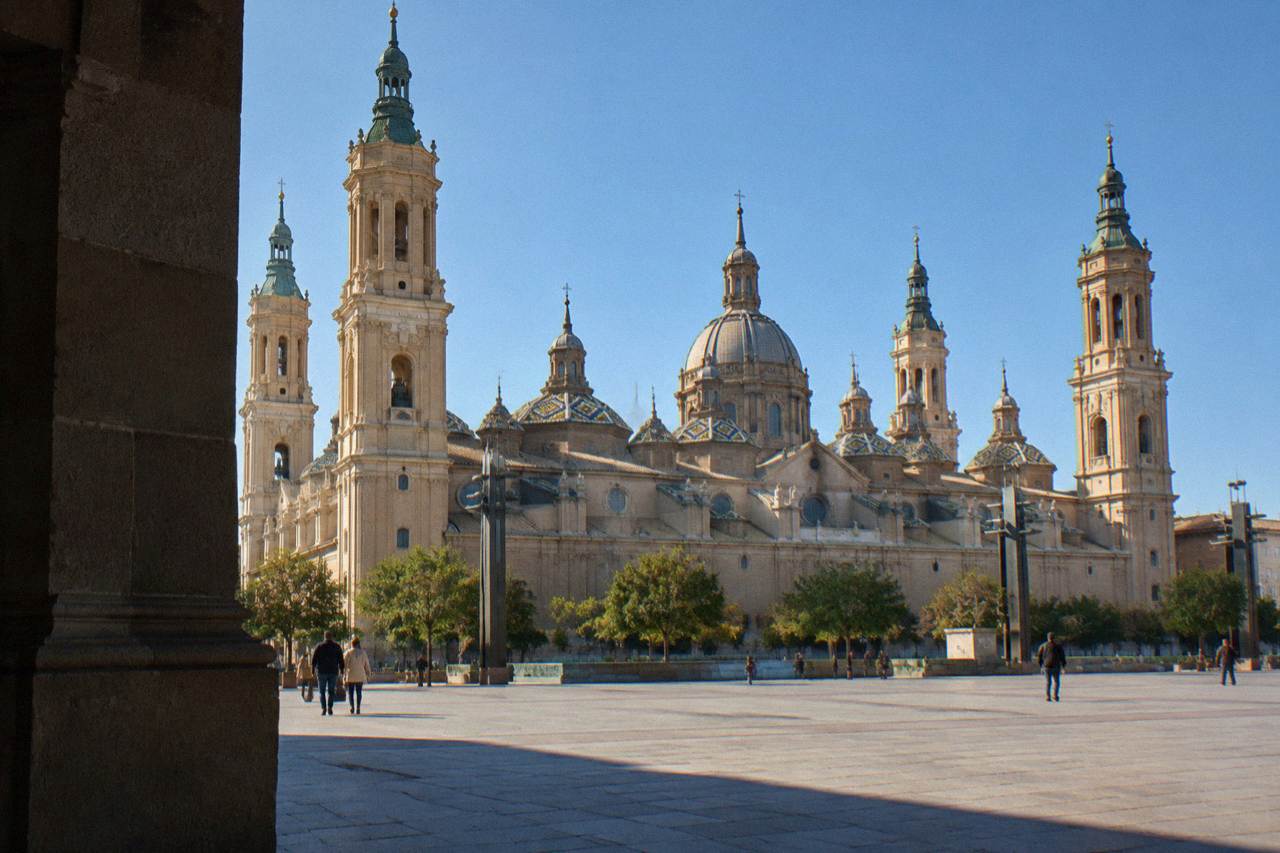
Zaragoza, the capital of Aragon on the Ebro in north-east Spain, is famous above all for the Basílica del Pilar, the vast Baroque basilica that anchors the city's main square. Around it sit the things that give the city its identity: the Aljafería; La Seo, a cathedral built over the main mosque; the Roman ruins of Caesaraugusta, exposed in four riverside museums; and the Mudéjar brickwork that earned Zaragoza three places on the UNESCO World Heritage List. Every October the Fiestas del Pilar turn the whole city into a festival, and the food, from tapas in the old town to ternasco lamb, holds up its end too.
What Is Zaragoza Famous For?
Zaragoza is famous for five things above all: the Basílica del Pilar, one of the largest churches in Spain and free to enter; three UNESCO-listed Mudéjar monuments, the Aljafería, San Pablo and La Seo; the visible remains of the Roman city of Caesaraugusta; the Fiestas del Pilar, held from 10 to 18 October 2026; and a food culture built on tapas, Aragonese lamb and Cariñena wine. The city sits inland on the Ebro, the capital of Aragon.
That combination is unusual. Most Spanish cities lead with one era: Granada with the Alhambra, Mérida with Rome. Zaragoza keeps four civilisations side by side in a few hundred metres, Iberian, Roman, Islamic and Christian, and the city's own marketing leans on exactly that. The square called Plaza del Pilar alone holds the basilica, La Seo, the Roman forum museum and the Renaissance Lonja within a short walk of one another.
It is also a city people reach by accident and then remember. High-speed trains put it about 1.5 to 2 hours from both Madrid and Barcelona, which makes it an easy stop on a crossing between the two. The question where in Spain is Zaragoza comes up constantly, precisely because the city sits between better-known neighbours rather than on a coast.
Why Is The Basílica Del Pilar The Symbol Of Zaragoza?
The Basílica del Pilar is famous as one of the largest churches in Spain and the centre of the Virgin of the Pilar devotion, and entering the temple is free. The municipal October timetable lists the Holy Chapel zone open 8:00 to 20:30 and the main altar zone from 7:30 on weekdays, and the Torre Mirador viewpoint costs EUR 6 for an adult, EUR 4 for ages 13 to 18 and nothing for children under 12. Its baroque towers define the city's skyline from every riverbank.
The devotion is the real engine. The Virgin of the Pilar is the patroness of Aragon and of all Spain in Catholic tradition, and 12 October, her feast day, is the hinge of the Fiestas del Pilar. Pilgrims have been coming to the pillar, the jasper column the Virgin is said to have left, for centuries, and the basilica that houses it grew around that shrine rather than around a bishop's seat. That seat is La Seo, a few hundred metres away, which is why Zaragoza has two cathedrals within one square.
The basilica's own pages record the current restoration of the Regina Patriarcharum dome, agreed in January 2026 and funded by Fundación Ibercaja, so the view of the building from the square may include scaffolding on one dome. The towers themselves have seen successive restorations, with the Tower of Santiago finished and its scaffolding removed in late 2025.
For a first visit, the practical pairing is the free nave plus the paid tower. The tower's last access is 30 minutes before closing, and the Museo Pilarista inside the basilica keeps its own daily hours, 10:00 to 13:30 and 16:00 to 20:00 per the municipal timetable. The full guide to the building is at Basílica del Pilar, and the tower has its own page at the Pilar tower viewpoint.
A guided walk is the efficient way to take the square in, because the stories are layered: Roman forum under one corner, Moorish qibla wall inside La Seo, baroque basilica on top. The Old Town Monumental Walk covers the Casco Histórico in one guided circuit, and Check availability if a fixed time suits your plans.
What Makes Zaragoza'S Mudéjar Architecture UNESCO-Listed?
Zaragoza holds exactly three components of the UNESCO World Heritage property Mudéjar Architecture of Aragon, inscribed in 1986 and extended in 2001: the surviving Mudéjar features of the Aljafería Palace, the tower and parish church of San Pablo, and the apse, parroquieta and cimborio of La Seo. Mudéjar is the brick-and-tile style built by Muslim craftsmen working under Christian rule after the Reconquest.
The detail that trips up most guides is the boundary. Likewise at La Seo, only the apse, the parroquieta and the cimborio are listed, not the whole cathedral. The Basilica del Pilar, La Magdalena and the Torre Nueva are not components at all, however often they appear on souvenir postcards.
| Zaragoza component of Mudéjar Architecture of Aragon | What is listed | Where to see it |
|---|---|---|
| Aljafería Palace | The surviving Mudéjar features of the palace | A 20-minute walk west of Plaza del Pilar, or by tram |
| San Pablo | The tower and parish church | Across the Ebro in the San Pablo district |
| La Seo | The apse, parroquieta and cimborio | On Plaza del Pilar, beside the Lonja |
The Aljafería is the easiest of the three to visit at length. The municipal October timetable lists it open daily 10:00 to 18:00, general entry EUR 7, guided visit EUR 9, and free on the first and third Sunday and Monday of each month, with Spanish-language guided tours at set times through the day. What is inside is covered in detail at what is inside the Aljafería, and the palace's history has its own answer at the history of the Aljafería Palace.
What Roman Remains Survive In Zaragoza?
Zaragoza was the Roman city of Caesaraugusta, and four museums in the old town preserve its forum, river port, baths and theatre, open Tuesday to Saturday 10:00 to 14:00 and 17:00 to 21:00. Individual entry is EUR 4 for the forum and EUR 3 for the baths and river port, and a four-museum ticket costs EUR 7, or EUR 5 reduced, with free entry on the first Sunday of the month. The modern city's name descends from Caesaraugusta.
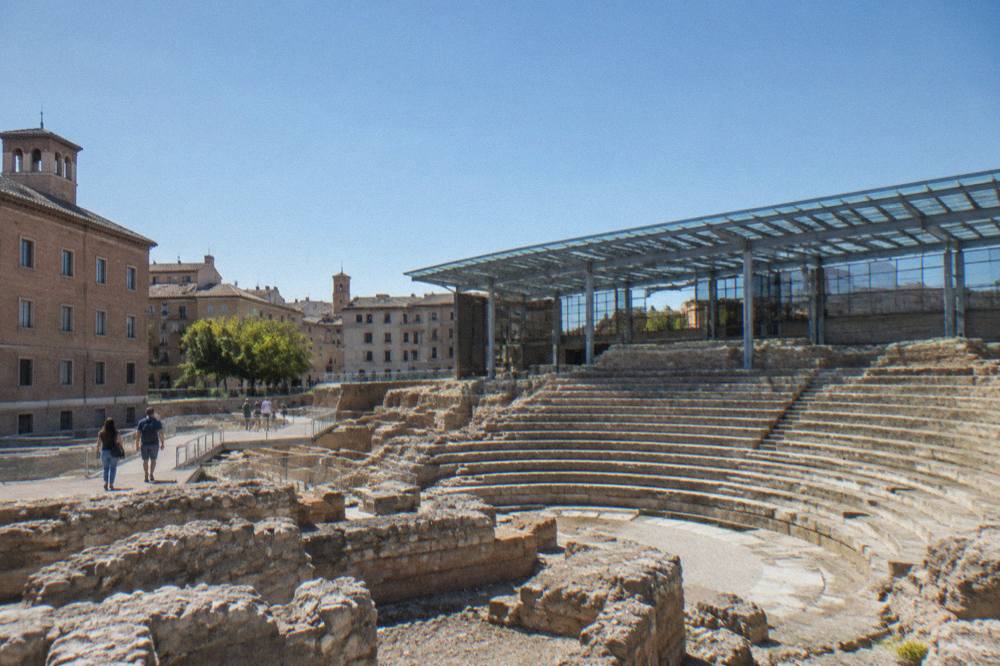
The theatre is the most theatrical of the four, a substantial arena you view from raised walkways, and the river port museum sits right by the Ebro, a reminder that the Roman city was a river port before it was anything else. The forum museum stands in the very square visitors come for the basilica, which is the whole point: in Zaragoza the Roman layer is not out at a suburban archaeological park, it is under the souvenir stalls. Everything else covered here is indexed on Zaragoza Travel Guide.
The full Roman picture, including the walls, is laid out at Roman Caesaraugusta, with individual pages for the forum, theatre, river port and baths museums. If you are deciding how much of this layer to fit in, the four-museum ticket at EUR 7 is the honest answer to that question.
Why Do The Fiestas Del Pilar Draw Crowds Every October?
The Fiestas del Pilar run from 10 to 18 October 2026, with the Ofrenda de Flores on 12 October, when registered groups parade flowers to build a mantle for the Virgin on Plaza del Pilar. The pregón opens the festival on 10 October at 21:00 from the balcony of the Ayuntamiento, and the programme includes jota competitions, concerts, fireworks and Venezuela as the guest country.
The Ofrenda is the image that travels. It starts in the early morning and fills Paseo de la Independencia with participants in regional dress carrying white and red flowers, and the scale is municipal: the city's own festival pages record 994 registered groups for 2026. The Ofrenda de Frutos and the Rosario de Cristal are reported for 13 October in local press coverage of the programme.
Practical consequences matter for visitors. The city is full, hotels price accordingly, and several cultural venues adjust: the municipal October timetable notes the Palacio de Sastago closed in October and the Museo Pablo Gargallo temporarily closed. The full festival picture, including what happens on the 12th, is at Fiestas del Pilar and the Ofrenda de Flores, and the wider question of what happens on October 12 in Spain explains the national holiday side.
What Food Is Zaragoza Famous For?
Zaragoza is famous for its tapas bars in the old town, ternasco de Aragón, slow-roasted young lamb with potatoes, migas aragonesas, and the sweets of its convent bakeries, alongside the wines of nearby Cariñena. The city's food identity is inland Aragonese cooking rather than coastal seafood, and the evening tapas circuit through the historic centre is the main social ritual visitors join.
Ternasco is the signature dish, lamb raised in Aragon and roasted with rosemary and potatoes, and it appears on menus across the centre rather than in one speciality district. Migas, breadcrumbs fried with garlic and grapes, is the winter counterpart. The sweets layer is genuinely local: novedades, cuartos de San Millán and other convent pastries that are hard to find outside the province. The full answer to what food Zaragoza is famous for goes dish by dish, and the practical crawl route is at the Zaragoza tapas crawl.
A guided version saves the guesswork. A tapas walk through the old town pairs the bars with the history around them, and the cooking-class option that starts in the market shows the raw ingredients first.
How Many Days Do You Need To See Zaragoza'S Famous Sights?
Two full days cover the famous core comfortably: day one for Plaza del Pilar, the basilica tower, La Seo and the Caesaraugusta museums, day two for the Aljafería, the Ebro river walk and the Puente de Piedra, with an evening left over for tapas. A third day opens up day trips to Monasterio de Piedra, Tarazona or the Somontano wine country. Rushing it into one long afternoon works, but the Roman museums are the thing that gets cut.
The one-day version is possible because the old town is compact: the basilica, La Seo, the forum museum and the Lonja share one square, and the Puente de Piedra, the stone bridge begun in 1401 and opened in 1440 with its four bronze lions added in 1991, is a short walk along the river. The question what is a good one-day itinerary for Zaragoza answers it hour by hour, and the deeper planning question, how many days you need in Zaragoza, weighs two days against three.
The Aljafería is the item people underestimate. It sits west of the centre, it deserves a guided visit for the Mudéjar and Islamic interiors, and pairing it with the same day's river walk is the usual mistake, because the palace deserves the slower half of a day on its own.
Whether the city justifies the trip on its own terms is a fair question, and the honest answer at is Zaragoza worth visiting weighs the famous sights against the two-day stopover most people give it. For more on the city's standing between its neighbours, the comparison at Valencia or Zaragoza is the one people actually search.
Common Questions About What Zaragoza Is Famous For
What is Zaragoza famous for?
Zaragoza, the capital of Aragon in Spain, is famous for the Basílica del Pilar, its three UNESCO-listed Mudéjar monuments, the Roman remains of Caesaraugusta, the Fiestas del Pilar in October, and an inland food culture of tapas, ternasco lamb and Cariñena wine.
Is the Basílica del Pilar free to enter?
Yes, entering the temple is free, per the municipal monument timetable. The Torre Mirador viewpoint costs EUR 6 for an adult, EUR 5 for over-65s and residents, EUR 4 for ages 13 to 18, students and groups of 20 or more, and is free for children under 12.
Is Zaragoza's Aljafería a UNESCO World Heritage Site?
Partly. The surviving Mudéjar features of the Aljafería Palace are one of Zaragoza's three components of the UNESCO property Mudéjar Architecture of Aragon, inscribed in 1986 and extended in 2001. The other two are the tower and parish church of San Pablo and the apse, parroquieta and cimborio of La Seo.
What is the most famous event in Zaragoza?
The Fiestas del Pilar, held from 10 to 18 October 2026, with the Ofrenda de Flores on 12 October as its centrepiece. The pregón opens the festival on 10 October at 21:00 from the balcony of the Ayuntamiento.
Is Zaragoza worth a stop between Madrid and Barcelona?
Yes. High-speed trains put Zaragoza about 1.5 to 2 hours from both cities, and the famous core, the Pilar, La Seo, the Aljafería and the Roman museums, fits into two comfortable days. Check the operator's live listings for current fares and times before booking.
What food should you try in Zaragoza?
Ternasco de Aragón, slow-roasted young lamb, migas aragonesas, the old town's tapas bars, and the local convent sweets, with Cariñena wine from the surrounding region. The evening tapas circuit through the historic centre is the ritual to join.
The short version: Zaragoza is famous for a basilica, a palace, a style of brickwork and a festival, all within a walkable old town on the Ebro, and two days is enough to see all four properly.