Where In Spain Is Zaragoza?
Zaragoza is the capital of Aragon, an inland city on the Ebro in north-eastern Spain, roughly equidistant by high-speed train from Madrid and Barcelona. Here is exactly where it sits, how to reach it and what that location means for a visit.
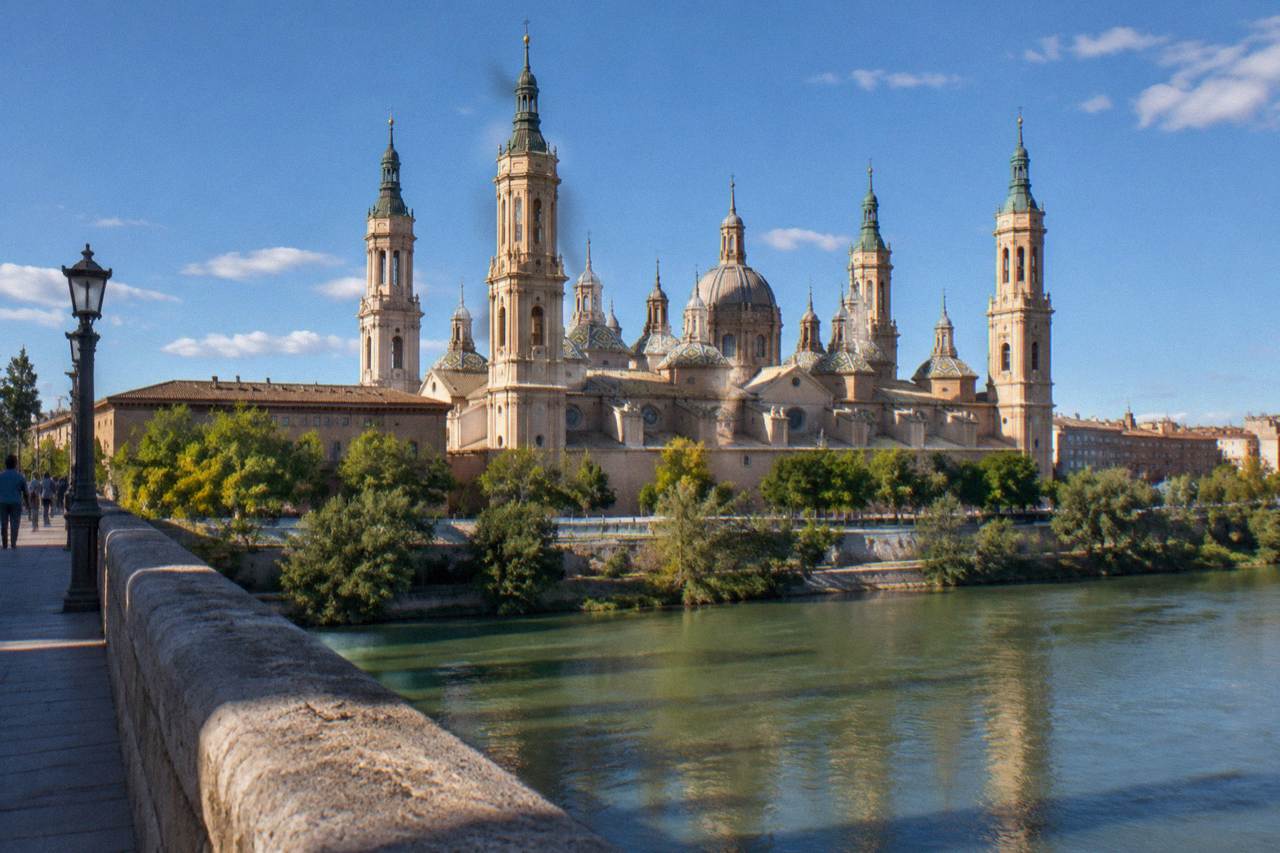
Zaragoza, Spain, is the capital of the region of Aragon and it stands inland on the Ebro, the river that runs west to east across the whole of northern Spain to the Mediterranean. It is not on the coast, it is not in Catalonia and it is not a Basque city: it sits in the middle of the Ebro valley, roughly between Madrid and Barcelona, each about 1.5 to 2 hours away by high-speed train. The city is built around the Basílica del Pilar and La Seo, two great churches facing each other across the same square by the river, with the Aljafería palace a short walk to the west.
Where In Spain Is Zaragoza?
Zaragoza sits in north-eastern Spain, roughly halfway between Madrid and Barcelona in a straight line across the interior, on the Ebro river in the wide valley that carries that river from the Cantabrian mountains to the Mediterranean. It is the capital of Aragon, Spain's inland region between Catalonia, Navarre, Castile and Valencia, and it is served by Zaragoza-Delicias station, where high-speed trains from both Madrid and Barcelona arrive in about 1.5 to 2 hours.
That position is the single most useful thing to understand about the city. Zaragoza is not a coastal stop on a southern beach circuit and it is not a detour from anywhere: it is a hub, deliberately placed where the Ebro valley meets the old road between Spain's two largest cities. The Romans founded it as Caesaraugusta, a colony on the Ebro at the crossing of their roads, and every layer since, Moorish, medieval, imperial and modern, has built on that same spot. The old town still occupies the river's south bank, with the Basílica del Pilar and La Seo Cathedral facing each other across the Plaza del Pilar.
The city's own character follows from the geography. Because Zaragoza is inland in the middle of a dry valley, it has a continental semi-arid climate rather than the mild coastal weather of Barcelona or Valencia: hot summers, cool winters and a famous cold, dry north-westerly wind, the cierzo, that funnels down the Ebro valley. The answers page on whether Zaragoza is a windy city covers that wind in detail.
In Which Country Is Zaragoza Located?
Zaragoza is located in Spain, in the country's north-eastern interior, and it is the political capital of the autonomous community of Aragon, one of Spain's largest regions. Aragon stretches from the Pyrenees on the French border down to the Iberian system, and Zaragoza is its demographic and administrative centre, the city where the regional government sits, on the Ebro about two hours inland from the Mediterranean coast.
Aragon is one of Spain's seventeen autonomous communities, and Zaragoza is the capital of all three of its provinces: Zaragoza, Huesca and Teruel. That is worth knowing because almost everything a visitor reads about the region, its Mudéjar churches, its Pyrenean valleys, its desert badlands at Bardenas Reales, is reached from this one city. The answers page on what Zaragoza is famous for and the answers page on whether Zaragoza is worth visiting cover what that fame consists of.
One confusion deserves a direct answer, because the question is searched often: Zaragoza is not in Catalonia and it is not a Basque city. It is in Aragon, a separate region with its own history as a medieval kingdom, and the answers page on whether Zaragoza is a Basque city settles the point fully. The name itself carries the region's layered past: the answers page on why Zaragoza is called Zaragoza traces it back to Caesaraugusta, the Roman name.
What Region Is Zaragoza The Capital Of?
Zaragoza is the capital of Aragon, the autonomous community that occupies Spain's north-eastern interior between Catalonia to the east, Navarre and the Basque Country to the north-west, Castile to the west and Valencia to the south. Aragon's three provinces are Zaragoza, Huesca and Teruel, and the city of Zaragoza on the Ebro is the seat of the regional government, the Cortes de Aragón, and by far the region's largest urban centre.
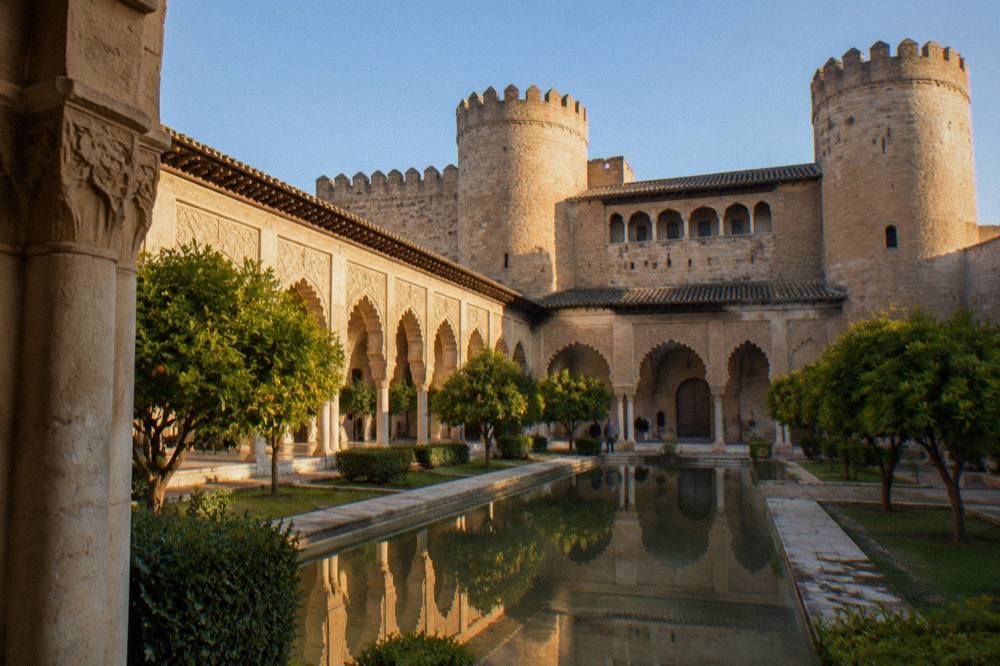
Aragon as a historical kingdom matters to the visitor because it explains the city's monuments. The Aljafería palace is the most visible piece: an Islamic palace of the taifa of Zaragoza, later used by the Catholic Monarchs, and today the seat of the Cortes de Aragón. The answers page on what is inside the Aljafería and the answers page on whether you can visit the Aljafería cover it in detail, and the Aljafería Palace guide gives the full picture.
The region also explains the city's calendar. Fiestas del Pilar, Aragon's biggest festival, runs from 10 to 18 October 2026, with the Ofrenda de Flores, the flower offering to the Virgin of the Pilar, on 12 October. The answers page on what happens on October 12 in Spain explains the national dimension of that date.
How Do You Get To Zaragoza From Madrid Or Barcelona?
Zaragoza is reached from Madrid and Barcelona by high-speed rail into Zaragoza-Delicias station in about 1.5 to 2 hours, which makes it one of Spain's most central big-city destinations. The city's airport, Zaragoza Airport, lies on the edge of town and is connected to the centre by bus line 505, a 25 to 35 minute ride timed to flights, while urban bus and tram single fares are 1.70 EUR.
The rail link is the reason Zaragoza works as either a destination or a stop. Trains from Madrid and from Barcelona arrive at Zaragoza-Delicias, a modern station with the tram running past its door, and the fastest services on both corridors take about 1.5 to 2 hours. The answers page on which city is closer to Zaragoza, Madrid or Barcelona compares the two corridors, and the answers page on the high-speed train from Barcelona covers the eastern one. For exact timetables and fares, check the operators' live listings before booking, because they vary by date and by company.
Getting around once you are there is cheap. The 2026 Avanza fare table lists the urban bus and tram single at 1.70 EUR, dropping to 0.55 EUR with the rechargeable Tarjeta Bus. The municipal tourism pages list the hop-on hop-off tourist bus at 10 EUR for a 24-hour ticket across 16 stops on a 90-minute loop, payable in cash on the bus.
| Journey or ticket | What the official sources list |
|---|---|
| High-speed train, Madrid to Zaragoza-Delicias | About 1.5 to 2 hours |
| High-speed train, Barcelona to Zaragoza-Delicias | About 1.5 to 2 hours |
| Airport bus line 505, airport to centre | 4.65 EUR single, 2.25 EUR with a Lazo card, 25 to 35 minutes |
| Urban bus or tram single | 1.70 EUR, or 0.55 EUR with the Tarjeta Bus |
| Tourist bus, 24-hour hop-on hop-off | 10 EUR general ticket, 16 stops, 90-minute loop |
One driving note matters if you arrive by car: Zaragoza operates a low-emission zone in the historic centre, with sanctions in force since 12 December 2025, active Monday to Friday from 08:00 to 20:00, and only vehicles carrying a DGT environmental label may enter. There is a 15-minute grace period if you enter by mistake, but the simplest answer is to park outside the zone and walk in.
What Is The Weather Like In Zaragoza Through The Year?
Zaragoza has a dry continental semi-arid climate, because it sits inland in the Ebro valley far from any sea: AEMET's 1981 to 2010 normals for the Zaragoza Aeropuerto station show July as the hottest month with a mean maximum of 32.4 C and 348 hours of sun, January the coolest with a mean maximum of 10.5 C, and only 322 mm of rain across the whole year, with July and August the driest months at 17 mm each and May the wettest at 44 mm.
Those normals are the only climate window the station publishes, and they describe a place with genuinely hot summers and genuinely cool winters, not the mild coastal pattern of eastern Spain. The answers page on the hottest month in Zaragoza and the answers page on whether it rains a lot in Zaragoza unpack the two questions visitors ask most. Spring and autumn are the comfortable seasons, and October, the month of Fiestas del Pilar, averages a mean maximum of 21.4 C with 36 mm of rain over the 1981 to 2010 window.
| Month (AEMET 1981 to 2010 normals, Zaragoza Aeropuerto) | Mean max C | Mean min C | Rain mm | Sun hours |
|---|---|---|---|---|
| January | 10.5 | 2.7 | 21 | 131 |
| April | 19.6 | 7.9 | 39 | 226 |
| July | 32.4 | 18.3 | 17 | 348 |
| October | 21.4 | 11.0 | 36 | 195 |
Why Do People Confuse Zaragoza With Other Places?
Zaragoza is confused with other places because the name travels: Real Zaragoza is a Spanish football club, Zaragoza is also a Mexican and a Colombian surname and place name, and the Zaragoza International Bridge crosses between El Paso in Texas and Ciudad Juarez in Mexico. The Spanish city on the Ebro, capital of Aragon, is none of these, and a search that says only "Zaragoza" can land a reader on a fixture list or a border crossing instead of a travel destination.
The football club is the most common collision, because Real Zaragoza plays in the city and match reports dominate search results in season. Its stadium, La Romareda, is a real building in Zaragoza and can be described as such, but results, transfers and standings are not travel content. The Mexican state of Nuevo León has its own Zaragoza, and the Zaragoza International Bridge at El Paso carries the name north of the border. The answers page on how Zaragoza is pronounced helps with the name itself, a Spanish pronunciation closer to "thah-rah-GOH-thah" in Castilian Spanish.
This is also why the city's location deserves emphasis: Zaragoza, Spain, is the one on the Ebro, with the Basílica del Pilar, the Aljafería and La Seo, in Aragon. If a page mentions a border crossing, a league table or a Mexican municipality, it is describing a different Zaragoza.
Does Zaragoza'S Location Make It A Good Base For Day Trips?
Yes: Zaragoza's position in the middle of the Ebro corridor makes it a practical base for day trips across Aragon, because the high-speed lines that connect it to Madrid and Barcelona in about 1.5 to 2 hours also put the Pyrenean valleys, the Moncayo massif and the wine country of Cariñena within range of a single day out, and the city's own transport, a 1.70 EUR bus and tram fare, makes returning to the centre straightforward.
The classic day trips run in every direction: the Pyrenees to the north, Tarazona and the Moncayo to the west, Belchite and the olive-oil country to the south-east, and Monasterio de Piedra to the south-west. Guided options exist for several of these, including a full-day excursion to Canfranc, Jaca and Sallent de Gállego, and an Ordesa day tour taking in Aínsa, Torla and the Sorrosal waterfall, both departing from Zaragoza. For a first visit, though, the city itself rewards a full day at minimum, and the answers page on how many days you need in Zaragoza and the one-day itinerary answers page give concrete plans.
A guided walk on the first morning is the most efficient way to fix the city's geography in your head, because Zaragoza's core is compact and the main monuments sit within a short walk of one another. The Must-See Attractions Walking Tour With A Guide covers the essentials, from $44.72 per person, and Check availability before you lock in your dates, especially for October, when the festival fills the old town.
If a guided walk is more structure than you want on day one, the free alternatives work well as a first orientation. The Free Monumental Tour of Zaragoza runs tip-based through the same core, and the Monumental Sightseeing Tour packs the first introduction into 105 minutes, so the choice is really about depth versus time.
Common Questions About Where In Spain Is Zaragoza
Where in Spain is Zaragoza?
Zaragoza is in north-eastern Spain, inland on the Ebro river, and it is the capital of the autonomous community of Aragon. It sits roughly between Madrid and Barcelona, each about 1.5 to 2 hours away by high-speed train into Zaragoza-Delicias station.
In which country is Zaragoza located?
Zaragoza is located in Spain. It is the capital of Aragon, one of Spain's seventeen autonomous communities, and it is the seat of the regional government and the largest city in the region.
Is Zaragoza in Catalonia or the Basque Country?
Neither. Zaragoza is in Aragon, a separate autonomous community with its own medieval history as a kingdom. It borders Catalonia to the east and Navarre and the Basque Country to the north-west, but the city itself is Aragonese.
Is Zaragoza near the sea?
No. Zaragoza is an inland city on the Ebro, in a dry continental valley well away from any coast. Its climate reflects that: hot summers, cool winters and low rainfall, per AEMET's 1981 to 2010 normals for the Zaragoza Aeropuerto station.
How long does it take to reach Zaragoza from Madrid or Barcelona?
About 1.5 to 2 hours by high-speed train from either city, arriving at Zaragoza-Delicias. Check the operators' live listings for exact timetables and fares, which vary by date and by company.
Is there a Zaragoza anywhere else in the world?
Yes, the name appears elsewhere: Real Zaragoza is a Spanish football club, Zaragoza is a Mexican and Colombian surname and place name, and the Zaragoza International Bridge crosses between El Paso, Texas and Ciudad Juarez, Mexico. None of those is the Spanish city on the Ebro.
Knowing where Zaragoza is, on the Ebro in Aragon, between Spain's two biggest cities and hours from any sea, explains almost everything about it: why the Romans built here, why the wind funnels down the valley, why the trains are fast and why the October festival fills the riverbank. For more on what that location produced, see the answers page on what Zaragoza is famous for, or start with the Zaragoza Travel Guide itself.