Is Zaragoza A Windy City?
Is Zaragoza a windy city? Yes: the capital of Aragon sits in the Ebro valley and is known for the cierzo, a cold, dry north-west wind. What it means for your visit.
Yes, Zaragoza is a windy city. The capital of Aragon lies inland on the Ebro, roughly halfway between Madrid and Barcelona, and its position at the bottom of a wide, dry valley makes it one of the breezier provincial capitals in Spain. The wind that defines the place is the cierzo, a cold, dry current that pushes down the Ebro corridor from the north-west, and locals talk about it the way coastal cities talk about rain. It is not a reason to skip the city, but it is a reason to pack a windbreaker even in months that look warm on paper.
Is Zaragoza A Windy City?
Yes, Zaragoza is genuinely a windy city, and the wind is the cierzo, a cold, dry north-west wind that runs down the Ebro valley. It is strongest when pressure differences between the Cantabrian coast and the Mediterranean pull air through the corridor, and it can make a mild afternoon feel sharply colder. No published wind-speed figure exists for the city on the official climate record, so treat any number you see quoted elsewhere with caution.
The geography explains the wind better than any forecast does. Zaragoza sits on a plain hemmed between the Iberian System to the south-east and the pre-Pyrenean ranges to the north, with the Ebro cutting a channel from north-west to south-east straight through it. Air that enters the valley upstream near Tudela and the Bardenas has nowhere to go but along that channel, and by the time it reaches Zaragoza it has gathered into the steady, bracing flow that locals call el cierzo. The name appears in Aragonese farming sayings, in vineyard lore, and in every local weather conversation, because it is the single most noticeable feature of the city's climate.
What the cierzo is not: a storm wind. It is a dry, usually clear-weather wind. Cierzo days often come with cloudless blue skies and excellent visibility, which is one reason the light in Zaragoza is so sharp for photography. The trade-off is that the same wind that scrubs the sky clean will push you along Paseo de la Independencia, whip your hair around on the Puente de Piedra, and turn an evening terrace drink into an endurance test. Locals read the sky, check the forecast, and pick their walking routes accordingly, and visitors quickly learn to do the same.
What Is The Cierzo And Why Does It Hit Zaragoza?
The cierzo is a cold, dry north-west wind characteristic of the middle Ebro valley, and Zaragoza sits directly in its path. It forms when high pressure sits over the Bay of Biscay and lower pressure over the Mediterranean, driving air down the valley corridor. It dries the landscape, clears the sky, and drops the felt temperature, and it is a defining part of the semi-arid climate the city records.
The Ebro valley acts as a natural wind tunnel. Air entering the gap between the Cantabrian mountains and the western Pyrenees accelerates along the valley floor, and Zaragoza, sitting mid-valley where the corridor narrows, catches the full flow. This is the same mechanism that keeps the surrounding countryside so dry: the region around the city is one of the driest in Spain, and the wind's drying effect on crops, soils and vineyards is a constant theme in Aragonese agriculture. Farmers in the Cariñena wine country to the south-west plan vineyard rows around it.
The official climate record for the city, the AEMET 1981 to 2010 normals for the Zaragoza Aeropuerto station, describes the cierzo only qualitatively, and that is how it should stay: it is a real, named, well-documented wind, but no speed or days-of-wind figure belongs on this page. What the record does quantify is the surrounding climate, and it confirms the picture of a dry, sunny, continental city. The annual rainfall average across 1981 to 2010 is just 322 mm, spread over 51.1 days of rain of 1 mm or more, and the sun totals 2,693 hours a year. Those are the numbers of a place where wind, not rain, is the weather you plan around.
| Month | Mean max C | Mean min C | Rain mm | Sun hours |
|---|---|---|---|---|
| January | 10.5 | 2.7 | 21 | 131 |
| April | 19.6 | 7.9 | 39 | 226 |
| July | 32.4 | 18.3 | 17 | 348 |
| October | 21.4 | 11.0 | 36 | 195 |
All four rows are AEMET 1981 to 2010 averages for the Zaragoza Aeropuerto station. The pattern they show, mild springs, hot dry summers with the year's lowest rainfall in July and August at 17 mm each, and pleasant Octobers, holds across the whole table, and the cierzo can blow through any of it.
Wind or not, Zaragoza rewards being on foot, and the old district is where the wind matters least, its narrow streets breaking the flow that sweeps the open squares. These guided options cover that ground well.
When Is Zaragoza Windiest For Visitors?
The cierzo can blow at any time of year, but visitors most often notice it in the cooler half of the year, from autumn through spring, when the cold air it drags down the valley makes itself felt. Summer cierzo days are actually a relief, cooling the 32.4 C July average maximum. The wind is not tied to rain: it blows hardest on dry, cloudless days, so a clear forecast in Zaragoza often means a breezy one.
There is a rhythm to it that locals learn. The classic cierzo setup needs a pressure gradient along the valley, and those gradients build most often around Atlantic fronts passing to the north. In October and November, when the Fiestas del Pilar bring hundreds of thousands of people onto the streets between 10 and 18 October, the evenings around the Ebro can be bitterly fresh, and the Ofrenda de Flores on 12 October, with its route up Paseo de la Independencia to the Plaza del Pilar, runs through exactly the kind of open avenue the cierzo loves. Anyone standing for hours watching the flower parade should have a windproof layer, not just a warm one.
Winter cierzo is the coldest. January averages a mean maximum of only 10.5 C on the 1981 to 2010 AEMET normals, and the wind strips whatever warmth the sun builds. The flip side is that the same record shows 81.6 clear days a year and only 21.3 fog days, so winter visitors trade soft grey light for hard blue skies and a biting breeze. Frost days total 23.1 a year on the same normals, and the wind makes each of them feel sharper than the thermometer suggests.
Spring is the season that catches people out. March and April look gentle on paper, with mean maxima of 17.3 C and 19.6 C, but the valley is at its windiest as pressure systems swing through, and a April afternoon can swing between short sleeves and a zipped jacket within an hour. May, the wettest month on the 1981 to 2010 averages at 44 mm, mixes the year's first proper warmth with the last of the cold winds.
Planning a walk around the weather is easier with a guide who knows which streets shelter and which squares funnel the wind.
Does The Wind Change How You Should Visit Zaragoza?
Yes, in small practical ways. The cierzo argues for windproof rather than merely warm clothing, for planning open-square sightseeing, like the Plaza del Pilar or the Ebro banks, in the calmer morning hours, and for keeping the narrow old-town streets for the windiest afternoons. It also makes the city's terraces a seasonal affair: locals sit outside from late spring to early autumn and move inside when the valley wind returns.
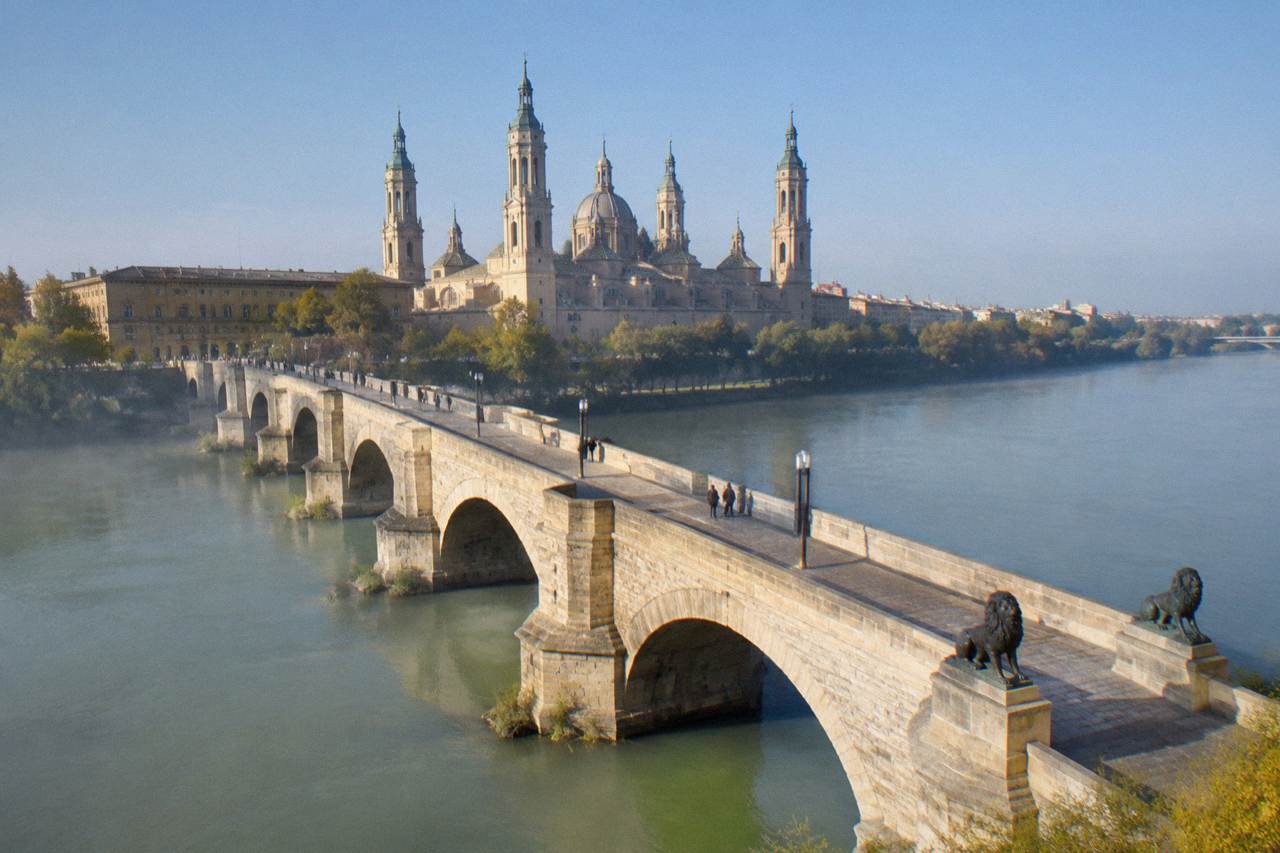
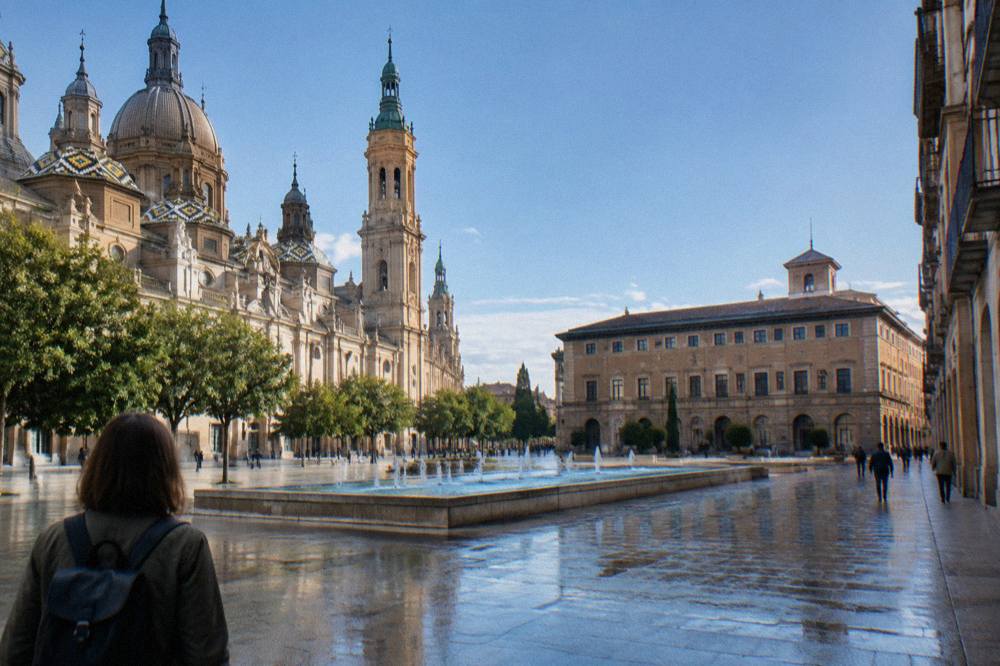
The city's headline sights split neatly into exposed and sheltered. The Basílica del Pilar, La Seo and the Puente de Piedra all stand in the open river plain, where the wind has a clear run, and the Ebro river walk is fully exposed along its whole length. The Aljafería, a little west of the centre, sits in its own open grounds. By contrast, the streets of the Casco Histórico, the lanes around the Mercado Central and the covered Caesaraugusta museum sites all offer breaks from the flow. A sensible windy-day plan puts the museums and the old-town lanes in the afternoon and the riverside and squares in the morning.
The 2.5-hour Historical Tour of the Old District with a guide is a good fit for a breezy day precisely because it stays in the sheltered core, moving between the cathedral quarter, the Roman remains and the small streets where the wind is a rumour rather than a fact. The listing shows a from price of $106.92 per person and a 5 rating from 14 reviews, and Check availability before you commit to a time. Pair it with the indoor options in a rainy and windy day plan for Zaragoza if the forecast looks wild.
Cyclists and tram riders feel the wind differently. The city's Bizi bike-share day pass costs a fixed 1 EUR plus 0.50 EUR for the first 30 minutes on the 2026 tariff, and a headwind along the Ebro can turn a casual ride into a workout, so check the direction before you pick a route. The tram and bus network, with a 1.70 EUR single fare or 0.55 EUR with the Tarjeta Bus, is the windproof alternative, and the hop-on hop-off tourist bus at 10 EUR for 24 hours lets you see the open squares from behind glass on the gustiest days.
How Windy Is Zaragoza Compared With Other Spanish Cities?
Zaragoza is windier than most inland Spanish cities because it sits in a valley that funnels a named wind, the cierzo, along its whole length. Coastal cities get sea breezes that switch with the daylight cycle, and Madrid gets summer heat without a signature wind, but Zaragoza's weather is built around a single dry current from the north-west. Its climate record, 322 mm of rain and 2,693 sunshine hours a year on the 1981 to 2010 AEMET normals, is the record of a wind-shaped, semi-arid city.
That dryness is the cierzo's fingerprint. The 51.1 rain days a year put Zaragoza among the drier provincial capitals in the country, and the 61 percent average humidity is low for a European city. Visitors coming from Barcelona or Valencia often notice their skin and lips drying out within a day or two, and the wind accelerates it. Lip balm and a water bottle are as much part of a Zaragoza packing list as the windbreaker.
For travellers comparing destinations, the wind is a footnote rather than a dealbreaker. The question is Zaragoza worth visiting answers itself in the Mudéjar towers, the two cathedrals and the river plain, none of which the cierzo touches, and the city's most famous sights are as impressive in a breeze as in a calm. The wind is simply the texture of the place, the same way the mistral is the texture of the Rhône valley and the tramontana of the Costa Brava.
| Zaragoza climate feature | 1981-2010 AEMET average | What it means for visitors |
|---|---|---|
| Annual rainfall | 322 mm | Light: rain rarely ruins a day |
| Rain days of 1 mm or more | 51.1 a year | Roughly one wet day a week |
| Annual sunshine | 2,693 hours | Bright, sharp light most days |
| July mean maximum | 32.4 C | Hot but dry; the cierzo cools it |
| January mean minimum | 2.7 C | Cold nights, wind makes them colder |
Whatever the season, a guided walk is the most weather-efficient way to see the centre, and these are the options that run year-round.
For more on the city's climate, see whether it rains a lot in Zaragoza and the hottest month in Zaragoza, and the Zaragoza Travel Guide covers everything else the wind does not.
Common Questions About Wind And Weather In Zaragoza
Is Zaragoza a windy city?
Yes. Zaragoza, the capital of Aragon, is a windy city, and its signature wind is the cierzo, a cold, dry north-west wind that runs down the Ebro valley. It is strongest around clear, dry weather rather than storms, and it is the defining feature of the city's semi-arid climate.
What is the cierzo in Zaragoza?
The cierzo is a cold, dry north-west wind that funnels down the Ebro valley and hits Zaragoza directly. It clears the sky, dries the air and drops the felt temperature. No official wind-speed figure is published on the city's climate record, so treat any number quoted online with caution.
Does the cierzo blow in summer in Zaragoza?
It can, and in summer it is welcome. The 1981-2010 AEMET normals put the July mean maximum at 32.4 C, and a cierzo day takes the edge off that heat. The wind is most noticeable, and coldest, from autumn through spring.
What should I pack for the wind in Zaragoza?
A windproof outer layer is the single most useful item, more useful than a heavy coat, because the wind is what makes cold days feel cold. Add lip balm and extra water, since the air is dry, with 61 percent average humidity on the 1981-2010 normals.
Does the wind ever close attractions in Zaragoza?
No. The city's monuments, museums and tours run in all normal weather, and the cierzo is a dry, clear-weather wind rather than a storm. On the windiest days, plan the open squares and riverside for the morning and the narrow old-town streets and museums for the afternoon.