What Is Inside The Aljafería?
A room-by-room answer to what is inside the Aljafería palace in Zaragoza, Spain: the courtyard, the throne room, the oratory, the Goya exhibition, ticket prices, hours and guided tour times.
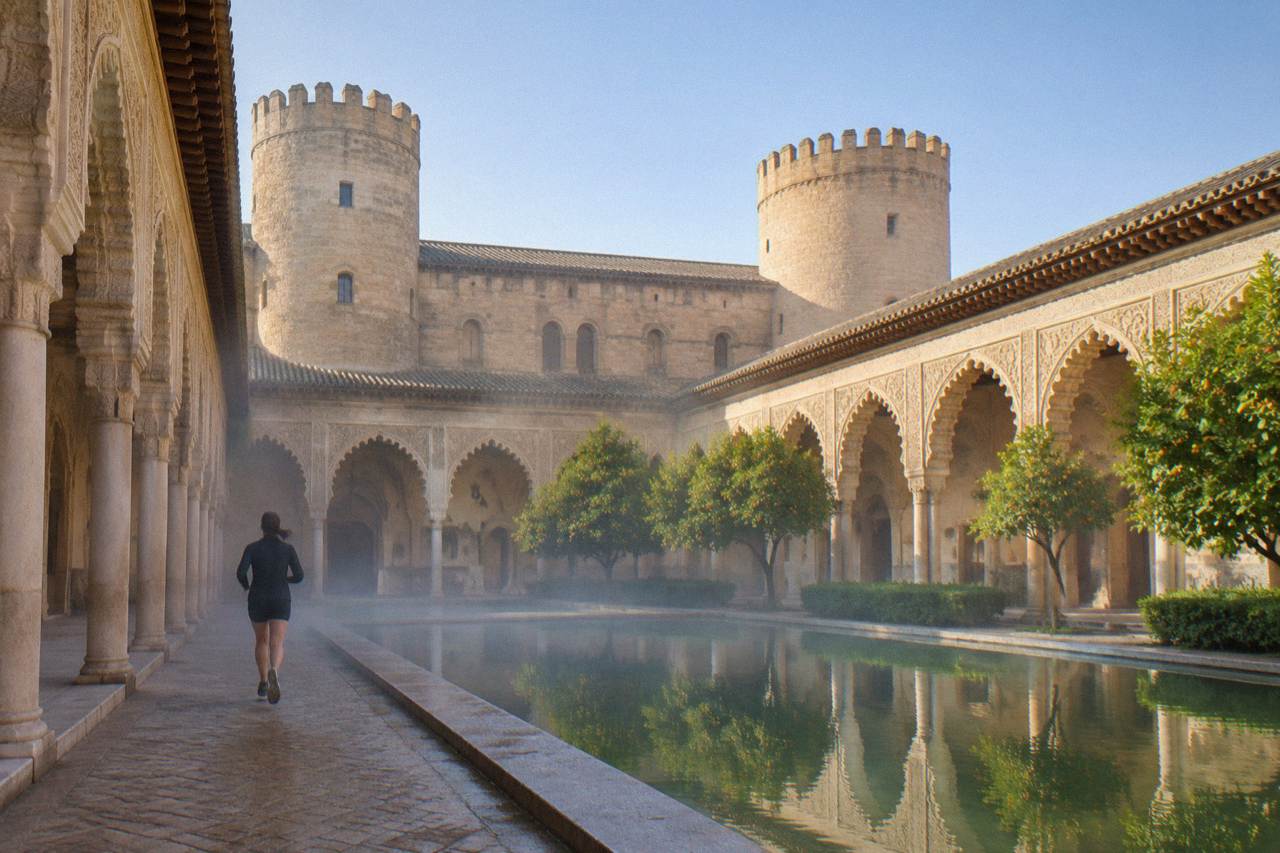
The Aljafería in Zaragoza, the capital of Aragon in northern Spain, is a fortified palace whose interior is one of the most complete ensembles of Hispano-Muslim and Mudéjar architecture open to visitors anywhere in the country. Walking through it means passing from a defensive gate and courtyard into a sequence of carved stucco halls, a brick oratory facing Mecca, a Mudéjar chapel, a Renaissance palace layer and a later restoration, all inside one building. This page answers what is inside the Aljafería room by room, with the verified opening hours, ticket prices and guided tour times a visitor needs to plan the visit.
What Is Inside The Aljafería?
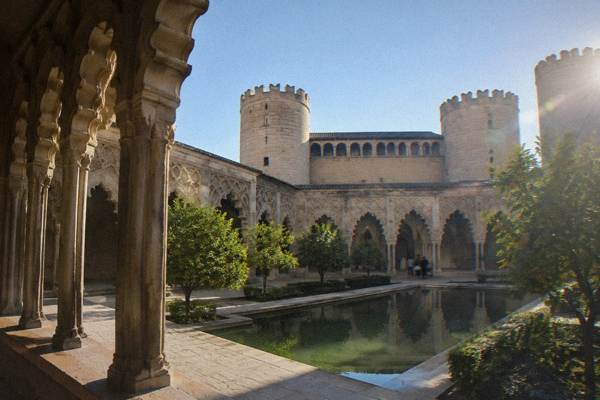
Inside the Aljafería visitors find a fortified Islamic palace core with a courtyard of intricate brick and stucco arches, a throne room with rich carved plasterwork, a small oratory with a mihrab, later Christian additions including a Mudéjar chapel and palace rooms, the Troubadour's Tower, and the exhibition "Goya, del Museo al Palacio", all open daily from 10:00 to 18:00 with last access 45 minutes before closing.
The palace is best understood as a sequence of layers. The Islamic core is organised around a courtyard, with interluding arches, pools and planted beds framing a formal reception hall where the ruler held audience. The carved decoration in these rooms, geometric stucco work, inscriptions and vegetal motifs, is the reason art historians treat the building as a bridge between the palace traditions of Córdoba and the later Alhambra. A small oratory off the main hall preserves its mihrab, the prayer niche oriented toward Mecca, and it is the most intimate and best-preserved space of the original palace.
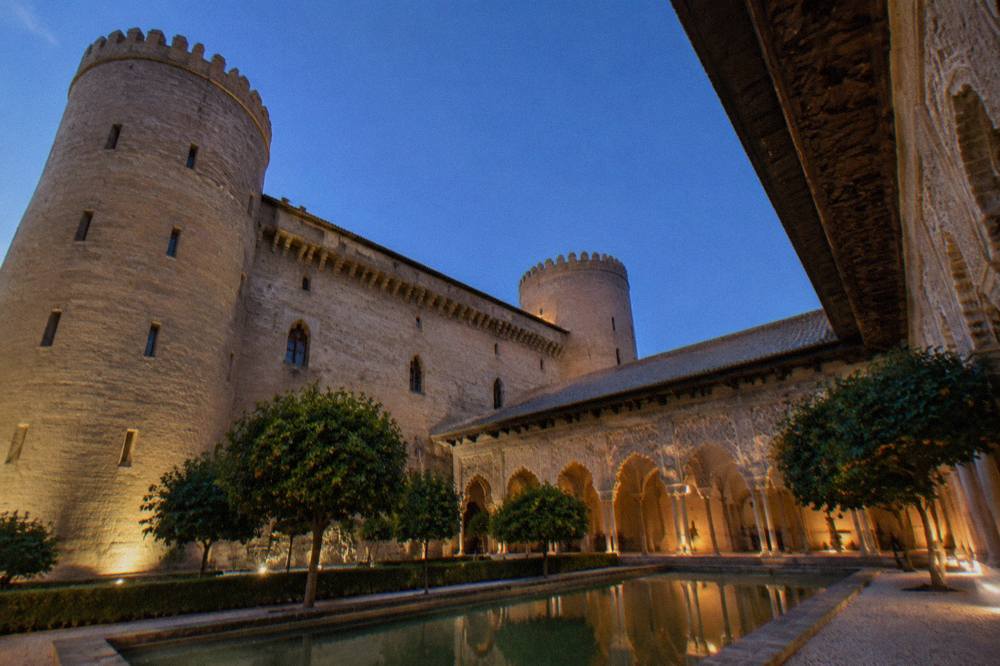
After the Christian conquest of Zaragoza the building kept being used, and each era left its own interior. A Romanesque and then Mudéjar chapel occupies part of the ground floor, its brick apse and ribbed vaults belonging to the same Aragonese Mudéjar tradition that UNESCO recognises across the region. Later rulers added a grand palace floor above the Islamic halls, and a later restoration gave the building much of its present silhouette, including the crenellated walls and the Troubadour's Tower that rises over the entrance complex. The whole circuit is compact: the municipal timetable lists the site as open daily 10:00 to 18:00 in October, and most visitors spend between one and two hours inside.
The surviving Mudéjar features of the Aljafería Palace are one of exactly three Zaragoza components of the UNESCO World Heritage property "Mudejar Architecture of Aragon", inscribed in 1986 and extended in 2001; the others are the tower and parish church of San Pablo and the apse, parroquieta and cimborio of La Seo. It is the Mudéjar parts of the palace that carry the listing, not the whole building, and that distinction is worth keeping in mind as you walk through the chapel and its brickwork. The full palace guide sits at the Aljafería palace page, and the practicalities of getting in are covered in can you visit the Aljafería.
Which Rooms And Spaces Can You See Inside The Aljafería?
The visitor route inside the Aljafería covers the entrance courtyard and the Troubadour's Tower, the Islamic palace courtyard with its pools and arches, the Salón del Trono throne room with its carved stucco, the oratory with its mihrab, the Mudéjar chapel of San Martín, the upper palace rooms of the Catholic Monarchs, and the exhibition spaces that currently hold "Goya, del Museo al Palacio".
The ground floor delivers the strongest impressions. The Islamic courtyard is the heart of the visit: a rectangular space of planted beds and water, ringed by walls of delicate mixtilinear arches supported on slender columns. From it you enter the reception hall, the Salón del Trono, whose walls carry the densest carved plasterwork in the building, geometric interlace, stylised vegetation and bands of inscription, faithful in scheme to the original decoration. Beside it, the tiny oratory is a jewel box of the same decoration at miniature scale, with its mihrab niche still intact.
The Christian layers are not an afterthought. The chapel of San Martín, with its Mudéjar brick apse and vaulted interior, is one of the spaces that connects the palace to the wider UNESCO listing, and the upper floor holds the rooms of the later Catholic Monarchs' palace, with coffered ceilings and the grand staircase that links the two worlds of the building. The Troubadour's Tower at the entrance, thick-walled and severe on the outside, opens into vaulted chambers that were used for very different purposes across the centuries. The deeper background of how these layers accumulated is told in the history of the Aljafería palace.
Practically, the palace is fully inside the city and easy to fold into a walking day. The tram runs close by, the single fare is 1.70 EUR with the Tarjeta Bus alternative at 0.55 EUR per trip, and the site sits a short hop from the centre. A guided option that puts the palace in the context of the whole old district is the Zaragoza: Historical Tour of the Old District with a Guide, a 2.5-hour walk rated 5 from 14 reviews, from $106.92 per person; Check availability if that framing appeals.
What Is The "Goya, Del Museo Al Palacio" Exhibition Inside The Aljafería?
"Goya, del Museo al Palacio" is an exhibition inside the Aljafería whose guided tour runs at 11:30, alongside the palace's regular Spanish-language guided tours at 10:30, 12:30, 13:30, 15:00 and 16:00, giving visitors a second, art-focused reason to enter the building beyond its architecture.
The exhibition brings Goya into the palace because the painter and the building belong to the same city's story: Francisco de Goya was born in the Aragonese village of Fuendetodos and trained in Zaragoza, and the Aljafería's own rooms have hosted art displays connected to that heritage. The 11:30 exhibition tour is listed in the municipal monument timetable alongside the five daily Spanish guided tours of the palace itself, so a visitor who wants both the architecture and the art can plan a single morning around them. Note that the tour is delivered in Spanish; visitors who do not follow the language comfortably should check the operator's notice before booking, since the timetable the municipality publishes carries no English-language equivalent.
The Goya thread runs deeper than one exhibition. The Museo Goya of the Fundación Ibercaja reopens on 9 October 2026 after renovation, open Tuesday to Saturday 10:00 to 20:00 and Sunday and holidays 10:00 to 14:00, closed Mondays, with its admission price not yet published. Anyone building a Goya-themed day in Zaragoza can pair the Aljafería exhibition with that museum and the city's other Goya landmarks. For the broader picture of the city's draw, what Zaragoza is famous for and is Zaragoza Spain worth visiting both cover the question from a planning angle.
What Are The Aljafería'S Opening Hours And Ticket Prices?
The Aljafería is open daily from 10:00 to 18:00 in October, with last access 45 minutes before closing. A general ticket costs 7 EUR, a guided visit 9 EUR, entry with the tourist-bus ticket 4 EUR, students, over-65s and Carnet Joven holders pay 2 EUR, and under-12s enter free, with free entry for everyone on the 1st and 3rd Sundays and every Monday of the month.
The price ladder rewards a little planning. If your dates are flexible, the free days are the obvious lever: the first and third Sunday of each month and every Monday cost nothing at all. If you are arriving on the Zaragoza Bus Turístico, the 10 EUR hop-on hop-off ticket doubles as a discount at the palace door, cutting entry to 4 EUR. The guided visit at 9 EUR is the only way to get the full interior explained by a specialist, and it books through the official ticketing page, tickets.aljaferia.es. The rest of the planning pages sit on Zaragoza Travel Guide.
| Ticket type | Price |
|---|---|
| General | 7 EUR |
| Guided visit | 9 EUR |
| With tourist-bus ticket | 4 EUR |
| Students, over 65, Carnet Joven | 2 EUR |
| Under 12 | Free |
| Free-entry days (1st and 3rd Sunday, every Monday) | Free |
The guided tour schedule is fixed and worth matching to your arrival time. All five daily tours are in Spanish, and the exhibition tour adds a sixth slot:
| Tour | Time |
|---|---|
| Palace guided tour (Spanish) | 10:30 |
| "Goya, del Museo al Palacio" exhibition tour | 11:30 |
| Palace guided tour (Spanish) | 12:30 |
| Palace guided tour (Spanish) | 13:30 |
| Palace guided tour (Spanish) | 15:00 |
| Palace guided tour (Spanish) | 16:00 |
For visitors who prefer a booked, English-friendly experience around the palace rather than inside it, the guided options below cover the old district and the city, and the Aljafería ticket-and-guided-visit product handles the palace itself.
Should You Take A Guided Tour Inside The Aljafería?
A guided visit inside the Aljafería costs 9 EUR against the 7 EUR general ticket and is the better choice for most first-time visitors, because the palace's interior decoration, its layers and its Mudéjar chapel read far better with explanation, and the official guided tours run five times a day in Spanish at 10:30, 12:30, 13:30, 15:00 and 16:00.
The honest trade-off is language. The palace's own guided programme is Spanish-only, and the interior rewards explanation: the stucco programmes in the throne room, the orientation of the oratory and the distinction between the Islamic core and the Mudéjar chapel are all easy to walk past unguided. Visitors comfortable in Spanish should book the 9 EUR guided visit through the official ticketing page. Visitors who need English have two workable routes: an independent visit with a good printed or audio guide, or one of the city tours led in other languages that include the palace district, such as the Aljafería ticket-and-guided-visit product or a private custom walk with a local guide, from $50.65 per person and rated 5 from 86 reviews.
Time budgeting matters more than people expect. The palace sits slightly west of the centre, and most itineraries pair it with the Casco Histórico, the Basílica del Pilar and La Seo. If you are working out how many days you need in Zaragoza, the Aljafería deserves a half-morning or half-afternoon slot, not a drive-by. Arriving at least 45 minutes before last access is a hard requirement of the ticket policy, and arriving for the first tour of the day at 10:30 gives you the calmest rooms.
Is The Aljafería'S Interior A UNESCO World Heritage Site?
The surviving Mudéjar features of the Aljafería Palace are one of the three Zaragoza components of the UNESCO World Heritage property "Mudejar Architecture of Aragon", inscribed in 1986 and extended in 2001, alongside the tower and parish church of San Pablo and the apse, parroquieta and cimborio of La Seo, so parts of the palace's interior decoration carry World Heritage status while the building as a whole is not itself the listed item.
That distinction shapes what to look at. Inside the Aljafería, the Mudéjar chapel and its brick and vaulted work are the spaces that connect to the listing; the Islamic-era stucco of the throne room belongs to an earlier tradition that predates Mudéjar as a label, and the later restoration layers are later again. A visitor who understands this walks the palace with sharper eyes: the UNESCO inscription, criterion (iv), recognises the Mudéjar tradition of Aragon as a whole, ten components across the provinces of Teruel and Zaragoza, and the Aljafería's listed share is specifically its surviving Mudéjar features. The wider story of brick architecture across the region is worth an afternoon in itself, and the palace is the easiest place in the city to see it indoors.
Common Questions About The Aljafería
What is inside the Aljafería?
A fortified Islamic palace core with a courtyard of carved arches, the Salón del Trono, an oratory with its mihrab, a Mudéjar chapel, later Christian palace rooms, the Troubadour's Tower and the exhibition "Goya, del Museo al Palacio". The site is open daily 10:00 to 18:00 in October, with last access 45 minutes before closing.
How much does it cost to go inside the Aljafería?
A general ticket costs 7 EUR and a guided visit 9 EUR. Entry with the tourist-bus ticket is 4 EUR, students, over-65s and Carnet Joven holders pay 2 EUR, and under-12s enter free. Entry is free for everyone on the 1st and 3rd Sundays and every Monday of the month.
Are the guided tours inside the Aljafería in English?
The palace's own guided tours run in Spanish, at 10:30, 12:30, 13:30, 15:00 and 16:00, with the "Goya, del Museo al Palacio" exhibition tour at 11:30. Visitors who need another language usually take an independent visit or a city tour with a local guide that covers the palace district.
How long does a visit inside the Aljafería take?
Most visitors spend between one and two hours inside. The route covers the courtyard, throne room, oratory, chapel and upper palace rooms, and last access is 45 minutes before the 18:00 closing time.
Is the Aljafería a UNESCO World Heritage site?
The surviving Mudéjar features of the Aljafería Palace are one of the three Zaragoza components of the UNESCO property "Mudejar Architecture of Aragon", inscribed in 1986 and extended 2001, alongside San Pablo's tower and parish church and La Seo's apse, parroquieta and cimborio. The Mudéjar parts carry the listing, not the whole building.
The Aljafería rewards exactly the kind of slow, room-by-room attention this page describes, and it is the single best indoor introduction to the layered history that makes Zaragoza worth the train ride.