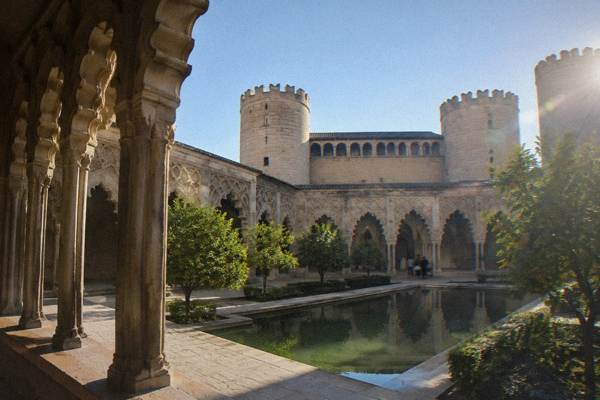
What Is The History Of The Aljafería Palace?
The history of the Aljafería Palace in Zaragoza, Spain, from an Islamic-era fortified palace to a royal seat, a military barracks and a restored monument, with UNESCO status, opening hours and ticket prices explained.
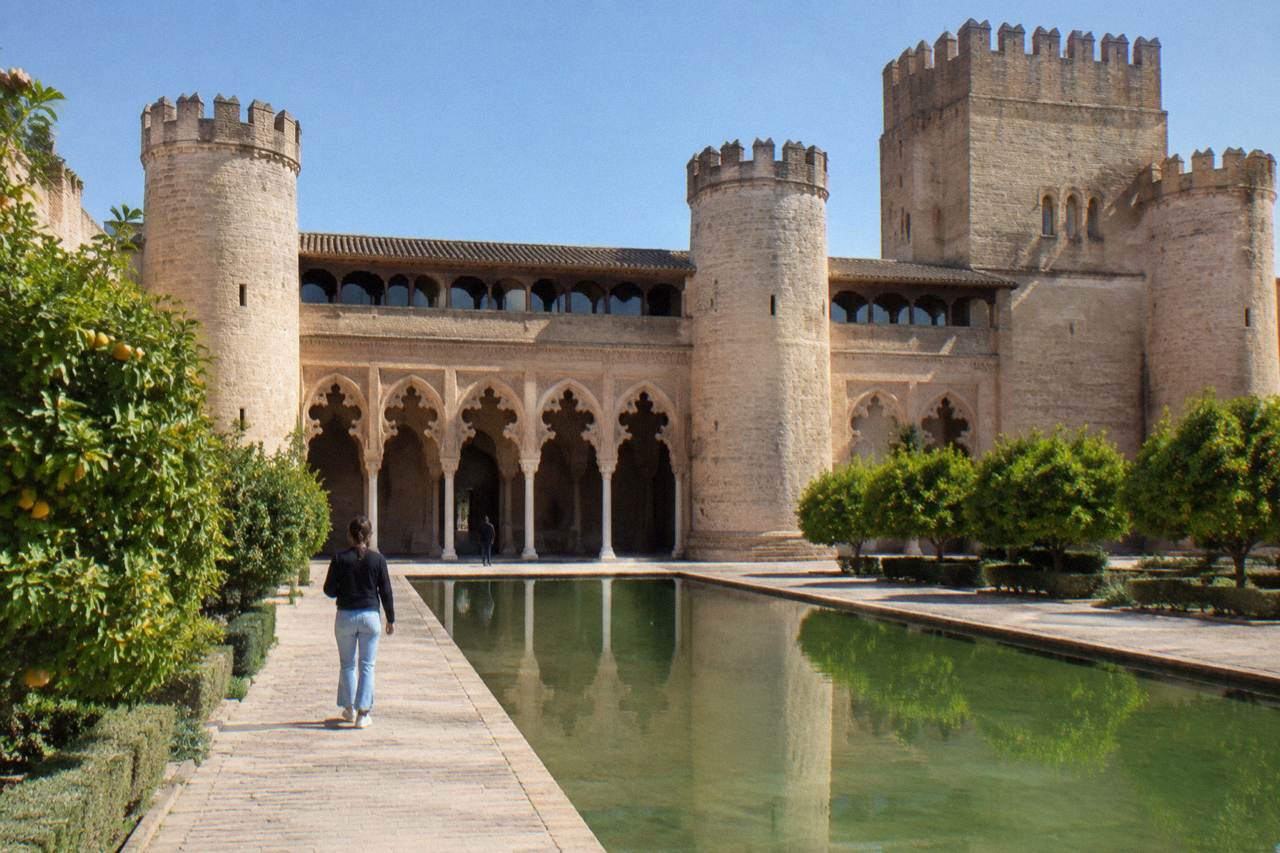
Zaragoza, the capital of Aragon on the Ebro, keeps its layered past in plain sight, and no building in the city tells that story more completely than the Aljafería. The palace stands just outside the old town, a fortified compound of walls, towers and carved plasterwork that has been a ruler's residence, a royal seat, a soldiers' quarters and a museum, sometimes all within the same century. This page from Zaragoza Travel Guide sets out what the history of the Aljafería Palace actually involves, what its UNESCO status does and does not cover, and how to visit it today. For the building as it appears on the ground now, see the Aljafería Palace attraction page.
What Is The History Of The Aljafería Palace?
The Aljafería is a fortified palace in Zaragoza, Spain, built as the residence of the rulers of the Islamic taifa that controlled the Ebro valley, taken over after the Christian conquest as a palace of the kings of Aragon, later converted into a military barracks, and finally restored in the modern era as a monument open to the public, with its surviving Mudéjar features listed by UNESCO as part of the World Heritage property Mudejar Architecture of Aragon.
That single building carries the whole arc of Zaragoza's past. The city began as the Roman colony of Caesaraugusta, passed under Islamic rule, was conquered by the kingdom of Aragon, grew around pilgrimage and trade, and was besieged, occupied and rebuilt repeatedly. The Aljafería sat at the edge of that story for most of it. Its walls were thick because it was a fortress before it was anything decorative; its carved interiors survived because later occupants, from kings to gunners, kept roofing over them.
The palace's Mudéjar elements matter for its modern standing. UNESCO's record for Mudejar Architecture of Aragon, inscribed in 1986 and extended in 2001, names exactly three components in Zaragoza city: the surviving Mudéjar features of the Aljafería Palace, the tower and parish church of San Pablo, and the apse, parroquieta and cimborio of La Seo. The listing covers the Mudéjar parts of the Aljafería, not the whole building, and it is the reason the palace sits alongside La Seo and San Pablo Church in the city's architectural first rank.
How Did The Aljafería Survive From Fortress To Barracks?
The palace survived because each era reused it rather than demolishing it: the taifa rulers built it as a fortified residence, the kings of Aragon extended it as a royal palace, later military authorities turned it into a barracks and buried parts of it under defensive works, and modern restorers uncovered and repaired the medieval fabric, which is why visitors today see Islamic-era plasterwork, Mudéjar additions and modern reconstruction side by side.
The transition from residence to royal seat came with the Christian conquest of Zaragoza. The kings of Aragon used the Aljafería as one of their palaces, and the Mudéjar craftsmen who worked for them added the elements that UNESCO now lists, applying Islamic decorative techniques under Christian patronage. That combination, Mudéjar art, is the thread that runs through Zaragoza's most celebrated buildings and gives the World Heritage property its name.
The hardest centuries for the palace were the military ones. Used as a fortress and barracks, the building lost its interior richness in places and gained ramparts, and by the modern period stretches of the original fabric were buried or built over. Restoration work in the modern era removed later accretions, consolidated what remained and reconstructed damaged sections, which is why a visit today moves between genuinely medieval rooms and rebuilt passages within a few steps of each other. The palace now also houses a cultural institution, and the October monument timetable lists a temporary exhibition there under the title Goya, del Museo al Palacio, toured at 11:30 each day.
For visitors who want the story told on site, the Aljafería guided tour in Spanish with ticket covers the palace's history in about two hours with entry included, from $24.76 per person and rated 4.8 from 103 reviews. Spanish-language guided tours inside the monument run at 10:30, 12:30, 13:30, 15:00 and 16:00, and the municipal timetable gives the palace the longest daily opening of any major monument in the city: 10:00 to 18:00, with last access 45 minutes before closing. A fuller walk through the old town afterwards pairs well with it, and the history of Zaragoza itself fills in the Roman and medieval context around the palace walls.
Is The Aljafería A UNESCO World Heritage Site?
Yes, in part: the surviving Mudéjar features of the Aljafería Palace are one of exactly three components of the UNESCO World Heritage property Mudejar Architecture of Aragon located in Zaragoza city, alongside the tower and parish church of San Pablo and the apse, parroquieta and cimborio of La Seo, a property inscribed in 1986 and extended in 2001 with ten components across the provinces of Teruel and Zaragoza.
The precision matters because casual guides get it wrong in both directions. The whole palace is not a World Heritage Site; only its Mudéjar elements carry the inscription, and those elements are what UNESCO's record names. Equally, the palace must not be written out of the listing: its Mudéjar features are firmly among the Zaragoza components, and denying that would be as wrong as claiming the entire compound is listed. The Basilica del Pilar, by contrast, is not part of the property at all, nor are La Magdalena, the Puente de Piedra or the demolished Torre Nueva.
| UNESCO component in Zaragoza city | What is listed |
|---|---|
| The Aljafería Palace | The surviving Mudéjar features of the palace |
| San Pablo | The tower and parish church of San Pablo |
| La Seo | The apse, parroquieta and cimborio of La Seo |
The other seven components of the property lie elsewhere in the provinces of Teruel and Zaragoza. For a visitor planning around the listing, the practical reading is simple: the Aljafería and La Seo are the two sights in Zaragoza where Mudéjar work listed by UNESCO can be seen up close, and both are within a short tram ride or a brisk walk of each other across the city centre.
What Can You See Inside The Aljafería Palace Today?
Visitors today walk through a restored fortified palace whose highlights include the Islamic-era courtyard and its carved plaster arches, the palace's oratory with its intricate decoration, the Mudéjar additions made for the kings of Aragon, later royal rooms above the medieval fabric, and the temporary exhibition Goya, del Museo al Palacio, all inside a building open daily in October from 10:00 to 18:00 with tickets from 7 EUR general admission.
The interior sequence rewards patience. The outer walls and towers read as military architecture, plain and heavy. Inside, the celebrated courtyard opens with layered polylobed arches and carved stucco, the work of craftsmen decorating a ruler's residence. Beyond it, the small oratory is the palace's most photographed space, a concentrated box of ornament. The Mudéjar additions from the Aragonese royal period sit alongside, and upper floors carry later royal rooms rebuilt during the restoration. Whether every surface is original or reconstructed is the question the guided tours address directly, and the honest answer is that centuries of barracks use, damage and rebuilding mean the palace is a careful composite.
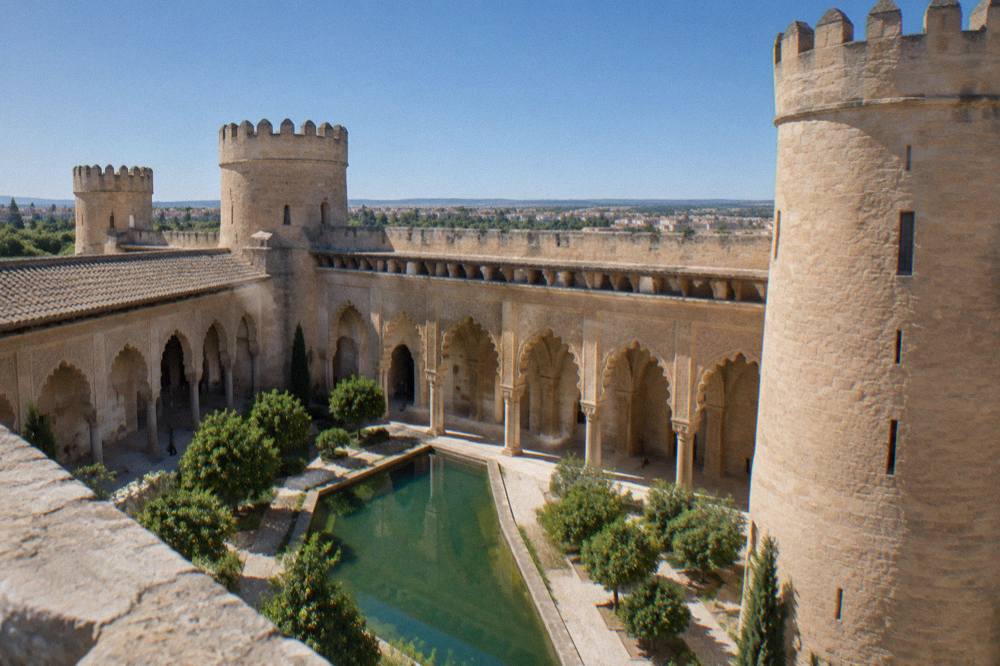
For what each space contains in detail, the what is inside the Aljafería page covers the rooms one by one, and the practicalities of getting in, including the free-entry days, are on can you visit the Aljafería.
How Much Does The Aljafería Cost And When Is It Free?
A general ticket costs 7 EUR, a ticket with a guided visit 9 EUR, holders of the tourist-bus ticket pay 4 EUR, students, visitors over 65 and Carnet Joven holders pay 2 EUR, and children under 12 enter free, while everyone enters free on the 1st and 3rd Sunday of each month and on Mondays, with tickets sold through the palace's ticketing page and last access 45 minutes before the 18:00 closing time.
| Ticket type | Price |
|---|---|
| General admission | 7 EUR |
| With guided visit | 9 EUR |
| With tourist-bus ticket | 4 EUR |
| Students, over 65, Carnet Joven | 2 EUR |
| Under 12 | Free |
| 1st and 3rd Sunday, every Monday | Free for all |
The free days are the budget traveller's lever, but they come with a trade-off: Mondays and the free Sundays draw the biggest crowds, and the guided times fill first. Anyone wanting the tour without the gamble should book the guided option in advance, either through the palace's own ticketing page or through a tour that bundles the ticket. The Aljafería guided tour with ticket is the direct route, and Check availability before committing to a day, since tour times mirror the palace's own guided slots.
How Does The Aljafería Fit Into A Zaragoza Visit?
The palace is the western anchor of a classic Zaragoza circuit: the Aljafería's Mudéjar features, then the Roman remains of Caesaraugusta in the old town, then La Seo's listed apse, parroquieta and cimborio, and finally the Basílica del Pilar on the Ebro, a line that takes in the city's four cultural layers and can be done in a single well-planned day using the tram, whose single fare is 1.70 EUR.
Pairing the palace with the rest of the city works because Zaragoza's sights cluster tightly. The old town holds the Roman forum, river port, baths and theatre museums, each a few minutes' walk from the next, with combined tickets at 7 EUR for all four and free entry on the first Sunday of the month. La Seo sits on the same square as the Pilar, so the two cathedrals, the Roman museums and the Puente de Piedra over the Ebro form one walkable core, and the Aljafería sits a short tram ride west of it.
The guided options above cover the palace itself, the old town as a whole and La Seo, which together trace the same historical arc this page has described, from Islamic-era fortress to Mudéjar royal seat to the cathedrals that followed. Anyone who prefers to walk the old town's monuments with a guide rather than alone can also consider the Old Town Monumental Walk, a walking tour rated 4.9 from 15 reviews.
Anyone working out how much time the whole city deserves can start with how many days you need in Zaragoza, and the one-day version of the circuit is laid out in a good one-day itinerary for Zaragoza. The Aljafería rewards the morning slot: the guided tours start at 10:30, the building is at its quietest before midday, and the old town's museums and tapas bars are better used in the afternoon and evening anyway.
Common Questions About The Aljafería Palace
What is the history of the Aljafería Palace?
The Aljafería is a fortified palace in Zaragoza, Spain, first built as the residence of the Islamic taifa rulers of the Ebro valley, later used as a palace of the kings of Aragon, converted into a military barracks for centuries, and restored in the modern era as a public monument whose surviving Mudéjar features are listed by UNESCO.
Is the Aljafería a UNESCO World Heritage Site?
Partly. The surviving Mudéjar features of the Aljafería Palace are one of three Zaragoza components of the UNESCO property Mudejar Architecture of Aragon, inscribed in 1986 and extended in 2001. The listing covers the Mudéjar parts of the palace, not the whole building.
How much does it cost to visit the Aljafería?
General admission is 7 EUR, 9 EUR with a guided visit, 4 EUR with the tourist-bus ticket, and 2 EUR for students, visitors over 65 and Carnet Joven holders. Children under 12 enter free, and entry is free for everyone on the 1st and 3rd Sunday and every Monday of the month.
When is the Aljafería open?
The October monument timetable lists the palace as open daily from 10:00 to 18:00, with last access 45 minutes before closing. Spanish guided tours run at 10:30, 12:30, 13:30, 15:00 and 16:00, and the Goya, del Museo al Palacio exhibition tour at 11:30.
Can you visit the Aljafería without a tour?
Yes, a general 7 EUR ticket covers independent entry during opening hours. The guided option costs 9 EUR, and a two-hour guided tour in Spanish with the ticket included is also bookable through the operator's live listing.
How do you get to the Aljafería from the city centre?
The palace sits just outside the old town to the west. The urban tram serves the area, and a single ticket on the tram or bus costs 1.70 EUR, or 0.55 EUR with the Tarjeta Bus. Check the operator's notice before you go for any route deviations caused by city works.
The Aljafería is the one building in Zaragoza where the city's whole history can be read in a single visit, from fortress walls to Mudéjar plasterwork to the seat of the Cortes of Aragon, and its restoration means that story is open to walk through every day of the week.