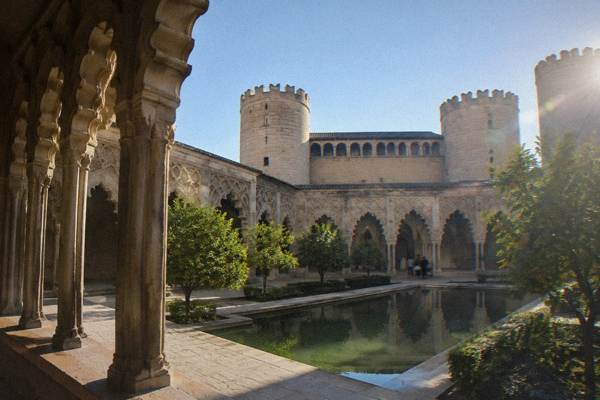
Aljaferia Palace
The Aljaferia Palace in Zaragoza, the capital of Aragon on the Ebro, is the best-preserved Islamic palace in Spain outside Andalusia, open daily in October from 10:00 to 18:00 with general admission at 7 EUR and guided visits at 9 EUR.
Short answer
The Aljaferia Palace in Zaragoza, Spain is open daily in October from 10:00 to 18:00, with last access 45 minutes before closing. General admission costs 7 EUR, a guided visit 9 EUR, and entry is free on the 1st and 3rd Sunday and every Monday of the month. Its surviving Mudejar features are one of the three Zaragoza components of the UNESCO World Heritage property Mudejar Architecture of Aragon.
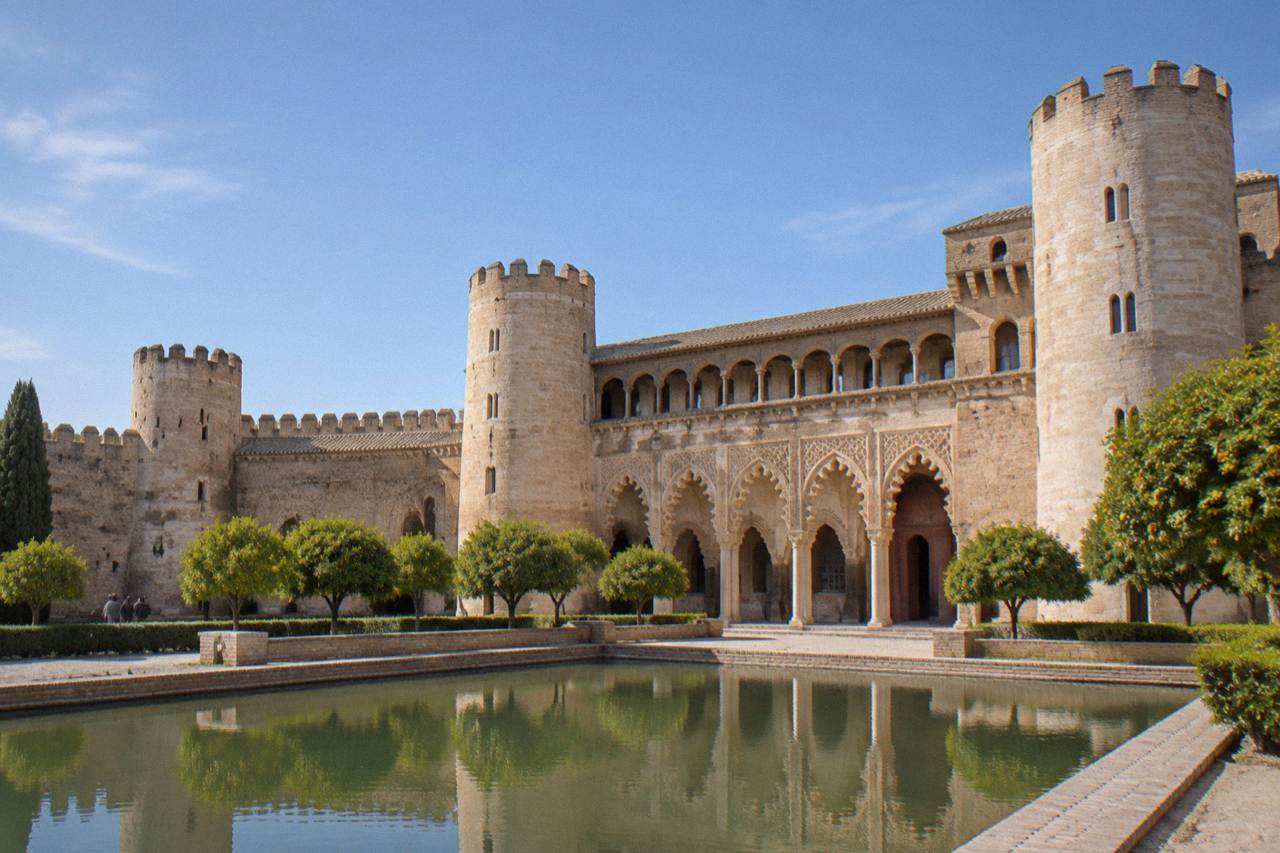
The Aljaferia Palace in Zaragoza, the capital of Aragon on the Ebro, is the finest surviving Islamic palace in Spain outside Andalusia, a fortified residence whose arcaded courtyards, carved plasterwork and horseshoe arches sit a short tram ride west of the city centre. The palace is open daily in October from 10:00 to 18:00, general admission costs 7 EUR, and its surviving Mudejar features are one of exactly three Zaragoza components of the UNESCO World Heritage property Mudejar Architecture of Aragon. This guide covers the hours, the prices, the Spanish-language guided tour times, what you actually see inside, and how the palace fits into a wider visit to the city, whether you arrive from the Basílica del Pilar, from La Seo Cathedral, or straight off a train at Zaragoza-Delicias.
What Is The Aljaferia Palace In Zaragoza?
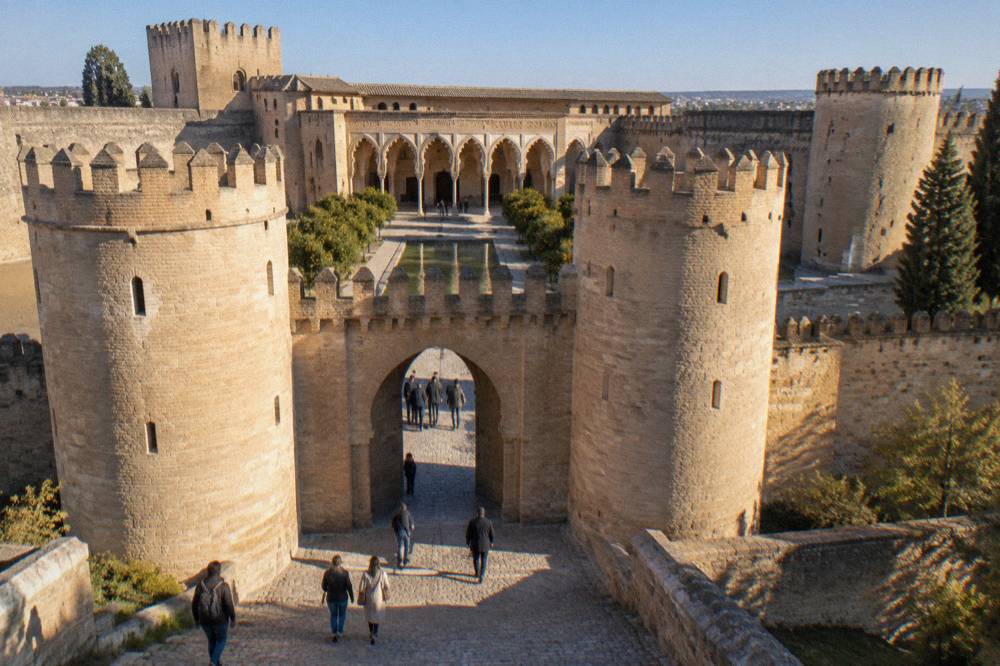
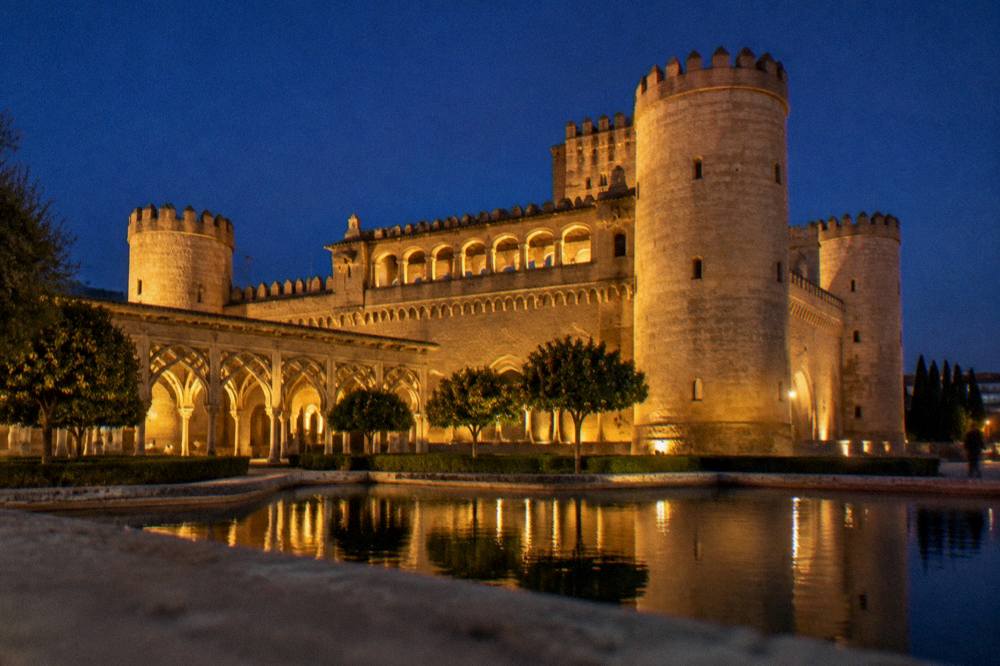
The Aljaferia Palace is a fortified medieval palace on the western edge of Zaragoza's city centre, built as the seat of the Banu Hud dynasty's taifa court and today the best-preserved Islamic palace in Spain outside Andalusia. Its carved plasterwork, interlaced arches and courtyard layout survive from the taifa period, while later Christian kings and the Catholic Monarchs reshaped its upper floors. It now houses the Cortes de Aragon, the regional parliament, which shares the building with the visitor route.
The palace stands apart from the old town, separated from the Roman and Renaissance core by a stretch of later streets, which is one reason visitors who stay only around Plaza del Pilar often miss it. That is a mistake. The building is the single most important piece of Islamic architecture in Aragon, and its layers tell the city's whole story in one site: Islamic taifa rule, the Christian Reconquista, the Catholic Monarchs, and modern parliamentary democracy.
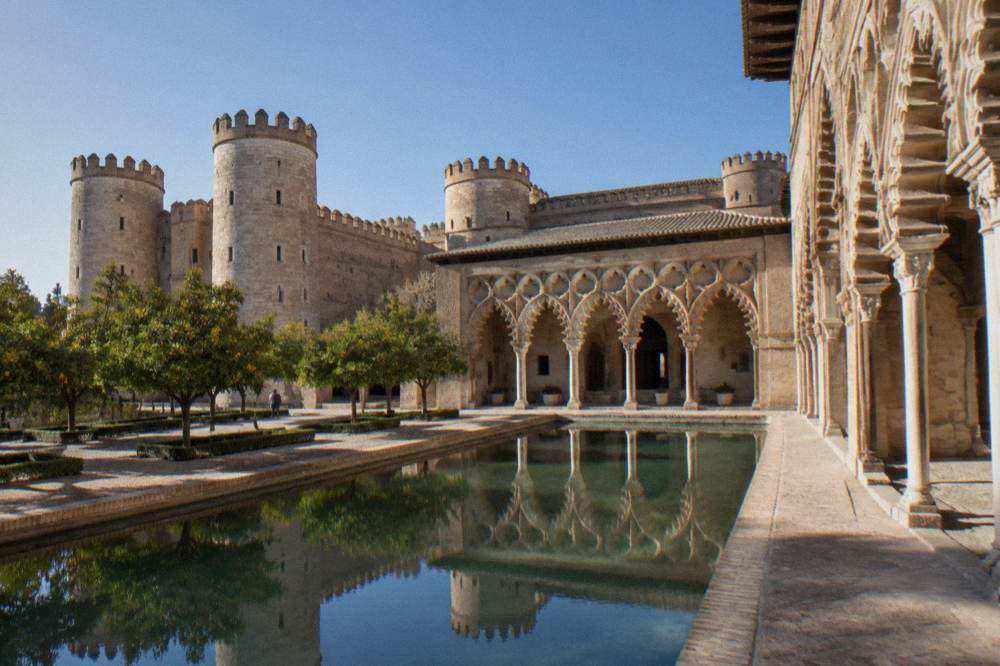
The architecture rewards close looking. The interlaced polylobed arches around the main courtyard, the fine carved stucco of the oratory, and the ceiling and panelling added under Christian rule sit within a compact circuit that most visitors cover in about two hours. The palace also carries the temporary exhibition "Goya, del Museo al Palacio", which has its own dedicated tour slot at 11:30 each day, connecting the palace to the wider Goya trail covered in Goya in Zaragoza.
What Are The Aljaferia Palace Opening Hours And Ticket Prices?
The Aljaferia Palace is open daily in October from 10:00 to 18:00, with last access 45 minutes before closing. General admission costs 7 EUR, a guided visit costs 9 EUR, students, visitors over 65 and Carnet Joven holders pay 2 EUR, children under 12 enter free, and a ticket bought with the Zaragoza tourist bus costs 4 EUR. Entry is free on the 1st and 3rd Sunday of each month and on every Monday.
The municipal October timetable publishes those hours and prices, and tickets are sold through the palace's own ticketing page. The free Mondays are the quiet bargain in that price list: a visitor who times a Monday or a first or third Sunday visit pays nothing at all, and the palace is open on Mondays when most of the city's other monuments, including La Seo and the Caesaraugusta museums, are closed.
| Ticket type | Price |
|---|---|
| General admission | 7 EUR |
| Guided visit | 9 EUR |
| With tourist bus ticket | 4 EUR |
| Students, over 65, Carnet Joven | 2 EUR |
| Under 12 | Free |
| 1st and 3rd Sunday, every Monday | Free |
The hours and prices in the table are the October 2026 figures from the municipal monuments timetable, and seasonal changes are announced on the palace's ticketing page, so a visit planned for another season should be checked there before you set out. The last-access rule matters more than it looks: arriving at 17:30 gets you in with half an hour inside, which is not enough for the full route.
Two ways of seeing the palace with a guide are compared below. The Spanish-language guided tour from the palace itself runs at fixed times, while the operator-led options include the ticket in the price and can be booked in advance.
What Can You See Inside The Aljaferia?
Inside, the visitor route covers the taifa-era courtyard with its interlaced arches and carved plasterwork, the oratory, the Islamic-era structural remains of the upper palace, the Christian-era rooms added under later kings, the Catholic Monarchs' floor with its coffered ceiling, and the "Goya, del Museo al Palacio" exhibition. The palace is compact enough that a full self-guided circuit takes most visitors between one and two hours, longer with a guide.
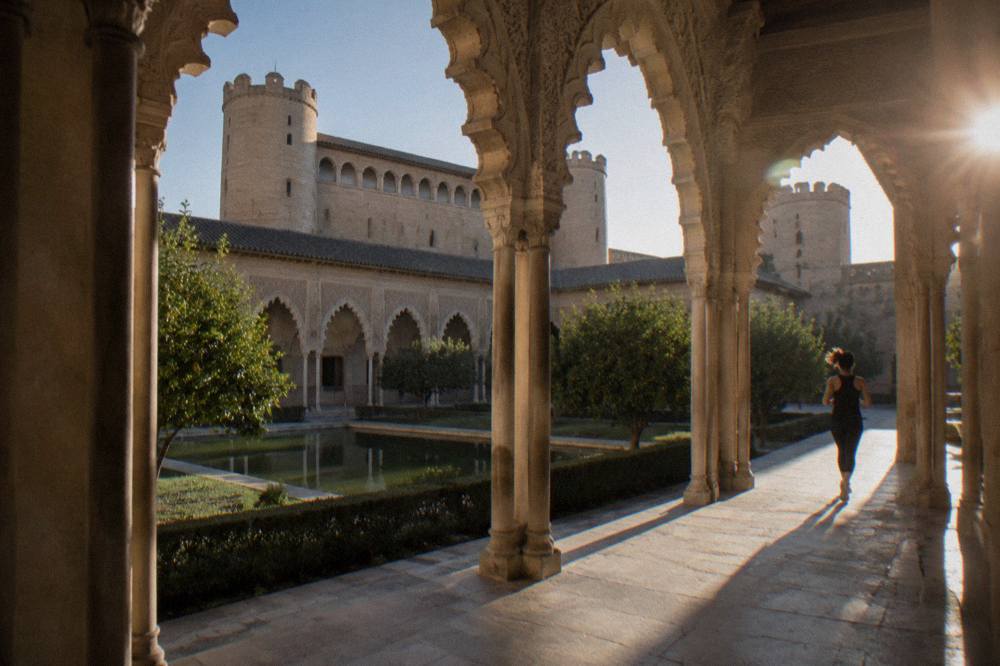
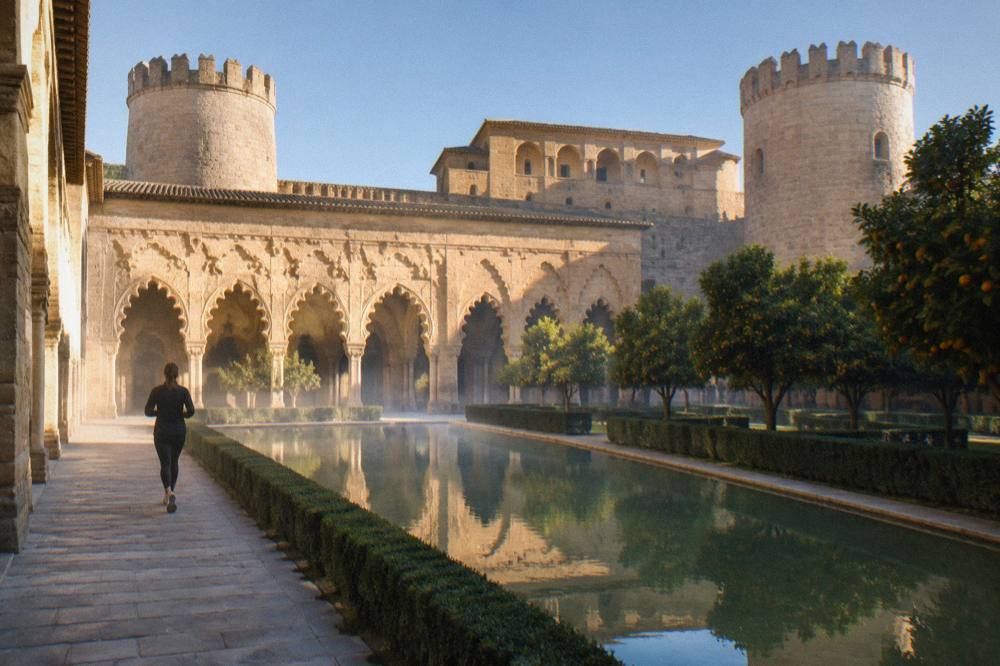
The heart of the visit is the courtyard. The arcades of polylobed and interlaced arches, the delicate vegetal stucco carving, and the water channel crossing the paving are the palace's signature images, and they are the work that made the Mudejar parts of the building famous enough to be inscribed by UNESCO. Look up as well as across: the upper structure, restored after centuries of use as a barracks, shows how much of the original fabric survived and how much was rebuilt.
The Christian layers are not an afterthought. The Catholic Monarchs' floor, with its ceiling and panelling, sits directly above the Islamic courtyard, and the contrast between the two levels is the palace's best argument for taking a guided visit rather than walking through alone. The temporary exhibition "Goya, del Museo al Palacio" adds a further stop, and its dedicated tour at 11:30 pairs naturally with a visit to the Museo Camon Aznar, which reopens as the Museo Goya on 9 October 2026.
For readers deciding how to spend a fixed amount of time in the city, the palace belongs on any list of the essential stops alongside the Basílica del Pilar and the Roman sites, and the things to do in Zaragoza overview places it in that wider context.
| Zone of the palace | What you see |
|---|---|
| Taifa courtyard | Interlaced polylobed arches, carved stucco, water channel |
| Oratory | Mihrab-facing chamber with fine plasterwork |
| Upper Islamic structure | Restored taifa-era walls and arcades |
| Christian-era rooms | Rooms reshaped under later Aragonese kings |
| Catholic Monarchs' floor | Coffered ceiling and period panelling |
| Temporary exhibition | "Goya, del Museo al Palacio" |
Is The Aljaferia A UNESCO World Heritage Site?
The surviving Mudejar features of the Aljaferia Palace are one of exactly three Zaragoza components of the UNESCO World Heritage property Mudejar Architecture of Aragon, inscribed in 1986 and extended in 2001. UNESCO lists the Mudejar parts of the palace, not the whole building. The other two Zaragoza components are the tower and parish church of San Pablo and the apse, parroquieta and cimborio of La Seo.
That precision matters, because loose writing about UNESCO status is everywhere. The Basilica del Pilar is not a UNESCO site, and neither are La Magdalena, the Torre Nueva, the Puente de Piedra or the Lonja. The property has ten components across the provinces of Teruel and Zaragoza, and only three of them stand within the city of Zaragoza itself. The Aljaferia's listing attaches to its Mudejar features specifically, the Islamic-derived work that later Christian builders continued and reinterpreted.
| Zaragoza component of Mudejar Architecture of Aragon | What UNESCO lists |
|---|---|
| Aljaferia Palace | The surviving Mudejar features of the palace |
| San Pablo | The tower and parish church |
| La Seo | The apse, parroquieta and cimborio |
A visitor who wants to see all three Zaragoza components in one day can do it on foot and by tram: the palace in the west, then the tram or a walk back to the old town for La Seo's Mudejar apse, then north to the San Pablo tower in its own barrio. The San Pablo church and barrio route and the Mudejar architecture trail around La Seo are covered on their own pages.
What Is The History Of The Aljaferia Palace?
The Aljaferia Palace was built as the fortified residence of the Banu Hud taifa rulers of Zaragoza, then passed to Christian control after the city's conquest, was rebuilt and extended under the kings of Aragon, gained the Catholic Monarchs' floor, and served later as a barracks before its restoration and its conversion into the seat of the Cortes de Aragon.
The palace's Islamic phase made its name. The taifa court of Zaragoza was one of the most sophisticated of its era, and the courtyard, oratory and carved plasterwork that survive from that period are the reason the building is compared with the Alhambra and with the great palace architecture of Seville and Cordoba. After the Christian conquest of the city, the palace became a royal residence of the kings of Aragon, who kept the Islamic fabric and built around it. The rest of the planning pages sit on Zaragoza Travel Guide.
The Catholic Monarchs added their floor, and after the palace ceased to be a royal residence it was repeatedly altered for military use, which is the phase that did the most damage to the original fabric. The modern restoration recovered the taifa courtyard and the surviving structure, and the decision to seat the regional parliament in the building gave it a living function that keeps it maintained and open. The full story, including the answers to the questions visitors ask most often about the palace's origins, is told in the history of the Aljaferia Palace, and the practical side of a visit is covered in can you visit the Aljaferia.
How Do You Get To The Aljaferia?
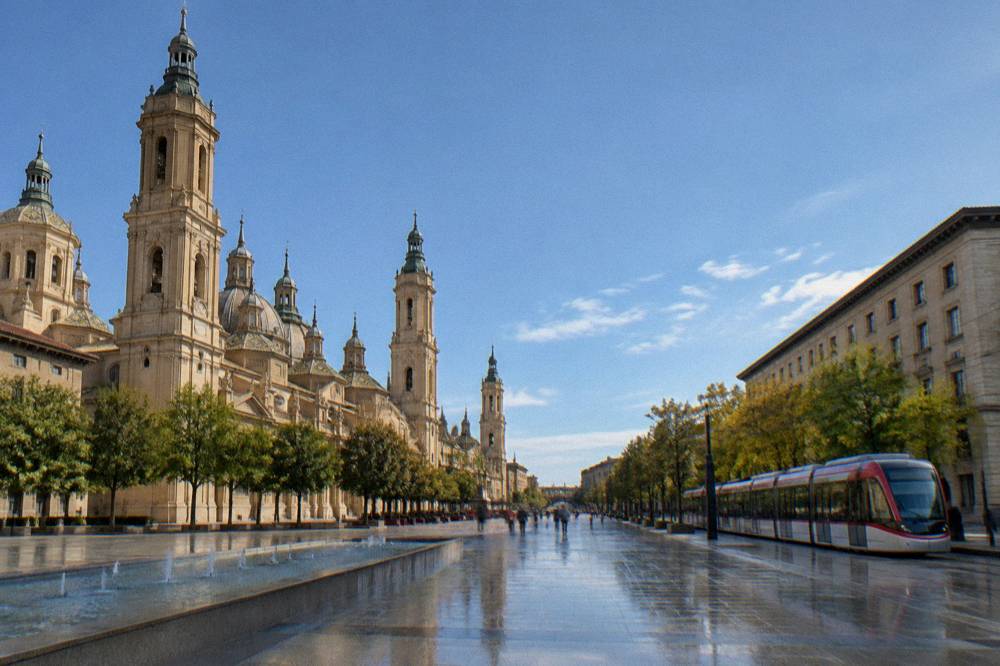
The Aljaferia Palace sits west of Zaragoza's old town, reached from the centre by the city's tram line toward the parliament stop, by urban bus, or on foot in a walk of roughly half an hour from Plaza del Pilar. A single tram or bus ticket costs 1.70 EUR, or 0.55 EUR with a Tarjeta Bus, and the card itself costs 7 EUR and works on both bus and tram.
The tram is the straightforward option from the centre. The urban fare table for 2026 lists the single at 1.70 EUR and the Tarjeta Bus rate at 0.55 EUR, with the card sold at 7 EUR and valid across bus and tram. Night buses cost 1.00 EUR a single. Visitors staying near the Paseo de la Independencia or the Ebro can also walk, crossing the later grid of streets west toward the palace, which stands in its own grounds with the parliament buildings around it.
| Way of getting there | Cost | Notes |
|---|---|---|
| Tram single | 1.70 EUR | Urban fare, 2026 |
| Tram with Tarjeta Bus | 0.55 EUR | Card costs 7 EUR, valid bus and tram |
| Bus single | 1.70 EUR | Same fare as tram |
| Night bus single | 1.00 EUR | Night lines |
| On foot from Plaza del Pilar | Free | Roughly half an hour west |
Drivers should know about the city's low emission zone. The ZBE Casco Historico operates Monday to Friday from 08:00 to 20:00, with sanctions in force since 12 December 2025, and vehicles without a DGT environmental label are restricted; a 15-minute grace period applies if you enter by mistake. The zone covers the historic centre rather than the palace's immediate surroundings, but anyone parking near the old town and walking or taking the tram out to the palace should check their label first.
Should You Take A Guided Tour Of The Aljaferia?
Yes, if you want the history explained rather than just seen: the palace's own Spanish-language guided tours run daily at 10:30, 12:30, 13:30, 15:00 and 16:00, cost 9 EUR, and the "Goya, del Museo al Palacio" exhibition tour runs at 11:30. Operator-led guided visits that include the ticket start from 24.76 USD per person, and the best-rated of them, from 4.8 out of 103 reviews, runs in Spanish with the ticket included.
The palace's own tour times are fixed, and the tour is in Spanish, which is the deciding factor for many visitors. If you speak Spanish, the 9 EUR palace tour is the cheapest way to get a guided hour of history. If you do not, an operator-led visit is the alternative, and the two Aljaferia products below are the strongest options: one pairs a Spanish-language guided tour with the ticket, the other offers a ticket with a guided visit.
The listing for that tour shows a 2-hour visit from 24.76 USD per person, rated 4.8 from 103 reviews. A visitor who prefers a fuller city context can instead take a private walk that includes the palace among the old town's other monuments, and the private walking options run from about 50 USD per person upward. Check availability if a private guide fits your group better than a fixed-time palace tour.
| Guided option | Times | Price |
|---|---|---|
| Palace Spanish guided tour | 10:30, 12:30, 13:30, 15:00, 16:00 | 9 EUR |
| "Goya, del Museo al Palacio" tour | 11:30 | Included with guided visit |
| Operator tour with ticket, Spanish | Bookable slots | From 24.76 USD per person |
| Operator ticket and guided visit | Bookable slots | From 24.76 USD per person |
That second Aljaferia product, a ticket with a guided visit from 24.76 USD per person, is rated 4.7 from 82 reviews and runs about 2 hours. Both operator products should be booked through the operator's live listing, where current times and availability are shown.
When Is The Best Time To Visit The Aljaferia?
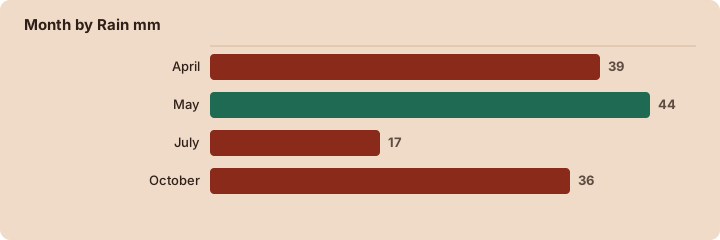
The best time to visit the Aljaferia is a weekday morning close to the 10:00 opening, or any Monday or 1st or 3rd Sunday when entry is free, and the palace is at its most crowded during the Fiestas del Pilar, which run from 10 to 18 October 2026. October's average high in Zaragoza is 21.4 C with 36 mm of rain across 5.4 rain days, so weather rarely decides the question.
AEMET's 1981 to 2010 normals for the Zaragoza Aeropuerto station put October's mean maximum at 21.4 C and its mean minimum at 11.0 C, with 36 mm of rain over an average of 5.4 days of 1 mm or more. Those are mild, mostly dry conditions, and the palace's interiors are the main event anyway, so rain matters less here than at the Ebro-river walks and terraces. Summer visitors should note that July, the hottest month on the same normals, carries a mean maximum of 32.4 C, which makes the palace's thick-walled interiors one of the city's more comfortable July stops.
| Month | Mean max C | Mean min C | Rain mm | Rain days 1 mm+ |
|---|---|---|---|---|
| April | 19.6 | 7.9 | 39 | 5.7 |
| May | 24.1 | 11.8 | 44 | 6.4 |
| July | 32.4 | 18.3 | 17 | 2.6 |
| October | 21.4 | 11.0 | 36 | 5.4 |
The figures are the 1981 to 2010 averages for the Zaragoza Aeropuerto station. Within any given week, the practical timing advice is simpler: go early, avoid the free-entry days if you dislike crowds, and remember that last access is 45 minutes before the 18:00 close.
How Does The Aljaferia Compare With Zaragoza'S Other Big Monuments?
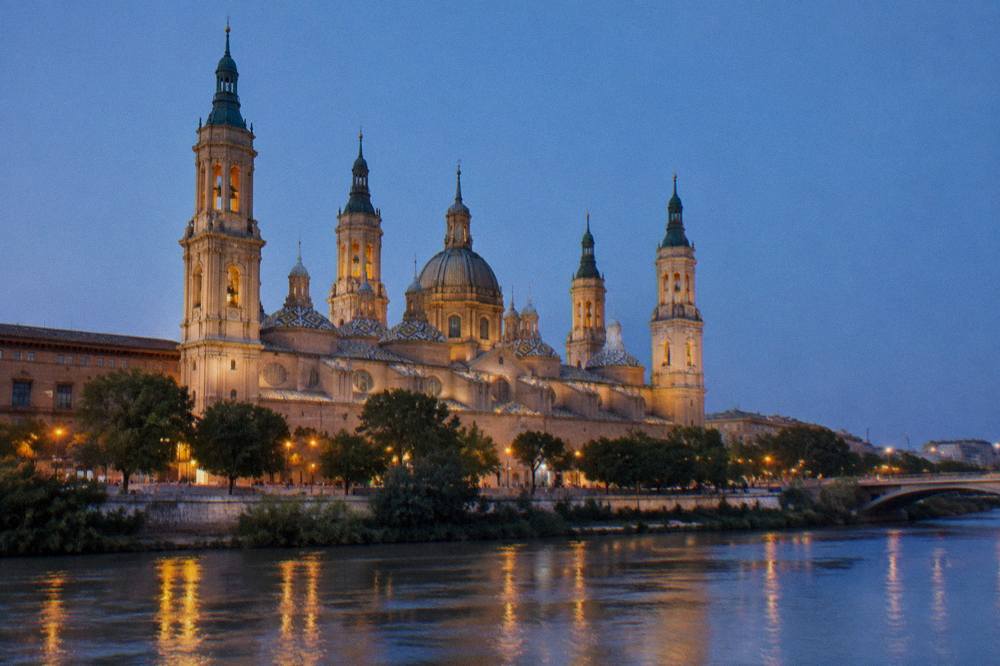
The Aljaferia, the Basílica del Pilar and La Seo are the city's three essential monuments, and they complement rather than duplicate each other: the palace for Islamic and Mudejar architecture, the Pilar for Baroque scale and free entry to the temple, and La Seo for a Gothic cathedral whose Mudejar apse, parroquieta and cimborio are themselves UNESCO-listed. Entry to the Pilar temple is free, La Seo costs 10 EUR including four museums, and the palace costs 7 EUR.
A first-time visitor with one full day can manage all three. The Pilar's temple is free to enter, its tower viewpoint costs 6 EUR for an adult, and its hours run late into the evening. La Seo charges 10 EUR general, a ticket that also includes the Museo de Tapices, the Museo Pilarista and the Rosario de Cristal, with free entry for Aragon residents on the 6th, 12th, 23rd and 27th of the month. The palace, as covered above, is 7 EUR general and free on Mondays and the 1st and 3rd Sundays.
| Monument | Entry cost | The one thing it does best |
|---|---|---|
| Aljaferia Palace | 7 EUR general | Islamic and Mudejar palace architecture |
| Basílica del Pilar | Temple free, tower 6 EUR | Baroque scale, tower viewpoint over the Ebro |
| La Seo | 10 EUR, four museums included | Mudejar apse, parroquieta and cimborio, UNESCO-listed |
The Pilar's own tower viewpoint and the riverside walk across the Puente de Piedra are covered in the Basílica del Pilar tower guide and the Ebro river walk, and the Roman layer of the city, the forum, theatre, river port and baths, is covered across the Roman Caesaraugusta pages. One caution for museum planners: the Museo de Zaragoza's central building is closed for Ministry of Culture works with no reopening date, so it should not be on an itinerary, and the Museo Pablo Gargallo is temporarily closed.
What Should You Know Before You Go To The Aljaferia?
Before you go, know the essentials: the palace is open daily in October from 10:00 to 18:00 with last access 45 minutes before closing, general admission is 7 EUR and a guided visit 9 EUR, the palace's own tours are in Spanish, tickets are sold through the palace's ticketing page, the tram reaches the palace from the centre for 1.70 EUR a single, and the surviving Mudejar features of the palace are UNESCO-listed as part of Mudejar Architecture of Aragon.
Buy tickets in advance if you are coming during the Fiestas del Pilar, when the city fills for the Ofrenda de Flores on 12 October and the celebrations that run from 10 to 18 October 2026. The palace remains open through that period, but the free Mondays and Sundays will be busy, and the operator-led visits with tickets included are the surest way to secure a slot at a fixed time. Outside festival week, a same-day ticket at the window is usually straightforward.
Plan the palace as a half-day block: the tram out, one to two hours inside, and the walk or tram back through the grid of streets toward the old town, where an evening in El Tubo or a tapas walk finishes the day. Visitors with more time can pair the palace with the Parque del Agua and Expo site to the north-west, which turns the palace into the first stop of a western Zaragoza circuit rather than an out-and-back detour.
Common Questions About The Aljaferia Palace
What are the Aljaferia Palace opening hours?
The palace is open daily in October from 10:00 to 18:00, with last access 45 minutes before closing. Seasonal changes are announced on the palace's ticketing page, so check current hours there before a visit outside October.
How much does it cost to visit the Aljaferia Palace?
General admission is 7 EUR and a guided visit is 9 EUR. Students, visitors over 65 and Carnet Joven holders pay 2 EUR, children under 12 enter free, and a ticket bought with the Zaragoza tourist bus costs 4 EUR. Entry is free on the 1st and 3rd Sunday and every Monday of the month.
Is the Aljaferia a UNESCO World Heritage Site?
The surviving Mudejar features of the Aljaferia Palace are one of the three Zaragoza components of the UNESCO World Heritage property Mudejar Architecture of Aragon, inscribed in 1986 and extended in 2001. UNESCO lists the Mudejar parts of the palace, not the whole building. The other Zaragoza components are the tower and parish church of San Pablo and the apse, parroquieta and cimborio of La Seo.
What can you see inside the Aljaferia?
The visitor route covers the taifa-era courtyard with its interlaced arches and carved stucco, the oratory, the restored upper Islamic structure, the Christian-era rooms, the Catholic Monarchs' floor and the temporary exhibition "Goya, del Museo al Palacio". A full circuit takes most visitors between one and two hours.
How do you get to the Aljaferia from Zaragoza city centre?
Take the tram toward the parliament stop, or an urban bus, or walk roughly half an hour west from Plaza del Pilar. A single tram or bus ticket costs 1.70 EUR, or 0.55 EUR with a Tarjeta Bus, and the card costs 7 EUR and works on both bus and tram.
Are guided tours of the Aljaferia in Spanish only?
The palace's own guided tours, at 10:30, 12:30, 13:30, 15:00 and 16:00, are in Spanish, as is the "Goya, del Museo al Palacio" exhibition tour at 11:30. Operator-led visits with the ticket included can be booked in advance through the operator's live listing.
Whether you come for the arches, the UNESCO-listed Mudejar fabric or simply the quietest great monument in one of Spain's most underrated cities, the Aljaferia Palace repays the tram ride west, and it belongs on any Zaragoza itinerary that also takes in the Pilar, La Seo and the Roman remains under the old town.