Roman Caesaraugusta: The Ancient Roman Sites Of Zaragoza
Zaragoza, the capital of Aragon on the Ebro, was Caesaraugusta, a Roman colony, and four municipal museums now display its forum, theatre, river port and baths.
Short answer
Roman Zaragoza survives in four municipal museums, the Foro, the Teatro, the Puerto Fluvial and the Termas, plus stretches of wall and a Roman-era crossing under the Puente de Piedra. A combined four-museum ticket costs 7 EUR, individual entries are 3 to 4 EUR, and every site is free on the first Sunday of the month.
Zaragoza, the capital of Aragon on the Ebro in north-eastern Spain, wears its Roman past closer to the surface than almost any city in the country. Under the name Caesaraugusta it was a full Roman colony, and the modern city centre is built directly on top of it. Excavation has left four separate municipal museums within a short walk of one another: the forum, the theatre, the river port and the baths, each one preserving a different layer of the ancient city in place, beneath the streets. The stones are not fenced off in a field outside town; they sit under the Paseo de la Independencia, beside the Basílica del Pilar, next to the La Seo cathedral. This guide covers what each site holds, what entry costs, when everything is free, and how to fit the whole Roman layer of the city into a single day.
What Was Caesaraugusta, The Roman City Under Zaragoza?
Caesaraugusta was a Roman colony founded on the Ebro, and it gave the modern city both its name and its street plan. Zaragoza is the Arabic-era pronunciation of Caesaraugusta, so the Roman name never left, it simply changed language. The colony grew wealthy on river trade along the Ebro, and today four municipal museums preserve its forum, theatre, river port and baths exactly where the Romans built them, under and beside the modern streets.
The name is the first thing to understand, because it explains why Roman Zaragoza is everywhere and nowhere at once. A visitor standing in the Plaza del Pilar is standing inside the footprint of the ancient city. The answer to what the ancient Roman ruins in Zaragoza Spain are is not one monument but a scattered field of them, and the city has handled that scattering in an unusual way: instead of moving finds to a single building, it has roofed each excavation where it lies and turned it into its own museum.
That decision shapes a visit. There is no single "Roman Zaragoza" ticket desk in one place, though a combined ticket does exist. You move between four small sites, each with its own entrance, its own hours and its own slice of the story: politics at the forum, entertainment at the theatre, commerce at the river port, daily life at the baths. The walk between them is itself part of the experience, because the route crosses the old town that grew out of the colony.
Which Roman Sites Can You Visit In Zaragoza Today?
Four municipal museums make up the Caesaraugusta route: the Foro (forum), the Teatro (theatre), the Puerto Fluvial (river port) and the Termas (baths), plus surviving stretches of the Roman walls. All four open Tuesday to Saturday from 10:00 to 14:00 and 17:00 to 21:00, and on Sundays and public holidays from 10:00 to 14:30, per the municipal October timetable. Individual entry is 4 EUR for the forum and 3 EUR for the baths and river port.
The four sites sit inside the old town, so a visit is a walk, not a commute. The Roman Forum Museum lies beneath the Paseo de la Independencia, the city's main promenade, where the sewer and the paving of the forum's porticoed square survive in place. The Roman Theatre Museum is a few minutes away toward the river, its seating built into a modern shell so the cavea can be climbed and viewed from above. The Roman River Port Museum sits near the Ebro and preserves the stone wharf where goods were landed, and the Roman Baths and Walls complete the set with the bathing rooms and the defensive circuit that once enclosed the colony.
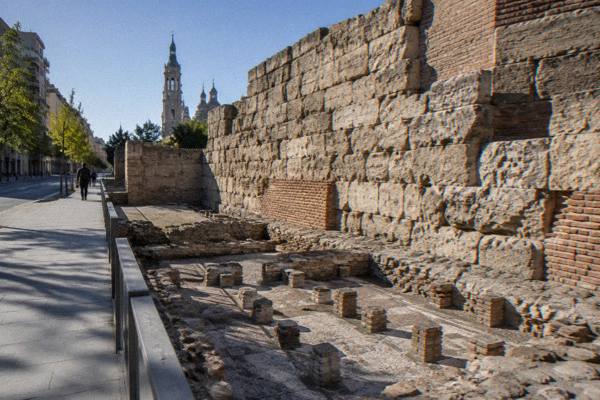
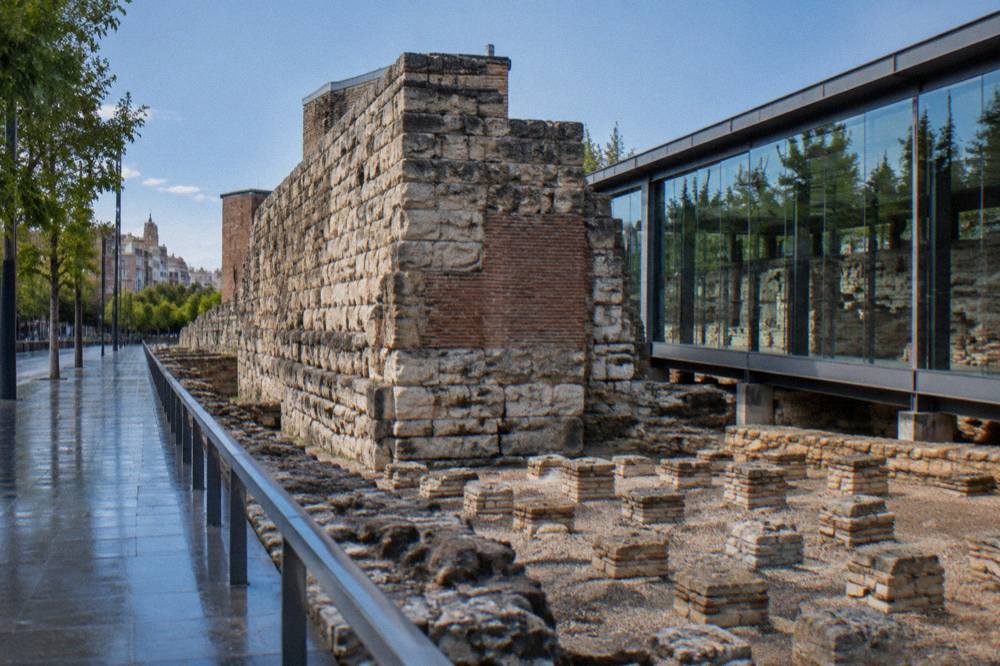
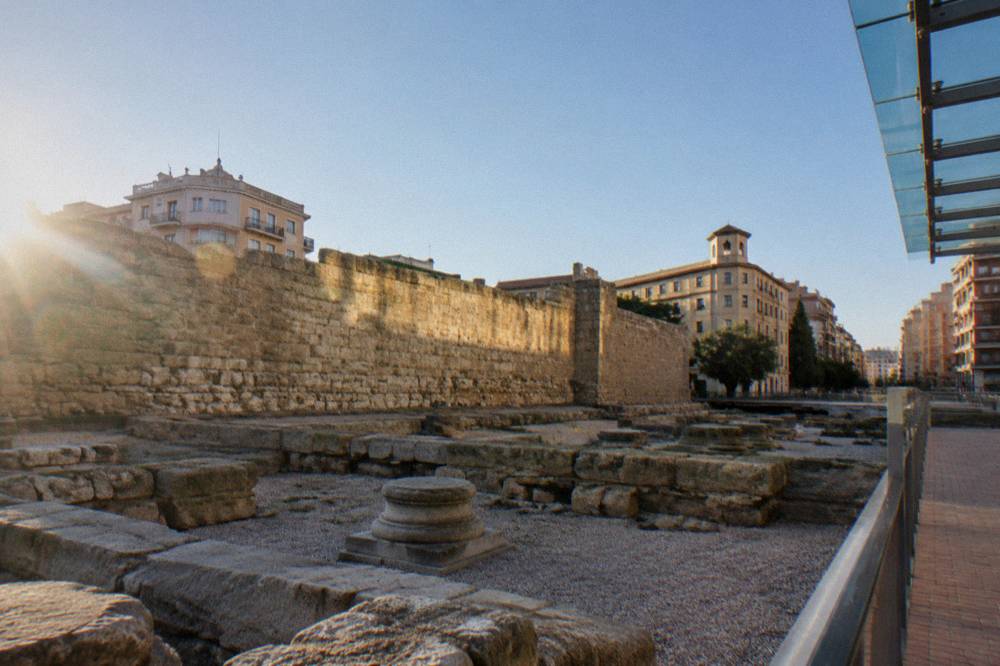
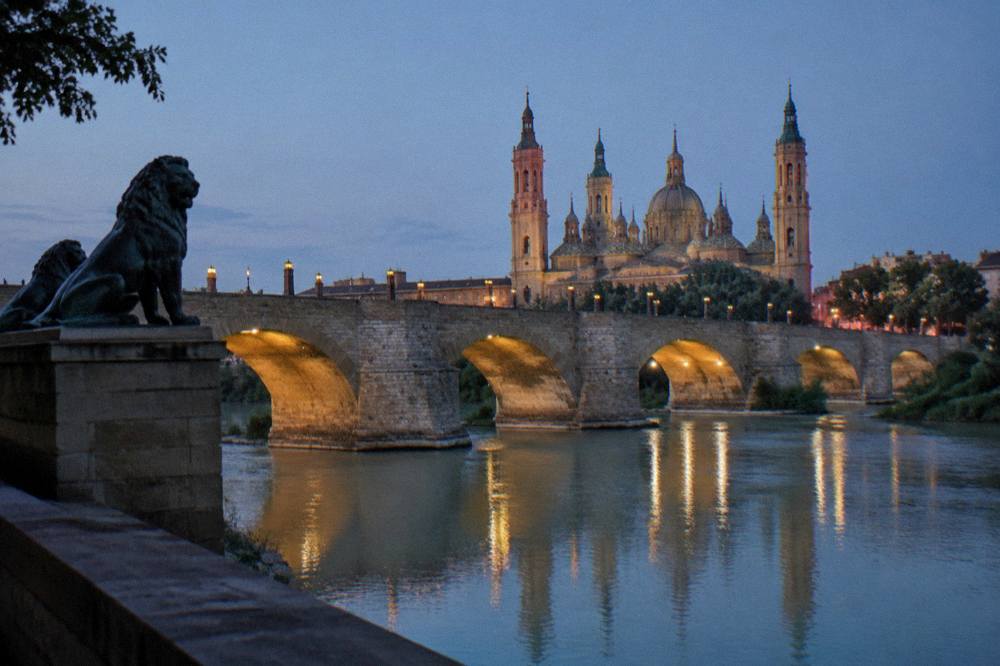
The walls deserve a separate word, because they are not a museum in the same sense. Stretches of the Roman defensive wall still stand in the open air around the old town, free to see from the street at any hour, and they connect the Roman story to the later city the way few inland Spanish cities can match. The Puente de Piedra, the stone bridge that now carries pedestrians across the Ebro, stands on the line of a Roman-era crossing; the current bridge dates from 1401 and opened in 1440, but the Romans crossed the river on the same alignment.
For orientation, a guided walk is the most efficient way to link the four museums and the outdoor remains into one narrative. The Monumental Walking Tour in Old Town of Zaragoza, from $97.47 per person and rated 4.9 from 15 reviews, covers the monumental core on foot, and Check availability if you want the Roman layer explained rather than just seen.
How Much Do The Caesaraugusta Museums Cost In 2026?
Entry to the four Caesaraugusta museums is 4 EUR for the forum and 3 EUR each for the baths and the river port, with the theatre covered by the same municipal ticketing, and a combined four-museum bono costs 7 EUR, or 5 EUR reduced. Every one of the four is free on the first Sunday of the month. Hours are Tuesday to Saturday 10:00 to 14:00 and 17:00 to 21:00, and Sundays and public holidays 10:00 to 14:30.
The bono is the obvious buy for anyone planning more than one site: 7 EUR against a maximum of 13 EUR bought separately. Tickets are sold through the municipal museums platform, museos-cultura.zaragoza.es, and the same platform handles the reduced 5 EUR rate. The first-Sunday rule is the budget traveller's best friend in this city, and it stacks with the free-entry days at other municipal museums, so a well-timed Sunday can take in the Roman route and more without spending anything at all.
| Site | Individual entry | Included in 7 EUR bono | Hours Tue-Sat | Sun and holidays |
|---|---|---|---|---|
| Foro (Roman Forum) | 4 EUR | Yes | 10:00-14:00, 17:00-21:00 | 10:00-14:30 |
| Termas (Baths) | 3 EUR | Yes | 10:00-14:00, 17:00-21:00 | 10:00-14:30 |
| Puerto Fluvial (River Port) | 3 EUR | Yes | 10:00-14:00, 17:00-21:00 | 10:00-14:30 |
| Teatro (Theatre) | Via bono or municipal ticketing | Yes | 10:00-14:00, 17:00-21:00 | 10:00-14:30 |
One caution for October visitors: not everything municipal is open. The central building of the Museo de Zaragoza on Plaza de los Sitios is closed for Ministry of Culture works with no reopening date, and the Palacio de Sástago and the Museo Pablo Gargallo are also shut this month. The four Caesaraugusta museums, by contrast, are open and running their normal timetable.
What Can You See At The Museo Del Foro De Caesaraugusta?
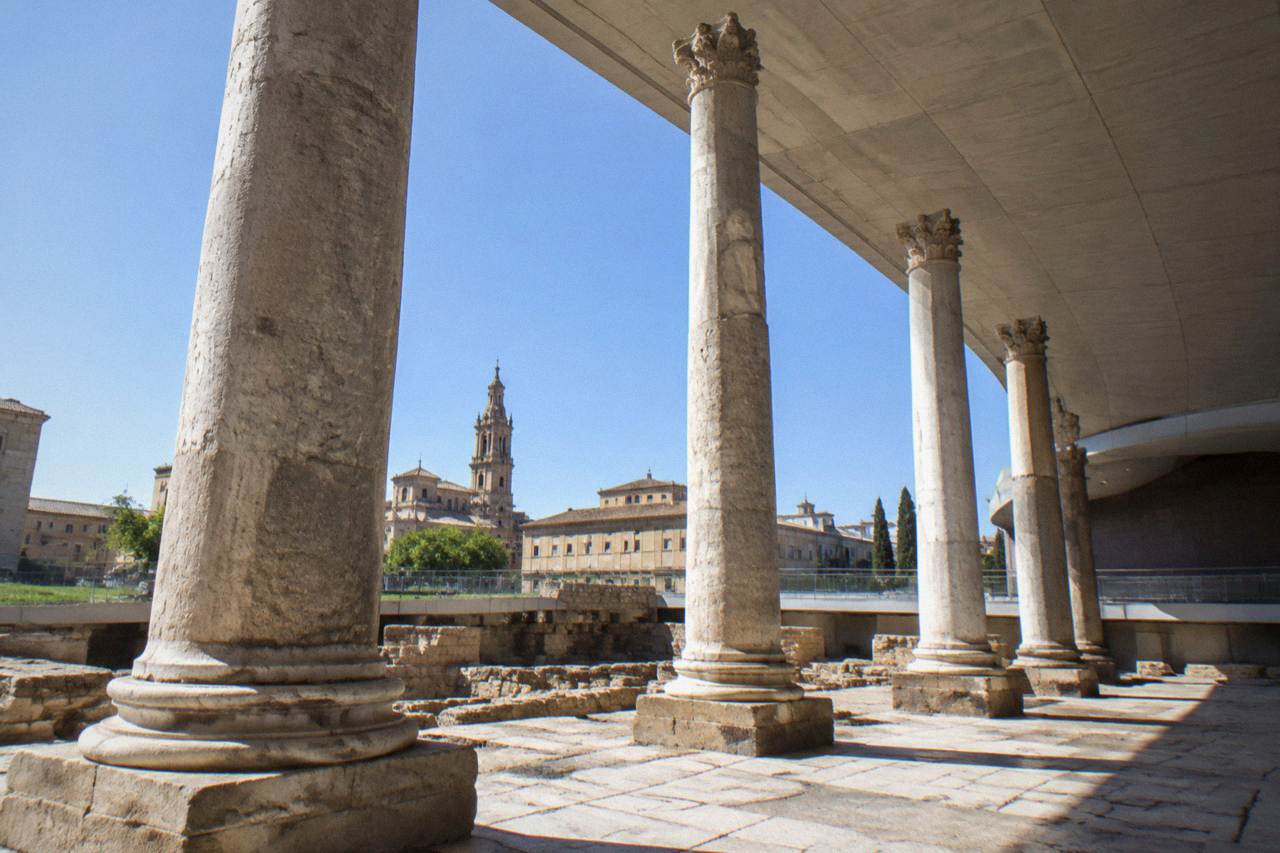
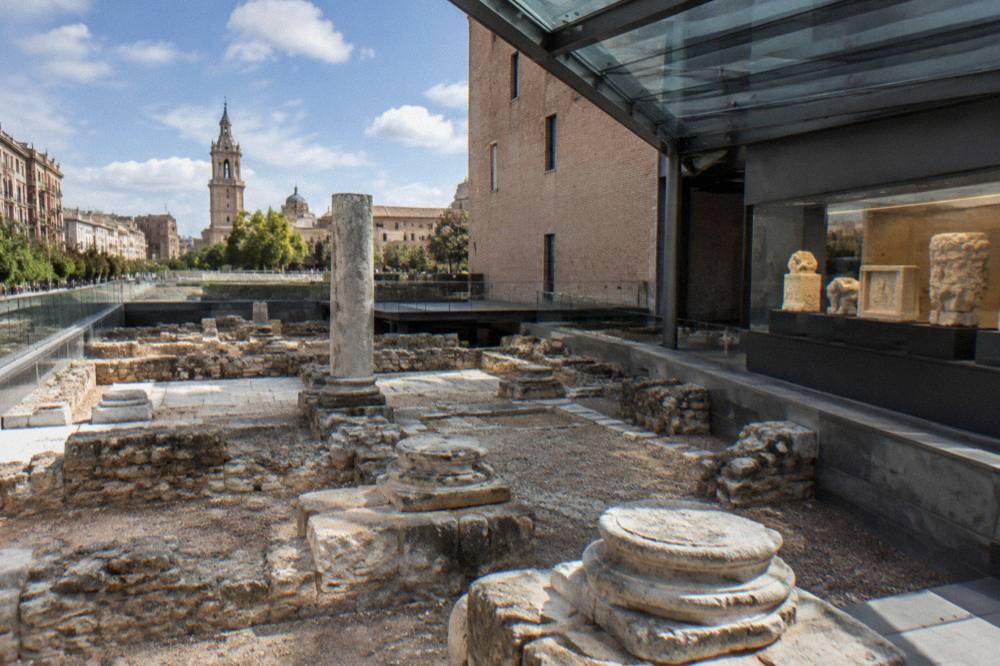
The Forum Museum preserves the excavated heart of Roman civic life beneath the Paseo de la Independencia: the great cloaca, the sewer that drained the forum, the paving of the porticoed square, and the bases of shops that lined it, all displayed in place under the modern promenade. Entry is 4 EUR, the highest single ticket of the four sites, or included in the 7 EUR bono.
It opens Tuesday to Saturday 10:00 to 14:00 and 17:00 to 21:00, and Sundays and holidays 10:00 to 14:30.
The pleasure of this museum is the vertigo of it. You descend from one of the busiest shopping streets in Aragon and stand inside a sewer the Romans cut to keep their forum dry, then walk the actual paving of the square where the colony's public business was done. The museum's display keeps the excavation visible rather than reconstructed, so the relationship between the ancient street level and the modern one is something you can see with your own eyes rather than read off a panel.
Because the forum sits at the top of the old town's slope, it is the natural first stop of a Roman-themed walk: from here the route runs downhill past the theatre toward the river port and the Ebro, which is roughly the direction the colony itself faced. Give it the better part of an hour; the interpretive material rewards slow reading, and the site rewards standing still and looking down.
What Is Inside The Roman Theatre Museum Of Zaragoza?
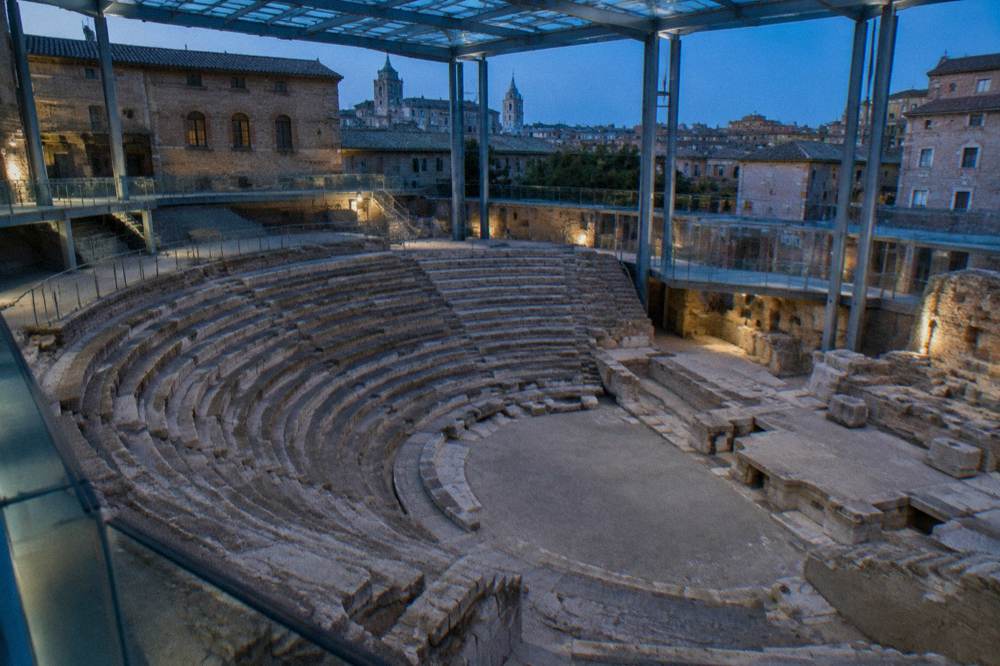
The Theatre Museum encloses the excavated cavea of Roman Caesaraugusta's entertainment venue inside a modern building, so visitors can climb through the seating tiers and view the stage area from above. The site is part of the four-museum Caesaraugusta ticketing, included in the 7 EUR bono or 5 EUR reduced, and it keeps the same hours as the other three: Tuesday to Saturday 10:00 to 14:00 and 17:00 to 21:00, Sundays and holidays 10:00 to 14:30.
The theatre is the most theatrical of the four museums in a literal sense: the modern shell was built around the ruins so that the experience of moving through the seating survives. The design decision matters, because a theatre is architecture for bodies in motion, and reading about it flat on a panel conveys far less than walking the tiers. The museum places the Roman building in the context of the city that grew over it, which is the recurring theme of every Caesaraugusta site. More of these guides are collected on Zaragoza Travel Guide.
Its location, close to the Basílica del Pilar and the Plaza del Pilar, makes it the easiest of the four to fold into a general sightseeing day. A visitor walking from the basilica to the La Seo Cathedral passes within a block or two of it, and the pairing is a neat lesson in how the Christian city literally raised itself on the entertainment quarter of the pagan one.
What Do The River Port And The Baths Museums Show?
The River Port Museum preserves the stone wharf where goods were unloaded from the Ebro in Roman times, and the Baths Museum preserves the bathing rooms of the colony, and together they cover the commercial and domestic halves of Roman Caesaraugusta. Each costs 3 EUR, both are in the 7 EUR bono, and both keep the shared municipal timetable, Tuesday to Saturday 10:00 to 14:00 and 17:00 to 21:00, Sundays and holidays 10:00 to 14:30.
The river port is the site that explains why the colony existed at all. Caesaraugusta sat where it sits because the Ebro was a working artery, and the Puerto Fluvial keeps the landing structures in view close to the modern bank. Standing there, the river stops being scenery and becomes infrastructure, the reason a Roman town was planted on this stretch in the first place. The Ebro river walk today follows the same water that carried the colony's trade.
The baths, a short walk away, show the other half of Roman life: the routine of hot and cold rooms that structured the day of every town that could afford them. The museum preserves the rooms themselves, so the sequence of the bathing circuit can be walked rather than imagined. Between the port and the baths you have commerce and leisure, and combined with the forum's politics and the theatre's entertainment, the four museums assemble a nearly complete picture of how a mid-sized Roman colony actually functioned.
Can You See Roman Zaragoza For Free?
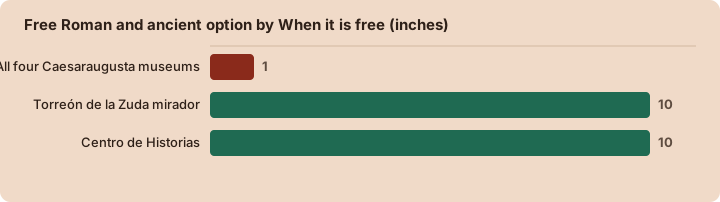
Yes, and more of it than most visitors expect. All four Caesaraugusta museums are free on the first Sunday of the month, the surviving stretches of the Roman walls stand in the open street and cost nothing, and the Torreón de la Zuda, with the Mirador de las Cuatro Culturas on its fifth floor, is free too, open Monday to Saturday 10:00 to 14:00 and 16:30 to 20:00 and Sundays 10:00 to 14:00.
The Centro de Historias adds another always-free option, open Tuesday to Saturday 10:00 to 14:00 and 17:00 to 21:00 and Sundays 10:00 to 14:30, and its exhibitions place the Roman layer inside the city's longer story. The first Sunday of the month is the headline, but the outdoor Roman remains are the everyday free option, and they are genuinely good: the wall fragments around the old town can be photographed, touched and walked along at any hour, with no fence and no ticket. The Torreón de la Zuda adds a viewpoint on top, and its name, the "four cultures" mirador, is a fair summary of the city's whole pitch: Roman, Visigothic, Moorish and Christian layers stacked in one small centre.
For a fuller free-day plan, the free options can be combined with the Roman route, and the Aljafería Palace adds another free window: it opens free on the first and third Sunday and Monday of each month, 10:00 to 18:00 in October, though that is the Islamic-era layer of the city rather than the Roman one.
| Free Roman and ancient option | When it is free | What you see |
|---|---|---|
| All four Caesaraugusta museums | 1st Sunday of the month | Forum, theatre, river port, baths |
| Roman wall stretches | Always, in the open street | Standing wall fragments around the old town |
| Torreón de la Zuda mirador | Always free, Mon-Sat 10:00-14:00 and 16:30-20:00, Sun 10:00-14:00 | Fifth-floor view over the layered city |
| Centro de Historias | Always free, Tue-Sat 10:00-14:00 and 17:00-21:00, Sun 10:00-14:30 | City history exhibitions |
How Should You Fit Roman Zaragoza Into One Day?
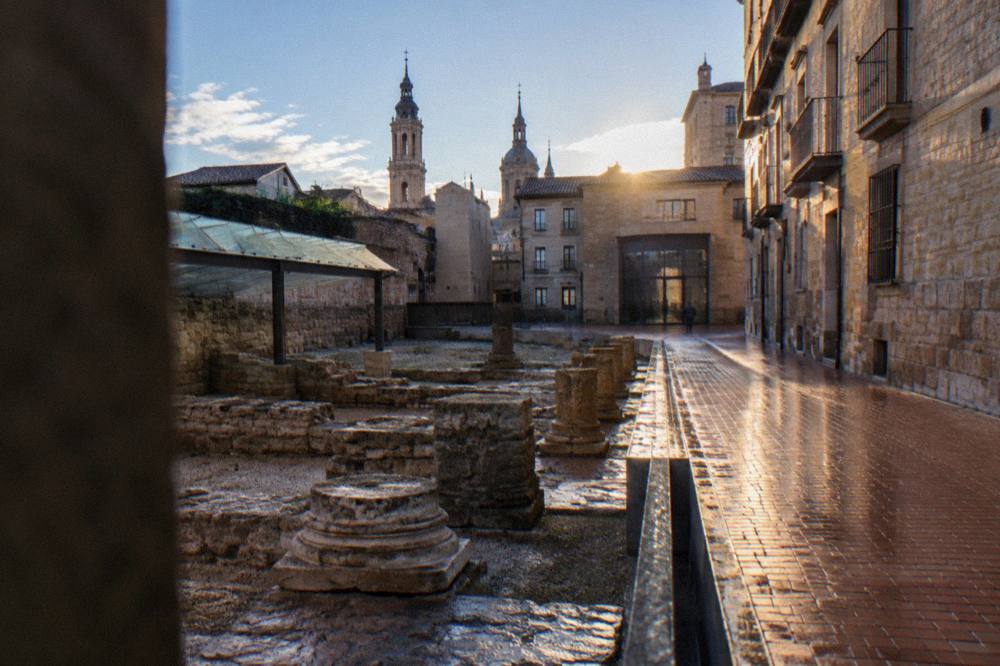
Start at the Forum Museum when it opens at 10:00, walk downhill to the Theatre Museum, then continue to the river port near the Ebro, break for lunch in the old town, and finish with the baths museum in the 17:00 to 21:00 evening session, using the 7 EUR bono throughout. That order follows the slope of the old town downhill toward the river, matches the museums' split-day timetable, and leaves the late afternoon for the free wall fragments and the Puente de Piedra at sunset.
The split timetable is the detail that makes or breaks a Roman day. The museums close at 14:00 and reopen at 17:00, so a visitor who arrives at 13:30 at the forum will get half a visit. Front-load the ticketed sites before lunch, use the closure for lunch and the outdoor remains, and return for one site in the evening session if anything is left over. On Sundays and holidays there is only the morning, 10:00 to 14:30, so the whole route compresses into the first part of the day.
| Time | Stop | Notes |
|---|---|---|
| 10:00 | Museo del Foro | Opens 10:00; buy the 7 EUR bono here |
| 11:15 | Museo del Teatro | Short downhill walk from the forum |
| 12:30 | Puerto Fluvial | Continue toward the Ebro |
| 14:00 | Lunch in the old town | Museums close; use the break |
| 16:00 | Wall fragments and Puente de Piedra | Free, outdoors, open all day |
| 17:00 | Museo de las Termas | Evening session, 17:00-21:00 |
A guided version of this day exists for visitors who would rather not self-direct. The Old Town Monumental Walk, from $97.47 per person and rated 4.9 from 15 reviews, strings the monumental old town together with a guide, and its live listing carries the current departure times and meeting point.
How Does Roman Zaragoza Compare With The Rest Of The City?
The four Caesaraugusta museums are the deepest layer of Zaragoza, but the same square kilometre also holds the Basílica del Pilar, whose temple is free to enter, La Seo cathedral at 10 EUR general admission including three further museums, and the Aljafería at 7 EUR general or 9 EUR with a guided tour, so a visitor can span two thousand years of building on foot in one day without leaving the old town.
The comparison is worth making because it is unusual. Few Spanish cities put a Roman forum, a Moorish palace and one of Europe's great baroque basilicas within the same walk. The Aljafería, open daily 10:00 to 18:00 in October, is the Islamic-era counterpart to the Roman museums, and the Basílica del Pilar towers over the theatre's remains a few streets away. Its tower viewpoint, the Torre Mirador, costs 6 EUR for an adult if you want the whole layered city laid out beneath you.
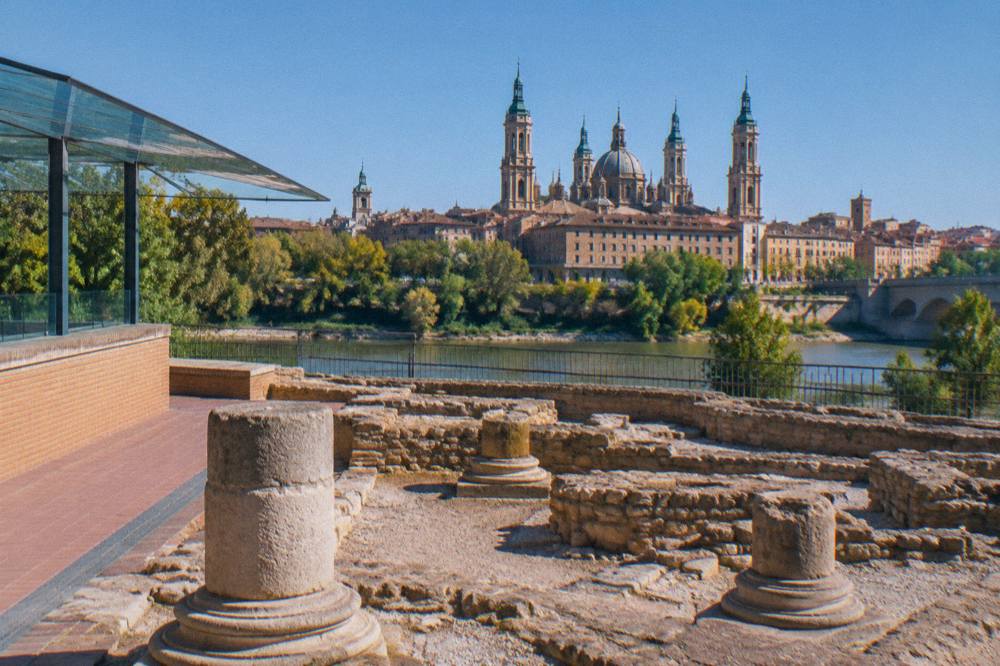
One honest note on the Pilar itself: the dome known as the Regina Patriarcharum has been under restoration since the agreement of 23 January 2026, funded by Fundación Ibercaja, with a planned run of around six months, but its completion is not confirmed, so check the basilica's own notices before counting on a clear view of the dome's frescoes.
Is Roman Zaragoza Worth It For Visitors Short On Time?
For most visitors with only half a day, yes: the Theatre and the Forum are the two sites that repay a tight schedule most, and the bono at 7 EUR makes adding the other two cheap. If time allows only one, the theatre is the most dramatic single space, but the forum tells you more about how the colony worked. The free wall fragments and the Puente de Piedra cost nothing and can be seen in twenty spare minutes between other sights.
The Roman layer of the city rewards curiosity more than it rewards stamina. None of the four museums is large, and none demands more than an hour. What they demand is that you connect them, and that is where the old town itself does the work: the walks between the sites pass through the El Tubo quarter and the Plaza del Pilar, so the ancient and the modern keep interrupting each other in a way that a purpose-built archaeological park never manages.
Common Questions About Roman Zaragoza
What are the ancient Roman ruins in Zaragoza, Spain?
Zaragoza was the Roman colony of Caesaraugusta, and its ruins survive in four municipal museums: the forum, the theatre, the river port and the baths, plus open-air stretches of the Roman wall around the old town.
How much do the Roman museums in Zaragoza cost?
The forum costs 4 EUR, the baths and the river port 3 EUR each, and a combined four-museum bono costs 7 EUR, or 5 EUR reduced, per the municipal October timetable. All four are free on the first Sunday of the month.
What are the opening hours of the Caesaraugusta museums?
Tuesday to Saturday 10:00 to 14:00 and 17:00 to 21:00, and Sundays and public holidays 10:00 to 14:30, according to the municipal monument timetable. They are closed on Mondays outside holiday periods.
Can you see Roman Zaragoza for free?
Yes. The four museums are free on the first Sunday of the month, the Roman wall fragments stand in the open street at any hour, and the Torreón de la Zuda with its Mirador de las Cuatro Culturas is always free.
Where do you buy tickets for the Caesaraugusta museums?
Through the municipal museums platform, museos-cultura.zaragoza.es, which handles individual entries and the 7 EUR four-museum bono.
Is the Roman theatre in Zaragoza worth visiting?
It is the most dramatic of the four sites: the modern museum shell lets you climb through the excavated seating tiers and view the stage from above, and it is included in the four-museum bono.
For a deeper look at any single site, start with the dedicated pages on the Roman Forum Museum, the Roman Theatre Museum, the Roman River Port Museum and the Roman Baths and Walls, and let Zaragoza Travel Guide handle the rest of the old town from there.