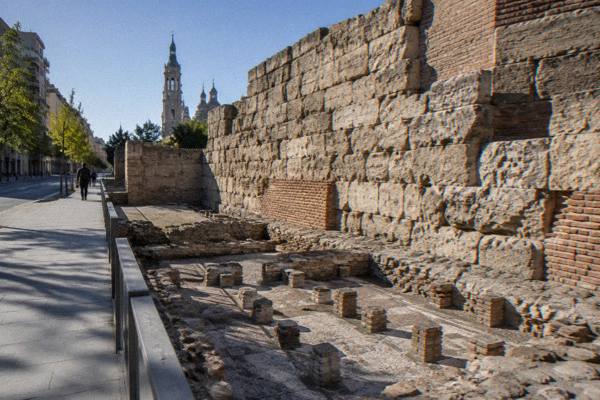
Roman Theatre Museum In Zaragoza: The Museum Of Caesaraugusta's Theatre
The Museo del Teatro de Caesaraugusta in Zaragoza, Spain, wraps a modern exhibition hall around the excavated remains of a Roman theatre, one of four municipal museums that together tell the story of the city the Romans called Caesaraugusta.
Short answer
The Roman Theatre Museum in Zaragoza is open Tuesday to Saturday 10:00-14:00 and 17:00-21:00, and Sunday and public holidays 10:00-14:30. It forms part of the four-museum Caesaraugusta bono at 7 EUR (5 EUR reduced), and entry is free on the first Sunday of the month.
The Roman Theatre Museum of Zaragoza, Spain, the capital of Aragon on the Ebro, is the most theatrical of the city's four Caesaraugusta museums: a modern exhibition space built around the excavated seating and stage of the theatre the Romans raised in the city they called Caesaraugusta. The museum sits in the heart of the old town, within a few minutes' walk of Plaza del Pilar, La Seo and the Puente de Piedra, and it belongs to the same municipal network as the Forum Museum, the River Port Museum and the Baths and Walls sites. Together those four museums piece together daily life in Roman Caesaraugusta, and the theatre is where the story becomes most vivid, because here you stand inside the ruin itself rather than looking at it through glass.
This page covers everything a visitor needs to plan a visit: opening hours and ticket prices from the municipality's October 2026 monument timetable, what the museum contains, how the four-museum bono works, how a visit fits with the other Roman sites described in Zaragoza's ancient Roman ruins, and which guided walks pass the theatre on their route through the old town.
What Is The Roman Theatre Museum In Zaragoza?
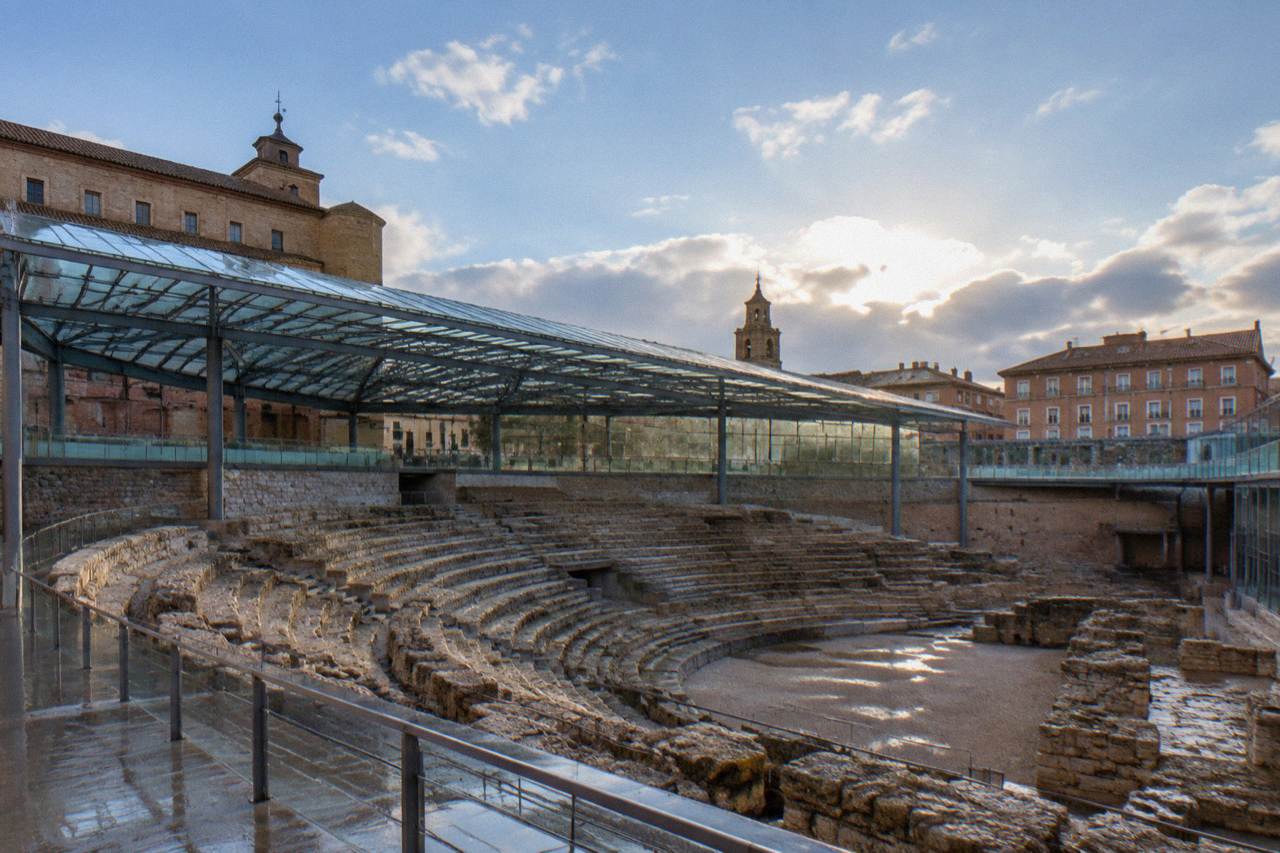
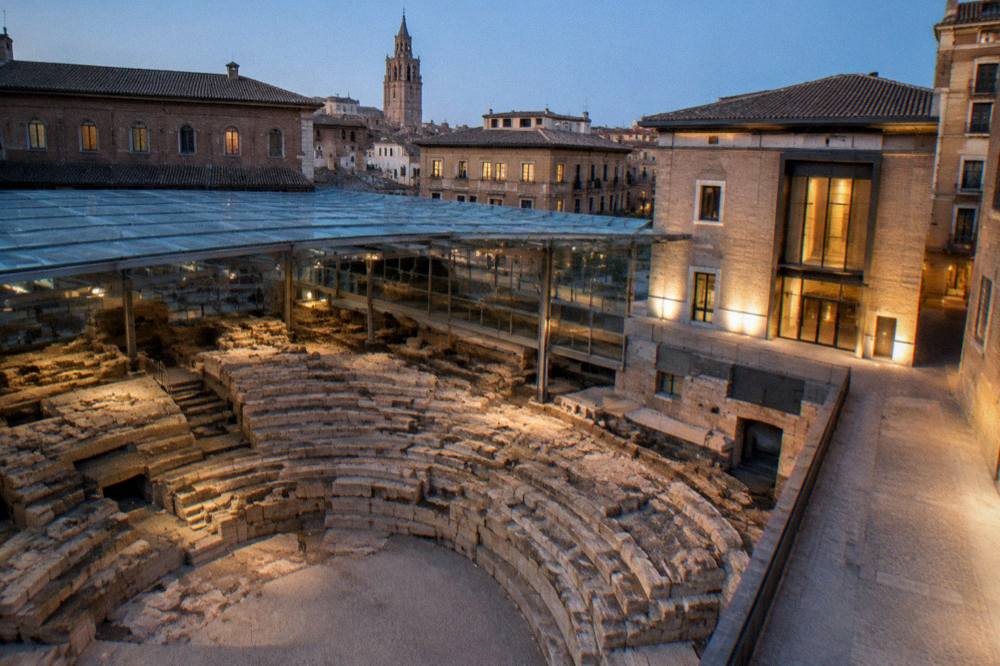
The Museo del Teatro de Caesaraugusta is a municipal museum in central Zaragoza that encloses the excavated remains of the Roman theatre of Caesaraugusta, presenting the ruin alongside displays on Roman performance, building techniques and the city's imperial past. It is one of four Caesaraugusta museums run by the city, and the theatre itself is the largest visible Roman structure in Zaragoza, displayed in situ rather than reconstructed elsewhere.
The museum belongs to the network of Roman sites that the municipality has excavated and opened across the old town, a network described in detail on the Caesaraugusta overview page. Where the Forum Museum shows the commercial and civic heart of the Roman city and the River Port Museum shows its river trade, the Theatre Museum shows its entertainment. The exhibition explains how the building worked, who performed in it, and how the seating was arranged, and it lets visitors walk along galleries that look directly into the excavated seating rows and stage area.
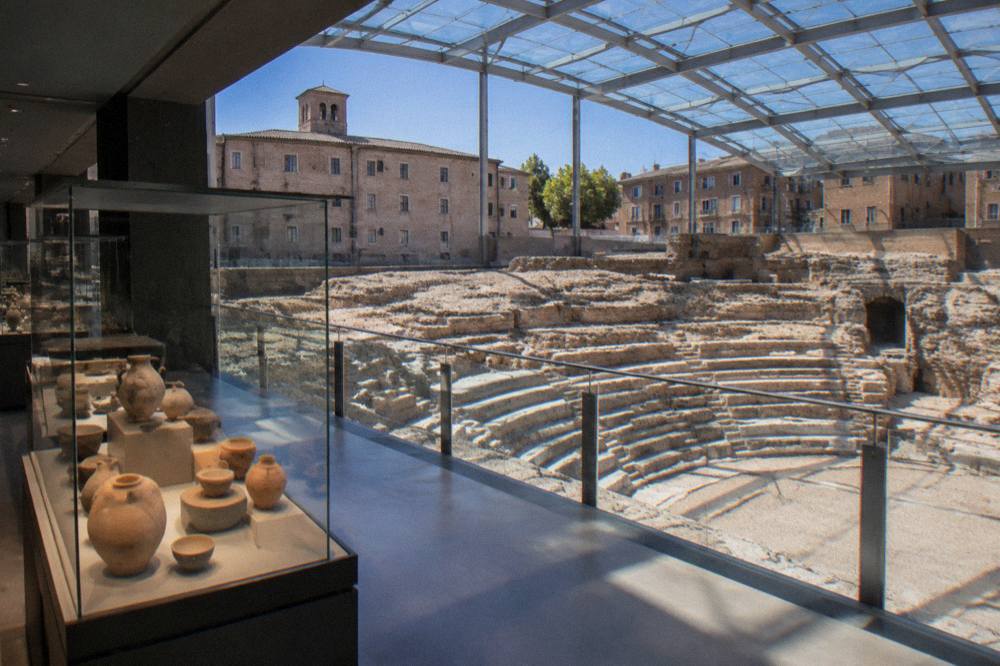
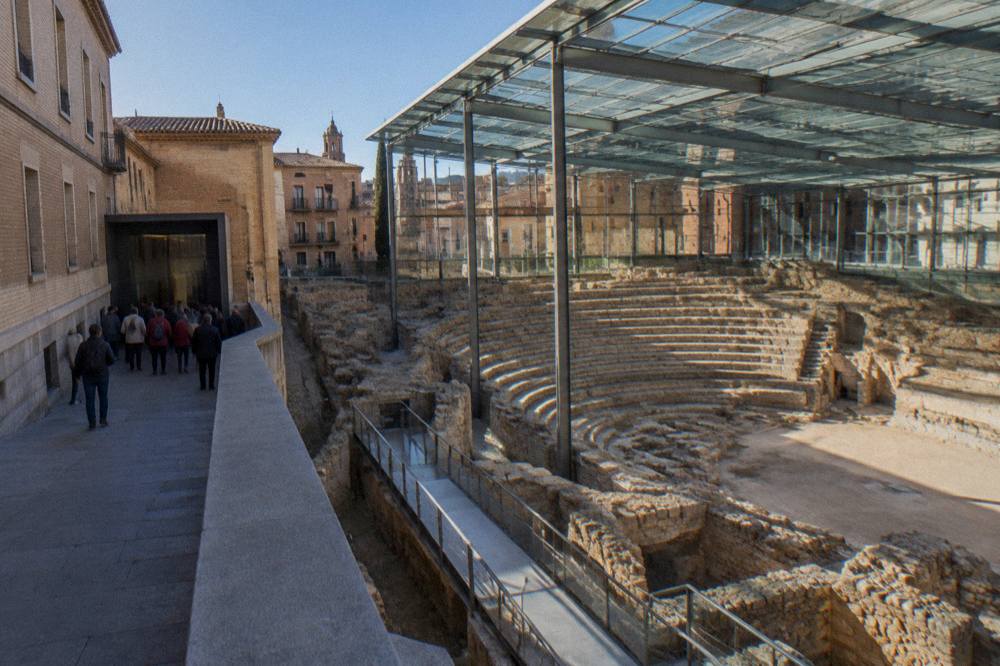
What makes the museum unusual among Spanish archaeological museums is the intimacy of the encounter. The ruin is not fenced off at a distance: the museum's interior routes are built around and above the remains, so the stone is continuously present as you move through the displays. The museum also treats the theatre as evidence of the city's rank. A theatre of this scale was a statement of Roman civic identity, a building type the empire planted in its most favoured cities.
Where Is The Roman Theatre Of Caesaraugusta?
The Roman Theatre Museum stands in Zaragoza's Casco Histórico, the old-town district between Plaza del Pilar and the Calle Mayor axis, a short walk from La Seo cathedral and the Puente de Piedra, and inside the ZBE low-emission zone that operates Monday to Friday 08:00-20:00 with sanctions since 12 December 2025.
The old town is compact and almost entirely walkable, which is why the theatre works so well as part of a loop rather than a standalone destination. A typical walking circuit takes in the Basílica del Pilar, La Seo cathedral, the theatre, the remains of the Roman walls and the river bank at the Puente de Piedra, all within the space of an afternoon. The full list of options sits on the things to do in Zaragoza page.
One planning point matters for drivers. The Casco Histórico is inside the city's ZBE low-emission zone, active Monday to Friday from 08:00 to 20:00, and vehicles without a DGT environmental label are restricted, with sanctions in force since 12 December 2025. The municipality publishes the rules and a fifteen-minute grace provision for drivers who enter by mistake. Visitors staying outside the centre and driving in should either check their vehicle's label or use public transport; the urban bus and tram single fare is 1.70 EUR, or 0.55 EUR with a Tarjeta Bus.
The theatre's central position also makes it a natural stop on a guided introduction to the city. The Zaragoza Must-See Attractions Walking Tour is a two-hour private walk that takes in the essential old-town monuments, and a guide who knows the site can point out details of the stonework that are easy to miss on a self-directed visit. Check availability on the operator's live listing if you want the Roman layer of the city explained rather than simply seen.
What Are The Roman Theatre Museum Opening Hours And Ticket Prices?
The Roman Theatre Museum opens Tuesday to Saturday from 10:00 to 14:00 and from 17:00 to 21:00, and on Sundays and public holidays from 10:00 to 14:30, with Monday as the weekly closing day. It is covered by the four-museum Caesaraugusta bono at 7 EUR, or 5 EUR reduced, and entry is free on the first Sunday of the month; tickets are sold through the municipal museums portal.
The municipality's October 2026 monument timetable lists the same hours for all four Caesaraugusta museums, the Forum, the River Port, the Baths and the Theatre, which makes multi-site planning straightforward. The individual site prices the timetable gives are 4 EUR for the Forum and 3 EUR each for the Baths and the River Port, with the theatre included in the four-museum bono at 7 EUR and 5 EUR reduced. If you plan to see more than two of the four sites, the bono is the better purchase on price alone.
| Ticket | Price | Notes |
|---|---|---|
| Four-museum Caesaraugusta bono | 7 EUR | Covers Foro, Puerto Fluvial, Termas and Teatro |
| Bono, reduced rate | 5 EUR | Reduced conditions as published by the museums |
| Forum Museum, individual | 4 EUR | Single-site ticket |
| Baths or River Port, individual | 3 EUR | Each, single-site ticket |
| First Sunday of the month | Free | All Caesaraugusta museums |
| Day | Hours |
|---|---|
| Monday | Closed |
| Tuesday to Saturday | 10:00-14:00 and 17:00-21:00 |
| Sunday and public holidays | 10:00-14:30 |
Two practical notes follow from the timetable. The midday break between 14:00 and 17:00 on weekdays is real, so a visit planned for early afternoon will find the doors shut; the morning block or the evening block is the choice. And the free first Sunday is popular, so if you visit then, arriving near the 10:00 opening gives the calmest hour inside the galleries.
What Do You See Inside The Roman Theatre Museum?
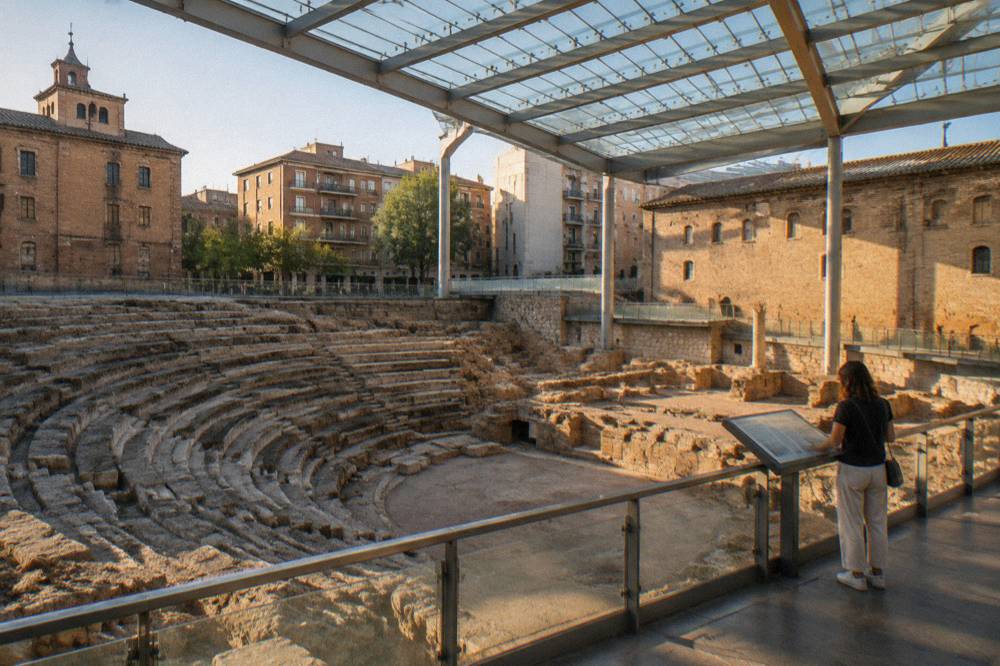
Inside, the museum walks you through the excavated theatre itself, the seating rows, stage structure and supporting masonry, together with interpretation on how Roman theatres functioned, what was performed in them, and how Caesaraugusta's building served its public, with the ruin visible from multiple levels of the interior galleries.
The route is built so that the archaeology does the talking. Display cases hold finds from the site and explanatory panels cover the building's architecture, but the centrepiece is the theatre's own stonework, seen from above and from the side as you descend or climb through the building.
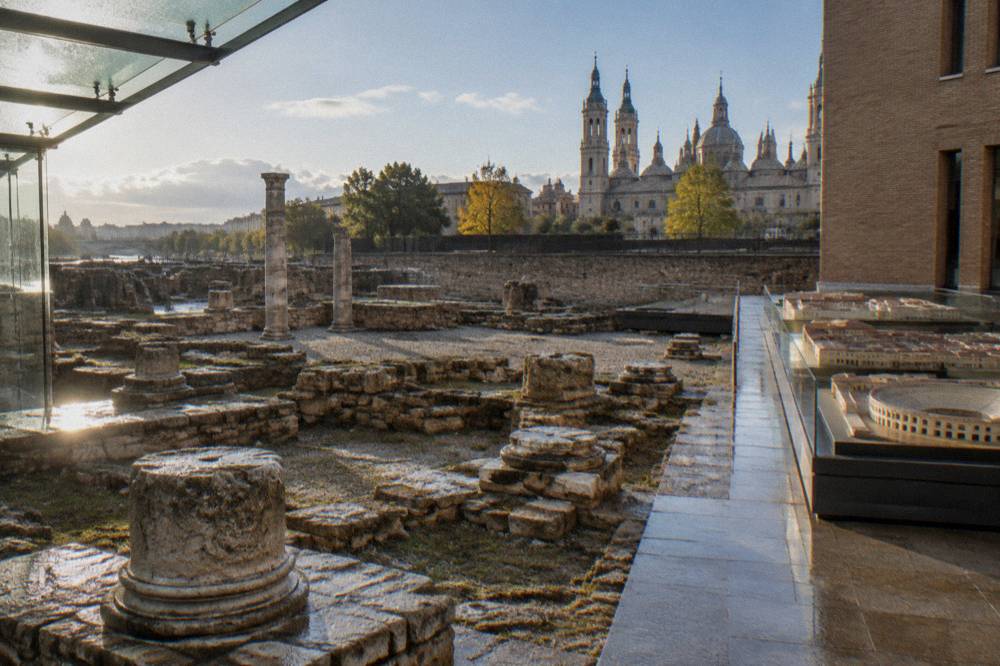
The interpretation also connects the theatre to the wider Roman city. The same colonia that built a theatre also built a forum, baths and a river port, and the four museums are designed as a set. Visitors who enjoy the theatre will get more from the Forum Museum and the Baths and Walls site, and the River Port Museum completes the quartet with the story of commerce on the Ebro.
Photography inside is generally tolerated in the galleries, but the museum is a municipal institution and its house rules are posted at entry; check the notices at the ticket desk rather than assuming. The building is modern, with lifts and level walkways on the gallery floors, which makes it one of the more accessible archaeological experiences in the city.
How Does The Theatre Museum Compare With The Other Caesaraugusta Museums?
The Theatre Museum is the largest and most dramatic of the four Caesaraugusta sites, because it encloses a standing ruin, while the Forum Museum shows excavated civic remains at 4 EUR, the Baths and the River Port each cost 3 EUR, and all four share identical opening hours and the 7 EUR combined bono, so the choice between them is about subject matter rather than schedule.
The four sites divide Roman city life into four themes, and each museum is small enough that visiting two in a morning is comfortable. The theatre covers spectacle, the forum covers government and commerce, the baths cover daily hygiene and social life, and the river port covers trade. If you only have time for one Roman site and you want the strongest visual experience, the theatre is the pick; if you want the densest concentration of interpretation, the forum runs it close. The wider set of guides lives on Zaragoza Travel Guide.
| Caesaraugusta Museum | Theme | Individual price | Best for |
|---|---|---|---|
| Teatro (Theatre) | Performance and spectacle | In the 7 EUR bono | Standing ruin, photography |
| Foro (Forum) | Civic and commercial life | 4 EUR | Urban archaeology |
| Termas (Baths) | Daily life and hygiene | 3 EUR | Quick visit |
| Puerto Fluvial (River Port) | Ebro trade | 3 EUR | River history |
A sensible order for a half-day of Roman Zaragoza is the theatre first, while your attention is freshest, then the forum, then whichever of the two smaller sites your energy allows, keeping the bono rather than buying singles. The museums' shared timetable means you can move between them without recalculating opening hours at each door.
Can You Visit The Roman Theatre With A Guided Tour In Zaragoza?
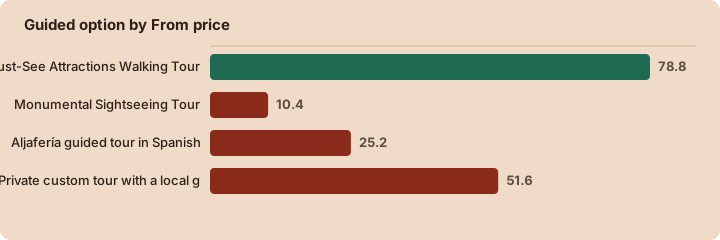
Guided walking tours of Zaragoza's old town regularly include the theatre district among their stops, with the two-hour private Must-See Attractions walk from 78.78 USD per person covering the essential monuments, a 105-minute monumental introduction from 10.41 USD per person, and a Spanish-language Aljafería guided tour from 25.23 USD per person for visitors who want a deeper monument visit in Spanish.
The guided options below suit different styles of traveller. The private walks let you set the pace and ask questions, the short monumental introduction suits a first evening in the city, and the Aljafería tour pairs the theatre's Roman layer with the city's Islamic palace, the other great architectural statement of Zaragoza's past, described on the Aljafería Palace page.
| Guided option | Format | From price | Rating |
|---|---|---|---|
| Must-See Attractions Walking Tour | Private walk, 2 hours | 78.78 USD per person | 4.6 from 9 reviews |
| Monumental Sightseeing Tour | Group intro, 105 minutes | 10.41 USD per person | 4.4 from 36 reviews |
| Aljafería guided tour in Spanish | Guided monument visit | 25.23 USD per person | 4.7 from 23 reviews |
| Private custom tour with a local guide | Private, flexible | 51.6 USD per person | 4.9 from 70 reviews |
For travellers who want the Roman story told in person rather than read from panels, a private guide is the most flexible route. The private custom tour with a local guide, rated 4.9 from 70 reviews on its listing, can be steered toward the Caesaraugusta sites, and the Spanish-language Aljafería tour suits visitors comfortable following a guide in Spanish; both are bookable through the operator's live listing.
How Long Does A Visit To The Roman Theatre Museum Take?
A typical visit to the Roman Theatre Museum takes 45 to 75 minutes, enough to walk the galleries, view the theatre from each level and read the main panels, with the full four-museum Caesaraugusta circuit comfortably fitting into half a day when the sites are visited in sequence between the 10:00 and 14:00 opening block.
The museum is not vast, and its layout funnels you through the building rather than leaving you to wander. Visitors who read everything and linger over the ruin from every angle will stretch toward the upper end of that range; visitors who skim the panels and come mainly for the stonework will be out in under an hour. Either way, the museum rewards the evening block as much as the morning: the 17:00 to 21:00 opening on weekdays means it is one of the few Roman sites in Spain you can visit after dinner-time hours begin.
| Visit style | Time needed | When to go |
|---|---|---|
| Quick ruin viewing | 30-45 minutes | Any opening block |
| Full museum read | 60-75 minutes | Morning block, 10:00 opening |
| Theatre plus Forum | About 2 hours | Morning block |
| All four museums | Half a day | Morning block with bono |
Pair the timing with the rest of your day. The museum's old-town location means lunch or evening tapas in the surrounding streets, the district described on the El Tubo page, needs no separate journey, and the evening opening hours slot neatly before or after food.
What Else Is Near The Roman Theatre Museum?
Within a few minutes' walk of the theatre museum stand the Basílica del Pilar, whose temple is free to enter and whose tower viewpoint costs 6 EUR for an adult, La Seo cathedral at 10 EUR general admission including three further museums, the Puente de Piedra with its four bronze lions, and the Forum and River Port museums, making the theatre the natural centre of a half-day old-town circuit.
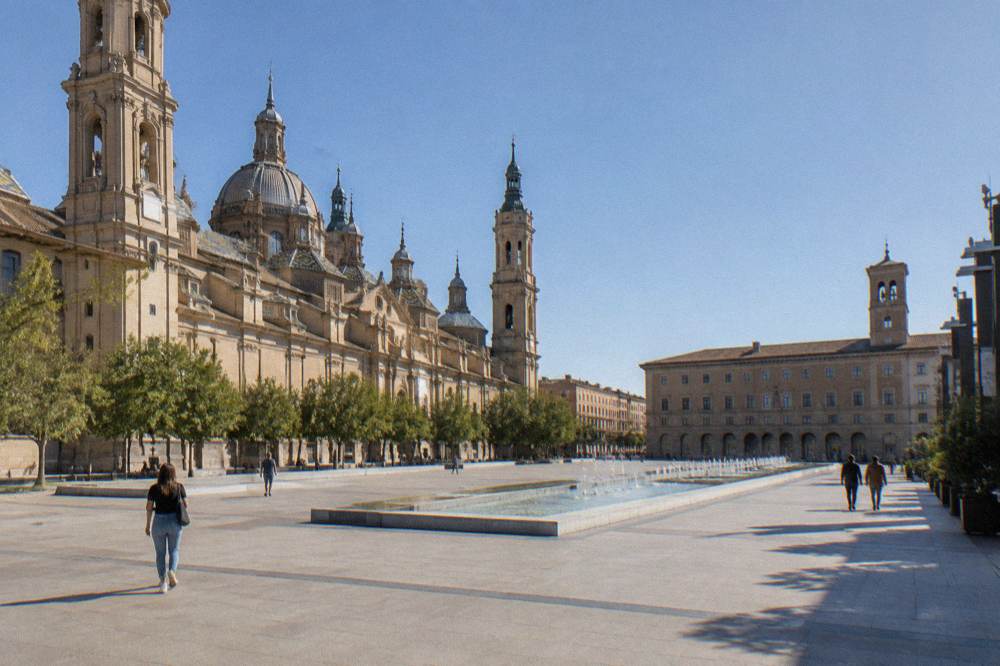
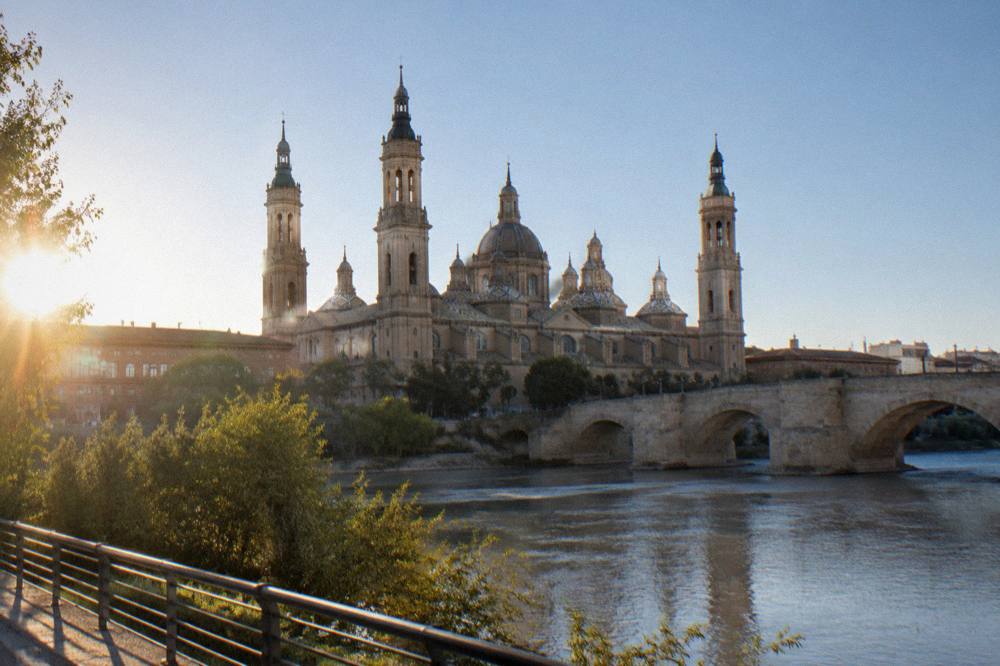
The density here is the point. Very few European cities put a Roman theatre, a Moorish-era cathedral, a baroque basilica and a Roman-era bridge within one short stroll, and Zaragoza does it without the crowds of the coastal mega-cities. The Basílica del Pilar tower and the Ebro river walk frame the district from either side.
| Nearby sight | Distance character | Entry |
|---|---|---|
| Basílica del Pilar | Same square cluster | Temple free; tower 6 EUR adult |
| La Seo and Museo de Tapices | Short walk | 10 EUR general |
| Puente de Piedra | Short walk | Free, public bridge |
| Forum Museum | Same district | 4 EUR |
| River Port Museum | Same district | 3 EUR |
Is The Roman Theatre Museum Worth Visiting?
The Roman Theatre Museum is worth visiting for anyone with more than a passing interest in history, and it earns its place on a Zaragoza itinerary as the single most atmospheric Roman site in the city, best bought as part of the 7 EUR four-museum bono and best visited in the quieter morning block, with the free first Sunday offering the lowest-cost entry of all.
The honest case against is that the museum is interpretive rather than vast, and a visitor expecting the scale of a grand imperial monument may find the galleries modest. The honest case for is that the ruin is genuine, in situ and well presented, and that the theatre completes a Roman narrative the other three museums only sketch. For most travellers the bono makes the decision easy: at 7 EUR for four sites, the theatre is effectively a low-cost addition to a forum visit you were probably making anyway.
How Does The Theatre Fit Into A First Visit To Zaragoza?
On a first visit to Zaragoza, slot the theatre museum into the second half of your opening day or the morning of your second, after Plaza del Pilar and La Seo, using the 10:00 opening block and the four-museum bono, and let a two-hour guided walk such as the Must-See Attractions tour from 78.78 USD per person orient you before you go underground into the Roman layer.
The logic is simple: the basilica and the cathedral give you the skyline first, the theatre gives you the depth, and the tapas streets give you the evening. A one-day visitor with no interest in Rome can skip the museum without guilt, but a visitor with two days, or with a free first Sunday, should treat it as one of the city's distinguishing sights, because it is precisely the layer most visitors to Spain's better-known cities never think of Zaragoza as having.
Common Questions About The Roman Theatre Museum In Zaragoza
Is the Roman Theatre Museum in Zaragoza open on Mondays?
No. The museum, like the other three Caesaraugusta museums, is closed on Mondays. It opens Tuesday to Saturday 10:00-14:00 and 17:00-21:00, and Sunday and public holidays 10:00-14:30.
How much does the Roman Theatre Museum cost?
The theatre is covered by the four-museum Caesaraugusta bono at 7 EUR, or 5 EUR reduced. The municipality's timetable lists individual prices of 4 EUR for the Forum and 3 EUR each for the Baths and River Port, and all four museums are free on the first Sunday of the month.
Can you see actual Roman remains at the museum?
Yes. The museum is built around the excavated theatre of Roman Caesaraugusta, and the seating and stage masonry are visible from the interior galleries, displayed in situ.
How long do you need at the Roman Theatre Museum?
Plan on 45 to 75 minutes for a full visit. All four Caesaraugusta museums together fit comfortably into a half day using the morning opening block.
Where is the Roman Theatre Museum located?
In Zaragoza's Casco Histórico, the old-town district between Plaza del Pilar and the Calle Mayor axis, a short walk from La Seo, the Basílica del Pilar and the Puente de Piedra.
The Roman Theatre Museum is the piece of Zaragoza, Spain, that most surprises first-time visitors, a working Roman ruin tucked into the streets behind the basilica, and with the bono, the shared timetable and the free first Sunday, it is also one of the city's easiest sights to plan.