Puente De Piedra: Zaragoza's Stone Bridge Over The Ebro
Zaragoza's Puente de Piedra has carried traffic across the Ebro since 1440, and its four bronze lions have watched over the crossing since 1991. This guide covers the bridge's history, the viewpoints that frame it and what to see on both banks.
Short answer
The Puente de Piedra is Zaragoza's historic stone bridge over the Ebro, built from 1401 and opened in 1440 on the line of a Roman-era crossing. Four bronze lions have guarded its ends since 1991, and Napoleonic troops blew up one of its arches in 1813. It connects the El Tubo and Basílica del Pilar side of the old town with the right bank, and it is free to cross at any hour.
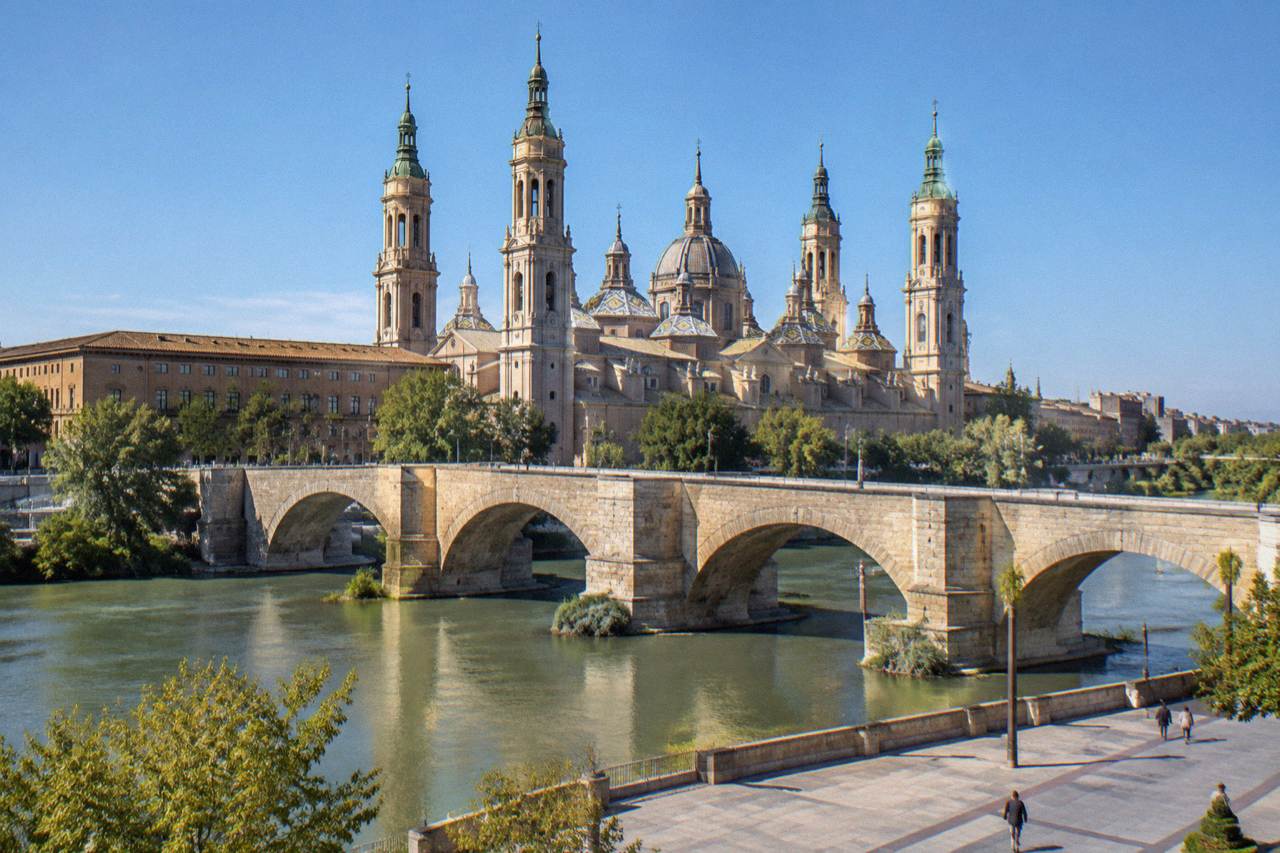
Zaragoza, the capital of Aragon on the Ebro, is a city defined by its river, and no crossing defines it like the Puente de Piedra. The municipality's own tourism page records that the current bridge was built from 1401 and opened in 1440, that a Roman-era crossing predates it on the same line, that four bronze lions have stood at its ends since 1991, and that Napoleonic troops blew up one of its arches in 1813. Six hundred years of crossings, wars and rebuilds sit in that one sentence. The bridge is also the single most photographed spot in the city, because from its upstream side the Basílica del Pilar rises directly behind it, and that pairing, stone bridge under baroque dome, is the image of Zaragoza that travels.
This page covers the bridge's history, what you can see from it and around it, the best times of day to photograph it, and how it fits into a first day in the city. If you want the wider picture of the city itself, start with things to do in Zaragoza and come back here for the deep dive on the crossing itself.
What Is The Puente De Piedra In Zaragoza?
The Puente de Piedra is Zaragoza's historic stone bridge over the Ebro, built from 1401 and opened in 1440 on the line of a Roman-era crossing that predates it. Four bronze lions have guarded its ends since 1991, and Napoleonic troops blew up one of its arches in 1813 during the Peninsular War. It links the Basílica del Pilar and El Tubo side of the old town with the right bank, and crossing it costs nothing at any hour.
The bridge sits at the heart of the Casco Histórico, the old town of Zaragoza, Spain, and it is one of those rare monuments that works as both a sight and a piece of infrastructure. Commuters cross it every day. Wedding parties photograph on it. Tour groups gather at its lion-guarded ends before walking into the El Tubo tapas district on the left bank. The municipality publishes the bridge's basic history on its tourism pages, and the facts there are short and firm: built 1401, opened 1440, lions since 1991, a destroyed arch in 1813.
Plenty of competing guides print those figures freely. What you get instead is what the primary sources actually say, which is more than enough to understand why this crossing matters.
The Roman connection is the part most visitors miss. Zaragoza began as Caesaraugusta, a Roman colony founded on the Ebro, and the city's Roman past is documented across four museums on the left bank: the Roman Forum Museum, the Roman Theatre Museum, the Roman River Port Museum and the Roman Baths and Walls. The river port museum in particular explains why a crossing existed here at all: the Ebro was a working river, and a ford and then a bridge at this point served the colony's trade. The stone bridge you walk today is the medieval heir to that Roman line.
How Old Is The Puente De Piedra And What Has Happened To It?
The current Puente de Piedra was begun in 1401 and opened in 1440, which makes it close to six hundred years old, though a Roman-era crossing stood on the same line long before it. Its hardest moment came in 1813, when retreating Napoleonic troops blew up one of its arches during the Peninsular War. The four bronze lions at its ends are modern by comparison, placed there in 1991.
The timeline below pulls together the verified moments in the bridge's story. Each entry is anchored to a fact the municipality or the historical record publishes, and nothing beyond it.
| Period | Event | Status in the record |
|---|---|---|
| Roman era | A crossing on the Ebro predates the stone bridge, tied to the colony of Caesaraugusta | Confirmed on the municipal page |
| 1401 | Construction of the current stone bridge begins | Confirmed on the municipal page |
| 1440 | The bridge opens to traffic | Confirmed on the municipal page |
| 1813 | Napoleonic troops blow up one of the bridge's arches during the Peninsular War | Confirmed on the municipal page |
| 1991 | Four bronze lions are placed at the bridge's ends | Confirmed on the municipal page |
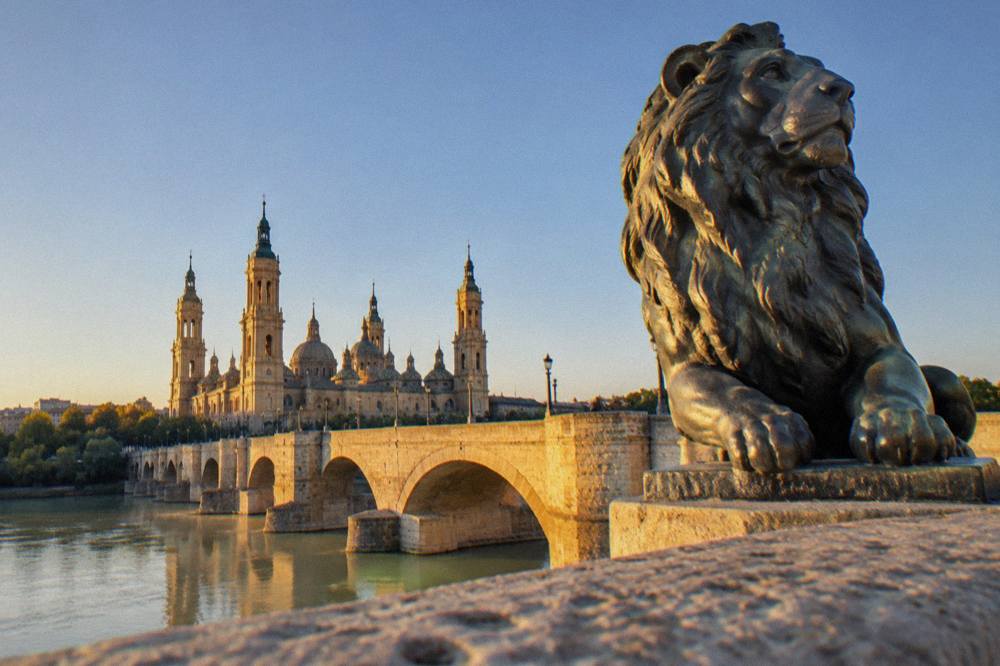
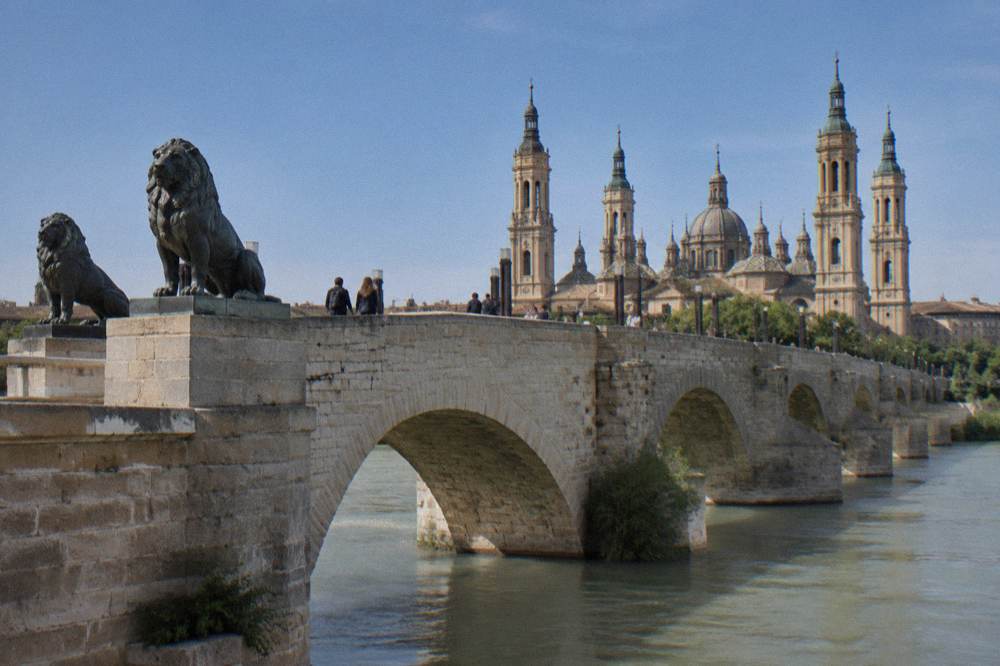
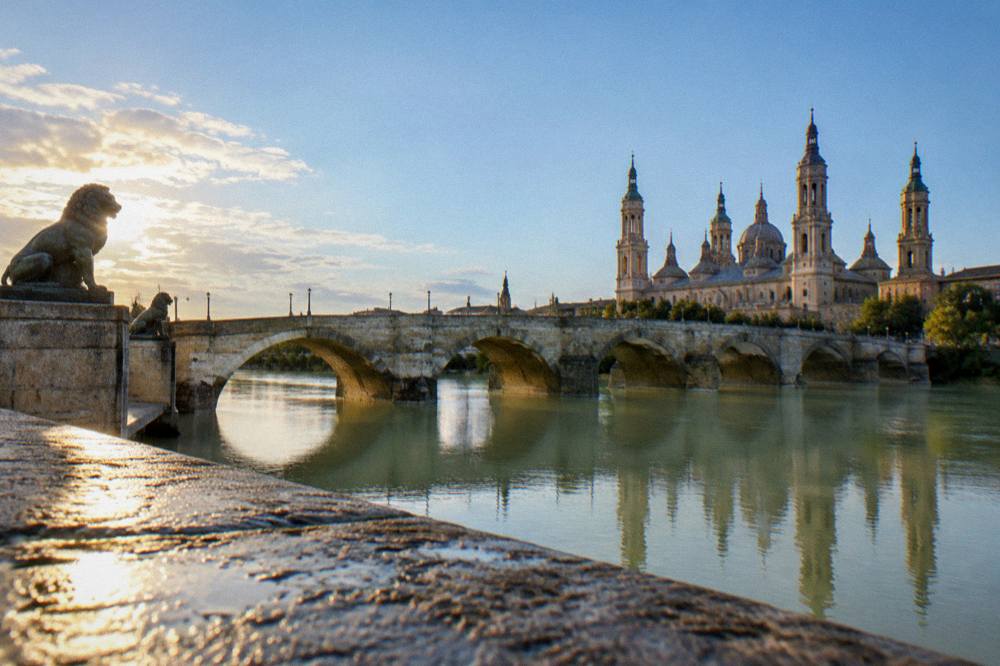
The 1813 explosion is worth a moment of thought, because it explains the bridge's patchwork character. A bridge that loses an arch gets rebuilt, and rebuilt sections rarely match the originals in stone or in line. When you stand at mid-bridge and look along its flank, you are looking at centuries of repair layered on a medieval core. The lions are the newest layer of all, from 1991, and they have become the bridge's signature: two on the left-bank side facing the old town, two on the right-bank side, each pair guarding the entrance to the crossing.
The lions also carry a civic meaning. Zaragoza's coat of arms shows two lions, and the bridge's four bronze figures echo that heraldry. It is a modern installation doing very old work, marking the threshold of the city the way medieval bridges always did.
If the bridge's history hooks you, the Museo de Zaragoza would normally be the place to go deeper, but note the situation before you plan around it: the museum's central building at Plaza de los Sitios 6 is closed for Ministry of Culture works, with no reopening date published, and its Etnología and Cerámica sites in Parque Grande are also shut at present. The Centro de Historias, free and open Tue-Sat 10-14 and 17-21 plus Sun 10-14:30, is the working alternative in the old town for the city's story in objects.
Where Are The Best Views Of The Puente De Piedra?
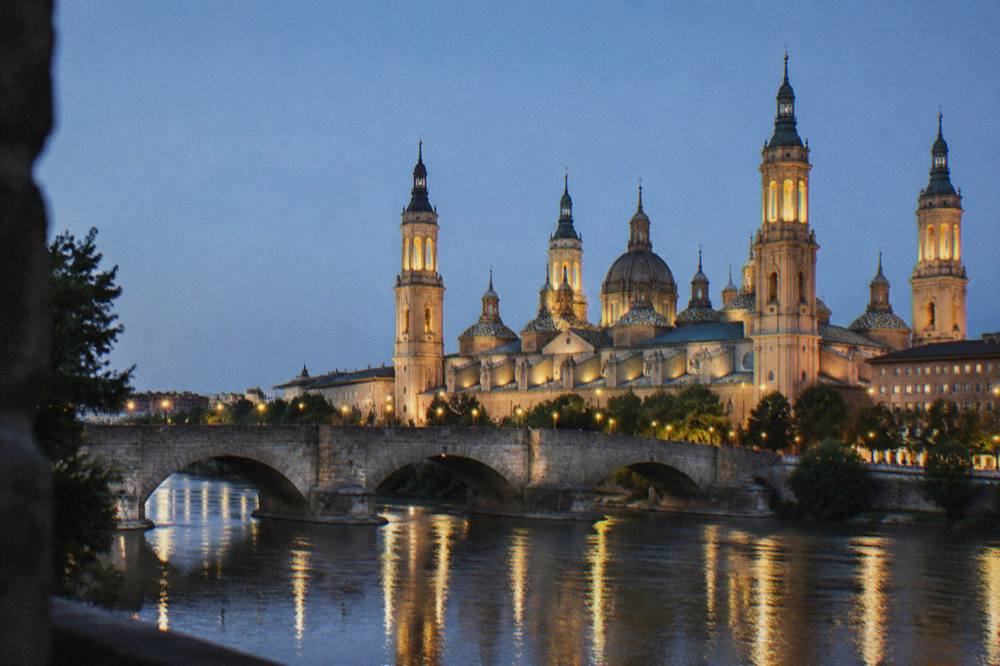
The classic view of the Puente de Piedra is from the Ebro's left bank upstream of the bridge, where the stone arches frame the Basílica del Pilar rising behind them, a composition that works at any hour but turns golden in the evening. The second best view is from the bridge deck itself, looking along the railing toward the Pilar towers, and the third is from the right bank, where the old town's skyline stacks up over the crossing.
The left-bank viewpoint is the one on every postcard. Walk from the Basílica del Pilar's river facade a short way upstream and the composition assembles itself: stone bridge in the foreground, baroque domes and towers behind, the Ebro sliding under the arches between them. Photographers work this stretch of bank constantly, and in October, when the Fiestas del Pilar fill the city, it is the busiest stretch of river in Aragon. The Ofrenda de Flores on 12 October ends in the Plaza del Pilar a few steps inland, and the whole riverside throngs during the festival.
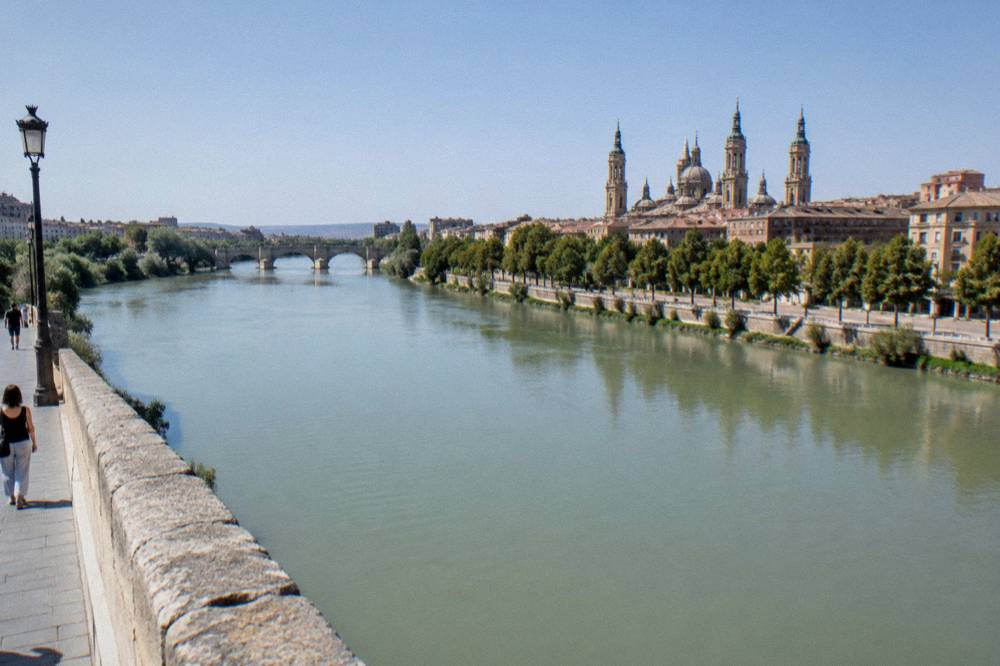
From the deck, the view changes character. The railing, the roadway and the flow of pedestrians put you inside the crossing rather than in front of it, and the Pilar towers loom directly ahead as you walk toward the old town. At dusk the basilica's facade is lit and the stone of the bridge catches the same light, which is why so many evening walking tours time their river segment for the last hour of daylight.
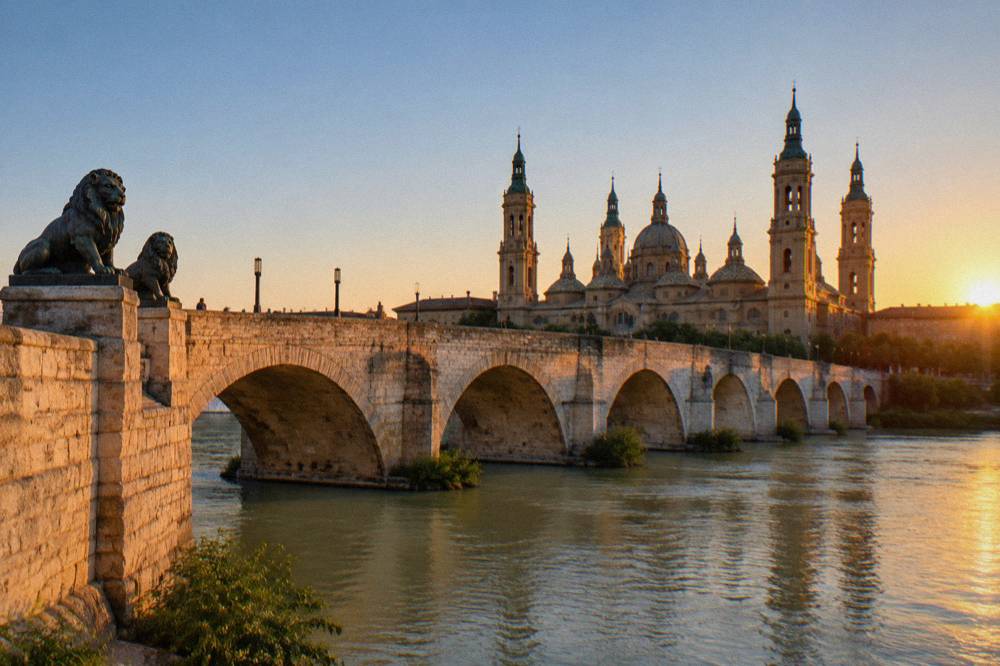
The right bank gives the least crowded angle. From over the river, looking back, the whole old-town skyline sits on top of the bridge: Pilar, La Seo and the roofline of the Casco Histórico in one frame. The Ebro river walk on the left bank connects this whole stretch, and the modern crossings downstream, including the Tercer Milenio Bridge, give a contemporary counterpoint to the medieval stone.
| Viewpoint | What you see | Best light | Crowd level |
|---|---|---|---|
| Left bank, upstream of the bridge | Stone arches with the Basílica del Pilar behind | Evening, sunset | Busy, busiest during Fiestas del Pilar |
| Bridge deck, walking toward the old town | Railing, towers and the basilica facade ahead | Dusk when the facade is lit | Steady pedestrian flow |
| Right bank, looking back at the old town | Full old-town skyline over the crossing | Morning, low sun behind you | Quiet by comparison |
| Downstream, from the modern bridges | The stone bridge in its river context | Midday | Quietest |
When Is The Best Time To Visit The Puente De Piedra?
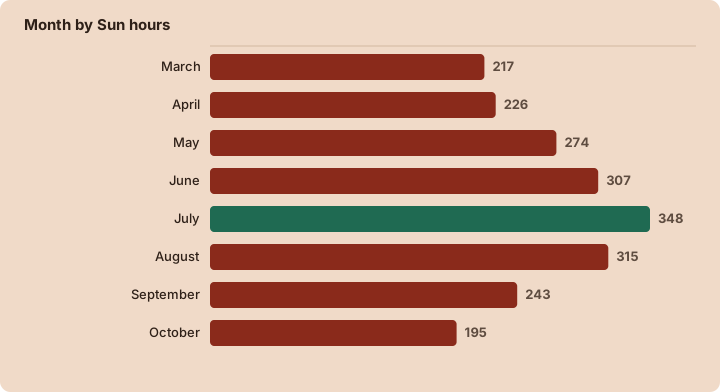
The Puente de Piedra is free, open at all hours and unstaffed, so the only planning variable is light and weather rather than tickets or times. AEMET's 1981 to 2010 normals for the Zaragoza Aeropuerto station show October afternoons averaging a 21.4 C maximum with 36 mm of rain across the month, and July and August averaging 32.4 C and 31.7 C, which makes the cooler months and the evening hours the most comfortable for standing on the bank.
Zaragoza has a dry continental climate, inland on the Ebro with no sea to soften it. The numbers below are the 1981 to 2010 averages from AEMET's Zaragoza Aeropuerto station, the only window the station publishes, and they are the right basis for choosing when to stand on an open bridge taking pictures.
| Month | Mean max C | Mean C | Rain mm | Sun hours |
|---|---|---|---|---|
| March | 17.3 | 11.6 | 19 | 217 |
| April | 19.6 | 13.8 | 39 | 226 |
| May | 24.1 | 18.0 | 44 | 274 |
| June | 29.3 | 22.6 | 26 | 307 |
| July | 32.4 | 25.3 | 17 | 348 |
| August | 31.7 | 25.0 | 17 | 315 |
| September | 27.1 | 21.2 | 30 | 243 |
| October | 21.4 | 16.2 | 36 | 195 |
Two readings follow from that table. First, May is the wettest month at 44 mm on this window and July and August the driest at 17 mm, so a summer visit is more reliably dry but hot, and a spring visit is greener with a real chance of a shower. Second, the evening is the friendliest hour in every season, because the bridge is unshaded and the deck heats through the afternoon; by dusk the stone gives its warmth back and the basilica lighting takes over.
October deserves a special note. The Fiestas del Pilar run from 10 to 18 October 2026, with the Ofrenda de Flores on 12 October, and the riverside around the bridge is the festival's main stage. If you want the city at its loudest and most crowded, come then. If you want the bridge to yourself, come in any other month and pick a weekday morning.
What Is Near The Puente De Piedra?
Within a few minutes' walk of the Puente de Piedra you reach the Basílica del Pilar, La Seo Cathedral, the El Tubo tapas district, the Roman River Port Museum and the whole of the Casco Histórico, all on the left bank, while the right bank opens onto the Ebro's green corridor and the modern Expo-side riverfront. The bridge is effectively the front door to Zaragoza's old town, and almost every first-visit itinerary crosses it.
The table below lists what sits around the crossing, with the verified October hours and prices from the municipal monument timetable. Distances are deliberately left out: the verified record does not carry walking times for these pairs, and a plan built on invented minutes is worse than no plan at all. Everything listed is inside the old town's compact grid, so think in terms of a stroll rather than a trek.
| Sight | Side of the river | October hours | Entry |
|---|---|---|---|
| Basílica del Pilar | Left bank | Temple free; Holy Chapel zone 8:00-20:30 | Free to enter |
| Basílica del Pilar tower viewpoint | Left bank | Mon-Thu 10:30-14:30 and 16:00-20:00, Fri-Sun 10:00-20:00 | 6 EUR adult, 5 EUR over 65 and residents, 4 EUR ages 13-18, students and groups 20+, free under 12 |
| La Seo Cathedral and Museo de Tapices | Left bank | Mon-Sat 10:00-14:30 and 16:00-20:00, Sun 10:00-12:00 and 16:00-20:00 | 10 EUR general, 9 EUR over 65, 7 EUR students and 13-18, free under 12 |
| Roman River Port Museum | Left bank | Tue-Sat 10:00-14:00 and 17:00-21:00, Sun and festivos 10:00-14:30 | 3 EUR, 4-museum bono 7 EUR |
| El Tubo tapas district | Left bank | Evening, bar by bar | No entry, pay as you eat |
| Centro de Historias | Left bank | Tue-Sat 10-14 and 17-21, Sun 10-14:30 | Free |
One standing fact to keep in mind while you plan: the Pilar's dome known as the Regina Patriarcharum has been under restoration since an agreement signed on 23 January 2026, and completion is not confirmed, so expect possible work visible on the basilica's exterior rather than a pristine dome in your photographs. The basilica itself remains open, and the tower viewpoint keeps its own hours and prices as listed above. The Basílica del Pilar and its tower each have a full page on this site.
On the right bank the character changes completely. The stone bridge drops you into the calmer side of the river, where the walk runs along the water toward the modern riverfront of the Expo site and the Acuario de Zaragoza further along, the self-styled largest river aquarium in Europe with 5,000-plus specimens, 20 EUR general admission and 14 EUR for children 4-14 and seniors, with ages 0-3 free and a 55 EUR online family pack for two adults and two children. Its daily hours are not published in a readable calendar, so check the operator's notice before you go.
Which Tours Include The Puente De Piedra?
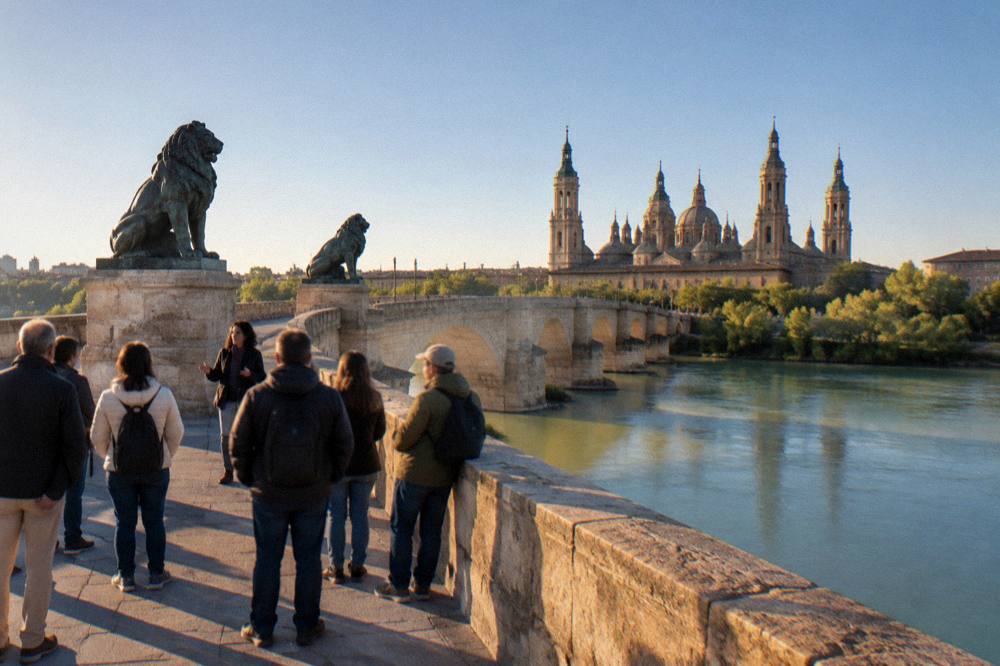
Almost every walking route through Zaragoza's old town crosses or views the Puente de Piedra, because the bridge sits between the Basílica del Pilar and the river, and the 105-minute Zaragoza Monumental Sightseeing Tour is the cheapest guided way to see it with context, from 10.41 USD per person with a 4.4 rating from 36 reviews. Free GuruWalk tip-based walks also cover the old town, and the platform's guru-led model means you pay what you want at the end.
The monumental introduction tour is this site's featured pick for the bridge, and for good reason: at 105 minutes and from 10.41 USD it is the shortest, cheapest guided circuit of the monuments, it carries a 4.4 rating from 36 reviews, and its route is built around exactly the cluster the bridge anchors. You can read the full tour page at the Zaragoza Monumental Sightseeing Tour, and if it fits your dates, Check availability before you travel.
Beyond that, the choice depends on what kind of walk you want. The table below compares the verified options that touch the old town and the river, using each listing's own figures.
| Tour | Kind | Length | From | Rating |
|---|---|---|---|---|
| Zaragoza Monumental Sightseeing Tour | Walking tour | 105 minutes | 10.41 USD | 4.4 from 36 reviews |
| The Best of Zaragoza Sightseeing Tour: Mysteries, Photos, Stories, and Surprises | Walking tour with mysteries | 2.5 hours | 22.28 USD | 4.6 from 41 reviews |
| Zaragoza: Legends and Ghosts Night Tour | Night legends tour | 2 hours | 15.76 USD | 5 from 1 review |
| Zaragoza: Evening Tapas Walking Tour in the Old Town | Tapas walk | 3 hours | 106.92 USD | 4.9 from 62 reviews |
| Indispensable Zaragoza Free Tour: Old Town | Free GuruWalk | 2 hours | Free, tip based | 4.97 from 576 reviews |
The free option deserves a plain explanation, because it is genuinely different in kind. The Indispensable Zaragoza Free Tour runs on GuruWalk, a platform for free and pay-what-you-want walks led by independent gurus, and it is not this site's product: it costs nothing to book and you tip the guru at the end. Its listing shows a 4.97 rating from 576 reviews over 2 hours, which is the strongest review base of any old-town walk in the city. If your budget is zero and your evening is open, see this free tour on GuruWalk and decide for yourself what the walk was worth.
The tapas walks deserve their line in the table for a specific reason connected to the bridge: the evening tours start in the old town and move through El Tubo, and the stone bridge is the natural before-dinner viewpoint on the way. The 3-hour Evening Tapas Walking Tour, from 106.92 USD with a 4.9 rating from 62 reviews, is the strongest-reviewed of them.
How Does The Puente De Piedra Fit Into A Day In Zaragoza?
A first day in Zaragoza works best as a loop that uses the Puente de Piedra as its hinge: start at the Basílica del Pilar, cross the bridge to the right bank for the skyline view, return along the Ebro's left-bank walk, then finish in El Tubo for tapas, with La Seo and the Roman museums slotted between the basilica and dinner. The bridge costs nothing and adds almost no time, so it fits any itinerary at any pace.
Here is the shape of that loop in order, with no invented timings attached. The verified record gives hours and prices, not walking minutes, so use your own pace and the sun rather than a schedule someone made up.
- Basílica del Pilar first, in the morning. The temple is free to enter, with the Holy Chapel zone open 8:00-20:30 and the main altar zone on its own daily pattern. If you want the tower viewpoint, it runs Mon-Thu 10:30-14:30 and 16:00-20:00, Fri-Sun 10:00-20:00, with last access 30 minutes before close, at 6 EUR adult.
- Cross the Puente de Piedra. Walk over to the right bank, turn around, and take the skyline shot. The lions at the bridge's ends are the detail most people photograph second.
- Return along the left bank. The Ebro river walk brings you back under the bridge's flank, which is the closest view of the stone arches themselves.
- La Seo and the Roman museums. La Seo is 10 EUR general including the Museo de Tapices, Museo Pilarista and Rosario de Cristal, free for Aragon residents on the 6th, 12th, 23rd and 27th of the month. The four Caesaraugusta sites are 4 EUR, 3 EUR and 3 EUR individually or 7 EUR on the four-museum bono, free the first Sunday of the month.
- El Tubo in the evening. The tapas district is the old town's pantry, and the El Tubo page covers it in full. For the food itself, start with ternasco de Aragón, the region's signature lamb dish.
If you have more than a day, the bridge also makes a good send-off point for the region. The Monasterio de Piedra and Loarre Castle day trips, the Monasterio de Veruela and San Juan de la Peña monasteries and the Cariñena wine region all start from a city whose centre you will already know on foot. The centro and Paseo de la Independencia area page covers where to sleep near the bridge if you want the view from your window.
What Should You Know Before You Go To The Puente De Piedra?
The Puente de Piedra is a free, always-open public bridge, so there are no tickets, no queues and no booking for the crossing itself, and the only things to plan are comfortable shoes, sun protection in summer and a check of the basilica hours if the tower viewpoint is on your list. The bridge is unshaded, the Ebro valley's dry heat is real in July and August, and the Fiestas del Pilar period from 10 to 18 October transforms the riverside from quiet to packed.
A few practical points, all drawn from the verified record. The bridge is fully public highway, so it never closes and it costs nothing. It carries pedestrians alongside vehicle traffic, so keep to the walkway. The left bank after dark is lit and busy, particularly in festival season. And the one thing worth checking live before a visit is the Pilar's dome restoration: the agreement was signed on 23 January 2026 and completion is not confirmed, so the basilica's silhouette in your photographs may carry work rather than a finished dome.
For the wider context, this site's Basílica del Pilar, La Seo Cathedral and Aljafería Palace pages cover the three monuments that anchor the old town, and Zaragoza Travel Guide holds the full picture of the city. The Aljafería deserves its own half-day: the palace, whose construction began under the taifa of Zaragoza, is open daily 10:00-18:00 in October at 7 EUR general, 9 EUR with a guided visit, 4 EUR with a tourist bus ticket, 2 EUR for students, over-65s and Carnet Joven holders, free under 12, and free the first and third Sunday and Monday of each month.
Common Questions About The Puente De Piedra
Is the Puente de Piedra in Zaragoza free to visit?
Yes. The bridge is a public crossing, open at all hours with no ticket, no gate and no staff. The only paid elements nearby are the Basílica del Pilar tower viewpoint at 6 EUR adult and the surrounding museums at their own prices.
How old is the Puente de Piedra?
The current stone bridge was built from 1401 and opened in 1440, and a Roman-era crossing predates it on the same line. The four bronze lions at its ends date from 1991.
Why does the Puente de Piedra have lions?
The four bronze lions were placed at the bridge's ends in 1991 and echo the lions of Zaragoza's coat of arms. They mark the threshold of the crossing on both banks.
What is the best view of the Puente de Piedra?
The left bank upstream of the bridge, where the stone arches frame the Basílica del Pilar behind them, is the classic composition. The right bank looking back at the old-town skyline is the quieter alternative.
Was the Puente de Piedra damaged in a war?
Yes. Napoleonic troops blew up one of the bridge's arches in 1813 during the Peninsular War, and the crossing was subsequently repaired, which is why its stonework shows layers of restoration over the medieval core.
Can you see the Basílica del Pilar from the Puente de Piedra?
Yes, directly. The basilica rises behind the bridge on the left bank, and the pairing of stone arches and baroque towers is the most photographed view in Zaragoza. Note that the Pilar's dome restoration, agreed in January 2026, has no confirmed completion date, so exterior work may be visible.
The Puente de Piedra is the one sight in Zaragoza you cannot miss even if you try, and the one you should walk at least twice: once in daylight for the history, once after dark for the basilica lit above the stone.