Tercer Milenio Bridge In Zaragoza: The Ebro's Boldest Crossing
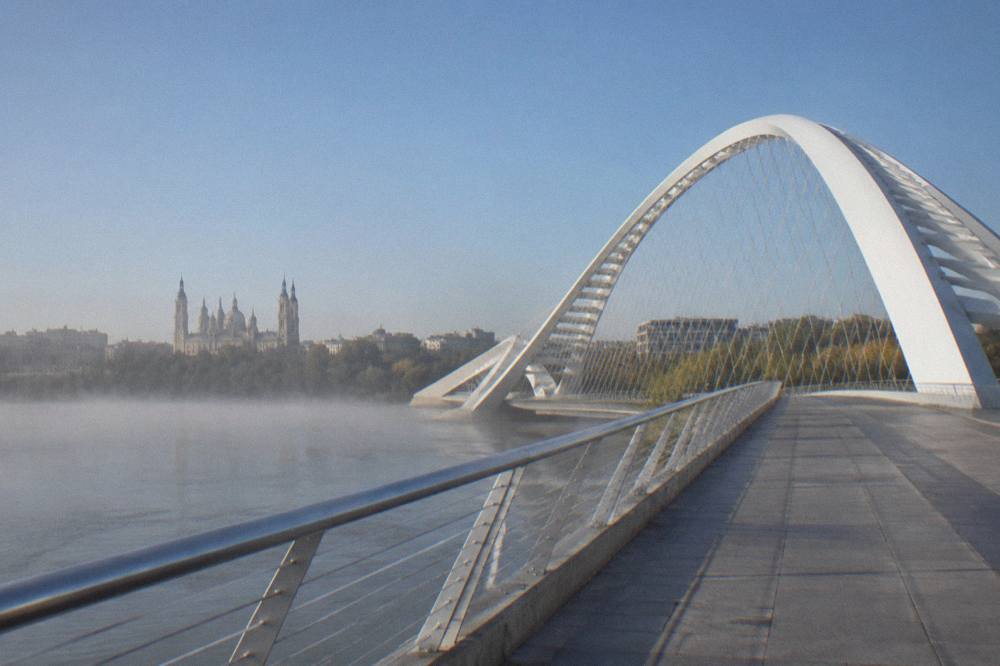
The Tercer Milenio Bridge is Zaragoza's most futuristic river crossing, built as part of the works for Expo 2008 and standing today at the centre of the city's newest district of parks, water and modern architecture on the Ebro.
Short answer
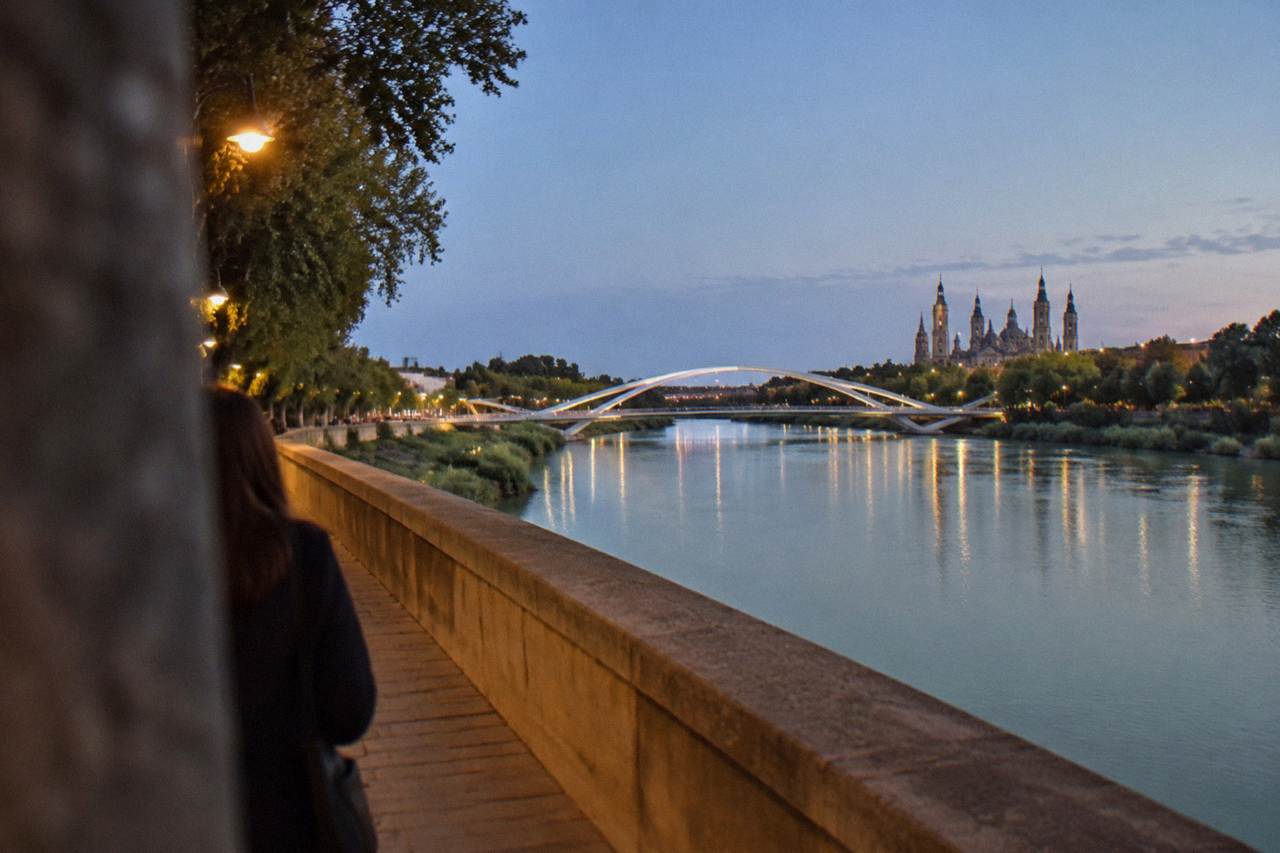
The Tercer Milenio Bridge is a modern road and foot crossing over the Ebro in Zaragoza, Spain, built for the Expo 2008 site in the Ranillas meander. It sits between the Parque del Agua Luis Buñuel and the Expo 2008 site, and it is free to cross on foot at any time, with the best light in the early morning and at sunset.
The Tercer Milenio Bridge carries traffic, cyclists and pedestrians across the Ebro in Zaragoza, the capital of Aragon in north-eastern Spain, at the point where the river sweeps through the Ranillas meander. It was built as part of the works that transformed this stretch of the riverbank for Expo 2008, and it still reads as the most futuristic piece of engineering in a city otherwise defined by Roman walls, Mudéjar brick and baroque towers. Crossing it takes you between two of modern Zaragoza's biggest open spaces: the Expo 2008 site on one side and the Parque del Agua Luis Buñuel on the other. Unlike the Puente de Piedra, which is four hundred years older and sits in the historic centre, this bridge belongs to the city's modern half, and it rewards a visit of an hour or two rather than a full day.
What Is The Tercer Milenio Bridge In Zaragoza?
The Tercer Milenio Bridge is a modern crossing over the Ebro in Zaragoza, Spain, built as part of the Expo 2008 works in the Ranillas meander, carrying road traffic, bikes and pedestrians. It links the Expo 2008 site with the Parque del Agua Luis Buñuel, and it is one of three landmark bridges from that era, alongside the Pabellón Puente and the Puente del Hierro. It has no ticket, no gate and no viewing fee: you simply walk or cycle across it.
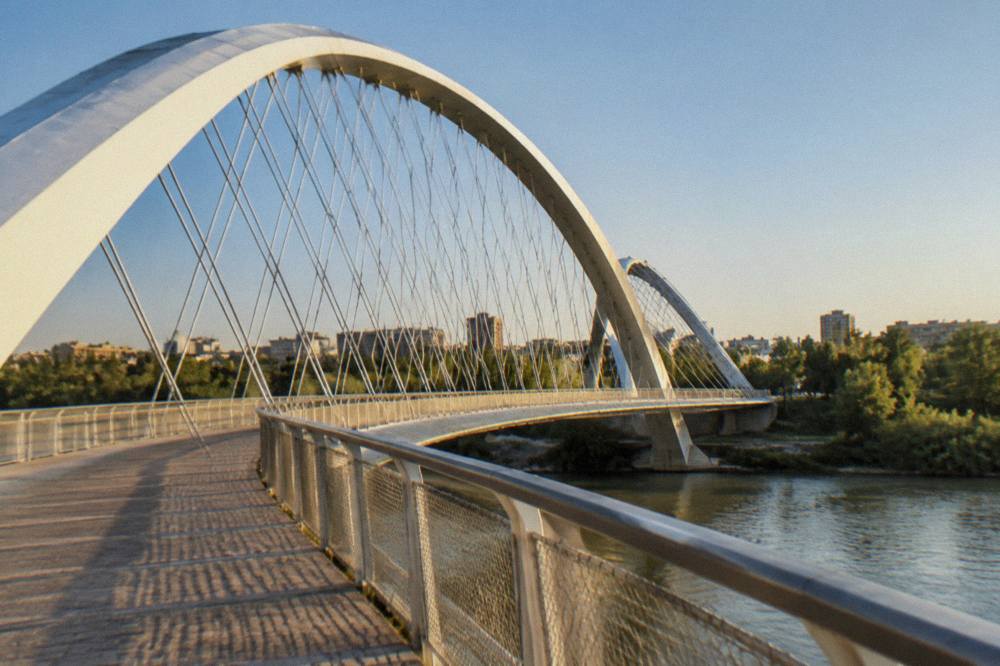
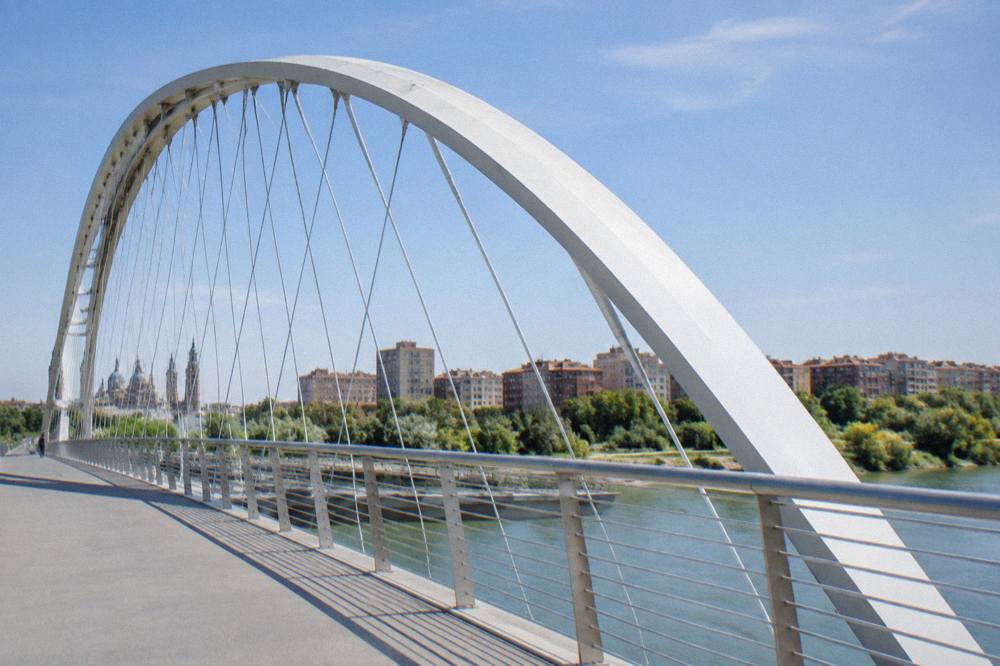
The name means "Third Millennium Bridge", and it was chosen deliberately. Zaragoza hosted the international exposition of 2008 on the theme of water and sustainable development, and the whole Ranillas meander was rebuilt around that idea: new bridges, a new park of more than 120 hectares, a water tower and a river aquarium all rose within a few years of each other. The Tercer Milenio Bridge is the traffic-bearing spine of that project, but its curved deck and leaning supports make it a piece of architecture rather than a plain road bridge, and photographers treat it accordingly.
The municipality publishes the Parque del Agua as more than 120 hectares of green space in the same meander, described as the first European park to hold the Green Globe certification, with running circuits of 5 and 10 kilometres. The bridge sits at the edge of this landscape, which is why a visit here never feels like a standalone errand: you arrive through parkland, cross the river, and land in the Expo site, where the Torre del Agua and the Pabellón Puente still stand as the exposition's signature structures.
What the bridge does not have is a museum, an interior or a climbable tower. It is infrastructure you experience from the outside and from the deck, which makes it the cheapest sight in this part of the city: free, open around the clock, and best in the hours when the low Aragon sun rakes across the water.
How Do You Get To The Tercer Milenio Bridge?
The Tercer Milenio Bridge lies in the Ranillas meander in western Zaragoza, Spain, reached by urban bus or tram for 1.70 EUR a single, or 0.55 EUR with a Tarjeta Bus. The Delicias train station and the historic centre both sit on the same flat river corridor, and cycling is a strong option, with Bizi day passes at 1 EUR plus per-trip charges.
The 2026 Avanza fare table lists the urban bus and tram single at 1.70 EUR, night lines at 1.00 EUR, and the Tarjeta Bus rate at 0.55 EUR, with the card itself sold at 7 EUR and valid on both bus and tram. The Bizi bike-share tariffs for 2026 are a 1 EUR fixed day pass plus 0.50 EUR for the first 30 minutes of each trip, a 10 EUR monthly pass and a 60 EUR annual pass, with a 50 EUR deposit held on the day, month and single-trip products.
Because Zaragoza is flat along the Ebro, the riverside approach is the pleasant one. The Ebro river walk runs the length of the city through the water, and you can follow it out of the historic centre past the Puente de Piedra and the Third Millennium Bridge is the far end of that corridor. Anyone staying near the Delicias station or the Expo district will find the bridge within easy reach, while visitors based in the old town should budget it as a riverside excursion rather than a stop between two monuments.
| Way to reach the bridge | 2026 cost | Notes |
|---|---|---|
| Urban bus or tram single | 1.70 EUR | Tarjeta Bus rate 0.55 EUR, card 7 EUR |
| Night bus lines | 1.00 EUR | Per the Avanza 2026 fare table |
| Bizi day pass | 1 EUR fixed + 0.50 EUR first 30 min | 50 EUR deposit held |
| Tourist bus (hop-on hop-off) | 10 EUR | 24 hours, 16 stops, 90-minute loop, cash only on the bus |
| On foot along the Ebro | Free | Flat riverside corridor from the centre |
One honest caveat: urban transformation works are causing bus and tram route deviations in several areas of Zaragoza, so check the operator's notices before you plan a precise connection. The bridge itself never closes, and the riverside paths on both banks are public.
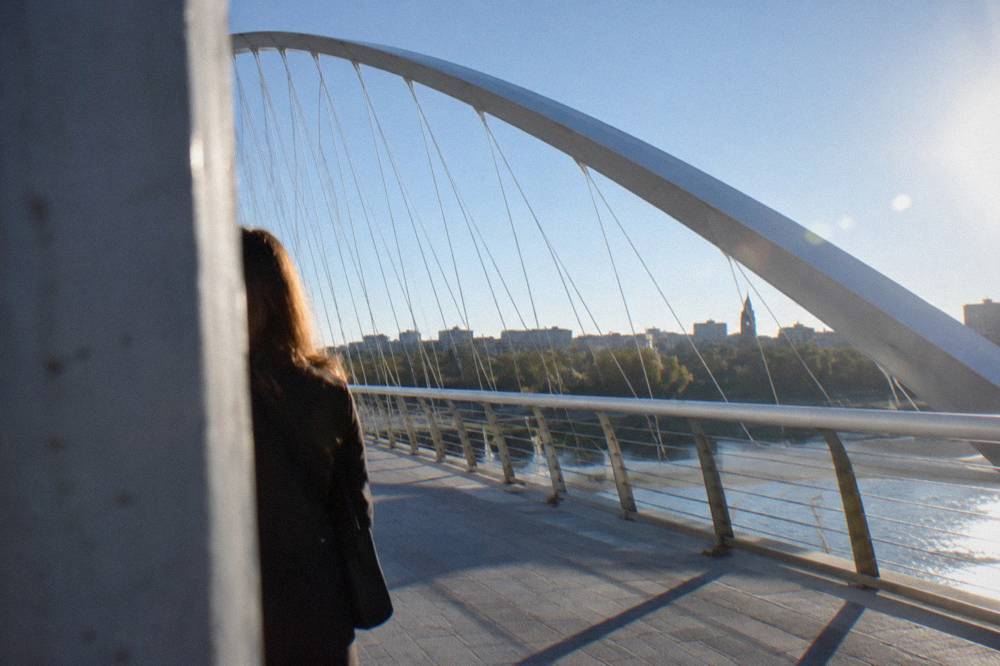
If you would rather have the whole sweep of the city explained while you walk it, the Must-See Attractions Walking Tour With a Guide is this site's featured pick for the area, Check availability on the operator's live listing.
What Can You See Beside The Tercer Milenio Bridge?
The Tercer Milenio Bridge sits inside Zaragoza's modern river district: on one bank the Parque del Agua Luis Buñuel, more than 120 hectares with 5 and 10 km running circuits, and on the other the Expo 2008 site with the Torre del Agua and the Pabellón Puente. The Acuario de Zaragoza, which its own site calls the largest river aquarium in Europe with more than 5,000 specimens, charges 20 EUR general admission.
The Parque del Agua Luis Buñuel is the biggest single reason to come out here. The municipality's own page describes it as designed to flood safely in big Ebro rises, which is why it feels so open and so low: the park is part of the river's machinery as well as a place to walk. The two running circuits, 5 and 10 kilometres, double as walking and cycling loops for visitors, and the Green Globe certification it holds was a first for a European green space.
Across the bridge, the Expo 2008 site preserves the exposition's landmark buildings. The Torre del Agua and the Pabellón Puente are the two that draw the eye, and both are worth photographing from the bridge deck itself, which gives you the water, the towers and the bridge's own curve in one frame. Be aware that admission prices and opening hours for the Torre del Agua and the Pabellón Puente are not published in a verifiable form, so check the operator's or venue's own notice before you promise a child a trip up the tower.
| Sight beside the bridge | Admission | Notes |
|---|---|---|
| Parque del Agua Luis Buñuel | Free | 120+ hectares, 5 and 10 km circuits |
| Expo 2008 site (grounds) | Free | Torre del Agua and Pabellón Puente stand here |
| Torre del Agua | Not verified | State no price or hours: check the venue's notice |
| Pabellón Puente | Not verified | Check the venue's notice before visiting |
| Acuario de Zaragoza | 20 EUR general, 14 EUR child 4-14 and senior, 55 EUR family pack online | Ages 0 to 3 free; daily hours not published |
The aquarium deserves its line of caution too: the site calls itself the largest river aquarium in Europe with more than 5,000 specimens, and the prices above come from its own page, but the opening calendar is published as an image and daily hours are not verified here, so check the live calendar before setting out.
When Is The Best Time To Photograph The Tercer Milenio Bridge?
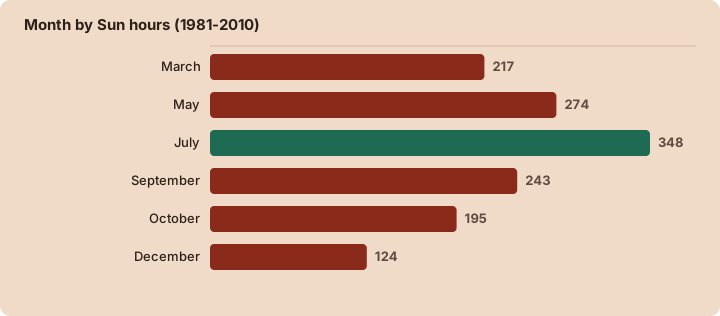
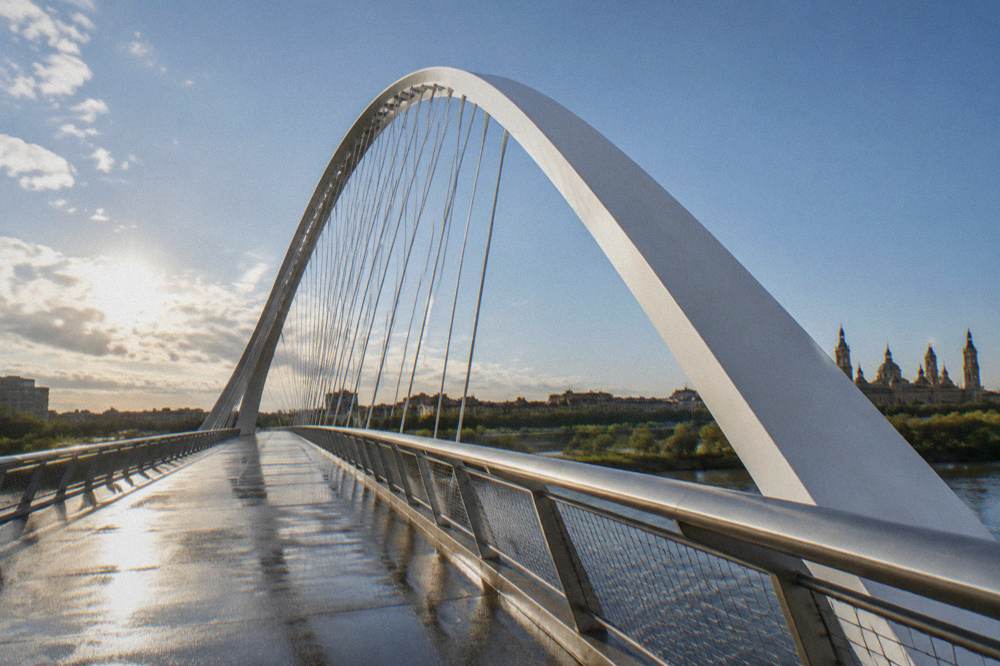
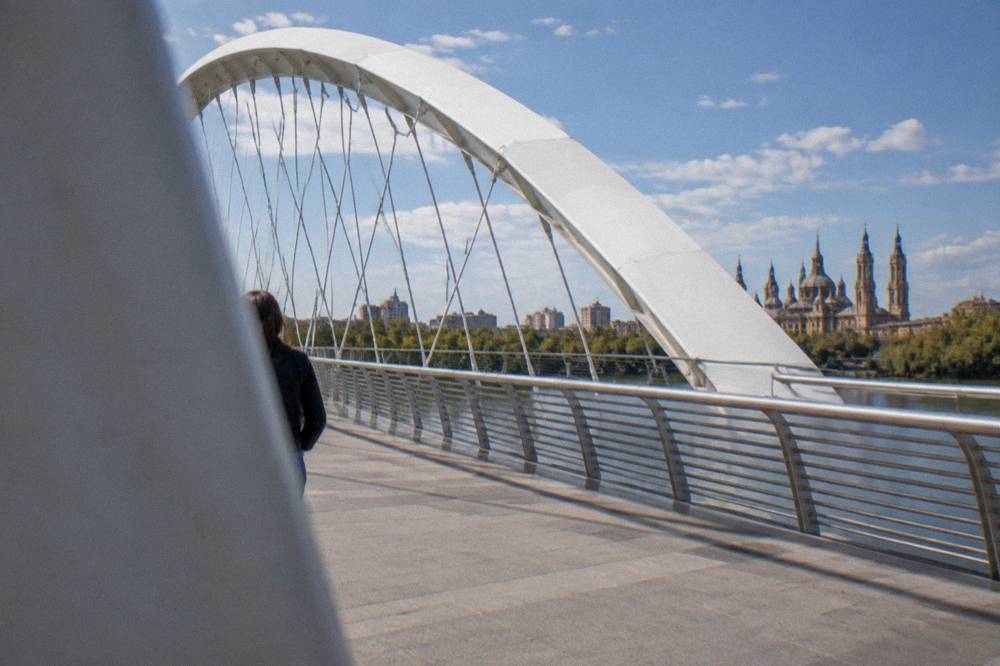
The best light on the Tercer Milenio Bridge in Zaragoza comes in the early morning and the last hour before sunset, when the low sun crosses the Ebro valley and catches the bridge's white structure against the water. AEMET's 1981 to 2010 normals for the Zaragoza Aeropuerto station show July as the sunniest month at 348 hours and October averaging 195 hours with a 21.4 C mean maximum, and the cierzo wind can clear the air sharply.
Photographers work this bridge from both banks, and the two classic compositions are different animals. From the Parque del Agua side you get the bridge against open parkland and the Expo towers behind it; from the Expo side you get the deck's curve with the river running wide in the foreground. Night is a third option, because the bridge and the surrounding Expo buildings are lit, and the water doubles every reflection.
The climate numbers matter more here than in most Spanish cities because Zaragoza is inland and dry. The AEMET 1981 to 2010 normals give the year 322 mm of rain over 51.1 days of 1 mm or more, with July and August the driest months at 17 mm each and May the wettest at 44 mm. In plain terms: you will usually get your shot, and the risk is glare rather than rain.
| Month | Mean max C (1981-2010) | Rain mm (1981-2010) | Sun hours (1981-2010) | Photography note |
|---|---|---|---|---|
| March | 17.3 | 19 | 217 | Mild evenings, clear air after cierzo days |
| May | 24.1 | 44 | 274 | Wettest month, greenest park |
| July | 32.4 | 17 | 348 | Longest light, harshest midday sun |
| September | 27.1 | 30 | 243 | Warm water, soft evenings |
| October | 21.4 | 36 | 195 | Fiestas del Pilar month, busy riverside |
| December | 10.8 | 21 | 124 | Short days, possible frost, quiet banks |
The cierzo, the cold dry north-west wind that funnels down the Ebro valley, is the wildcard. No published speed figure exists for it at this station, but it is the wind that gives Zaragoza its reputation, and on a clear cierzo day the visibility across the meander is outstanding. Bring a layer for the riverbank even in summer evenings.
How Does The Tercer Milenio Bridge Compare With Zaragoza'S Other Bridges?
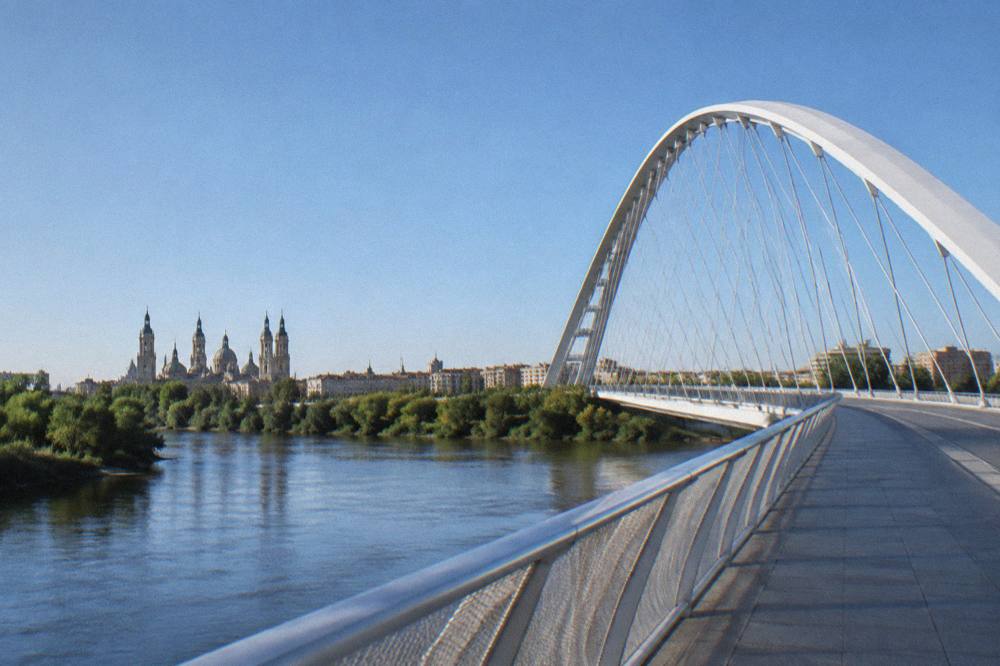
The Tercer Milenio Bridge is the modern pole of a set of five Zaragoza crossings that spans the city's whole history: the Puente de Piedra, whose current bridge was built in 1401 and opened in 1440 on a Roman-era crossing point, the stone and iron bridges of later eras, the Pabellón Puente from Expo 2008, and the Tercer Milenio itself. Where the Puente de Piedra carries you into the Roman and baroque city, the Tercer Milenio carries you into the water-and-park district.
The Puente de Piedra is the emotional centre of the set. The municipality's page records that Napoleonic troops blew up one of its arches in 1813, that four bronze lions have watched it since 1991, and that a Roman-era crossing predates the current stone bridge. From its deck you look straight at the Basílica del Pilar, which is the view most visitors come to Zaragoza for, and the contrast with the Ranillas meander could not be sharper: one bridge is about history, the other about engineering. More of these guides are collected on Zaragoza Travel Guide.
In between sit the city's workaday bridges, the stone and iron crossings that grew up with Zaragoza's industrial expansion, and then the Expo pair. The Pabellón Puente is the one that looks like a building stretched across the water, and the Tercer Milenio is the one that looks like a drawing of a bridge. Visitors who enjoy the Ebro river walk can trace the whole family in one afternoon, and the Puente de Piedra page on this site covers the old crossing in detail, while the Pabellón Puente and the water tower pages cover its Expo neighbours.
| Bridge | Era | What it connects | Character |
|---|---|---|---|
| Puente de Piedra | Built 1401, opened 1440 | Old town to the west bank | Stone, lions, the classic Pilar view |
| Older road bridges | Modern era | Centre to the northern districts | Workaday crossings |
| Pabellón Puente | Expo 2008 | Expo site banks | A building-bridge, exhibition architecture |
| Tercer Milenio Bridge | Expo 2008 | Expo site to Parque del Agua | Curved deck, the modern landmark |
The honest planning advice is not to choose. Zaragoza is one of the few Spanish cities where the river itself is the itinerary, and the Tercer Milenio Bridge is simply the newest chapter of a story that starts with a Roman ford.
Can You Visit The Tercer Milenio Bridge And The Old Town On The Same Day?
Yes, comfortably: the Tercer Milenio Bridge and Zaragoza's old town sit on the same flat Ebro corridor, so a single day can cover the Ranillas meander in the morning and the Basílica del Pilar, La Seo and the Aljafería in the afternoon. Entry to the Basílica del Pilar is free, La Seo costs 10 EUR general including three museums, and the Aljafería is 7 EUR general or 9 EUR with a guided visit.
The old town end of that day is dense with sights the municipal October timetable documents precisely. The Basílica del Pilar's tower viewpoint costs 6 EUR for an adult, 5 EUR for over 65s and residents, and 4 EUR for ages 13 to 18, students and groups of 20 or more, with under 12s free. La Seo's 10 EUR general ticket includes the Museo de Tapices, the Museo Pilarista and the Rosario de Cristal, and Aragon residents enter free on the 6th, 12th, 23rd and 27th of the month.
The Aljafería, the great Islamic palace of Aragon, runs Spanish guided tours at 10:30, 12:30, 13:30, 15:00 and 16:00, with an exhibition tour at 11:30, and last access 45 minutes before closing. The Caesaraugusta Roman museums offer a four-museum bono at 7 EUR, or 5 EUR reduced, with free entry on the first Sunday of the month, and the Roman forum museum and Roman river port museum pages cover two of them.
| Old town sight on the same day | General admission | Free or reduced notes |
|---|---|---|
| Basílica del Pilar (temple) | Free | Tower viewpoint 6 EUR adult, 4 EUR ages 13-18 |
| La Seo | 10 EUR | Includes three museums; Aragon residents free on the 6th, 12th, 23rd, 27th |
| Aljafería | 7 EUR | 9 EUR guided; free 1st and 3rd Sunday and Monday |
| Caesaraugusta four-museum bono | 7 EUR | 5 EUR reduced; free 1st Sunday |
| IAACC Pablo Serrano | Free | Tue-Sat 10-14 and 17-21, Sun 10-14 |
Two closures matter in October 2026. The Museo de Zaragoza's central building at Plaza de los Sitios 6 is closed for Ministry of Culture works with no reopening date, and the Museo Pablo Gargallo is temporarily closed, so do not build a day around either. The Museo Goya, by contrast, reopens on 9 October 2026, open Tuesday to Saturday 10:00 to 20:00 and Sunday 10:00 to 14:00, with its admission price not yet published.
A guided version of the old town half of this day exists, and it is the one this site features: the Must-See Attractions Walking Tour With a Guide covers the headline monuments with a local guide. For a first taste of the historic centre at no fixed price, the Free Monumental Tour of Zaragoza runs on a tip basis, and the Visit to the Seo or Catedral del Salvador adds a guided cathedral visit. The Parque del Agua page covers the park side of the river in full.
Is The Tercer Milenio Bridge Area Good For Families And Running?
Yes: the Tercer Milenio Bridge area is one of the most family-friendly corners of Zaragoza, Spain, because the Parque del Agua Luis Buñuel offers more than 120 hectares of open space with marked 5 and 10 km circuits, the Acuario de Zaragoza sits minutes away at 20 EUR general and 14 EUR for children 4 to 14, and the whole meander is flat, traffic-light and free to roam. Runners get the two circuits, families get the park and the aquarium, and cyclists get the riverside paths.
The park's flood-safe design means the ground is deliberately soft and open rather than formal, with wide lawns rather than flowerbeds, and the running circuits are the municipality's own published figures: 5 and 10 kilometres. For a city that hosts a major marathon-route culture along the Ebro, this meander is where locals do their daily kilometres, and the bridge itself is the natural turnaround point for anyone building a riverside loop.
Families should plan the aquarium as the anchor of the trip. Its own site claims the title of largest river aquarium in Europe with more than 5,000 specimens, all freshwater species rather than the usual sharks, which fits the Expo 2008 water theme that the whole district was built around. The online family pack at 55 EUR covers two adults and two children, and ages 0 to 3 enter free, but the daily opening hours are published only as a calendar image, so check the live calendar before promising a time.
What Should You Know Before Visiting The Tercer Milenio Bridge?
You should know four things before visiting the Tercer Milenio Bridge in Zaragoza: it is free and always open, with no ticket or hours of its own; the surrounding district is a riverside walk from the historic centre, so plan transport rather than assuming proximity; the Torre del Agua and Pabellón Puente have no verified admission or hours, so check their notices; and the whole meander is exposed, with AEMET's 1981 to 2010 normals showing just 322 mm of rain across the year.
Dress for the Ebro valley, not for the Mediterranean coast, because Zaragoza is inland with a dry continental climate and no sea anywhere near it. The cierzo wind can turn a warm afternoon cool in an hour on the riverbank, and the summer mean maximum of 32.4 C in July, from the same 1981 to 2010 normals, makes the morning the sensible time for the walk out.
Bring what you need with you. The park and the Expo site are green and spacious rather than dense with kiosks, and while the area is served by the city's bus and tram network at 1.70 EUR a single, the immediate riverbank is a place for walking shoes and a water bottle. Anyone driving should note the ZBE low emission zone applies in the Casco Histórico, not out here, but parking near the Expo site is the practical choice if you arrive by car and there is no tourist tax anywhere in Aragon to add to your budget.
Finally, do not treat the bridge as a box to tick between two photographs. It is the hinge of the modern half of Zaragoza, and the district around it, park, towers, aquarium and all, is the part of the city that most visitors under-plan. Give it a half day, ideally the evening one, and let the old town have the morning.
Common Questions About The Tercer Milenio Bridge
Is the Tercer Milenio Bridge free to visit?
Yes. The bridge is a public road and foot crossing with no ticket, no gate and no viewing fee, open at all hours. The Parque del Agua beside it is also free, while the Acuario de Zaragoza charges 20 EUR general and 14 EUR for children 4 to 14.
How far is the Tercer Milenio Bridge from the Basílica del Pilar?
The bridge sits in the Ranillas meander at the western end of the Ebro river corridor, a flat riverside walk from the historic centre. Plan it as a separate excursion from the Basílica del Pilar rather than a stop between monuments, using the bus or tram at 1.70 EUR a single or the riverside paths on foot or by Bizi bike.
Can you walk across the Tercer Milenio Bridge at night?
Yes. The bridge never closes and the surrounding Expo site and parkland are public space. The bridge and its neighbours are lit after dark, and the reflections on the Ebro make night a genuine photography option, though the exposed riverbank cools quickly when the cierzo blows.
What is the difference between the Tercer Milenio Bridge and the Pabellón Puente?
Both were built as part of the Expo 2008 works in Zaragoza. The Pabellón Puente is a covered building-bridge that served as the exposition's signature pavilion, while the Tercer Milenio Bridge is an open road, cycle and foot crossing linking the Expo site with the Parque del Agua Luis Buñuel. Neither has a verified admission price for its interior spaces, so check the venue notices.
Is the Tercer Milenio Bridge suitable for children?
Yes, in combination with the park and the aquarium. The Parque del Agua Luis Buñuel offers more than 120 hectares with 5 and 10 km circuits for scooters and bikes, and the Acuario de Zaragoza, with more than 5,000 freshwater specimens, charges 14 EUR for children 4 to 14 with under 4s free, though its daily hours are published only as a calendar image.
When is the best time of year to see the Tercer Milenio Bridge?
October is the standout month, because the Fiestas del Pilar run from 10 to 18 October 2026 and the riverside fills with life, with a 1981 to 2010 mean maximum of 21.4 C. Spring and early summer are also excellent, with May the wettest month of the year at 44 mm, and July the sunniest at 348 hours if you accept the heat.
The Tercer Milenio Bridge is the piece of Zaragoza that proves the city did not stop building in 1440, and a visit that pairs its curves with the lions of the Puente de Piedra gives you centuries of river crossings in a single day.