Fiestas Del Pilar: The Full Guide To Zaragoza's Biggest Festival
The Fiestas del Pilar turn Zaragoza, the capital of Aragon, into nine days of processions, concerts and flower offerings every October. Here is what happens, when, and how to plan around it.
Short answer
Fiestas del Pilar 2026 run from Saturday 10 to Sunday 18 October in Zaragoza, Spain. The Ofrenda de Flores falls on 12 October, when the usual route runs from Paseo de la Independencia to Plaza del Pilar. The city publishes the full programme on its official fiestas page.
The Fiestas del Pilar are the biggest thing that happens in Zaragoza, the inland capital of Aragon on the Ebro, all year. For nine days each October the city stops being simply a quiet baroque stop between Madrid and Barcelona and becomes the stage for one of Spain's largest festivals, built around the Virgen del Pilar, the patroness of Aragon and, by long tradition, of the whole Hispanic world. The municipality publishes the programme on its official fiestas page, and for 2026 the dates are fixed: Saturday 10 to Sunday 18 October.
This guide covers the dates, the events you can actually plan around, the viewpoints, the prices that are published, and the practical details of staying in the city while a festival is running. It links out to the site's own pages on the basilica, where to stay and the best time to visit Zaragoza, which carry more detail on each of those subjects.
What Are The Fiestas Del Pilar In Zaragoza?
The Fiestas del Pilar are Zaragoza's main annual festival, held every October around 12 October, the feast day of the Virgen del Pilar, who is the patroness of Aragon and of the city. The 2026 edition runs Saturday 10 to Sunday 18 October, and its centrepiece is the Ofrenda de Flores on 12 October, a mass flower offering that ends at the Basilica del Pilar.
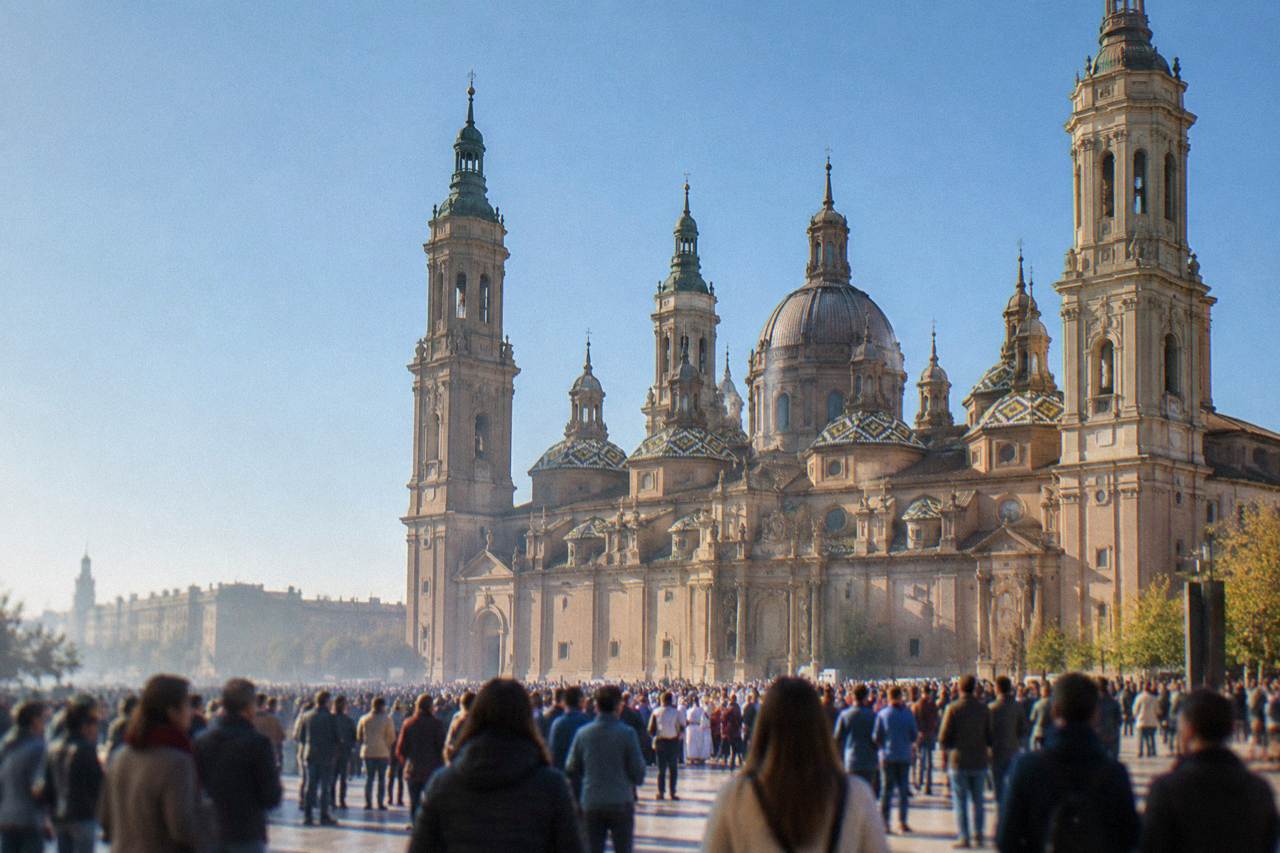
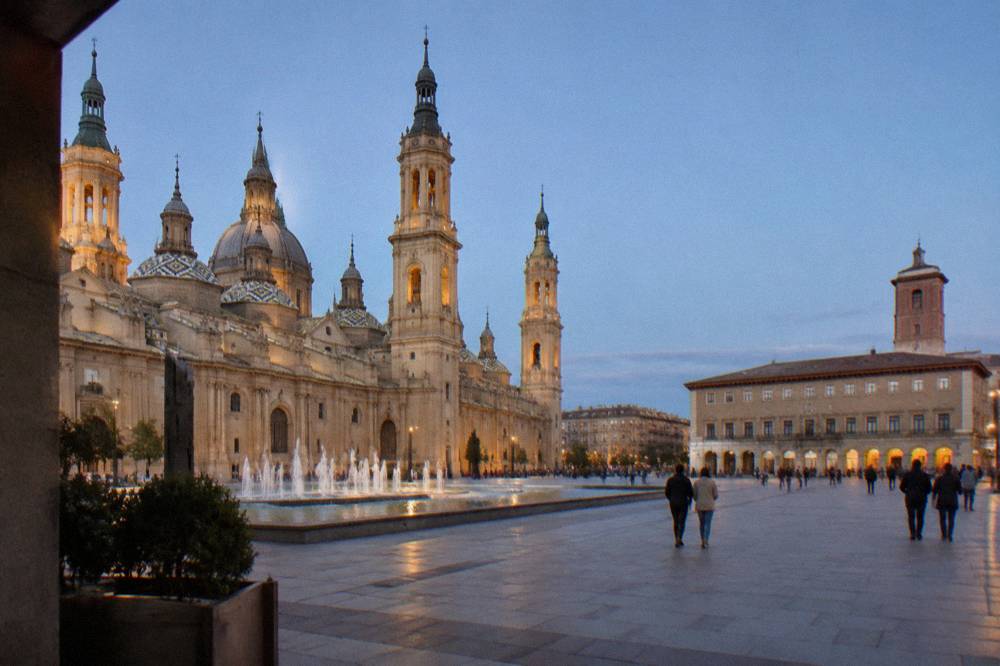
The festival honours the pillar itself, the jasper column that tradition says the Virgin Mary left for the apostle James beside the Ebro. That pillar sits inside the Basílica del Pilar, and the whole festival is oriented around it: the flower offering builds a giant mantle of blooms for the image of the Virgin, the processions converge on the Plaza del Pilar, and the fireworks close over the river within sight of the basilica's domes. The site's Plaza del Pilar guide covers the square itself.
Scale is the thing to understand early. The municipality's own fiestas page registered 994 groups for the flower offering, and the 2026 programme lists Venezuela as guest country. This is not a neighbourhood party. It is a city-wide event that fills hotels, closes streets and doubles the footfall in the old town, and planning around that is what the rest of this page is for.
When Are The Fiestas Del Pilar 2026 And What Happens Each Day?
The Fiestas del Pilar 2026 run from Saturday 10 October to Sunday 18 October 2026, per the city's official fiestas page. The pregón, the opening speech, is reported for Saturday 10 October at 21:00 from the Ayuntamiento balcony, and the Ofrenda de Flores is confirmed for Sunday 12 October, following its usual route from Paseo de la Independencia to Plaza del Pilar.
The confirmed spine of the festival is short and solid. The city's page gives the 10 to 18 October window and the 12 October flower offering. Local press adds detail that the official page had not confirmed at publication, and those items should be read as reported rather than promised: the pregón from the town hall balcony on the opening Saturday, the Ofrenda de Frutos and the Rosario de Cristal on 13 October, and an expanded fireworks programme with shows after the pregón, in Parque Pignatelli, in the new Plaza San Francisco, and a closing display beside the Ebro on 18 October. Reported programme highlights include jota contest finals on 10 and 11 October, free concerts, and new stages such as the Raíz stage in Plaza Salamero.
| Date | Event | Status |
|---|---|---|
| Sat 10 Oct 2026 | Festival opens, pregón reported at 21:00 from the Ayuntamiento balcony | Reported by local press |
| Sun 10 to Sun 18 Oct | Full festival programme city-wide | Confirmed on the official fiestas page |
| Sun 12 Oct 2026 | Ofrenda de Flores, usual route Paseo de la Independencia to Plaza del Pilar | Confirmed on the official fiestas page |
| Tue 13 Oct 2026 | Ofrenda de Frutos and Rosario de Cristal | Reported, not confirmed on the official page |
| Sun 18 Oct 2026 | Closing fireworks beside the Ebro | Reported by local press |
Two things follow from the calendar. First, 12 October is both the feast of the Virgen del Pilar and Spain's national day, so the flower offering day is the busiest single day the city sees all year, and it is a public holiday across the country. Second, the festival's second weekend, not the first, carries the closing events, so a stay from Thursday 15 to Sunday 18 October gets the closing fireworks with slightly less pressure on rooms than the opening stretch.
The guided options below are the ones that fit the festival best, because they are built around the two monuments the whole city is looking at during these nine days.
What Is The Ofrenda De Flores And How Does It Work?
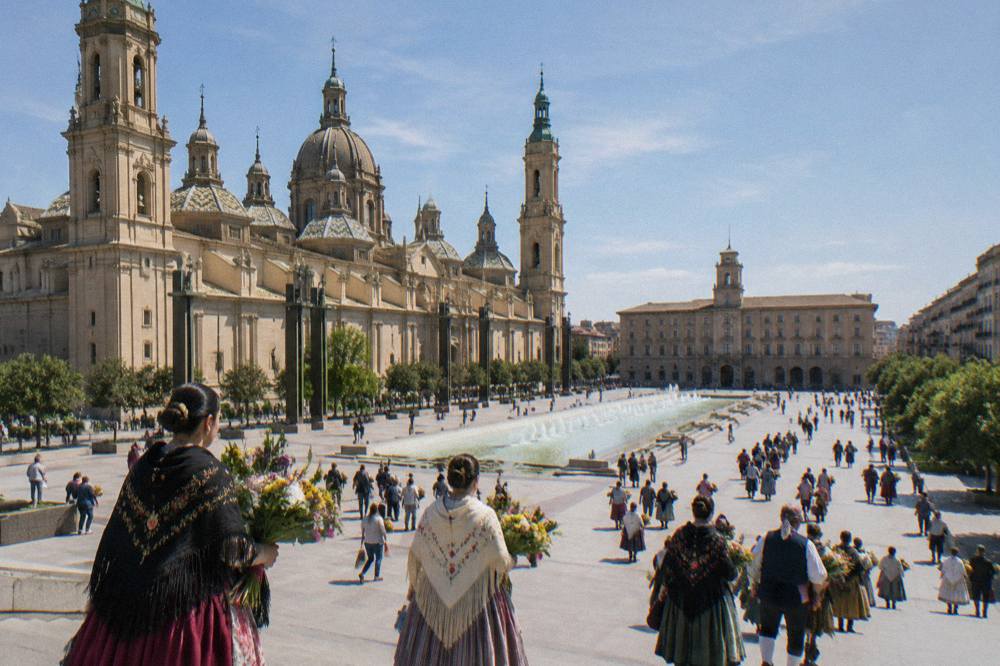
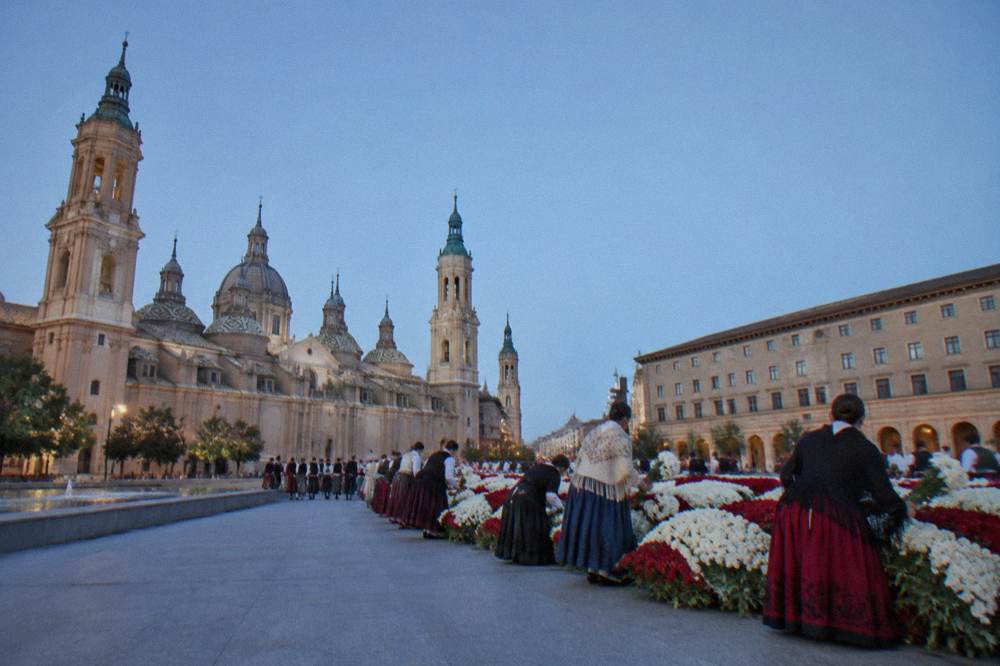
The Ofrenda de Flores is a mass flower offering to the Virgen del Pilar held on 12 October, in which registered groups in Aragonese regional dress carry flower bunches along the usual route from Paseo de la Independencia to Plaza del Pilar, where the blooms are built into a giant mantle for the image of the Virgin in the basilica.
The scale comes from the numbers the city itself publishes: 994 registered groups take part. Groups set off from early morning, and the offering runs through the whole day, so there is no single moment to photograph but a rolling column of white blouses, black skirts, headscarves and armfuls of flowers that takes hours to pass any given point. The municipality's page notes the start is from about 06:30.
Watching it well is about position more than timing. The start near Paseo de la Independencia is less dense than the finish; the final stretch into Plaza del Pilar is the classic view but the tightest crowd of the year. The Paseo de la Independencia area guide covers hotels that put you within walking distance of both ends.
If you want to understand what you are looking at rather than just watching it pass, a guided visit to the basilica is the efficient way in, and the site's full review of the Spanish-language basilica visit explains what the 1.5-hour tour covers. The listing rates it 4.7 from 46 reviews, from $12.38 per person.
One practical note on timing: the basilica keeps its normal visiting pattern through the festival, so a guided visit slots easily into a festival morning or the late afternoon gap between the daytime offering and the evening concerts. Book the time you want early in your stay, because the festival pulls far more visitors than a normal October week and the guided slots are the first thing to fill.
What Are The Best Spots To Watch The Fiestas From In Zaragoza?
The best viewpoints are the Plaza del Pilar for the flower offering's finish, the Puente de Piedra and the Ebro banks for the closing fireworks, and the Paseo de la Independencia for the start of the offering and the daytime processions, with the basilica's own tower viewpoint as the paid option above it all.
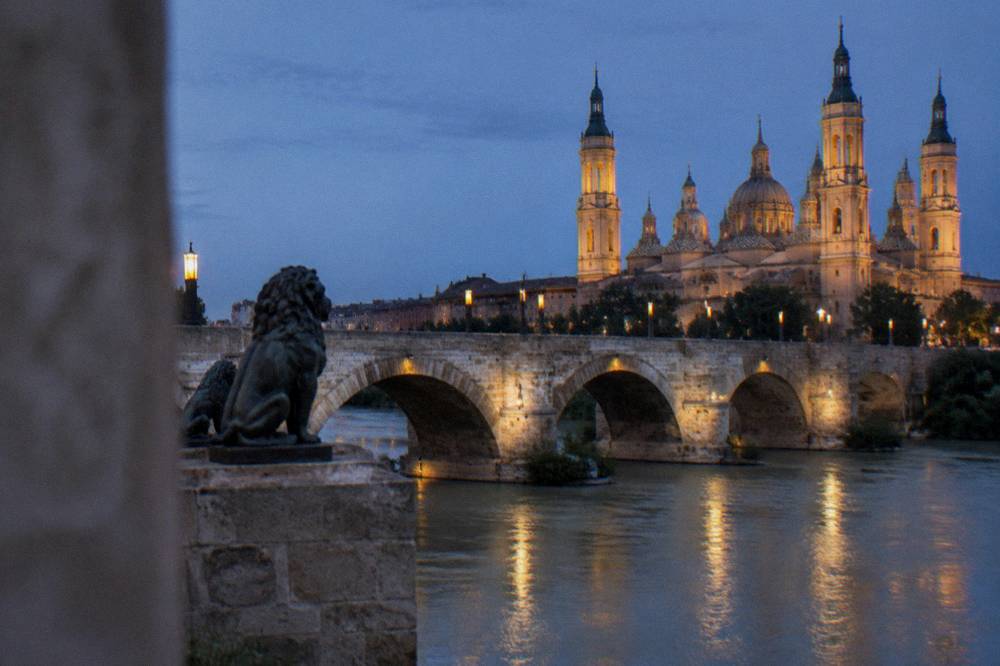
The free choices are obvious once you know the geography. The Plaza del Pilar is the festival's heart, and everything converges there. The Puente de Piedra, the stone bridge whose current version was built from 1401 and opened in 1440, gives the classic river-level frame of the basilica's domes, and the Ebro banks on both sides carry the closing firework crowds on 18 October. The Ebro river walk guide on this site describes that stretch of bank in detail.
The paid option is the basilica's Torre Mirador, the tower viewpoint. The municipal October timetable prices it at 6 EUR for adults, 5 EUR for over 65s and residents, 4 EUR for ages 13 to 18, students and groups of 20 or more, and free for under 12s. Hours are Monday to Thursday 10:30-14:30 and 16:00-20:00, Friday to Sunday 10:00-20:00, with last access 30 minutes before closing. During the fiestas that Friday-to-Sunday span is the one that matters, and booking ahead is sensible because the tower is the one place with a fixed capacity.
| Viewpoint | What you see | Cost |
|---|---|---|
| Plaza del Pilar | Finish of the Ofrenda de Flores, processions, basilica facade | Free |
| Puente de Piedra | Basilica domes over the river, fireworks on closing night | Free |
| Paseo de la Independencia | Start of the Ofrenda de Flores route | Free |
| Ebro river banks | Fireworks, crowds, river reflections | Free |
| Basilica Torre Mirador | The whole city and festival from above | 6 EUR adult |
One caution the basilica's own situation imposes: a restoration of the Regina Patriarcharum dome, funded by Fundacion Ibercaja at 600,000 EUR, was agreed on 23 January 2026 with work expected to last about six months from a February start, and its completion is not confirmed. Works may affect what you see from some angles, so check the basilica's own site before counting on a clean dome in your photographs.
What Do The Basilica And The Other Monuments Cost During The Fiestas?
Entering the Basilica del Pilar is free, with the tower viewpoint at 6 EUR for adults, the Aljafería at 7 EUR general or 9 EUR with a guided tour, La Seo at 10 EUR general including three museums, and the Caesaraugusta museums at 3 to 4 EUR each or 7 EUR for a four-museum bono, all per the city's October monument timetable.
The basilica keeps its normal pattern through the festival, which surprises people. The Holy Chapel zone runs 8:00-20:30, the main altar zone Monday to Saturday 7:30-13:30 and 16:30-20:15, and Sunday 7:30-13:30 and 16:30-21:30, with shorter Saturday hours when weddings are scheduled. The Museo Pilarista is open daily 10:00-13:30 and 16:00-20:00. The temple is a working church and the festival does not close it, but 12 October itself is heavy with services and the offering, so treat a quiet interior visit as a morning-of-a-weekday proposition. The wider set of guides lives on Zaragoza Travel Guide.
| Monument | General price | October hours |
|---|---|---|
| Basílica del Pilar (temple) | Free | Holy Chapel 8:00-20:30 daily |
| Basílica del Pilar tower | 6 EUR | Mon-Thu 10:30-14:30, 16:00-20:00; Fri-Sun 10:00-20:00 |
| Aljafería | 7 EUR, 9 EUR guided | Daily 10:00-18:00 |
| La Seo (incl. Museo de Tapices, Museo Pilarista, Rosario de Cristal) | 10 EUR | Mon-Sat 10:00-14:30, 16:00-20:00; Sun 10:00-12:00, 16:00-20:00 |
| Caesaraugusta Foro | 4 EUR | Tue-Sat 10:00-14:00, 17:00-21:00; Sun 10:00-14:30 |
| Caesaraugusta four-museum bono | 7 EUR | Same as individual museums |
The Aljafería is the other monument the festival programme leans on, and its own guided-tour products are the natural fit if you want the palace explained rather than just walked through. The Aljafería Palace guide on this site covers the building; for the festival visit, the guided options are below.
Free-entry days are worth knowing because they collide with the festival. The Caesaraugusta museums are free the first Sunday of the month, which in October 2026 falls inside the festival window, and the Aljafería is free the first and third Sunday and Monday of each month. Those days are also the most crowded days of the month at those monuments, so the free entry trades money for queue.
How Do You Get Around Zaragoza During The Fiestas?
A single ticket on Zaragoza's urban bus or tram costs 1.70 EUR, or 0.55 EUR with a Tarjeta Bus that costs 7 EUR, the tourist bus is 10 EUR for 24 hours of hop-on hop-off across 16 stops, and the airport bus is line 505 at 4.65 EUR single, with the city's low-emission zone restricting unlabelled cars in the old town Monday to Friday 08:00-20:00.
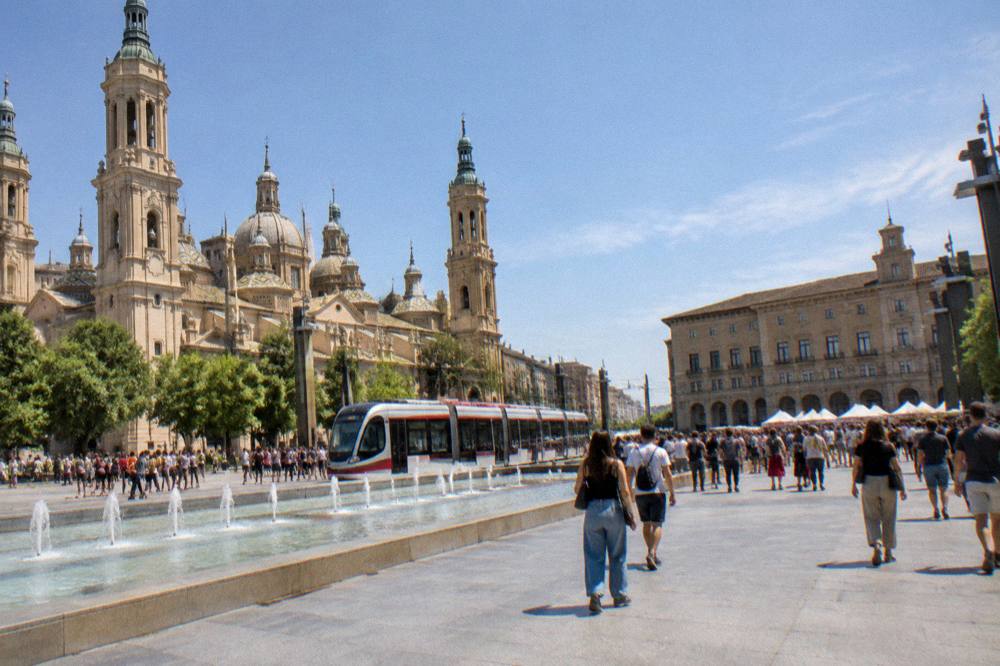
The tram and bus network is the practical answer during the festival because the old town's streets are full of people and, on the offering day, closed to through traffic. The 2026 Avanza fare table lists the single at 1.70 EUR, 1.00 EUR on night lines, and 0.55 EUR with the rechargeable card. The tourist bus, per the municipality's page, runs a 90-minute loop with 16 stops and takes cash only on board.
| Transport | Single fare | Notes |
|---|---|---|
| Urban bus | 1.70 EUR | 0.55 EUR with Tarjeta Bus; no transfer |
| Tram line 1 | 1.70 EUR | Same fare as bus, per the 2026 Avanza table |
| Night bus lines | 1.00 EUR | Per the 2026 Avanza table |
| Tourist bus | 10 EUR | 24 h hop-on hop-off, 16 stops, 90-minute loop, cash on board |
| Airport bus (line 505) | 4.65 EUR | About 2.25 EUR with a Lazo card, timed to flights |
If you are driving in, the low-emission zone matters. The ZBE Casco Histórico has applied sanctions since 12 December 2025, restricting vehicles without a DGT environmental label Monday to Friday 08:00-20:00, with a 15-minute grace period if you enter by mistake. The festival sits exactly inside that zone, so a car without a label is the wrong tool for these nine days. The site's getting around Zaragoza guide has the fuller picture, and the airport to city centre guide covers the line 505 in detail.
What Is The Weather Like In Zaragoza In October?
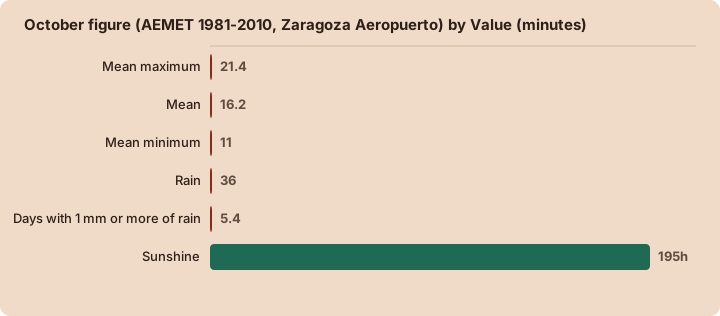
AEMET's 1981-2010 normals for the Zaragoza Aeropuerto station put October at a mean maximum of 21.4 C, a mean of 16.2 C, a mean minimum of 11.0 C, and 36 mm of rain over 5.4 days with 1 mm or more, which makes it a mild, mostly dry month rather than a hot one.
Those figures are the 1981-2010 averages for the airport station, and they describe a festival you can walk all day in. A jacket for the evenings is the standard advice: the mean minimum of 11.0 C means the fireworks crowds on the riverbank at night are standing in cool air, and the cierzo, the cold dry north-west wind of the Ebro valley, can drop the felt temperature further, though AEMET publishes no speed figure for it.
| October figure (AEMET 1981-2010, Zaragoza Aeropuerto) | Value |
|---|---|
| Mean maximum | 21.4 C |
| Mean | 16.2 C |
| Mean minimum | 11.0 C |
| Rain | 36 mm |
| Days with 1 mm or more of rain | 5.4 |
| Sunshine | 195 hours |
The rain number is the one that surprises people who assume southern-Spanish weather. At 36 mm over 5.4 wet days, October in Zaragoza is wetter than July or August, which average 17 mm each, but drier than May, the wettest month at 44 mm. Pack for the possibility of a wet afternoon, not a wet week. The site's Zaragoza weather guide carries the full monthly table.
Where Should You Stay For The Fiestas Del Pilar?
The best base for the festival is the old town or the Paseo de la Independencia corridor, because the Ofrenda de Flores route, the Plaza del Pilar and the fireworks on the Ebro are all walkable from there, and the tram's 1.70 EUR single makes anywhere on line 1 a practical second choice once the old town's hotels fill.
Distance is the wrong thing to optimise for during these nine days; crowd flow is the right one. The flower offering runs down Paseo de la Independencia into Plaza del Pilar, the pregón is from the Ayuntamiento balcony on the same square, and the closing fireworks are beside the Ebro, all within a rectangle you can cross on foot in under half an hour when the streets are empty. During the festival they are never empty, so a hotel inside that rectangle saves you the worst of the crush twice a day. The site's where to stay in Zaragoza guide breaks the neighbourhoods down properly.
Book early and expect the peak around 10 to 12 October, the pregón weekend and the offering. The second weekend, 15 to 18 October, carries the reported concert highlights and the closing fireworks, and rooms there are usually under slightly less pressure than the national-holiday stretch.
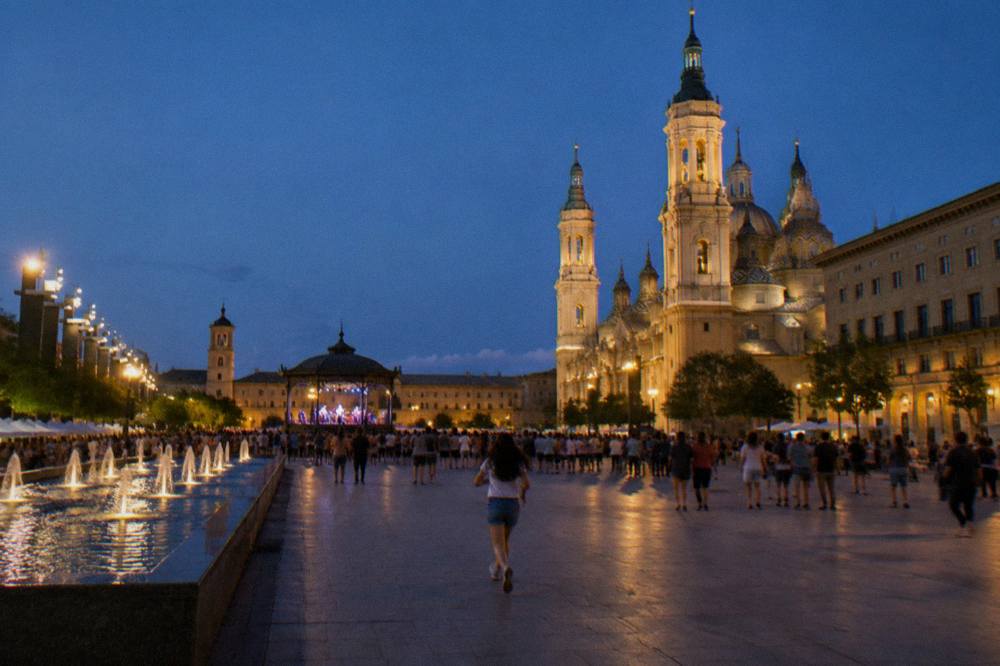
If the festival itself is only part of your visit, the guided options below cover the two monuments most visitors want explained, and both run year-round, not only during the festival.
What Should You Know Before Going To The Fiestas Del Pilar?
The four things that shape a festival visit are that 12 October is a national holiday, that the old town's low-emission zone restricts unlabelled cars on weekdays, that the Ofrenda de Flores starts before dawn and runs all day, and that the Museo de Zaragoza's central building is closed for Ministry of Culture works, so plan museum time around the Caesaraugusta sites and the Aljafería instead.
The holiday point matters more than visitors expect. On 12 October, Spain celebrates its national day and Zaragoza celebrates the Virgen del Pilar on the same date, so shops, offices and many services close across the country while the city centre fills with festival crowds and arriving regional groups. Eat before you need to, and do not plan errands for that day.
The museum point matters for rainy afternoons. The Museo de Zaragoza's central building at Plaza de los Sitios 6 is closed for Ministry of Culture works with no reopening date, and its Etnología and Cerámica sections in Parque Grande are also shut at present. The Caesaraugusta museums, the Aljafería and La Seo are the working alternatives, and the free first-Sunday entry at Caesaraugusta lands inside the festival window. For a fuller festival-plus-city plan, the site's one-day itinerary for Zaragoza shows how the pieces fit together when time is short.
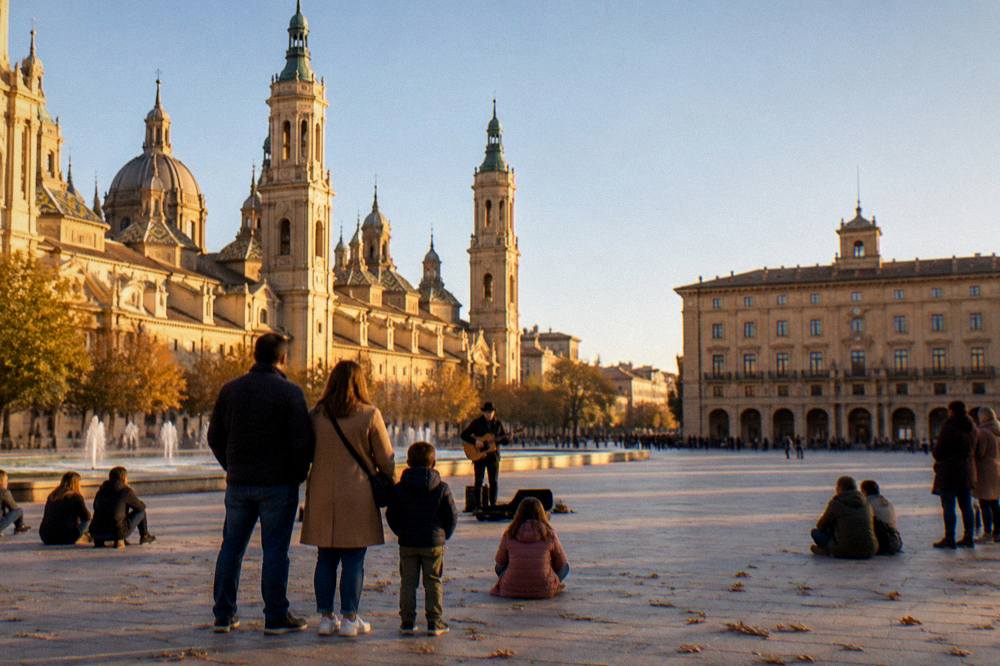
For the Aljafería, the ticket-and-guided-visit product below is the English-friendly option if your Spanish is not up to a Spanish-language tour, and the palace is open daily 10:00-18:00 in October with last access 45 minutes before closing.
Common Questions About The Fiestas Del Pilar
What Are The Fiestas Del Pilar?
They are Zaragoza's main annual festival, held every October around 12 October, the feast day of the Virgen del Pilar. The 2026 edition runs 10 to 18 October, and its centrepiece is the Ofrenda de Flores, a mass flower offering that ends at the Basilica del Pilar.
When Is The Ofrenda De Flores 2026?
On 12 October 2026, confirmed on the city's official fiestas page, following the usual route from Paseo de la Independencia to Plaza del Pilar. The start is reported from about 06:30, and the offering runs through the day.
Is 12 October A Public Holiday In Spain?
Yes. 12 October is Spain's national day and the feast of the Virgen del Pilar, so it is a public holiday across the country and the single busiest day of the year in Zaragoza's centre.
How Much Does It Cost To Go To The Fiestas Del Pilar?
Nothing to watch. The programme's street events, processions and fireworks are free and open; the costs are the basilica tower at 6 EUR, transport at 1.70 EUR a single, and whatever you spend on food and rooms, with no tourist tax in Aragon.
Where Is The Best Place To Watch The Ofrenda De Flores?
The finish in Plaza del Pilar is the classic view and the densest crowd; the start near Paseo de la Independencia is lighter, and the whole route is walkable, so many people watch an hour at the start and then move toward the square.
Do The Fiestas Del Pilar Have Fireworks Every Night?
The reported 2026 programme spreads pyrotechnic shows across the festival, after the pregón on 10 October, in Parque Pignatelli, in the new Plaza San Francisco, and closing beside the Ebro on 18 October, rather than a single display. Check the city's programme page for the final schedule.
The festival's real pull is that it is not a show put on for visitors at all: it is the city's own holiday, with 994 registered groups bringing flowers to their patroness, and everything a visitor does during those nine days, from the tower viewpoint to a tapas bar in the old town, happens inside a celebration that would run whether anyone came to watch or not. That is the difference between attending the Fiestas del Pilar and attending almost any other European city festival, and it is why the dates 10 to 18 October 2026 are worth building a whole trip around.