Best Time To Visit Zaragoza
Zaragoza, the capital of Aragon on the Ebro, is an inland city with dry summers, crisp winters and one enormous festival in October. Here is how to pick the right month.
Short answer
The best time to visit Zaragoza is May, June, September or early October, when AEMET's 1981-2010 averages show pleasant temperatures and manageable rain. Mid-July and August are the hottest months; 10 to 18 October brings the Fiestas del Pilar.
Zaragoza, the capital of Aragon, sits inland on the Ebro a long way from any coast, and that geography decides its calendar: the city bakes in July and August, cools fast after sunset in a way coastal Spain never does, and puts on its biggest party of the year in the second week of October. Choosing when to go matters more here than in Valencia or Barcelona, because the gap between the best month and the worst month is wide. This guide works through the AEMET climate averages for the Zaragoza Aeropuerto station, the festival calendar and the practical rhythms of the city, so the choice becomes a simple one.
What Is The Best Time To Visit Zaragoza?
The best time to visit Zaragoza is May, June, September or the first three weeks of October, when AEMET's 1981-2010 averages show mean temperatures of 16 to 23 C and few rain days. October adds the Fiestas del Pilar, from 10 to 18 October 2026, at the cost of peak crowds. July and August, with mean maxima of 32.4 and 31.7 C, are the months to treat with care.
The reasoning behind that answer is arithmetic, not taste. Zaragoza's year averages 15.5 C overall, with 322 mm of rain spread over just 51.1 days, which makes it one of the driest provincial capitals in Spain. Rain is rarely the problem; heat and cold are. The 1981-2010 normals put July's mean maximum at 32.4 C and January's mean minimum at 2.7 C, and because the city sits on a high inland plateau at 249 m above sea level, the temperature swings within a single day are large in every season.
May and June hit a sweet spot before the heat arrives. September recovers quickly once the summer peak passes. October is the month the city itself has chosen for its biggest celebrations, the Fiestas del Pilar, which tells you a good deal about what the people who live here think of their own weather. For the full climate breakdown, see Zaragoza Weather: Averages, Wind And What To Expect Each Month.
How Does Zaragoza'S Weather Change Through The Year?
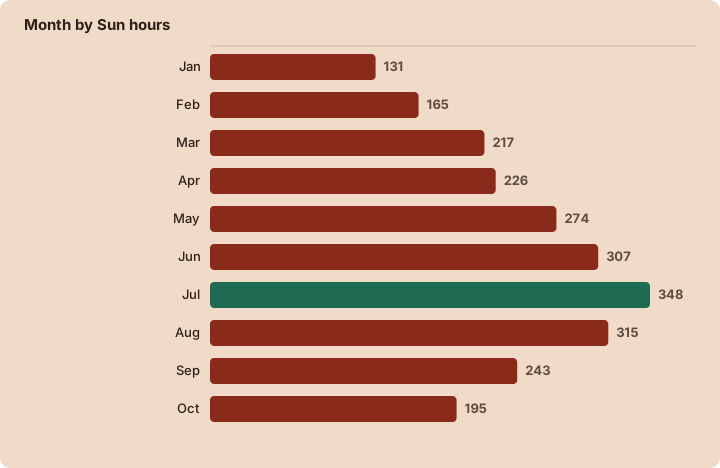
AEMET's 1981-2010 climate normals for the Zaragoza Aeropuerto station show a dry continental pattern: the coldest month is January at a mean of 6.6 C, the hottest is July at a mean of 25.3 C with a mean maximum of 32.4 C, May is the wettest month at 44 mm, and July and August tie as the driest at 17 mm each. The year as a whole averages 15.5 C, 322 mm of rain and 2,693 hours of sunshine.
Those figures come from the only averaging window the station page publishes, so treat them as long-term averages rather than a forecast for any given week. The distribution matters more than the headline. Rain falls on only 51.1 days a year with 1 mm or more, and even the wettest month, May, averages just 44 mm, so a rained-out day is unusual in any season. What the table also shows is how fast spring turns to summer: the mean maximum climbs from 17.3 C in March to 24.1 C in May and 29.3 C in June.
| Month | Mean C | Mean max C | Mean min C | Rain mm | Rain days 1 mm+ | Sun hours |
|---|---|---|---|---|---|---|
| Jan | 6.6 | 10.5 | 2.7 | 21 | 4.0 | 131 |
| Feb | 8.2 | 13.1 | 3.3 | 22 | 3.9 | 165 |
| Mar | 11.6 | 17.3 | 5.8 | 19 | 3.7 | 217 |
| Apr | 13.8 | 19.6 | 7.9 | 39 | 5.7 | 226 |
| May | 18.0 | 24.1 | 11.8 | 44 | 6.4 | 274 |
| Jun | 22.6 | 29.3 | 15.8 | 26 | 4.0 | 307 |
| Jul | 25.3 | 32.4 | 18.3 | 17 | 2.6 | 348 |
| Aug | 25.0 | 31.7 | 18.3 | 17 | 2.3 | 315 |
| Sep | 21.2 | 27.1 | 15.2 | 30 | 3.2 | 243 |
| Oct | 16.2 | 21.4 | 11.0 | 36 | 5.4 | 195 |
| Nov | 10.6 | 14.8 | 6.3 | 30 | 5.1 | 148 |
| Dec | 7.0 | 10.8 | 3.2 | 21 | 4.8 | 124 |
The annual extras at the same station fill out the picture: 61 percent average humidity, 23.1 frost days, 21.3 fog days and 81.6 clear days a year. The frost and fog both belong to the winter half of the year, when cold air settles in the Ebro valley. The cierzo, the cold, dry north-westerly wind that funnels down the valley, can sharpen a winter day considerably; AEMET issues wind warnings for Aragon when it blows hard, and it is a reason to pack a windproof layer between November and March even when the sky is blue.
Whatever month you pick, a first afternoon with a guide sets the geography straight before you explore alone. The 105-minute Monumental Sightseeing Tour, the city's cheapest guided introduction at $10.41 per person and rated 4.4 from 36 reviews, covers the core monuments in a single loop, and the operator's live listing shows the current departure times.
Which Month Should You Choose For Zaragoza?
May and June are the strongest all-round months, with 1981-2010 mean maxima of 24.1 and 29.3 C and the year's longest evenings; September is the best month once the peak heat has passed; October suits visitors who want the Fiestas del Pilar; and March, April and early November suit travellers who prefer empty squares and cool walking weather over warmth.
Each month earns its place for a different traveller. A visitor whose priority is sitting outside in the evening wants June, when the mean minimum is 15.8 C and dinner on a terrace is comfortable past midnight. A visitor whose priority is photography wants the low, warm light of October, when the mean maximum of 21.4 C keeps walking pleasant all day. A visitor who mainly wants the city to themselves should look at November or February, accepting mean maxima of 14.8 and 13.1 C in exchange for short queues everywhere.
| If you want | Best months | Why |
|---|---|---|
| Warm evenings outdoors | June, early July | Mean minima of 15.8 and 18.3 C, 307 and 348 sun hours |
| The festival | 10 to 18 October | Fiestas del Pilar, Ofrenda de Flores on 12 October |
| Fewest crowds | November, February | Off-season, mean maxima of 14.8 and 13.1 C |
| Cheapest stays | November to March, excluding events | Low season outside festival and holiday weeks |
| Cool sightseeing | March, April, October | Mean maxima of 17.3 to 21.4 C |
| Longest days | June | Highest sun hours before the July peak |
One caution belongs in this comparison: the Fiestas del Pilar reverse the low-season logic inside October. The city fills for those nine days, and accommodation that sits empty in early October is booked solid from the 10th to the 18th. If the festival is the reason for the trip, book early; if the festival is a reason to avoid the city, arrive in September or after the 18th. The dedicated Fiestas del Pilar guide breaks down the programme day by day.
Is October The Best Month To Visit Zaragoza?
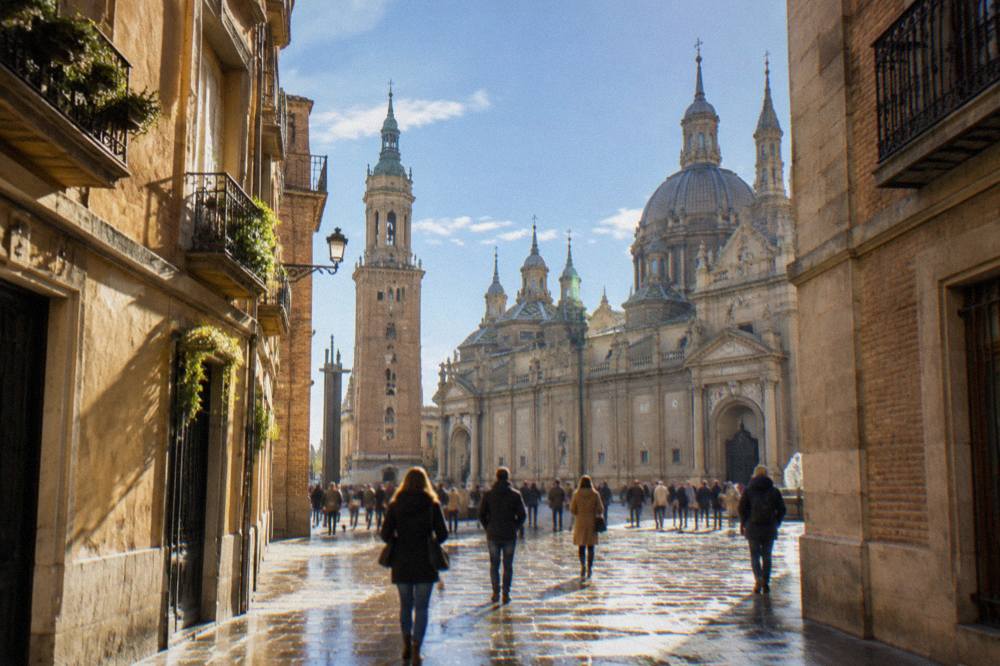
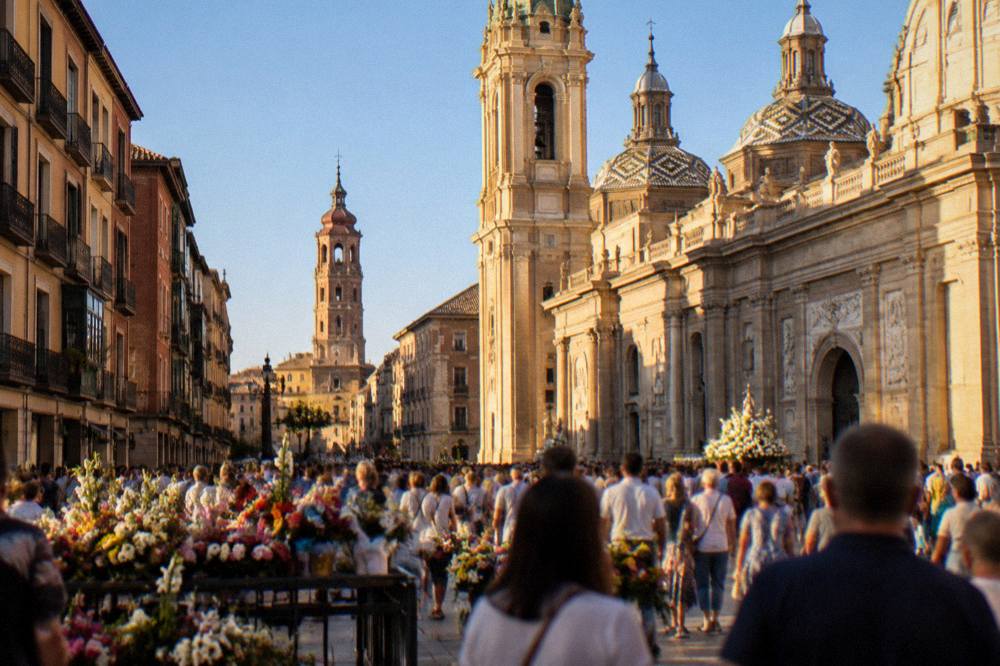
October is the month the city saves its biggest event for: the Fiestas del Pilar run from 10 to 18 October 2026, with the Ofrenda de Flores on 12 October, when hundreds of groups file from Paseo de la Independencia to Plaza del Pilar. The 1981-2010 averages give October a mean of 16.2 C and a mean maximum of 21.4 C, which is close to ideal walking weather, and 36 mm of rain over 5.4 days.
The festival is the single largest thing on Zaragoza's calendar, and it changes the character of the city completely for nine days. The pregón opens it from the balcony of the Ayuntamiento at 21:00 on 10 October; the Ofrenda de Flores fills the route from Paseo de la Independencia to Plaza del Pilar with flowers through the day of 12 October; the Ofrenda de Frutos and the Rosario de Cristal are reported for 13 October; and fireworks close the programme by the Ebro on the 18th. Venezuela is the guest country for the 2026 edition, and the concert programme includes free shows in the city's squares.
Against that, weigh the practicalities. The Ofrenda de Flores means the centre is crowded from early morning on the 12th, and the municipal monument timetable shows knock-on schedule changes: the Rosario de Cristal display is closed from 4 to 15 October, the Palacio de Sastago is closed in October and the Museo Pablo Gargallo is temporarily closed. A visitor who arrives for the festival should plan around those closures; a visitor who arrives in late October should check what has reopened. The Ofrenda de Flores guide covers the flower offering in detail.
October also carries one closure worth knowing regardless of the festival: the Museo Goya, the Fundación Ibercaja collection, reopens on 9 October 2026 after renovation, with Tuesday to Saturday hours of 10:00 to 20:00 and Sunday hours of 10:00 to 14:00. An October visit is the first chance in the renovation period to see it.
Is Summer Too Hot For Sightseeing In Zaragoza?
July and August are genuinely hot, with 1981-2010 mean maxima of 32.4 and 31.7 C and mean minima of 18.3 C, but they are also the sunniest and driest months of the year, at 348 and 315 sun hours and 17 mm of rain each. Summer sightseeing in Zaragoza works if the day is shaped around the heat: monuments in the morning, a long lunch indoors, and the old town after 19:00.
The numbers say hot; they also say reliable. With just 2.6 and 2.3 rain days in July and August respectively, a summer visit almost never loses a day to weather, and 81.6 clear days a year at the station mean blue sky is the default. The mistake to avoid is treating Zaragoza like a coastal city in August. There is no sea here, no beach and no sea breeze; the Ebro valley heats up through the day and cools sharply after dark, which makes the evenings pleasant but the mid-afternoon streets punishing.
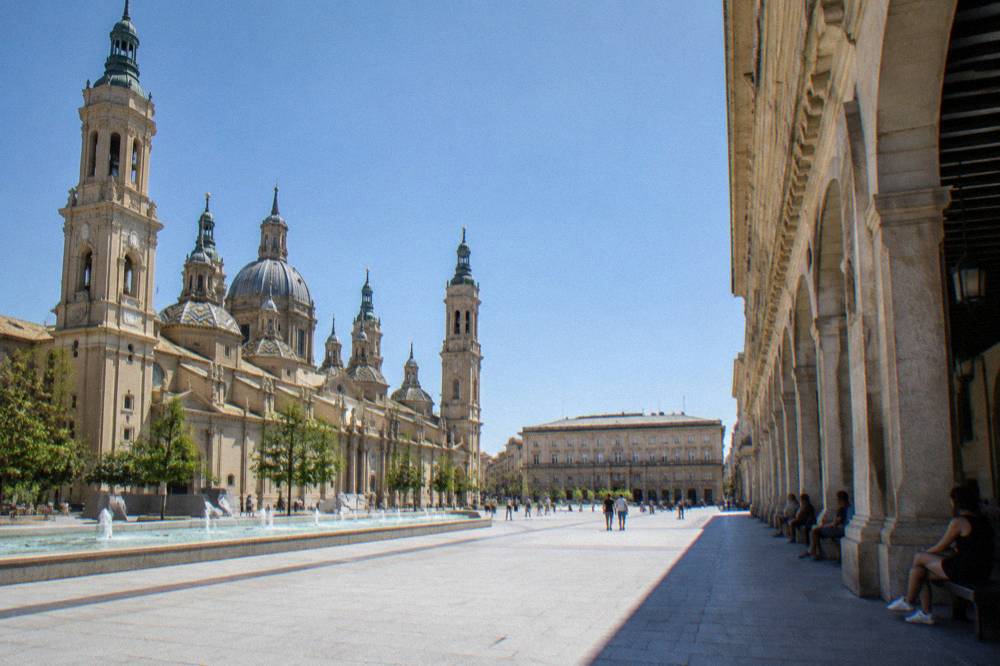
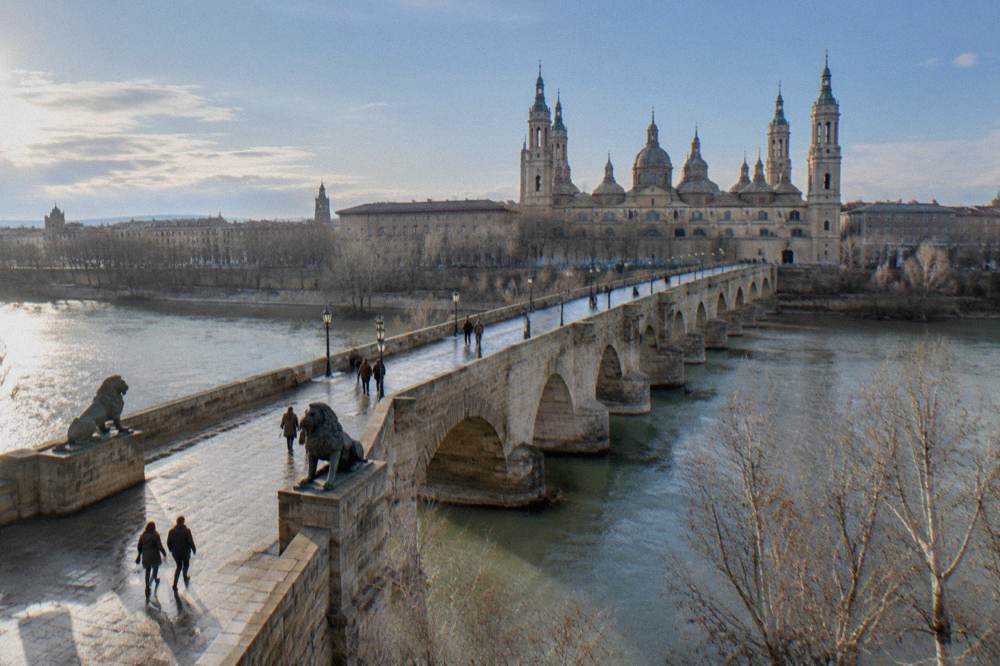
The practical pattern locals follow is the one worth copying. Enter the Aljafería or the Caesaraugusta museums in the middle of the day, where the thick stone walls hold the cool, and save the Puente de Piedra and the riverside walk for the evening, when the mean minimum of 18.3 C feels like relief. The Aljafería opens daily 10:00 to 18:00 in October and charges EUR 7 general admission, EUR 9 with a guided tour, and the Caesaraugusta museums run 10:00 to 14:00 and 17:00 to 21:00 Tuesday to Saturday, so there is a late slot built into the timetable. The Zaragoza At Night guide picks up where the hot afternoon leaves off.
What Is Winter Like In Zaragoza?
Winter is cold for Spain: AEMET's 1981-2010 normals give January a mean of 6.6 C with a mean maximum of 10.5 C and a mean minimum of 2.7 C, and the year totals 23.1 frost days and 21.3 fog days. Rain stays low, at 21 mm in January and December, so winter in Zaragoza is mostly dry, bright and sharply cold at night rather than grey.
The inland plateau is the reason. Zaragoza sits at 249 m in the middle of the Ebro valley, far from the moderating effect of the Mediterranean, and the same dryness that makes July fierce makes January crisp. Fog is the winter wildcard: 21.3 fog days a year, concentrated in the cold months, can flatten visibility along the river in the early morning, and it usually burns off by late morning as the sun climbs.
Winter rewards a certain kind of visitor. The queues at the Pilar tower, EUR 6 for an adult ticket, are short; the free museums, including the IAACC Pablo Serrano and the Centro de Historias, cost nothing and are warm; and the tapas bars of the old town are at full local volume rather than festival volume. Semana Santa, the Easter week of processions, is the one winter-period event that fills the city; in 2027 it runs from 21 to 28 March, with Palm Sunday on 21 March and Good Friday on 26 March, and the Semana Santa in Zaragoza guide covers it. For a sense of the city without spending, the Free Things To Do In Zaragoza guide lists the no-cost sights that shine in low season.
When Is The Cheapest Time To Visit Zaragoza?
The cheapest months to visit Zaragoza are November through March, excluding the Christmas period and any festival week, when demand drops and hotel rates follow; the most expensive nights of the year are 10 to 18 October for the Fiestas del Pilar, followed by Semana Santa and the Easter holiday. Midweek stays undercut weekends in every season.
The cost structure follows the festival calendar more than the weather. October is, on paper, a shoulder month, but the Fiestas del Pilar turn its second week into the year's peak, and prices behave accordingly. One permanent saving worth knowing: Aragon has no tourist tax, and the regional government ruled one out in September 2026 on the grounds that it would discourage visitors, so the price of a room is the whole price of a room.
Getting there also varies by season rather than by month. High-speed trains connect Zaragoza-Delicias to Madrid and Barcelona in about 1.5 to 2 hours, and the budget airlines serving Zaragoza Airport discount hardest in the quiet months. The Zaragoza Cost And Budget guide itemises the daily figures, and the Flights To Zaragoza guide covers the airlines and destinations.
| Period | Demand | What it means for price |
|---|---|---|
| 10 to 18 October | Year's peak | Book months ahead for the Fiestas del Pilar |
| Semana Santa | High | Procession week fills the centre |
| July and August | High summer | Family travel raises city prices |
| May, June, September | Comfortable shoulder | Moderate rates, best weather |
| November to March | Low, except Christmas | Cheapest rooms and flights |
How Do Zaragoza'S Opening Hours Change With The Seasons?
The municipal monument timetable changes with the clock rather than the weather: sights including the Pilar tower, La Seo and the Aljafería run longer opening hours in the summer half of the year and shorter ones from late autumn, and the Caesaraugusta museums keep a split timetable of 10:00 to 14:00 and 17:00 to 21:00 Tuesday to Saturday all year. The Pilar tower charges EUR 6 for an adult and opens until 20:00 from Friday to Sunday.
The October timetable the municipality publishes shows the shape of it. The Pilar's tower viewpoint runs 10:30 to 14:30 and 16:00 to 20:00 Monday to Thursday, and 10:00 to 20:00 Friday to Sunday, with last access 30 minutes before closing. La Seo runs 10:00 to 14:30 and 16:00 to 20:00 Monday to Saturday, and charges EUR 10 general admission including the Museo de Tapices, the Museo Pilarista and the Rosario de Cristal. The Aljafería opens daily 10:00 to 18:00 in October, with free entry on the first and third Sunday and Monday of each month.
| Sight | Admission | Timetable note |
|---|---|---|
| Basílica del Pilar, temple | Free | Open daily, zones vary by time of day |
| Pilar tower viewpoint | EUR 6 adult | Last access 30 min before close |
| La Seo | EUR 10 general | Includes three further sights |
| Aljafería | EUR 7 general, EUR 9 guided | Free 1st and 3rd Sunday and Monday |
| Caesaraugusta museums | EUR 4 Foro, EUR 3 others, EUR 7 bono | Free 1st Sunday of the month |
| Museo Goya | Price not published | Reopens 9 October 2026, closed Mondays |
Seasonal travellers should plan around two standing facts. First, the Museo de Zaragoza's central building at Plaza de los Sitios 6 is closed for Ministry of Culture works, with no reopening date, so it belongs on no itinerary for now. Second, the Museo Goya reopens on 9 October 2026, which makes an autumn visit the first chance to see the renovated collection; its admission price has not been published, so check the listing before you go.
What Should You Pack For Each Season In Zaragoza?
Pack for big day-to-night swings in every season: AEMET's 1981-2010 normals show July dropping from a mean maximum of 32.4 C to a mean minimum of 18.3 C, and January from 10.5 C to 2.7 C, so a layer for the evening belongs in the bag even in midsummer, and a windproof jacket matters from November to March when the cierzo blows down the Ebro valley.
The swing is the constant. In May the gap between the mean maximum of 24.1 C and the mean minimum of 11.8 C is more than twelve degrees, and in October it is more than ten. Visitors who dress for the afternoon temperature and carry nothing for the evening are the ones standing outside a bar at 22:00 wishing they had a jacket. The dryness helps: at 61 percent average humidity, summer heat in Zaragoza is more forgiving than the same reading on the coast, and winter cold is a dry cold that layers fix easily.
| Season | Mean max / min C | What to bring |
|---|---|---|
| Spring, Mar to May | 17.3 to 24.1 / 5.8 to 11.8 | Light layers, a rain shell for May's 44 mm |
| Summer, Jun to Aug | 29.3 to 32.4 / 15.8 to 18.3 | Sun protection, water, an evening layer |
| Autumn, Sep to Nov | 14.8 to 27.1 / 6.3 to 15.2 | Jacket, comfortable walking shoes |
| Winter, Dec to Feb | 10.5 to 13.1 / 2.7 to 3.3 | Warm layers, windproof shell, gloves for evenings |
May deserves one specific note: it is the wettest month at 44 mm over 6.4 rain days, which is still not much, but it is the one month where a folded rain jacket earns its place. The rest of the year, rain is a low-probability event: July and August average 17 mm each, and the whole year manages only 51.1 days with 1 mm or more.
Which Season Suits Which Kind Of Trip To Zaragoza?
A first sightseeing trip suits May, June or September; a food-and-wine trip suits October to December, when the new wine and the tapas bars are in full swing; a festival trip means 10 to 18 October; and a quiet, low-cost city break belongs to November, January or February, when the museums are empty and the cold is manageable with the right layers.
The kind of trip should set the month, not the other way round. A visitor whose days will be spent walking between the Basílica del Pilar, La Seo and the Aljafería needs the mean maxima of the 17-to-24 C band, which means late April through June or September through mid-October. A visitor whose evenings matter more than the afternoons can take July, provided the plan respects the siesta rhythm of the city. A visitor coming for the food should read the Zaragoza Food Guide and aim for autumn, when the terrace season has cooled enough to linger.
Families have a narrower window. School holidays push family travel into July and August, which in Zaragoza means planning around the heat: the Zaragoza With Kids guide lists the indoor options, including the Acuario de Zaragoza, which charges EUR 20 general admission and EUR 14 for children aged 4 to 14, and the Parque del Agua, whose 120 hectares of riverside green space make a good early-morning or evening outing. Couples choosing between seasons can compare the options in the Zaragoza Romantic guide.
For the practical scaffolding of the trip, whatever the month, the Zaragoza Travel Planning guide gathers the transport, ticketing and timing decisions in one place, and Zaragoza Travel Guide holds the full set of neighbourhood, monument and itinerary pages.
Does The Time Of Year Change How You Should Tour The City?
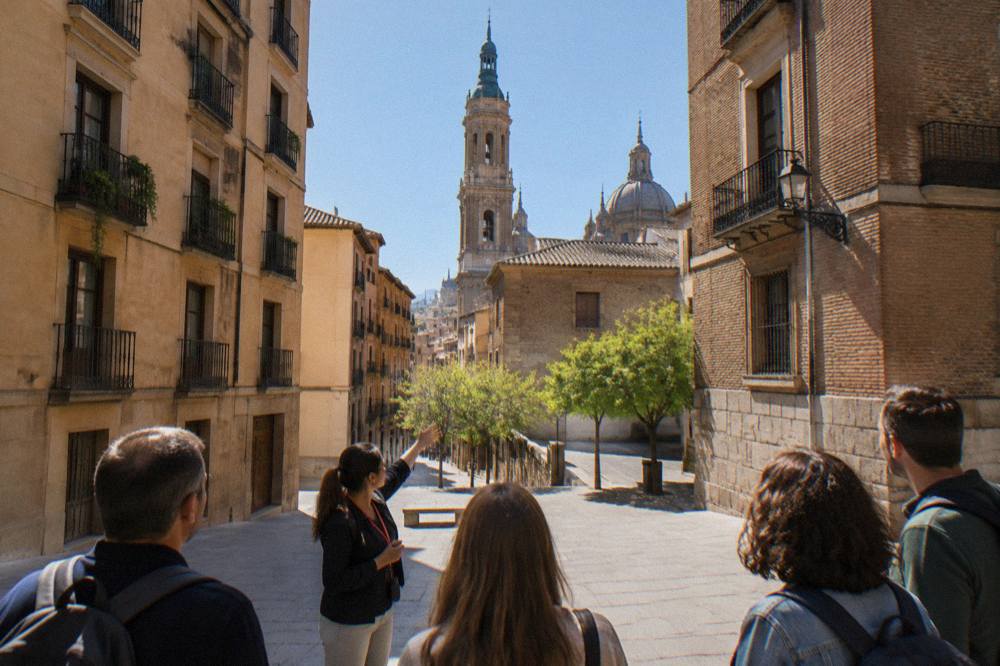
Yes: in the hot months a guided tour works best in the morning or the evening, while in the October festival week booking ahead matters more than timing, and in the low season a private guide gives the most value because the routes are quiet and the guide can adapt the pace to the weather.
The tour calendar flexes with the seasons in ways the listing pages reflect. The Zaragoza: Evening Tapas Walking Tour in the Old Town, from $106.92 per person and rated 4.9 from 62 reviews over 3 hours, is built for the evening slot that summer demands, when the mean minimum of 18.3 C makes a walking dinner comfortable. The same tour in November is a different experience, warmer inside the bars and shorter in daylight, but no less good. Check availability for the season you choose, since departure times shift.
The Legends and Ghosts Night Tour, from $15.76 per person, is a winter-friendly option too: it starts after dark, which in December means early enough for children and in July means properly late. The operator's live listing shows the current start times for the dates you hold.
The private options are the ones that flex furthest. The Zaragoza: Private Walking Tour with a Local, from $54.02 per person and rated 4.7 from 86 reviews, runs 2 to 6 hours and can be shaped around the heat or the cold in a way a fixed group tour cannot, and the operator's live listing shows what each duration covers.
Common Questions About The Best Time To Visit Zaragoza
What is the best time to visit Zaragoza?
May, June, September and early October, when AEMET's 1981-2010 averages for the Zaragoza Aeropuerto station show mean temperatures of 16 to 23 C and few rain days. October adds the Fiestas del Pilar from 10 to 18 October, at the cost of peak crowds.
What is the hottest month in Zaragoza?
July, with a 1981-2010 mean maximum of 32.4 C and a mean of 25.3 C. August is a close second at a mean maximum of 31.7 C. Both months average only 17 mm of rain.
Does it rain a lot in Zaragoza?
No. The 1981-2010 normals give the year just 322 mm of rain over 51.1 days of 1 mm or more, and the wettest month, May, averages 44 mm. July and August are the driest at 17 mm each.
When is the Fiestas del Pilar?
The Fiestas del Pilar 2026 run from Saturday 10 to Sunday 18 October, with the Ofrenda de Flores on 12 October. It is the busiest week of the Zaragoza year, so book accommodation well ahead.
Is Zaragoza cold in winter?
Yes, by Spanish standards. January averages 6.6 C with a mean minimum of 2.7 C, and the station records 23.1 frost days a year. The cold is dry and the skies are often clear.
Is October a good time to visit Zaragoza?
October is one of the best months: the 1981-2010 mean maximum is 21.4 C, the Museo Goya reopens on 9 October 2026, and the Fiestas del Pilar run from the 10th to the 18th. Expect crowds and book early.
The month you choose sets the trip you get: June for the terraces, October for the festival, November for the quiet museums, and February for the lowest prices of the year under a bright, cold sky. Pick the one that matches what you want from Zaragoza, and the rest of the plan falls into place around it.