Do They Speak English In Zaragoza?
Do they speak English in Zaragoza, Spain? A plain answer for visitors to the Aragonese capital, with what to expect at monuments, museums, menus and guided tours.
Zaragoza, the capital of Aragon in northern Spain, is a working Spanish city, not a resort built around foreign visitors, and that shapes the language you will hear on its streets. Spanish is the language of daily life here, from the tram announcements to the tapas orders shouted over a bar counter. English exists in the city, mostly in the tourist-facing corners, but a visitor who arrives with a handful of Spanish words will notice the difference within an hour of arriving at Zaragoza-Delicias. This page answers the question directly, then goes through where English helps you, where it will not, and how to bridge the gap without stress.
Do They Speak English In Zaragoza?
Yes, but less than in Spain's coastal tourist hubs, and not as a default. Spanish is the city's everyday language, and Zaragoza receives far fewer international visitors than Barcelona, Madrid or Seville, so many people in shops, bars and on public transport speak little or no English. Staff at the major monuments, hotels and the train station generally manage in English, and younger people often can, but a visitor should not assume it. Basic Spanish phrases go a long way here.
The honest framing is that Zaragoza is an inland administrative and university city. It has a large student population, and students across Spain learn English at school, so the odds of finding an English speaker under thirty are materially better than among people in their sixties. What can be said from what the city itself publishes is practical: the municipal monument timetable, the museum ticketing pages and the fiesta programmes are all issued in Spanish first, with English versions available for some but not all of them. That is the clearest signal of where the city sits.
Compare this with the experience of a visitor landing in Barcelona, where hotel staff, taxi drivers and restaurant menus routinely switch to English without being asked. Zaragoza is a different rhythm. A waiter may try a few words, apologise, and carry on in Spanish with gestures, and this is normal rather than unfriendliness. Aragonese hospitality tends to be warm and direct; the language barrier is real but soft, and effort is rewarded. If you are still weighing whether the city merits the trip, the answer to is Zaragoza Spain worth visiting runs through what the city is famous for, not through how much English is spoken.
What Language Do They Speak In Zaragoza?
Spanish is the official and universal language of Zaragoza, spoken by essentially everyone in the city, in the Castilian standard used across Spain. Aragon's regional tongues, Aragonese and Catalan, survive in the mountainous north of the region rather than in the capital, so a visitor will hear Spanish everywhere in Zaragoza: in shops, on the tram, at monuments and in every bar. English appears as a second language for some people, not as a parallel daily language.
The distinction matters because travellers sometimes expect a bilingual city on the model of Barcelona, where Catalan sits beside Spanish on every street sign. Zaragoza is not that. Street names, municipal notices, the Zaragoza-Delicias station displays and the Aljafería's ticketing portal are Spanish-first. Some monument pages offer English versions, and the big sights have printed material in several languages at the desk, but the ambient language of the city is one language.
That single-language reality has an upside: it is an easy city in which to practise. Unlike the biggest destinations, where a halting sentence in Spanish is met with a reply in English, Zaragoza rewards the attempt. The pronunciation is also friendlier than newcomers expect, and the question of how Zaragoza is pronounced resolves to a phonetic "thah-rah-GOH-thah" in Castilian, roughly "sah-rah-GOH-sah" in Latin American Spanish and in English. A small phrasebook carries you through most transactions, and the table below covers the ones that earn their weight in a Zaragoza day.
| Situation | Spanish | How it sounds |
|---|---|---|
| Greeting a bar or shop | Buenos días | BWEH-nos DEE-as |
| Ordering two beers | Dos cañas, por favor | dos KAH-nyas por fa-VOR |
| Asking if English is possible | ¿Habla inglés? | AH-bla een-GLES |
| Asking for the bill | La cuenta, por favor | la KWEN-ta por fa-VOR |
| Asking a price | ¿Cuánto es? | KWAN-to es |
| Saying you do not understand | No entiendo | no en-TYEN-do |
| Thanking | Gracias | GRA-thyas |
The phrases above cover perhaps ninety percent of what a visitor needs in a bakery, a market stall or a tram ticket machine. The rest can be handled by pointing, which is universally understood, and by the translation app on any phone. Before choosing how to spend your days, the guided options below include English-friendly walking tours that remove the language question from the sightseeing itself.
Will Museum Signs And Menus Be In English In Zaragoza?
At the major monuments, partly yes: the Basílica del Pilar, La Seo, the Aljafería and the Caesaraugusta museums all provide some printed or panel material in English alongside Spanish, and hotel and restaurant staff in the centre of Zaragoza usually manage basic English. Small neighbourhood bars, market stalls and local shops generally do not, and the municipal timetable and ticketing pages are published in Spanish. Expect a Spanish-first city with English support at the tourist layer, not the reverse.
The pattern is consistent across the big sights. The Aljafería sells tickets through its own portal and runs Spanish-language guided tours at set times, with printed information available for foreign visitors at the desk; the question of whether you can visit the Aljafería answers yes on any day of the week in October, with the palace open daily from 10:00 to 18:00 and a general ticket at 7 EUR. The Caesaraugusta Roman museums, the Forum, the River Port, the Baths and the Theatre, operate on the same bilingual-support model. The one thing to plan around is that several guided products in the city, including some of the best-priced monument tours, run in Spanish only, and the listing states the language clearly. Read the language line before booking anything, and treat it as binding rather than hopeful.
Menus follow the same gradient. Restaurants around Plaza del Pilar and the Paseo de la Independencia, the streets most travelled by visitors, frequently offer English menus, and the establishments featured in a Zaragoza food guide context are used to non-Spanish speakers. A neighbourhood bar three streets back from the plaza may have nothing but a chalkboard in Spanish, and that chalkboard is often where the best cooking is. The workable strategy is simple: eat where the locals eat, use a phone camera and a translation app on the chalkboard, and order the dishes Aragon is known for, ternasco lamb and migas, by name, because those two words are understood everywhere in the region.
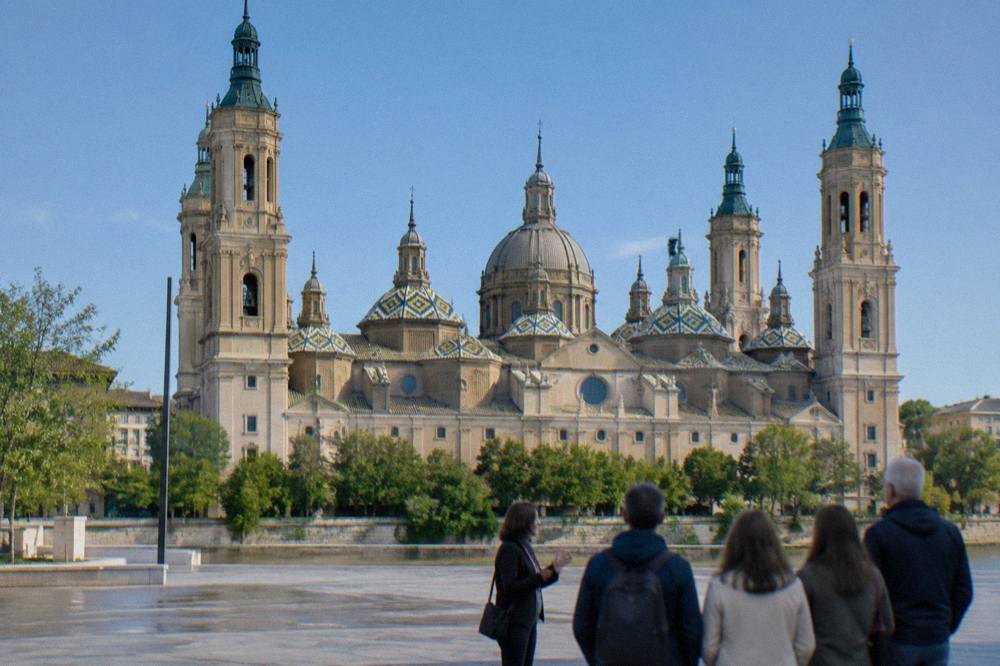
The language question is also a good reason to consider a guided walk on your first day. A guide translates the city in both senses, and the Monumental Walking Tour in Old Town of Zaragoza is the natural pick for exactly this: a walking-tour of the old district, rated 4.9 from 15 reviews, from 97.47 USD per person, which turns the Casco Histórico into a narrated experience rather than a series of Spanish-language plaques. You can read more on its own page, and Check availability for your dates.
Do Guided Tours In Zaragoza Run In English?
Some do and some do not, and the language is stated on each listing rather than assumed. Several of Zaragoza's guided tours, including the Aljafería's Spanish-language guided visits and the Basílica del Pilar's Spanish tour, run in Spanish only, while the private and small-group walking tours of the old town operate in English and other languages on request. The rule for a visitor is to read the language line on the operator's live listing before booking, because it is the only reliable source.
The split is visible in the city's own monument programming. The Aljafería's Spanish guided tours run at fixed times, 10:30, 12:30, 13:30, 15:00 and 16:00, per the municipal October timetable, and the Basílica del Pilar's guided visit is likewise a Spanish-language product. Neither is a problem for a visitor with even modest Spanish, and both are excellent value, but a traveller expecting an English commentary would be disappointed. On the other side of the ledger, the private walking tours of Zaragoza, including the Private Walking Tour with a Local, from 54.02 USD per person and rated 4.7 from 86 reviews, are built around a guide who adapts to the group's language, and the listing confirms what is offered before you pay.
The table below sets out the language reality of the main guided formats, using what each listing states.
| Guided format | Language stated | Typical price | Rating |
|---|---|---|---|
| Private walk with a local | Matches your booking, English available | from 54.02 USD | 4.7 from 86 reviews |
| Old Town monumental walk | Check the listing for the departure language | from 97.47 USD | 4.9 from 15 reviews |
| Aljafería guided tour in Spanish | Spanish only | from 25.23 USD | 4.7 from 23 reviews |
| Basílica del Pilar guided visit | Spanish only | from 12.38 USD | 4.7 from 46 reviews |
| Self-guided scavenger hunt | App-based, language chosen in the app | from 5.73 USD | 4.5 from 37 reviews |
The self-guided option deserves a word, because it sidesteps language entirely. An app-based walk or scavenger hunt, from 5.73 USD per person, delivers its commentary in the language you select on your own phone, and the app-guided Roman-walls walk works the same way. For a visitor who wants the monuments explained in English without depending on a guide's schedule, these are the most language-proof products in the city.
How To Get By In Zaragoza With Basic Spanish
Plan on three tools and the city opens up: a dozen Spanish phrases, a translation app on your phone, and a willingness to book English-friendly guided tours for the sights that matter most. Zaragoza rewards the attempt at Spanish warmly, the tourist layer at monuments and hotels carries English support, and the only real trap is assuming that every guided visit or menu will be in English when the listing or the chalkboard says otherwise. None of this requires fluency, only preparation.
Start with the phrases in the table above, learned to the point of reflex, because greetings and please-and-thank-you are noticed in Aragon more than in the heavily visited south. Add the two food words that matter, ternasco and migas, and the name of the city itself, and you have the working core. The translation app handles menus, museum panels and the occasional municipal notice. For the sights where the commentary carries the value, the Aljafería's interiors, the Roman remains under the plaza, the old town's layered history, book a guided product whose listing states your language, and let the guide do the translating. The Zaragoza Travel Guide site's own pages carry the verified opening hours and prices for each monument, so the practical layer of your trip needs no Spanish at all.
One last practical note: numbers are the easiest Spanish you will learn and the most useful. Ticket prices, tram fares and the 1.70 EUR single on bus and tram are all spoken and displayed as digits, and the ticket machines at Zaragoza-Delicias offer an English menu option. The station, the airport bus and the tram network are the three places where a visitor's first transactions happen, and all three have English support at the machine if not always at the counter. From there, the city meets you halfway.
Common Questions About Speaking English In Zaragoza
Do they speak English in Zaragoza, Spain?
Yes, but less than in Spain's biggest tourist cities. Spanish is the everyday language, English support is solid at hotels, the station and the major monuments, and basic Spanish phrases are worth learning for bars, shops and transport.
What language do they speak in Zaragoza, Spain?
Spanish, in the Castilian standard used across Spain. The regional languages of Aragon are found in the mountainous north of the region, not in the capital, so Zaragoza is effectively a single-language city with English as a second language for some residents.
Are museum signs in Zaragoza in English?
Partly. The major sights, the Basílica del Pilar, La Seo, the Aljafería and the Caesaraugusta museums, provide some English printed material, but the municipal timetable and ticketing pages are published in Spanish first.
Do guided tours in Zaragoza run in English?
Some do. The private walking tours adapt to the group's language, while the Aljafería's and the Basílica del Pilar's guided visits run in Spanish only. The language is stated on each operator's live listing, so read it before booking.
Is Spanish hard to get by with in Zaragoza?
No. A dozen phrases plus a translation app cover most daily transactions, and Zaragoza is friendlier to attempted Spanish than heavily touristed cities, where staff often switch to English. Numbers, greetings and the names of local dishes carry a visitor a long way.
Zaragoza will not test your Spanish the way a rural village might, but it will not spare you from it either, and that balance is part of what makes the city feel like real Aragon rather than a staged version of it.