How Is Zaragoza Pronounced?
The correct Castilian pronunciation of Zaragoza, Spain, syllable by syllable, plus how to say Basílica del Pilar, Aljafería and La Seo like a local.
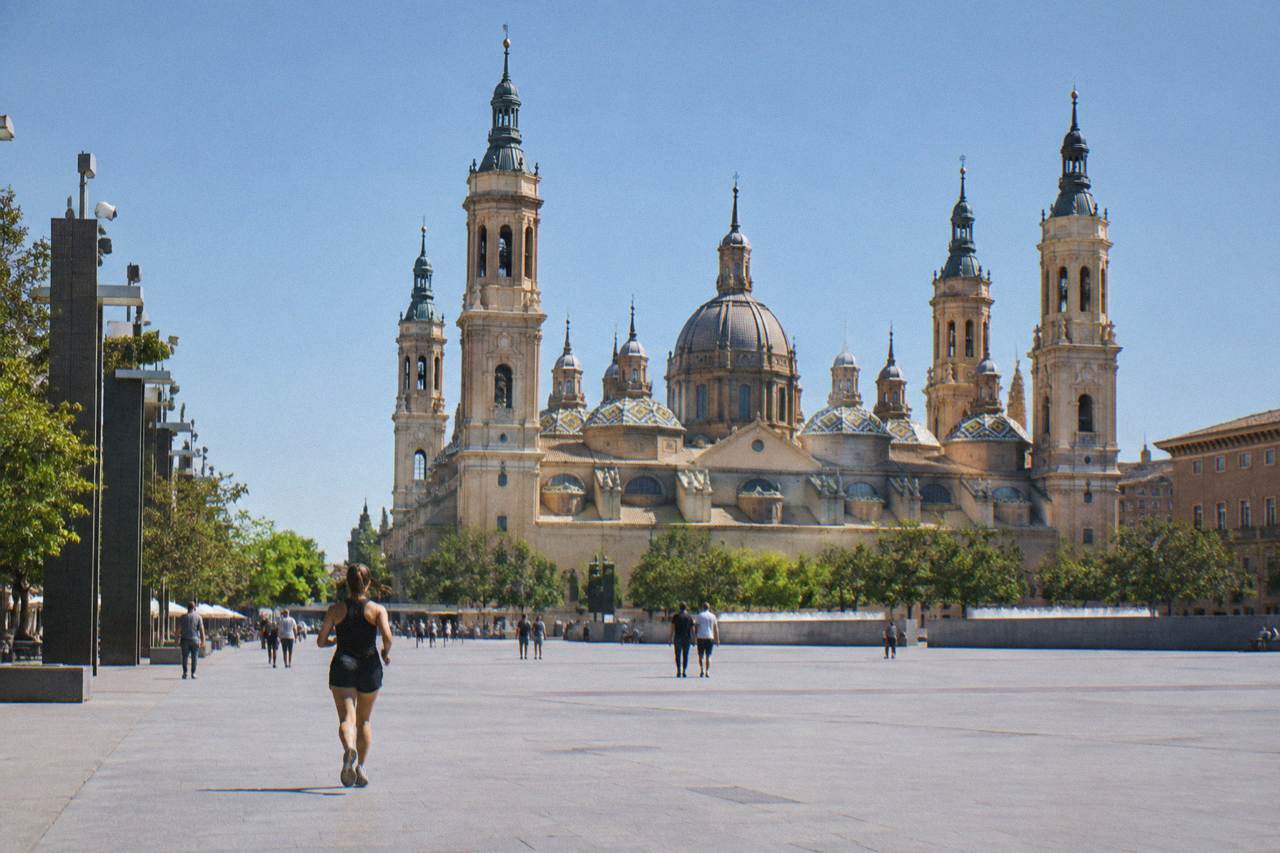
Zaragoza, the capital of Aragon on the Ebro, is one of those Spanish cities whose name travels badly. Visitors arrive knowing the Basílica del Pilar, the Aljafería and the Roman ruins of Caesaraugusta, then hesitate at the hotel desk because they are not sure whether the city they have come to is "zara-GO-za", "sah-rah-GOH-sah" or something else entirely. The answer is simple once the syllables are separated, and it matters more than you might think: the name appears on train tickets to Zaragoza-Delicias, on tram stop announcements, on the Fiestas del Pilar programme and in every conversation with a local. This page gives the Castilian pronunciation syllable by syllable, explains where the stress falls and why, and covers the other names in the city, from La Seo to the Puente de Piedra, that are harder to say than the city itself.
How Is Zaragoza Pronounced?
In Castilian Spanish, the Spanish of Spain, Zaragoza is pronounced thah-rah-GOH-thah, four syllables with the stress on the third, and both the z and the final c or s of each pair are sounded as a soft English th as in think. In Latin American Spanish the same word is said sah-rah-GOH-sah, with an s sound in place of the th. Locals in Zaragoza use the Castilian version, and both are correct; the stress never moves.
The word breaks into four syllables: Tha-ra-GO-tha. The stress lands on the "GO" because Spanish words ending in a vowel carry the stress on the last syllable unless an accent mark says otherwise, and in a four-syllable word like this one the rule pushes the emphasis back to the antepenultimate position in the spoken form locals use. Say it slowly once, then let the first and last syllables fall away to almost nothing, and you have the rhythm Aragonese speakers use at speed: the middle "GO" carries the word.
The th sound is the part that changes by country. In Spain, the letter z and the letter c before i or e are both pronounced as the th of English "thin", a feature of Castilian Spanish that has been standard in Spain for centuries. In most of Latin America, both letters are pronounced as s. So a Mexican or Argentine speaker says sah-rah-GOH-sah, and a speaker from Zaragoza says thah-rah-GOH-thah. Neither is a mistake. If you are travelling in Spain, the Castilian version is what you will hear from tram announcements, from guides at the Aljafería and from the person selling you a ticket at La Seo.
English speakers tend to make two errors. The first is stressing the wrong syllable, turning zar-a-GO-za into ZAR-a-goza, which sounds odd to a Spanish ear because the opening syllable is never emphasised. The second is flattening the vowels. Spanish vowels are short and pure: the a of "Zaragoza" is the a of "father" but clipped, never the ay of "zara" or the uh of an unstressed English syllable. Keep every vowel clean, put the weight on "GO", and the rest of the word takes care of itself.
Where Does The Name Zaragoza Come From?
The modern name Zaragoza descends from the Roman city of Caesaraugusta, the settlement founded on the Ebro in the imperial period, and the city's own name is the direct ancestor of the word in use today. Caesaraugusta is also the name the city's Roman museum network still uses, the Caesaraugusta museums of the Forum, the River Port, the Baths and the Theatre. The modern pronunciation preserves the four-syllable shape that has come down through the city's history.
That inheritance is visible all over the modern city, not just in the name. The four Caesaraugusta museums sit in the old town within a short walk of each other, and their combined ticket, 7 EUR general and 5 EUR reduced per the municipal monument timetable, is one of the best-value ways into the Roman layer of Zaragoza. The Theatre museum, the Forum and the River Port each hold excavated remains in situ, so the pronunciation question and the sightseeing question meet in the same few streets.
The name also explains a confusion worth clearing up before you travel. Zaragoza is not in Catalonia and it is not a Basque city; it is the capital of Aragon, an inland community in north-east Spain, and the city sits on the Ebro, a long way from any coast. Spanish is the city's language, alongside Aragonese in some surrounding areas, and the pronunciation guide on this page is Castilian Spanish because that is what is spoken at the Puente de Piedra and the Paseo de la Independencia. For the fuller story of the name, the companion page on why Zaragoza is called Zaragoza takes the question further.
How Do You Say Basílica Del Pilar And Aljafería?
Basílica del Pilar is said bah-SEE-lee-kah del pee-LAR, with the stress on the second syllable of Basílica and the second syllable of Pilar, and the accent on the í marking the long ee. Aljafería is al-hah-feh-REE-ah, five syllables, stress on the fourth, the j a strong throaty sound like the ch of Scottish loch. La Seo is simply lah SEH-oh, two syllables, stress on the second.
These three names cover the city's headline sights, and each has a trap in it for an English-speaking visitor. In Basílica del Pilar, the accent mark on the í does the work: it says "stress me", so the word is bah-SEE-lee-kah, never BAH-si-li-ca. Pilar is a common Spanish given name as well as the basilica's title, and it rhymes with "ear" wrapped in a p and an r: pee-LAR in Castilian, where the final r is tapped, not rolled.
Aljafería is the hardest word on the list. The j in Spanish is never the English j; it is a harsh, breathy sound produced at the back of the throat, the same sound as the ch in the Scottish word loch or the German Bach. The word runs al-hah-feh-REE-ah, with the stress on the penultimate syllable even though there is no accent mark, because Spanish words ending in a vowel or n or s default their stress to the last-but-one syllable. The palace itself, the Islamic palace that is the finest of its kind in Spain, is open daily in October from 10:00 to 18:00 per the municipal timetable, with last access 45 minutes before closing, so you will have several chances during the day to say its name at the ticket desk.
La Seo, the cathedral of San Salvador, is the easiest of the three: lah SEH-oh. "Seo" is the Aragonese word for cathedral seat, and locals use it constantly, so a visitor who says it correctly at a taxi rank will be understood immediately. The cathedral's general ticket, 10 EUR, includes the Museo de Tapices, the Museo Pilarista and the Rosario de Cristal per the same municipal timetable.
| Name | Syllables | Stress | Rough English guide |
|---|---|---|---|
| Zaragoza | Tha-ra-GO-tha | 3rd syllable | thah-rah-GOH-thah |
| Basílica del Pilar | Ba-sí-li-ca del Pi-lar | 2nd and 2nd | bah-SEE-lee-kah del pee-LAR |
| Aljafería | Al-ja-fe-rí-a | 4th syllable | al-hah-feh-REE-ah |
| La Seo | La Se-o | 2nd syllable | lah SEH-oh |
| Caesaraugusta | Cae-sa-rau-gus-ta | 3rd syllable | sigh-sah-row-GOOS-tah |
| Puente de Piedra | Puen-te de Pie-dra | 1st and 1st | PWEN-teh deh PYEH-drah |
The last two rows are worth a moment. Caesaraugusta, the Roman name that survives in the museum network, is pronounced with a hard g in the Latin manner, and Puente de Piedra, the stone bridge whose current structure was built from 1401 and opened in 1440, is the sight whose name visitors most often mangle into "pwentay". The bridge's four bronze lions, in place since 1991, guard the crossing that leads straight to the Basílica del Pilar, and the walk over it is the classic first view of the city.
If you would rather hear all of this than read it, a guided walk solves the problem in one morning. The Zaragoza Must-See Attractions Walking Tour, a two-hour private walk from 78.78 USD per person, rated 4.6 from 9 reviews, covers the Pilar, the old town and the Roman remains with a guide who will say every one of these names at conversational speed. Check availability
Do You Need Spanish To Visit Zaragoza?
No, you do not need Spanish to visit Zaragoza, but a handful of correctly pronounced words change the tone of every interaction, and the city's sightseeing, transport and food scenes are workable in English with some patience. The Basílica del Pilar is free to enter, the urban bus and tram single fare is 1.70 EUR, and the city's headline sights are all reachable on foot from the centre, so a visitor with no Spanish at all can still see a great deal.
The practical reality sits somewhere in the middle. Zaragoza receives far fewer international visitors than Madrid, Barcelona or Seville, so English is less uniformly spoken than on the Mediterranean circuit, and menus in the old town's traditional bars are often Spanish-only. The numbers that matter are simple enough to learn: a single bus or tram ticket is 1.70 EUR, dropping to 0.55 EUR with a Tarjeta Bus per the 2026 Avanza fare table, and the cathedral and museum tickets listed above all have their prices printed at the desk. The city's answer pages cover this in detail, starting with whether they speak English in Zaragoza.
Pronunciation earns goodwill out of proportion to the effort. Say "Zaragoza" correctly at a hotel desk and the conversation warms; say "Basílica del Pilar" with the stress in the right place and a bar owner in the El Tubo lanes will often finish the sentence for you. The same logic applies to ordering: ternasco and migas, the two dishes the Zaragoza food guide covers in depth, are both easy words to say once you know that ternasco is tern-AS-koh and migas is MEE-gahs.
How Is Zaragoza Pronounced In Other Languages?
In English, Zaragoza is conventionally said with an s rather than a Castilian th, so "Saragossa" was the historical English form of the city's name and still appears in older texts, while modern English-language guidebooks use the Spanish spelling with an approximation of the Spanish pronunciation. In French the city is Saragosse, in Italian Saragozza, and in German Saragossa, all carrying the s-sound version of the name.
The English "Saragossa" spelling is a genuine historical artefact rather than an error. It was the standard English name for the city for centuries, from the Napoleonic-era sieges, when Napoleonic troops blew up one of the Puente de Piedra's arches in 1813, right through to older encyclopaedia entries, and it reflects the pronunciation of visitors from languages without the Castilian th. Modern usage has largely reverted to the Spanish spelling, but the older form survives in place names and surnames far from Spain, which is part of why the Zaragoza International Bridge between El Paso and Juarez carries the same word: the surname travelled with Spanish speakers to the Americas, where the s-sound pronunciation is native.
That diaspora of the name is the reason this page exists. Search for "Zaragoza" and you can land on Real Zaragoza the football club, on the Zaragoza International Bridge, on Mexican and Colombian places that share the name, or on the capital of Aragon. The city this site covers is the Spanish one, the capital of Aragon on the Ebro, and its pronunciation in the mouth of a local is the thah-rah-GOH-thah given at the top of this page.
| Language | Form | Approximate pronunciation |
|---|---|---|
| Castilian Spanish | Zaragoza | thah-rah-GOH-thah |
| Latin American Spanish | Zaragoza | sah-rah-GOH-sah |
| English (historical) | Saragossa | sah-rah-GOSS-ah |
| French | Saragosse | sah-rah-GOSS |
| Italian | Saragozza | sah-rah-GOTS-sah |
Common Questions About Pronouncing Zaragoza
How is Zaragoza pronounced?
Thah-rah-GOH-thah in Castilian Spanish, with the stress on the third syllable and the z sounded as th. In Latin American Spanish the same word is sah-rah-GOH-sah. Both are correct; in the city itself you will hear the Castilian version.
Is the stress on the second or third syllable?
The stress falls on the third syllable, "GO". The first and last syllables are light and quick, and stressing the opening "Tha" is the most common mistake English speakers make.
Why do Spaniards say th and Latin Americans say s?
Castilian Spanish, the standard variety used in Spain, pronounces the letter z, and c before i or e, as the th of English "thin". Most Latin American varieties pronounce the same letters as s. Both systems are internally consistent and neither is a deviation from the other.
How do you say Aljafería?
Al-hah-feh-REE-ah, five syllables, stress on the fourth, with the j as the throaty ch of Scottish loch. The palace is open daily in October from 10:00 to 18:00 per the municipal monument timetable.
How do you say Basílica del Pilar?
Bah-SEE-lee-kah del pee-LAR. The accent mark on the í marks the stressed syllable, so the stress sits on "SEE", and Pilar carries its stress on the final syllable's tapped r.
Is Saragossa the same city?
Yes. Saragossa is the historical English spelling of Zaragoza, and it appears in older English texts about the Napoleonic sieges. Modern English usage has largely adopted the Spanish spelling, and the city itself is always Zaragoza on Spanish maps, tickets and signs.
The name of the city is the first word of every trip to it, on the AVE ticket to Zaragoza-Delicias, on the airport bus timetable and on the Fiestas programme, and it is worth saying well. For everything that follows the pronunciation, from the sights Zaragoza is famous for to planning how many days you need in Zaragoza, Spain, the rest of Zaragoza Travel Guide picks up where the syllables end.
Whichever way you choose to see the city, a guided walk remains the fastest way to hear its names spoken properly, from the Pilar to the Roman walls, and the options above cover both a paid private format and a free, tip-based alternative. A guide who lives in Zaragoza says "Zaragoza" the way this page has taught it, thah-rah-GOH-thah, and hearing it at conversational speed is the last piece of the pronunciation puzzle.