Is Zaragoza In Catalonia?
No, Zaragoza is not in Catalonia. It is the capital of Aragon, an inland city on the Ebro in north-east Spain. Here is where it actually sits, what region it belongs to, and what that means for a visit.
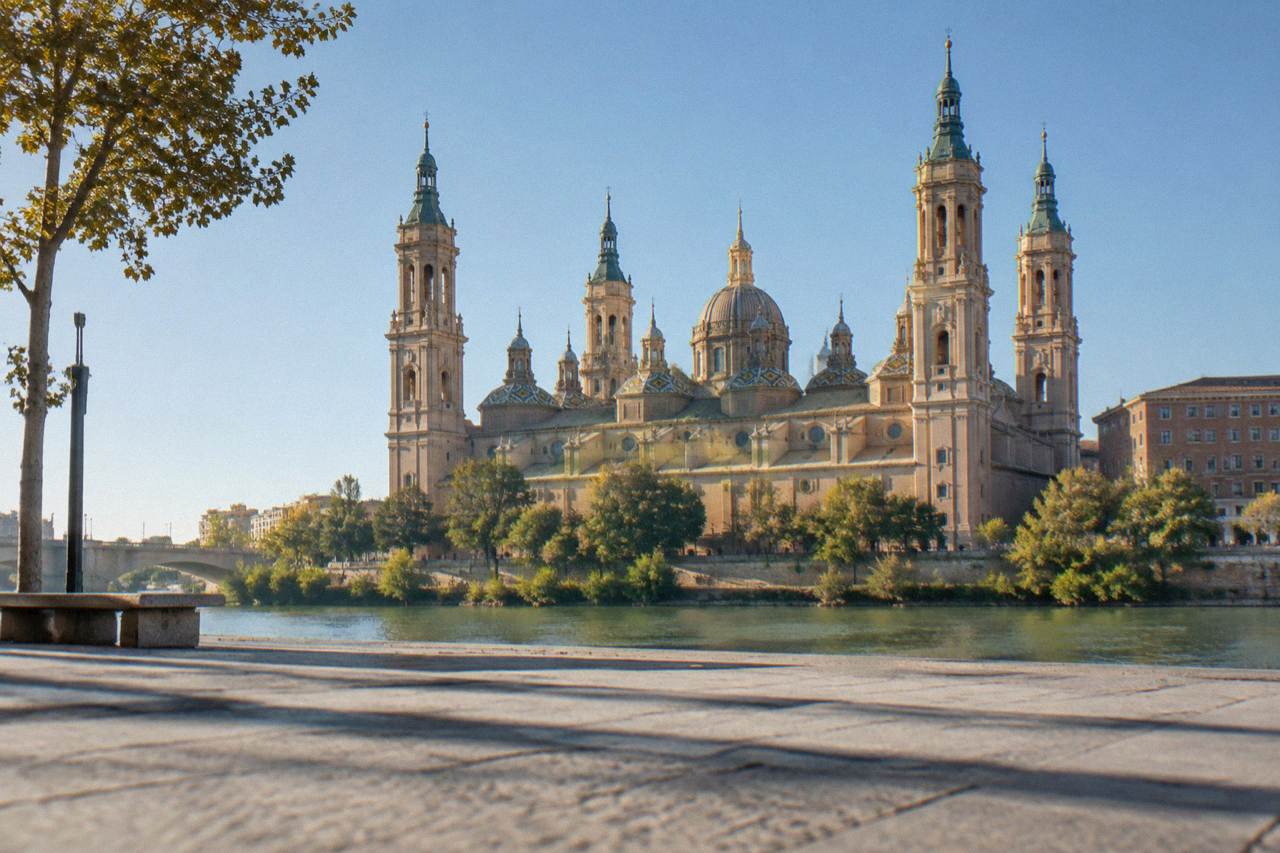
Zaragoza is the capital of Aragon, an inland autonomous community in north-east Spain, and it sits on the Ebro river roughly halfway between Madrid and Barcelona. It is not in Catalonia, it is not a Basque city, and it has never been either: it has been the political seat of Aragon since the community was constituted, and its monuments, the Basílica del Pilar, La Seo, the Aljafería, are Aragonese ones. The confusion usually starts because both regions share the north-east of the country and both appear on the same Madrid-to-Barcelona rail corridor, so the question deserves a straight, sourced answer.
Is Zaragoza In Catalonia?
No. Zaragoza is not in Catalonia. It is a city and a municipality in Aragon, and it is the capital of both its province and of the whole autonomous community of Aragon. Catalonia is a separate community with its own capital, Barcelona, and its own coastline on the Mediterranean. Zaragoza sits inland on the Ebro, with no sea and no coast, roughly midway between Madrid and Barcelona on the high-speed rail line.
That single sentence settles the geography, but the reasons the question exists are worth unpacking. Spain is organised into seventeen autonomous communities, and Aragon and Catalonia are neighbours that were once joined under the medieval Crown of Aragon, a confederation whose name still misleads readers today. The Crown of Aragon was not the same thing as the modern community of Aragon, and it was certainly not Catalonia, but the shared medieval history means the two names keep getting tangled together in search results and travel forums.
There is also a simpler practical source of the confusion. If you land in Barcelona and want to see Zaragoza, the fastest trains cover the distance in about 1.5 to 2 hours, so plenty of visitors treat Zaragoza as a Catalan day trip in the way they might treat Toledo as a Madrid day trip. It is closer to Catalonia than almost any other major Spanish city, but proximity is not belonging. Zaragoza is Aragonese, and its own institutions, fiestas and architecture say so at every turn.
Where Is Zaragoza If It Is Not In Catalonia?
Zaragoza is in Aragon, the autonomous community that occupies the north-eastern interior of Spain, and it is that community's capital and largest city. It stands on the Ebro, Spain's biggest river by volume, in a wide dry valley far from any coast. The city is a natural midpoint on the Madrid to Barcelona corridor, about 1.5 to 2 hours from each by high-speed train from Zaragoza-Delicias station.
Aragon borders Catalonia to its east, but the border lies well downstream of the city, beyond the Aragonese provinces of Teruel and Zaragoza. The community is made up of three provinces: Zaragoza, Huesca and Teruel, and the city of Zaragoza is the seat of the regional government, the Cortes de Aragón. When a Spaniard says "Zaragoza" they mean this city on the Ebro, capital of Aragon, and nothing else.
The landscape tells you immediately that you are not on the Mediterranean side. Zaragoza has a dry continental semi-arid climate: AEMET's 1981 to 2010 normals for the Zaragoza Aeropuerto station show just 322 mm of rain across the whole year, with July and August the driest months at 17 mm each and May the wettest at 44 mm. July is the hottest month by mean maximum at 32.4 C in the same 1981 to 2010 window. The famous local wind, the cierzo, is a cold, dry north-westerly that runs down the Ebro valley, and it is a fixture of Aragonese weather talk in a way no coastal city's would be.
For a fuller picture of the city's geography and how to reach it, see where Zaragoza sits in Spain and the rundown of what Zaragoza is famous for.
Is Zaragoza A Basque City Or A Catalan One?
It is neither. Zaragoza is Aragonese. The Basque Country is a separate community on the northern coast, hundreds of kilometres from Zaragoza, and Catalonia is a separate community to the east. Spanish is the everyday language of Zaragoza; the city's own heritage identity is Mudéjar, the Moorish-influenced Christian architecture that UNESCO recognises here with three listed components.
The Basque question comes up almost as often as the Catalan one, probably because both regions carry strong identity politics and travellers lump the north-east together. Geographically there is no ambiguity at all: Zaragoza is inland, on the Ebro, in the middle of the Ebro valley, while the Basque Country lies on the Bay of Biscay coast at the other end of the Pyrenean foothills. The two share no border and no administrative tie.
The Catalan question has slightly deeper roots. Under the medieval Crown of Aragon, Aragonese and Catalan lands were ruled together, and some historical writing blurs the two into one "Aragonese" identity that modern readers misread as the modern community. Modern Spain settled the matter clearly: Aragon became its own autonomous community with Zaragoza as its capital, and Catalonia became a separate one with Barcelona as its capital. The two communities cooperate on Ebro water management, among other things, but each goes its own way politically and culturally.
The clearest way to feel the difference is architectural. Zaragoza's UNESCO inscription, "Mudéjar Architecture of Aragon", covers exactly three components in the city: the surviving Mudéjar features of the Aljafería Palace, the tower and parish church of San Pablo, and the apse, parroquieta and cimborio of La Seo. Catalonia's UNESCO identity is an entirely different set of buildings by entirely different architects in an entirely different style, and none of it is here. The Mudéjar architecture of Zaragoza is the city's own signature, and it exists nowhere in Catalonia.
What Region Is Zaragoza The Capital Of?
Zaragoza is the capital of Aragon, one of Spain's seventeen autonomous communities, and also of the province of Zaragoza, the community's western-central province. It is the seat of the regional parliament and government, the largest city of the community, and the economic centre of the Ebro valley. Aragon itself is split into three provinces: Zaragoza, Huesca and Teruel.
That structure matters to a visitor in small, practical ways. The city's biggest festival, the Fiestas del Pilar, is organised through the municipal culture portal and runs 10 to 18 October in 2026, with the Ofrenda de Flores on 12 October following its traditional route from Paseo de la Independencia to Plaza del Pilar.
The regional museum network also answers to Aragon rather than to Madrid or Barcelona, and it has one live quirk worth knowing before you plan a museum day: the Museo de Zaragoza's central building on Plaza de los Sitios is closed for Ministry of Culture works, with no reopening date announced, so it cannot be visited at present. The Museo Goya, Fundación Ibercaja's collection, reopens on 9 October 2026 after renovation, with hours of 10:00 to 20:00 Tuesday to Saturday and 10:00 to 14:00 on Sundays and holidays, Monday closed. Its admission price has not been published, so check the foundation's own page before you go.
If you are weighing Zaragoza against its bigger neighbours, whether Zaragoza is worth visiting covers the case for the city, and how many days you need in Zaragoza helps with the calendar.
How Do You Get To Zaragoza From Catalonia?
You take a high-speed train. Zaragoza-Delicias station sits on the Madrid to Barcelona corridor, and the fastest services cover the run from Barcelona in about 1.5 to 2 hours, with Madrid the same. The city's airport is served by Ryanair, Wizz Air, Vueling, Volotea, Binter and Alba Star, and airport bus line 505 runs to the centre in roughly 25 to 35 minutes for 4.65 EUR a single.
Catalonia is therefore the easiest big region to travel from, which is exactly why the "is it Catalan" question persists. A Barcelona resident can be standing in front of the Basílica del Pilar two hours after leaving home, and the city's own history as a Roman colony, Caesaraugusta, sits on the same Ebro corridor that the Romans used to link the interior to the coast.
| Journey | Best Option | Typical Time | Verified Fare |
|---|---|---|---|
| Barcelona to Zaragoza-Delicias | High-speed train | About 1.5 to 2 hours | Check the operator, fares vary by date |
| Madrid to Zaragoza-Delicias | High-speed train | About 1.5 to 2 hours | Check the operator, fares vary by date |
| Zaragoza airport to centre | Bus line 505 | 25 to 35 minutes, flight-timed | 4.65 EUR single, about 2.25 EUR with a Lazo card |
| Around the city | Urban bus or tram | Frequent | 1.70 EUR single, 0.55 EUR with Tarjeta Bus |
Once you are in the city, everything is walkable in the centre, and the tram runs on the same 1.70 EUR single fare as the bus network, or 0.55 EUR with the rechargeable Tarjeta Bus. The high-speed train from Barcelona to Zaragoza has its own detailed answer if you are planning that leg.
What Should You See In Zaragoza Instead Of Catalonia?
See the Aragonese set: the Basílica del Pilar, free to enter, with its tower viewpoint at 6 EUR for an adult; La Seo cathedral at 10 EUR general admission including the Museo de Tapices; the Aljafería palace at 7 EUR, or 9 EUR with a guided tour; and the four Caesaraugusta Roman museums on a 7 EUR combined ticket. None of these is Catalan, and together they are the reason to come.
The Pilar is the emotional centre of the city and the destination of the Ofrenda de Flores every 12 October, when the municipal portal lists close to a hundred thousand registered participants filing to Plaza del Pilar with flowers. Entering the temple is free; the tower viewpoint costs 6 EUR for an adult, 5 EUR for over-65s and residents, and 4 EUR for ages 13 to 18, students and groups of 20 or more, with under-12s free. One thing to check before a visit: the basilica's dome, the Regina Patriarcharum, has been under restoration since the agreement of 23 January 2026, funded by Fundación Ibercaja, and completion is not confirmed, so some scaffolding may still be in place.
| Monument | What It Is | Verified Admission |
|---|---|---|
| Basílica del Pilar | Baroque basilica on Plaza del Pilar, free to enter | Temple free; tower viewpoint 6 EUR adult |
| La Seo | Gothic cathedral with UNESCO-listed Mudéjar apse and parroquieta | 10 EUR general, includes Museo de Tapices |
| Aljafería | Islamic palace, UNESCO-listed Mudéjar features | 7 EUR general, 9 EUR guided, free 1st and 3rd Sunday and Monday |
| Caesaraugusta museums | Forum, river port, baths and theatre of the Roman city | 7 EUR four-museum ticket, free 1st Sunday |
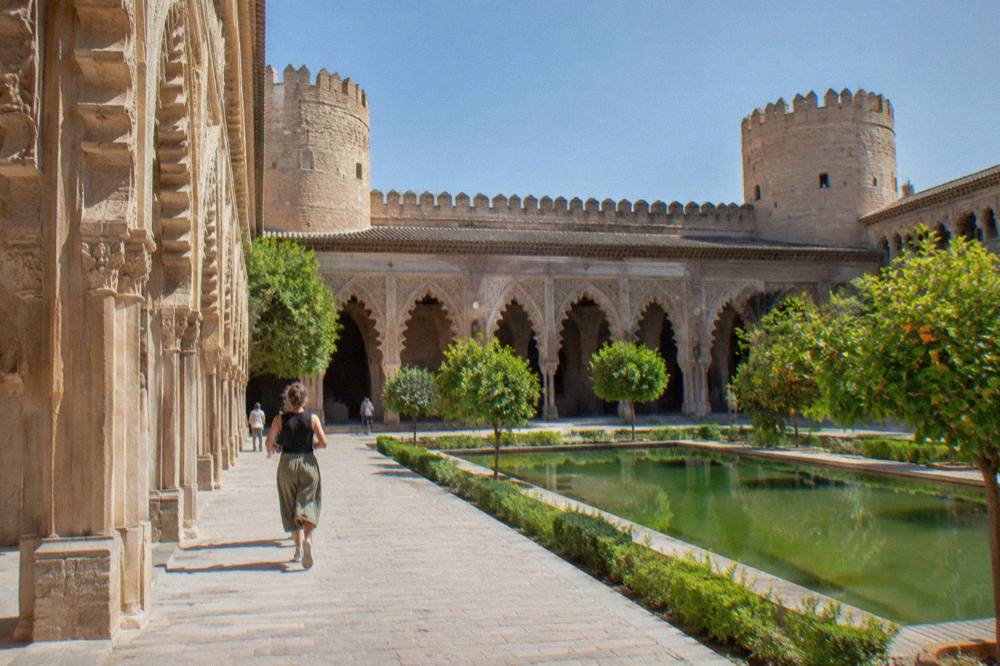
The Aljafería deserves the longest stop of the four. It is the most complete Islamic palace in Spain outside Córdoba, and the surviving Mudéjar features of the palace are one of Zaragoza's three UNESCO components. Guided visits in Spanish run at set times through the day, and a ticket-and-tour product is available if you want the building explained rather than just walked through. For depth on the individual buildings, start with the Basílica del Pilar and the Aljafería palace.
A guided walk ties the geography lesson together better than anything else, because a local guide will point at the stones while explaining which layer is Roman, which is Islamic, which is Mudéjar and which is Baroque. The Must-See Attractions Walking Tour covers the core set in two hours, from $78.78 per person, rated 4.6 from 9 reviews on the operator's live listing. Check availability if that format suits your group.
Common Questions About Zaragoza And Catalonia
Is Zaragoza, Spain in Catalonia?
No. Zaragoza is the capital of Aragon, a separate autonomous community in north-east Spain. Catalonia's capital is Barcelona, on the Mediterranean coast, while Zaragoza sits inland on the Ebro.
Is Zaragoza a Basque city?
No. Zaragoza is Aragonese. The Basque Country is a separate community on Spain's northern coast, and Zaragoza shares no border with it.
Was Zaragoza ever part of Catalonia?
No. Zaragoza was the seat of the medieval Kingdom of Aragon, which was distinct from the Principality of Catalonia even when both were ruled under the Crown of Aragon. Modern Aragon and Catalonia are separate autonomous communities.
Do they speak Catalan in Zaragoza?
Spanish is the everyday language of the city. Catalan is not an official language of Aragon, and you will hear it in Zaragoza only from visitors or on Catalan television.
How close is Zaragoza to Barcelona?
About 1.5 to 2 hours by high-speed train from Zaragoza-Delicias, which is close enough for a day trip in either direction but firmly on the Aragonese side of the regional border.
Is Zaragoza worth visiting if I have already seen Barcelona?
Yes. Zaragoza offers what Barcelona cannot: three UNESCO-listed Mudéjar components, the Roman city of Caesaraugusta, the Basílica del Pilar and the Aljafería palace, at Spanish-inland prices rather than Catalan coastal ones.
The short version, then: Zaragoza is Aragon's capital on the Ebro, an inland city of Mudéjar towers and Roman foundations, and the only thing it shares with Catalonia is a fast train between them. For more on the city's name and its Roman ancestor, read why Zaragoza is called Zaragoza, and for the neighbouring confusion, whether Zaragoza is a Basque city gets the same treatment. This Zaragoza Travel Guide keeps every regional fact on the Aragonese side of the line.