Loarre Castle: The Romanesque Fortress Day Trip From Zaragoza
Loarre Castle is a Romanesque fortress on a limestone ridge in Huesca province, the most complete castle of its kind in Spain and one of the most striking day trips you can make from Zaragoza.
Short answer
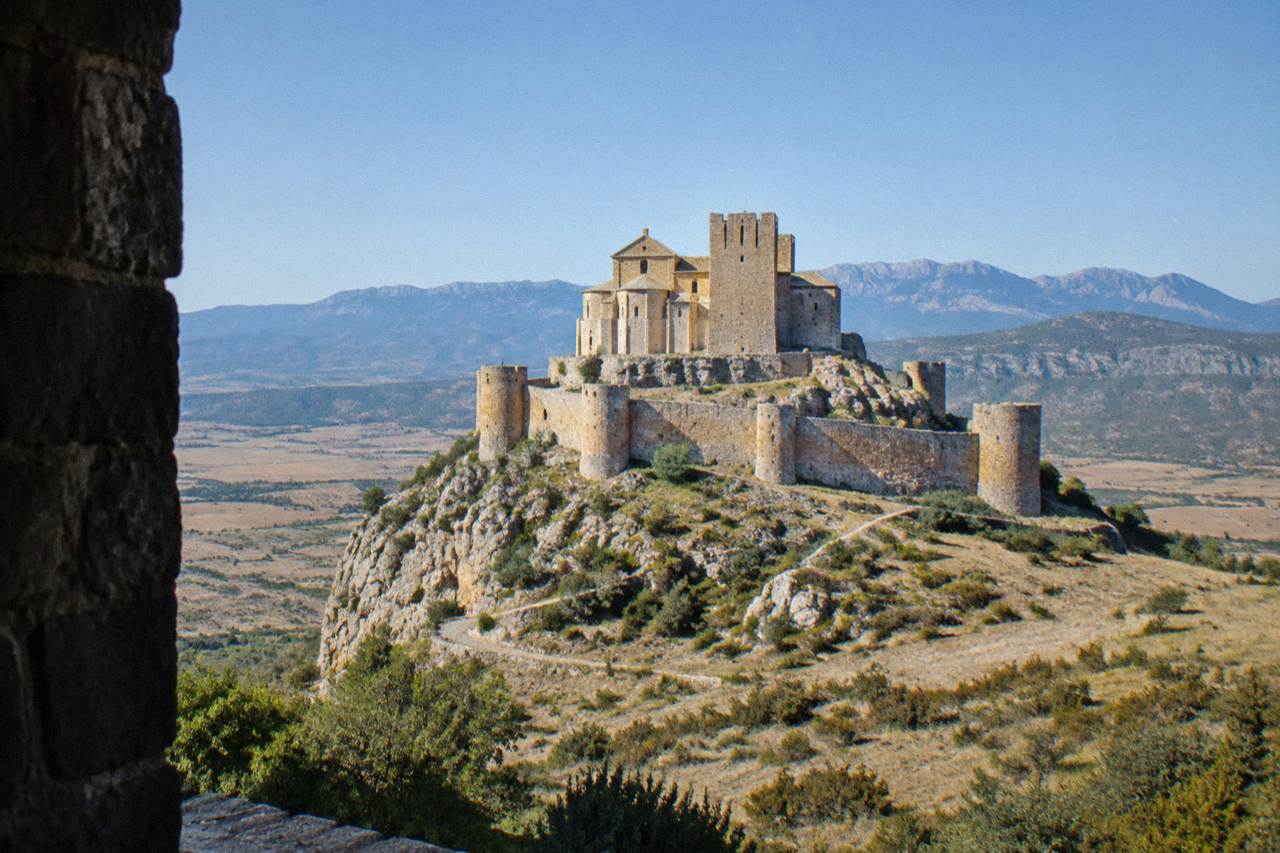
Loarre Castle is a Romanesque fortress in the Sierra de Loarre, in Huesca province north of Zaragoza. Built for the medieval kings of Aragon during the Reconquista, it is regarded as the best-preserved Romanesque castle in Europe, with its walls, towers, chapel and crypt substantially intact.
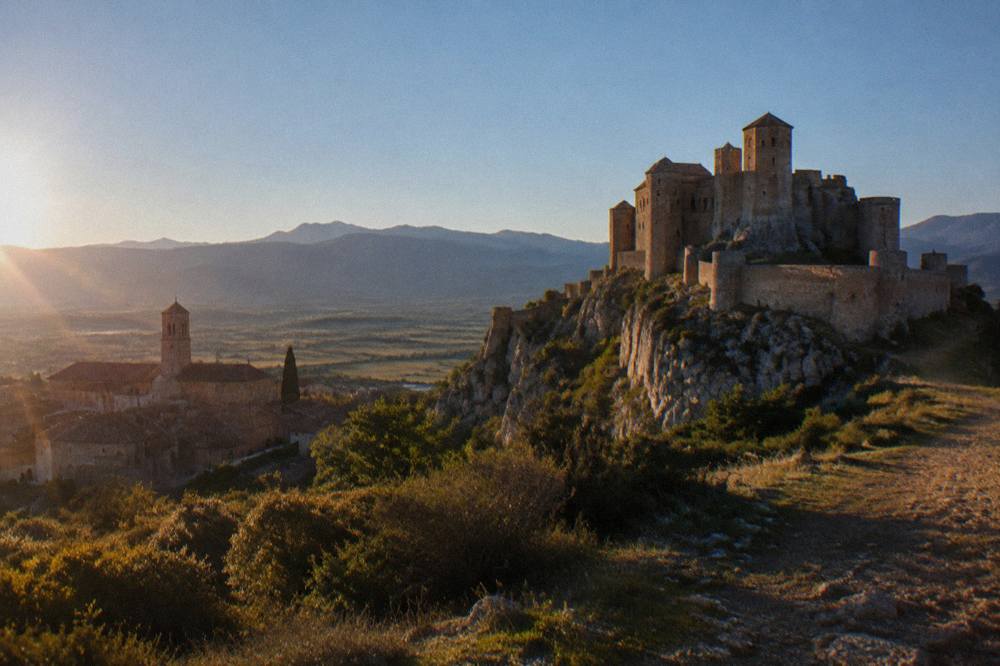
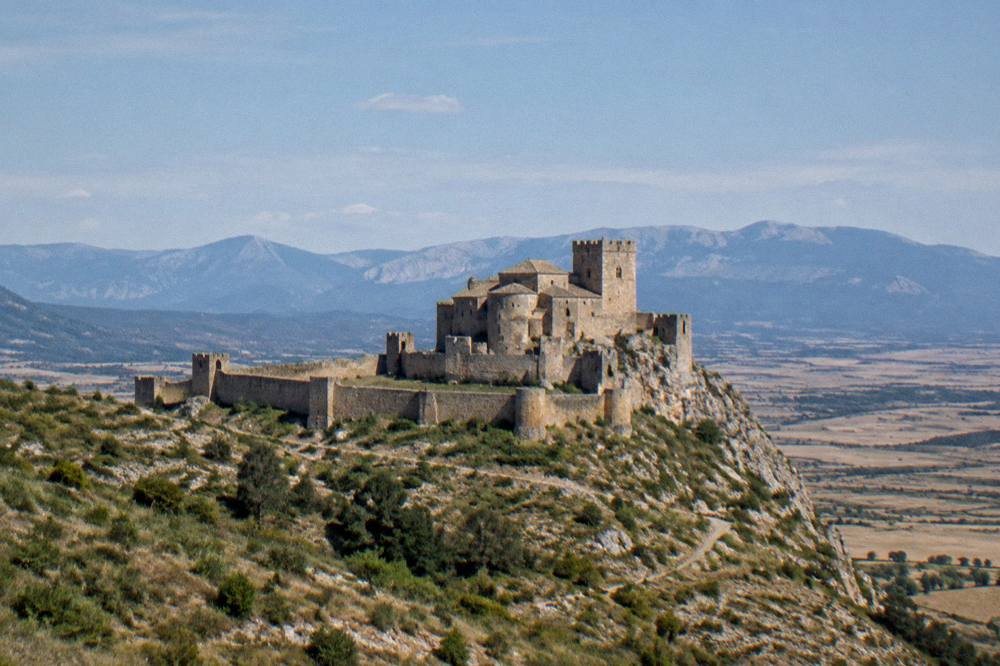
Loarre Castle stands on a limestone ridge in the Sierra de Loarre, in Huesca province, the Aragonese territory that rises north of Zaragoza toward the Pyrenees. Zaragoza, the capital of Aragon on the Ebro, is the natural base for a day in that direction, and Loarre is the castle most visitors to the region have never heard of and never forget. It is a Romanesque fortress, built for the kings of Aragon as the Christian frontier pushed south, and its walls, towers, chapel and crypt survive to a degree that makes it, in the judgement of the Spanish heritage establishment, the best-preserved Romanesque castle in Europe. The setting does half the work: the ridge rises out of dry, pale hills, and the silhouette from the approach road is the picture that sells the whole province.
What Is Loarre Castle And Why Does It Matter?
Loarre Castle is a Romanesque fortress built under the medieval kings of Aragon as a Christian stronghold on the frontier with the Muslim taifa of Zaragoza, during the centuries when the Christian kingdoms pushed south into the Ebro valley. Its church of San Pedro, its crypt, its keep and its double line of walls survive almost whole, which is why it is routinely described as the finest and most complete Romanesque castle in Europe.
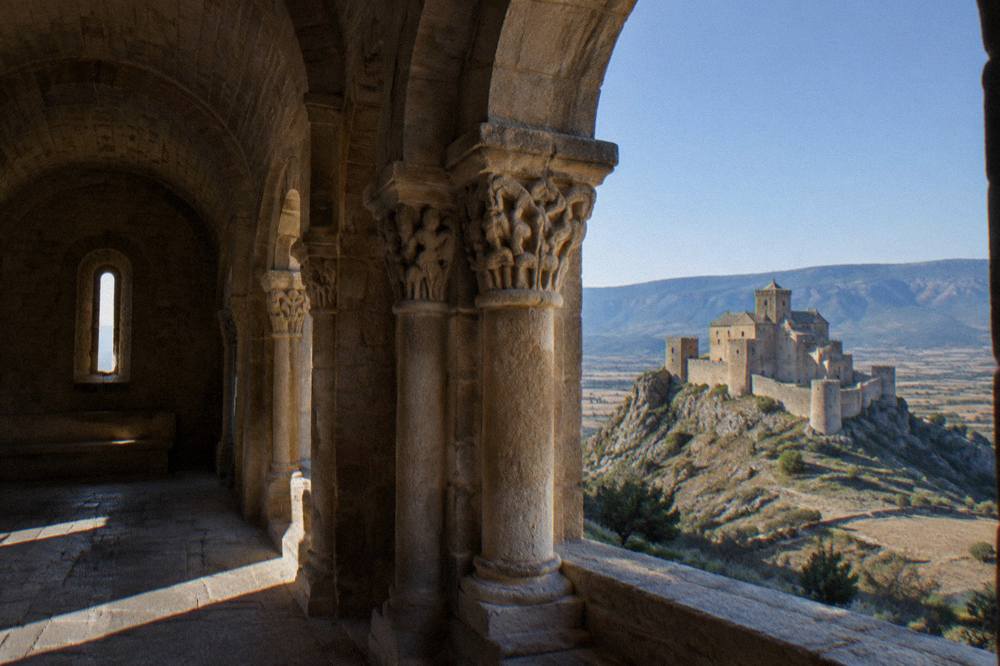
That frontier context is the reason the castle looks the way it does. In the Reconquista centuries, Huesca itself was still in Muslim hands and Loarre sat on the very edge of the Christian world, a fortified monastery-castle rather than a decorative residence. The builders put a full collegiate church inside the walls, dedicated to San Pedro, with a barrel-vaulted nave, a crypt beneath it and carved capitals that survive in remarkable condition. The queen of the complex is the keep, the Torre del Homenaje, and the ring of round towers and curtain walls that climb the ridge behind it.
The castle's later life explains its survival. Once Huesca fell to the Christians and the frontier moved far to the south, Loarre lost its military purpose and slid into quiet rural use, which is precisely why no later century rebuilt it into a Renaissance palace or a gun fort. What stands today is substantially medieval fabric. The film industry has noticed: the castle served as a location for the medieval film Kingdom of Heaven, and that exposure did more for its international reputation than centuries of obscurity.
For a visitor based in Zaragoza, Loarre offers something the city's own great monuments, the Basílica del Pilar, La Seo and the Aljafería, cannot: an empty horizon. Zaragoza's sights are urban and crowded around Plaza del Pilar. Loarre is a ridge, a valley and a castle, with a walk up from the parking area and views back over the plains of Huesca toward the sierras. The Zaragoza Travel Guide day-trip pages exist for exactly this contrast, and Loarre is one of the strongest entries in the set.
How Do You Get To Loarre Castle From Zaragoza?
Loarre Castle lies north of Zaragoza in Huesca province, in the Sierra de Loarre at the southern edge of the Pyrenean foothills, reached by road through the town of Ayerbe on the regional route toward Huesca city. No train serves the castle, and no verified public bus timetable connects it to Zaragoza, so the realistic options are a hire car, a private driver, or a guided excursion that covers the mountain roads for you.
The honest planning answer is that Loarre is a driving destination. The route runs out of Zaragoza to the north-west, joins the corridor toward Huesca, and then climbs off the main road into the sierra; the final stretch is a mountain road that ends at a parking area below the walls, with the last part of the approach on foot. The castle sits high, and the walk from parking to gate is part of the experience, so wear real shoes rather than city sandals. In the hottest months the exposed ridge is serious: AEMET's 1981-2010 normals for the Zaragoza Aeropuerto station put July's mean maximum at 32.4 C, and the Huesca hills are not far behind.
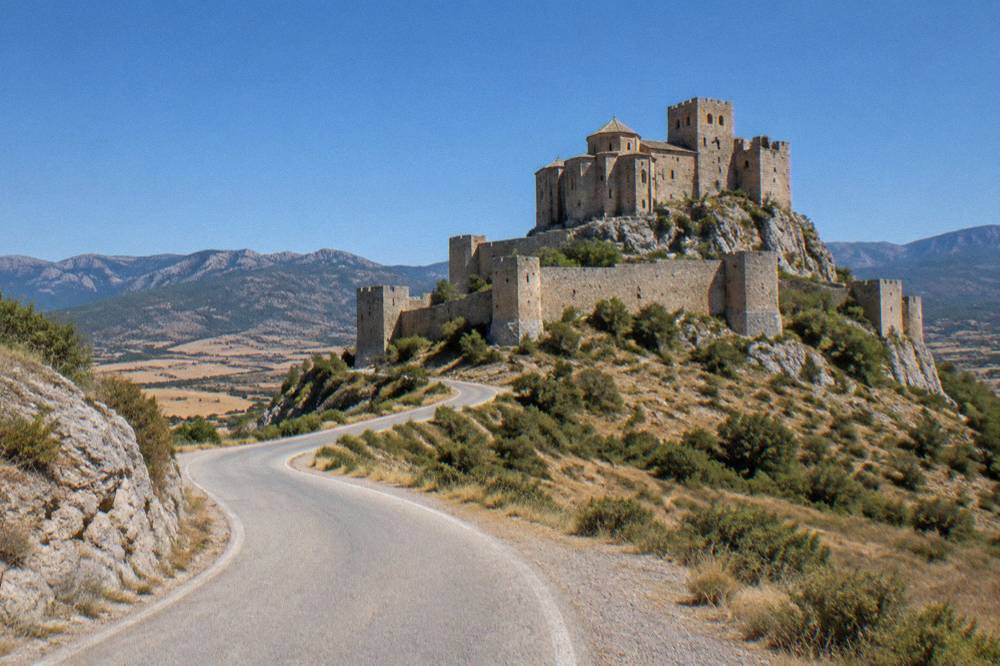
No verified timetable or fare exists in this site's sources for any bus or train to Loarre, so check the current opening arrangements on the castle's official notice before you set out, and confirm the access road is open in winter, when snow can close the upper stretch. What can be stated is the direction and the character of the drive: north out of the Ebro valley, through the plains of Huesca, into country that turns rocky and green within a short stretch of leaving Aragon's capital. The change is dramatic and it is the whole argument for the trip.
If you would rather not drive mountain roads on a Spanish holiday, the guided options below are the practical alternative. The Pyrenees excursions from Zaragoza handle the driving, the schedule and the pickup for you.
A note on season. The castle is at its best in spring and autumn, when the ridge is green and the light is low enough to model the stonework. Midsummer is hot and busy; midwinter can be cold, with AEMET's 1981-2010 series showing 23.1 frost days a year at the Zaragoza Aeropuerto station, and the sierra gets more. Plan water, a hat and an early start between June and August.
What Can You See Inside Loarre Castle?
The castle's core sights are the church of San Pedro with its carved capitals and barrel vault, the crypt beneath it, the Torre del Homenaje keep, the outer wall with its round towers and its covered stair, and the panoramic ridge walk behind the walls over the plains of Huesca. The whole circuit is compact, a couple of hours covers it at a relaxed pace, and the setting over the sierra is the sight that stays with you.
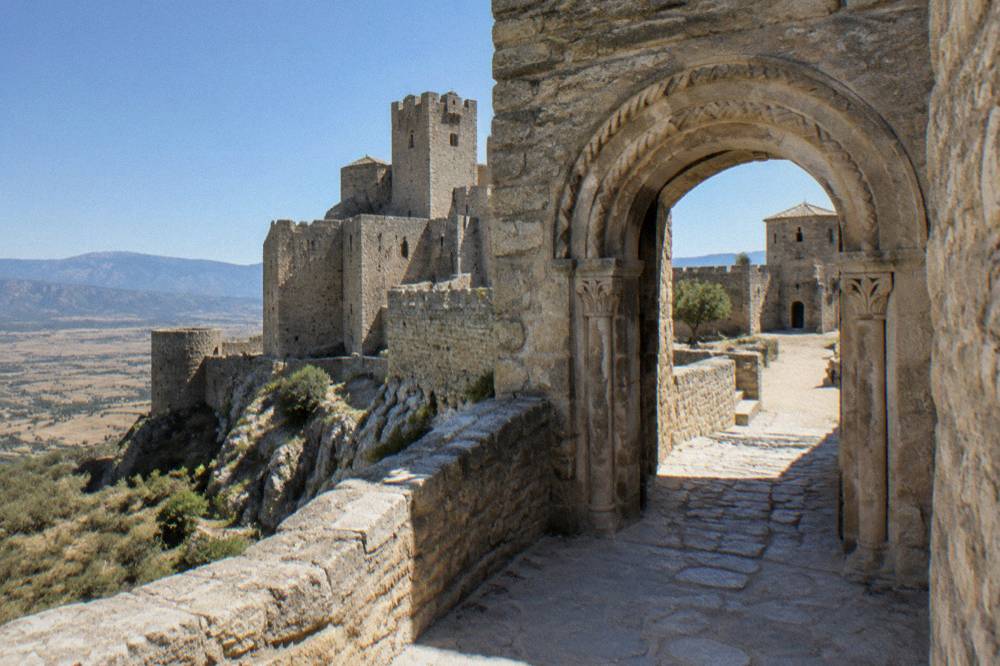
Start, as everyone does, with the church. San Pedro de Loarre is one of the great Romanesque interiors of Aragon: a nave under a stone barrel vault, an apse lit by narrow windows, and capitals carved with figures, scrolls and creatures that have kept their detail across the centuries. Beneath the nave sits the crypt, its vaults carried on simple columns, a cool, dim space that reads as the spiritual engine of the whole fortress. The castle was a monastery as much as a barracks, and the church makes that obvious.
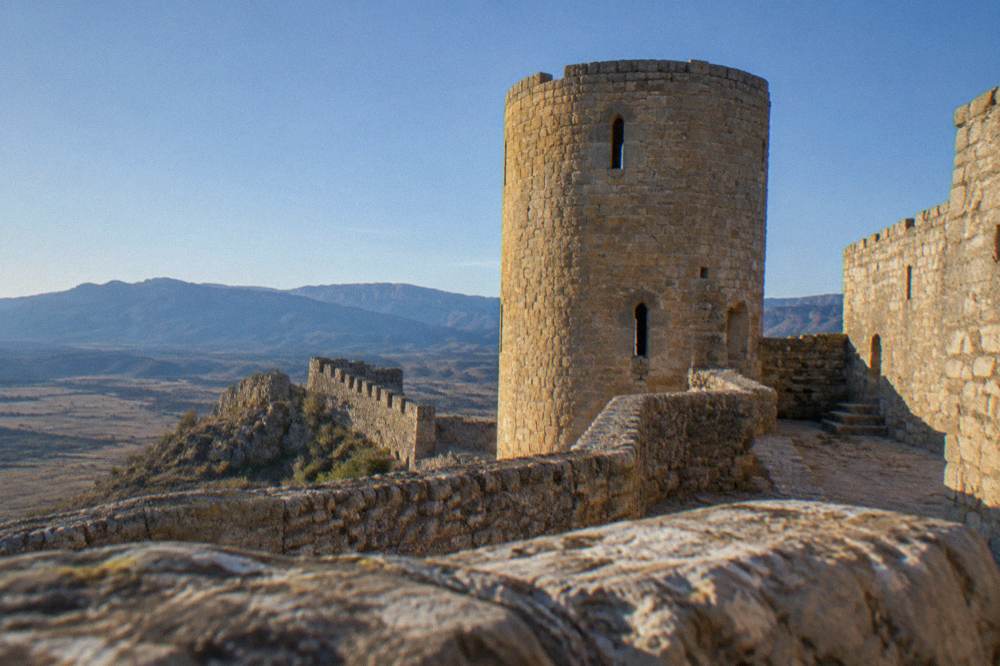
Then the military half. The Torre del Homenaje, the great keep, anchors the upper enclosure. The outer wall, added in a later building campaign under the medieval kings, rings the ridge with round towers and a remarkable covered stair, a vaulted passage in the thickness of the wall that let defenders move under cover. From the towers the view runs back over the Sierra de Loarre and out across the plains toward Ayerbe and Huesca, and on a clear day the horizon is all mountain.
There is no verified entry fee, opening calendar or guided-tour schedule for Loarre in this site's sources, so check the castle's official notice before you go, especially for winter closures and holiday hours. What can be said firmly is what the visit feels like: a short climb, a compact circuit, and stone that rewards slow looking. Give it half a day and combine it with the territory around it rather than rushing back.
Prefer a day in the high mountains with everything arranged? A booked excursion covers the roads, the timings and the pickup, with free cancellation available.
When Is The Best Time Of Year To Visit Loarre From Zaragoza?
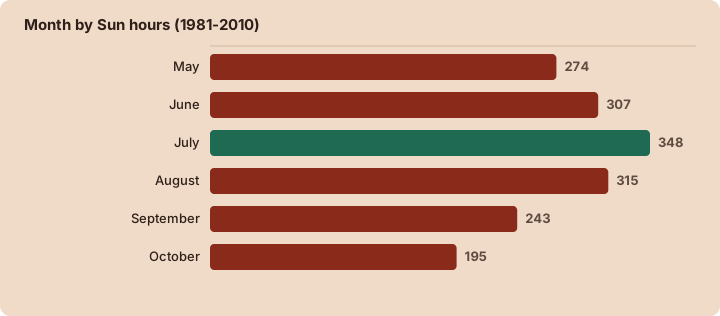
The best months for Loarre are May, June, September and October, when the Huesca foothills are green or golden, the ridge walk is comfortable, and Zaragoza's own weather, per AEMET's 1981-2010 normals for the Zaragoza Aeropuerto station, runs from a mean maximum of 24.1 C in May down to 21.4 C in October with modest rain. July and August are the hottest and busiest; winter is quiet but cold and sometimes snowbound.
The climate logic comes straight from the verified series. Zaragoza's driest months are July and August at 17 mm each in the 1981-2010 normals, and its wettest is May at 44 mm, but even the wettest month averages only 6.4 days with a millimetre or more of rain. In other words, almost any date you pick is likely to be dry; the variable that matters is heat. July carries the highest mean maximum of the year at 32.4 C, and August follows at 31.7 C, which on an exposed limestone ridge with no shade is a genuine constraint.
| Month | Mean max C (1981-2010) | Mean C (1981-2010) | Rain mm (1981-2010) | Sun hours (1981-2010) |
|---|---|---|---|---|
| May | 24.1 | 18.0 | 44 | 274 |
| June | 29.3 | 22.6 | 26 | 307 |
| July | 32.4 | 25.3 | 17 | 348 |
| August | 31.7 | 25.0 | 17 | 315 |
| September | 27.1 | 21.2 | 30 | 243 |
| October | 21.4 | 16.2 | 36 | 195 |
October deserves a special mention for a different reason: the Fiestas del Pilar run in Zaragoza from 10 to 18 October 2026, with the Ofrenda de Flores on 12 October, and the city fills up around them. A Loarre day before or after the fiesta window is a smart way to balance a Zaragoza stay, fiesta days in the city and one quiet day in the mountains. The best time to visit Zaragoza page carries the full seasonal breakdown.
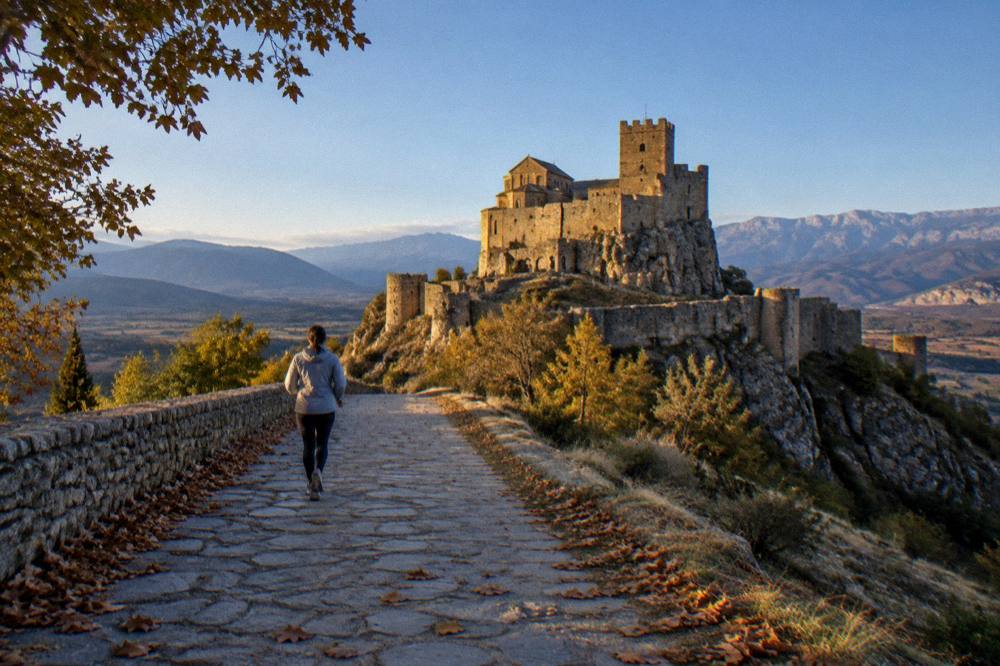
Winter has one attraction and one risk. The attraction is emptiness: the ridge in cold, clear light, with frost on the plain. The risk is access, since mountain roads in the Sierra de Loarre can close after snow, and this site's sources carry no verified winter opening schedule for the castle. If a winter trip appeals, confirm the road and the opening notice before committing the day.
Can You Visit Loarre On A Guided Day Trip From Zaragoza?
No guided excursion from Zaragoza goes to Loarre Castle itself, so the castle is a self-drive or private-driver destination. What the guided options do cover is the same northern territory: the Pyrenees excursions to Canfranc, Jaca and Sallent de Gállego, and the Ordesa day trip through Aínsa and Torla, all of which depart from Zaragoza and cross the Huesca province that Loarre belongs to.
That is the honest position, and it is worth stating plainly. The bookable day trips that start in Zaragoza head for the high Pyrenees, the wine country and the Moncayo, not for the castle. If your heart is set on Loarre, a hire car is the plan, and the Zaragoza car rental and parking guide covers the city end of that logistics chain. If you are flexible, and the mountains rather than one specific monument are the goal, the guided excursions below are excellent, and they handle the mountain roads.
| Guided excursion from Zaragoza | Duration | Price | Rating |
|---|---|---|---|
| Excursion to Canfranc, Jaca and Sallent de Gállego | 11 hours | 4.7 from 10 reviews | |
| Ordesa day tour: Aínsa, Torla and Sorrosal Waterfall | 11 hours | 5 from 3 reviews | |
| Canfranc, Jaca and Sallent de Gállego tour | Not stated | 5 from 2 reviews |
The Canfranc excursion is the one this site features alongside its day-trip pages: an eleven-hour loop from Zaragoza into the Aragonese Pyrenees, taking in the abandoned grandeur of Canfranc station, the fortified town of Jaca and the village of Sallent de Gállego, rated 4.7 from 10 reviews with the price. You can read the full write-up on the Canfranc, Jaca and Sallent excursion page, or Check availability directly.
The Ordesa day tour makes the same argument in wilder country: Aínsa, Torla and the Sorrosal waterfall, eleven hours from Zaragoza, with a 5 rating from 3 reviews and the price. The Ordesa National Park day-trip page covers the destination in depth.
A practical pattern for a two-car-free-days stay: one booked Pyrenees excursion, and one self-drive castle day, is a better combination than two booked excursions if Loarre is the thing you came for. Zaragoza itself supplies the evening: the Zaragoza tapas crawl route in the old town is the standard way to end a day in the mountains.
What Else Can You Combine With Loarre On A Huesca Day Trip?
The natural pairing is Loarre Castle with Huesca city, the provincial capital, whose cathedral and old streets sit on the route back toward Zaragoza. Beyond that, the same northern arc holds the monastery of San Juan de la Peña beneath its cliff, the town of Jaca and the Canfranc valley, and the high country of Ordesa, all covered in this site's Huesca and Pyrenees day-trip pages.
Huesca city is the obvious half of the day. It is a small, quiet provincial capital with a Gothic cathedral, a Romanesque church of San Pedro el Viejo in the old quarter, and the atmosphere of a place that never learned to be a tourist city, which is its charm. A morning at Loarre, lunch in Huesca, and the drive back to Zaragoza is the classic loop. The Huesca day-trip page carries the detail.
The deeper alternative is the San Juan de la Peña combination. The old monastery hides beneath a great rock overhang in the mountains south of Jaca, one of the most extraordinary buildings in Aragon and the legendary resting place of the Holy Grail in local tradition. Loarre and San Juan de la Peña are both medieval frontier monuments of the same kingdom, and a day that takes in both is a complete lesson in how Aragon was built. The San Juan de la Peña day-trip page lays out the full argument.
For a longer northern loop, the Jaca day-trip page and the Canfranc station page extend the same territory toward the French border, while the Monasterio de Piedra page describes the other direction entirely, south-west into the Iberian System with its waterfalls. The Zaragoza travel planning guide helps you sequence several of these into one stay.
What Should You Pack For A Loarre Day From Zaragoza?
Pack for an exposed mountain ridge, not a city walk: solid shoes for the climb from parking to gate, sun protection and more water than feels reasonable in summer, layers for spring and autumn, and something warm for winter, when AEMET's 1981-2010 series for the Zaragoza Aeropuerto station averages 23.1 frost days a year and the sierra runs colder than the plain.
The list is short because the day is simple. The castle has no shade, the approach is on foot, and the reward is standing on walls with wind in your face. In July and August, when the mean maximum runs above 31 C, go early and treat the middle of the day as lunch in the valley. In the green months, a light layer is enough. In winter, assume the ridge will be several degrees colder than Zaragoza and possibly icy on the path.
| Season | Mean max C in Zaragoza (1981-2010) | Rain mm (1981-2010) | What to carry |
|---|---|---|---|
| Spring (Mar-May) | 17.3 to 24.1 | 19 to 44 | Layers, light rain shell, water |
| Summer (Jun-Aug) | 29.3 to 32.4 | 17 to 26 | Hat, high-factor sun cream, two litres of water per person |
| Autumn (Sep-Nov) | 14.8 to 27.1 | 30 to 36 | Layers, windproof layer, water |
| Winter (Dec-Feb) | 10.5 to 13.1 | 21 to 22 | Warm coat, gloves, grippy shoes |
One more practical note: this is a day for a proper breakfast in Zaragoza before you leave. The city's café-bars around the Centro and Paseo de Independencia area open early, and the mountain villages on the route are small, with limited services. Fill the flask, fill the tank, and check the castle's official opening notice the evening before.
Is Loarre Castle Worth The Trip From Zaragoza?
Yes, unreservedly, if Romanesque architecture, empty landscapes or frontier history mean anything to you: Loarre is the best-preserved Romanesque castle in Europe, a day trip north from Zaragoza into the Huesca foothills, and it delivers a complete medieval fortress rather than a ruin. It is not worth it if you will not drive or arrange transport, since no verified public connection exists.
The case for Loarre is the case for Aragon itself. This is the Spain that the coastal itineraries skip: a capital city with a Basílica del Pilar and an Aljafería that most foreign visitors have never stood inside, ringed by a province of castles, monasteries and mountains that costs a fraction of Catalonia or the Basque Country to enjoy. Loarre is the purest expression of that inland Aragon, a building that looks like a film set and has the stones to prove it is real.
Zaragoza's own monument list makes a strong base camp for the trip, and the entry prices are modest. The Pilar's tower viewpoint costs EUR 6 for an adult, La Seo is EUR 10 including three associated museums, the Aljafería is EUR 7 general and EUR 9 with a guided tour, and the four-site Caesaraugusta bono is EUR 7. A day of Roman Zaragoza, a day of Loarre and Huesca, and an evening of tapas is a better three days than most Spanish cities can offer.
| Zaragoza sight | Adult entry | Free-entry day |
|---|---|---|
| Basílica del Pilar tower viewpoint | EUR 6 | None stated |
| La Seo (includes Museo de Tapices, Museo Pilarista, Rosario de Cristal) | EUR 10 | Aragon residents on the 6th, 12th, 23rd and 27th |
| Aljafería | EUR 7 (EUR 9 guided) | 1st and 3rd Sunday and Monday of each month |
| Caesaraugusta four-museum bono | EUR 7 (EUR 5 reduced) | 1st Sunday of the month |
If the castle day is the peak of your trip, the guided mountain excursions below are the natural complement, and they run year-round from Zaragoza.
However you build the day, Loarre rewards the effort of getting there. Zaragoza gives you the food, the fiestas and the great churches; the Sierra de Loarre gives you the silence and the stones. Very few trips to Spain include both, and a stay in Zaragoza makes it almost effortless.
Common Questions About Loarre Castle
What is Loarre Castle?
Loarre Castle is a Romanesque fortress in the Sierra de Loarre in Huesca province, built by the medieval kings of Aragon on the Christian frontier. Its church of San Pedro, crypt, keep and double walls survive almost intact, and it is widely described as the best-preserved Romanesque castle in Europe.
How far is Loarre Castle from Zaragoza?
Loarre lies north of Zaragoza in Huesca province, reached by road toward Huesca city and then into the foothills. This site's verified sources carry no distance or drive time for the route, so check a current map before planning; the trip is comfortably done as a day out of Zaragoza with a hire car.
Can you get to Loarre Castle by public transport?
No verified train or bus connection to the castle appears in this site's sources. The realistic options are a hire car, a private driver, or a guided excursion into the same northern territory, such as the Pyrenees day trips from Zaragoza that cover Canfranc, Jaca and the Ordesa region.
What is there to see inside Loarre Castle?
The church of San Pedro with its carved Romanesque capitals and barrel vault, the crypt beneath it, the Torre del Homenaje keep, the outer wall with its round towers and covered stair, and the views over the plains of Huesca from the ridge.
When is the best time of year to visit Loarre?
May, June, September and October, when the foothills are green or golden and the heat is manageable. July and August are the hottest months, with a mean maximum of 32.4 C in July at the Zaragoza Aeropuerto station in AEMET's 1981-2010 normals, and winter can bring snow to the access road.
Was Loarre Castle used as a film location?
Yes. The castle appears in the film Kingdom of Heaven, which brought it international attention. Its unbroken silhouette and intact Romanesque stonework are what made it credible as a medieval fortress on screen.