Where Is Zaragoza
Zaragoza is the capital of Aragon, an inland city on the Ebro in north-east Spain, roughly halfway between Madrid and Barcelona and often confused with a football club, a surname and a bridge in Texas.
Short answer
Zaragoza is the capital of the autonomous community and province of Aragon, in north-east Spain. It lies inland on the Ebro river, about 1.5 to 2 hours from both Madrid and Barcelona by high-speed train, and it is not in Catalonia and not a Basque city.
Zaragoza, Spain, is the capital of the province of Zaragoza and of the autonomous community of Aragon, an inland city on the Ebro river in the country's north-east. It is not in Catalonia and it is not a Basque city, two confusions that surface constantly in searches, and it has no coast: the nearest sea is a long way off, and the city's whole character comes from the river valley it occupies. The name also travels badly. Real Zaragoza is a football club, "Zaragoza" is a common Mexican and Colombian surname and place name, and the Zaragoza International Bridge links El Paso in Texas with Ciudad Juárez in Mexico. This page is about the Spanish city, and it pins down exactly where that city sits, what region governs it, how to reach it and what marks the spot on the ground.
Where Is Zaragoza On The Map Of Spain?
Zaragoza sits in the Ebro valley in north-east Spain, roughly midway between Madrid and Barcelona, and it is the capital of both its province and the whole autonomous community of Aragon. It is an inland city with no coast, placed where the Ebro, the Huerva and the Gállego rivers meet. The city gives its name to the province around it, and the province sits inside Aragon, one of the largest regions in the country by area.
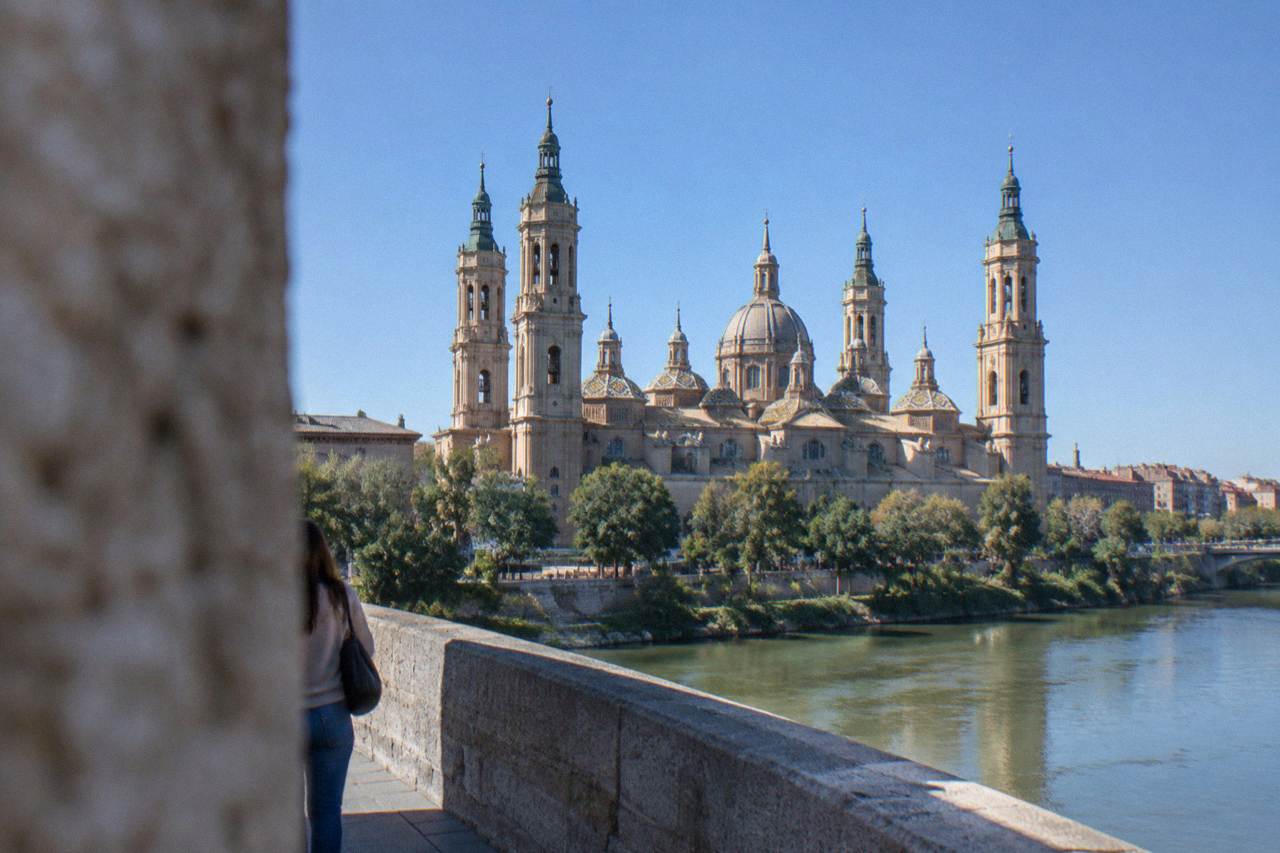
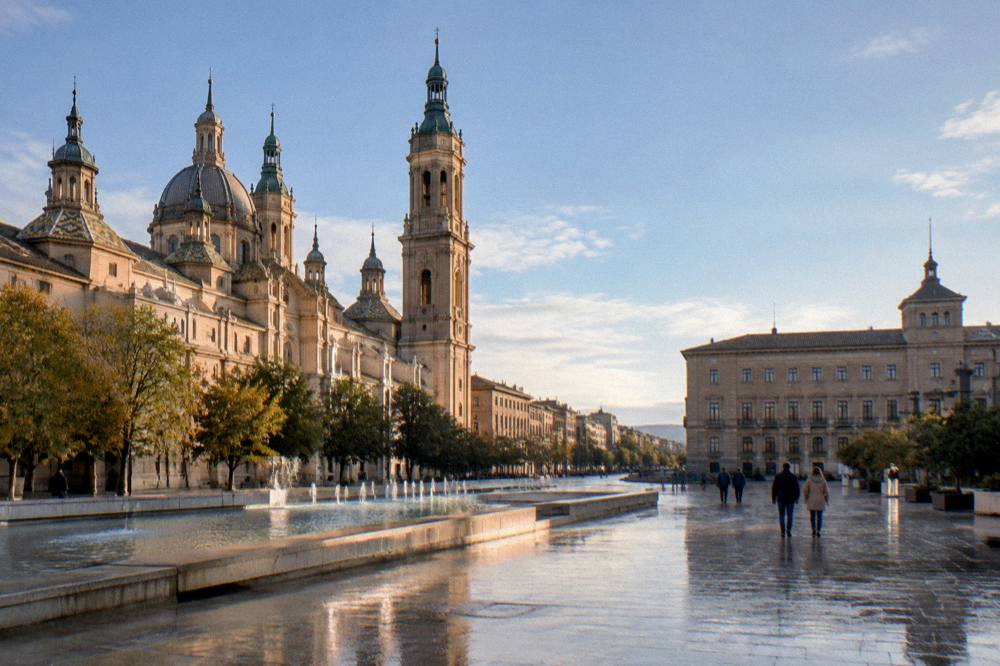
That position is the single fact that explains most of the city's history. A Roman city called Caesaraugusta, the ancestor of the modern name, grew here because the crossing point on the Ebro mattered, and every later layer, Visigothic, Islamic, Aragonese, used the same site. The Ebro still runs through the middle of the modern city, and the two great churches face each other across one square beside it: the Basílica del Pilar and La Seo, the cathedral of San Salvador. The Puente de Piedra, the stone bridge whose current form was built from 1401 and opened in 1440 on the line of a Roman-era crossing, carries you over the river between them.
Aragon itself is one of Spain's inland communities, bordered by Catalonia to the east, Navarre and the Basque Country to the north, Castilla y León to the west, Castilla-La Mancha to the south and, at its northern tip, France. Zaragoza is by far its largest city and its seat of government. If you want the practical follow-up, the guide to getting to Zaragoza covers every entry route, and the Zaragoza travel planning page puts the location into a full itinerary.
Which Zaragoza Is This? The Club, The Surname And The Bridge
This page is about Zaragoza, the city in Spain. Three other things share the name and pollute search results: Real Zaragoza, the football club that plays at the Romareda stadium in the city; the surname Zaragoza, common in Mexico and Colombia, and the Zaragoza International Bridge between El Paso, Texas and Ciudad Juárez, Mexico. None of those is a place to visit in Spain, and only the club actually lives there.
The football club is the most frequent collision. Searches for "Zaragoza" return fixtures, transfers and league tables, and none of that is travel content. The Romareda stadium is a real building in the city and can be described as one, but results about the club's results belong to sport pages, not to a location guide.
The bridge is a different trap entirely. The Zaragoza International Bridge is a border crossing on the Rio Grande, thousands of kilometres from Aragon, and it has nothing to do with the Ebro. The surname, likewise, belongs to people, including the Mexican general after whom several streets and towns in the Americas are named. When a search result mentions Texas, Juárez, a match report or a Mexican state, it is not about this city.
For orientation once you have confirmed you are in the right place, the things to do in Zaragoza page lists the sights in order, and a short guided walk is an efficient way to see how the old town fits together. The 105-minute Monumental Sightseeing Tour, your first introduction to Zaragoza, is built exactly for that first-hour orientation, and it costs from $10.41 per person on the operator's live listing.
What Region Is Zaragoza In, And What Is It Not?
Zaragoza is in Aragon, an autonomous community in north-east Spain, of which it is the capital. It is not in Catalonia, which lies to Aragon's east, and it is not a Basque city, since the Basque Country is a separate community on the northern coast. Aragon has its own government and its own language alongside Spanish, and Zaragoza hosts the regional institutions.
The Catalonia confusion is worth killing outright, because it changes itineraries. Travellers sometimes lump Zaragoza into a Barcelona trip as if it were a Catalan satellite, but Aragon and Catalonia are distinct communities with separate administrations, separate languages and separate histories. Zaragoza's own heritage label is Mudéjar, the post-Islamic Christian architecture with Islamic craft, and a UNESCO World Heritage item called "Mudéjar Architecture of Aragon", inscribed in 1986, carries the region's name.
The Basque confusion is rarer but appears in questions, and the answer is simple geography: the Basque Country is on the Cantabrian coast, hundreds of kilometres from the Ebro valley. Aragon's own northern edge is the Pyrenees, which is why mountain day trips from Zaragoza are a real part of the city's offer.
A quick table of what belongs where:
| Question | Answer for Zaragoza |
|---|---|
| Autonomous community | Aragon |
| Role in the region | Capital of Aragon |
| Province | Zaragoza, of which it is also the capital |
| In Catalonia? | No, Catalonia is the neighbouring community to the east |
| A Basque city? | No, the Basque Country is on the northern coast |
| Coastline | None, the city is inland on the Ebro |
If the region's identity appeals, the guide to Mudéjar architecture explains the style Aragon is known for, and the Zaragoza facts and history page carries the longer story.
How Far Is Zaragoza From Madrid And Barcelona?
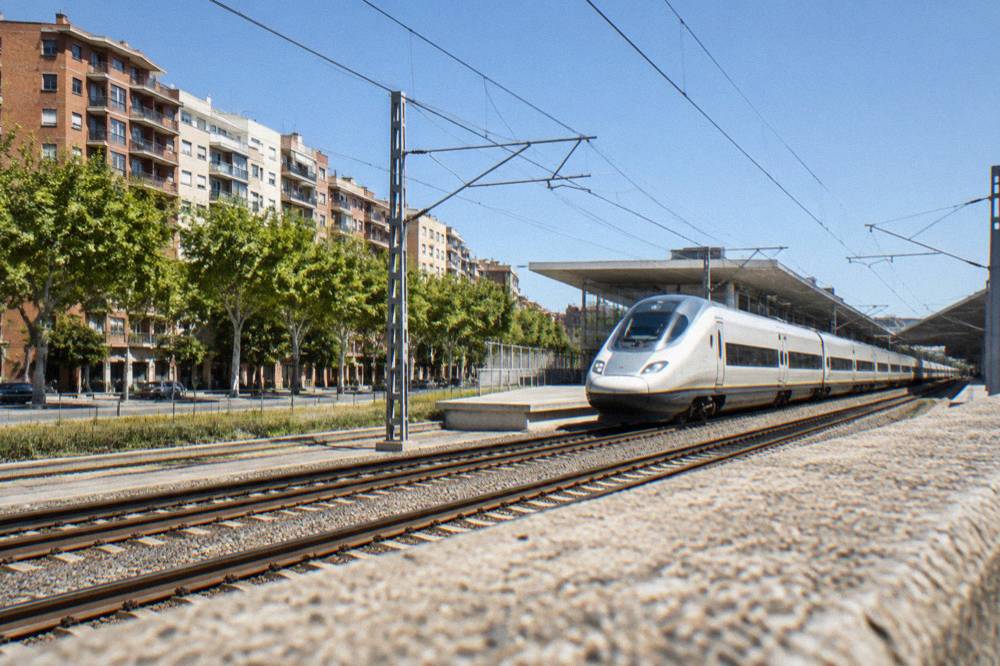
Zaragoza lies roughly midway between Madrid and Barcelona, and high-speed trains from either city take about 1.5 to 2 hours to Zaragoza-Delicias station. The city is a natural stop on any journey between Spain's two biggest cities, and many travellers break the rail line here for a day or two rather than treating the city as a destination reached by detour.
The rail connection is what the location means in practice. Zaragoza-Delicias is the city's main station and the stop for the high-speed line that connects Madrid and Barcelona through the Ebro corridor. The exact fastest time and fare vary by operator and date, so check the operator's own site before booking, but "about 1.5 to 2 hours" is the honest planning range for both capitals. The dedicated pages, Madrid to Zaragoza and Barcelona to Zaragoza, walk through each route in detail, and the Zaragoza-Delicias train station guide covers the station itself.
The city's airport, Zaragoza Airport, keeps a smaller schedule: Aena's 2026-09-30 list shows Ryanair, Wizz Air, Binter, Volotea, Vueling and Alba Star flying to 13 destinations. The flights to Zaragoza page tracks the route list, and the airport to city centre guide covers the onward journey, including airport bus line 505, which costs 4.65 EUR for a single, about 2.25 EUR with a Lazo card, and takes roughly 25 to 35 minutes, timed to flights.
The main ways in:
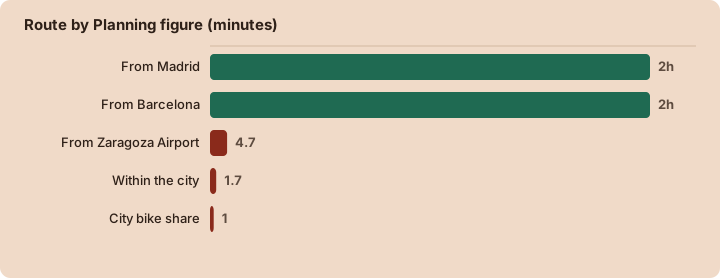
| Route | How | Planning figure |
|---|---|---|
| From Madrid | High-speed train to Zaragoza-Delicias | About 1.5 to 2 hours |
| From Barcelona | High-speed train to Zaragoza-Delicias | About 1.5 to 2 hours |
| From Zaragoza Airport | Airport bus line 505 | 4.65 EUR single, about 25 to 35 minutes |
| Within the city | Urban bus and tram | 1.70 EUR single, 0.55 EUR with Tarjeta Bus |
| City bike share | Bizi day pass | 1 EUR fixed plus 0.50 EUR for the first 30 minutes |
What Does The Ebro River Mean For The City?
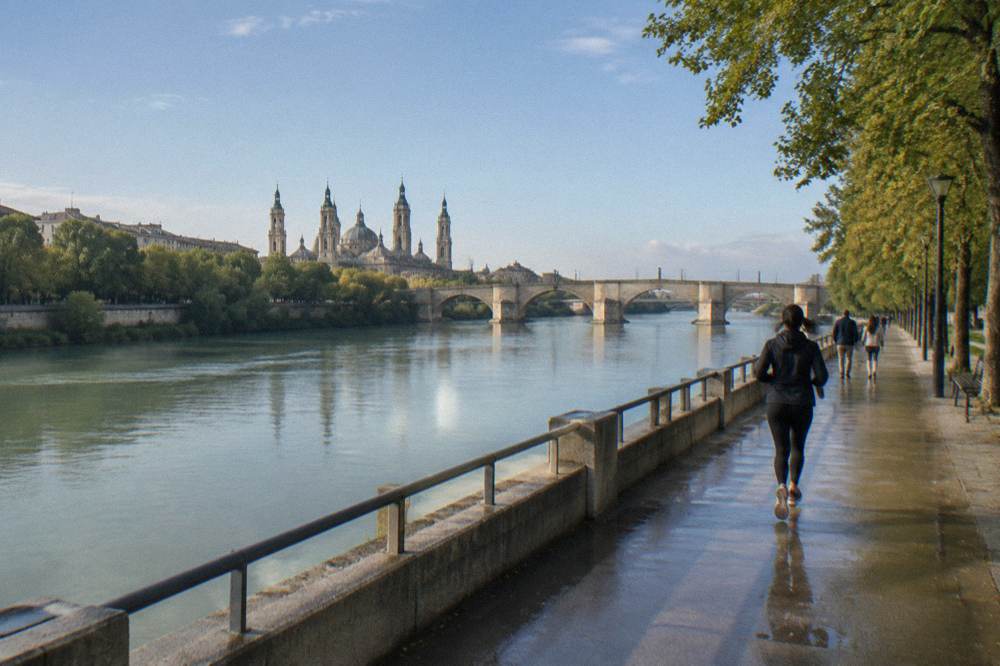
The Ebro is the reason Zaragoza exists where it does: the city grew around a crossing point on the river, and the river still divides and defines it. The Puente de Piedra marks the historic crossing, the Basílica del Pilar rises beside the water, and the Parque del Agua, more than 120 hectares in the Ranillas meander, occupies the floodplain downstream of the Expo 2008 site.
Rivers built this city twice. First as Caesaraugusta, the Roman crossing with its forum, river port, baths and theatre, whose remains are now four visitable museums under the modern streets. Then as the medieval and Aragonese city, whose stone bridge, Puente de Piedra, was rebuilt from 1401 and opened in 1440, with four bronze lions guarding it since 1991. Napoleon's troops blew up one arch in 1813, and the bridge you cross today is the repaired result.
The river's modern footprint is the Parque del Agua Luis Buñuel, a green space in the Ranillas meander beside the Expo 2008 site, with running circuits of 5 and 10 km, the first European green space to hold the Green Globe certification. The park floods safely in big Ebro rises, which is itself a piece of geography worth knowing: the meander is designed to take the water. For walking the whole riverside, the Ebro river walk guide traces the banks end to end, and the Roman Caesaraugusta page covers the underground museums.
What Is The Weather Like In Zaragoza?
Zaragoza has a dry continental climate with hot summers and cool winters, and it is one of the driest provincial capitals in Spain: AEMET's 1981 to 2010 normals for the Zaragoza Aeropuerto station show just 322 mm of rain across the whole year, with July and August the driest months at 17 mm each and May the wettest at 44 mm. July is the hottest month, averaging a 32.4 C mean maximum.
Those figures all come from the 1981 to 2010 normals, the only series the station page publishes, and they describe an inland Ebro-valley climate with no sea to moderate it. The summer heat is real but dry, and the evenings cool off: July's mean minimum is 18.3 C. Winters are cool rather than severe, with January, the coldest month, averaging a 10.5 C mean maximum and a 2.7 C mean minimum. The station records 23.1 frost days and 21.3 fog days a year on average.
The cierzo, the cold, dry north-west wind that runs down the Ebro valley, is the city's signature weather feature, and it is qualitative: no speed or frequency figure is published, only that AEMET issues Aragon wind warnings when it blows hard. The full breakdown lives on the Zaragoza weather page, and the best time to visit Zaragoza guide matches the climate to the events calendar.
| Month | Mean max C | Mean min C | Rain mm | Sun hours |
|---|---|---|---|---|
| January | 10.5 | 2.7 | 21 | 131 |
| April | 19.6 | 7.9 | 39 | 226 |
| July | 32.4 | 18.3 | 17 | 348 |
| October | 21.4 | 11.0 | 36 | 195 |
What Sights Mark The Spot In Zaragoza?
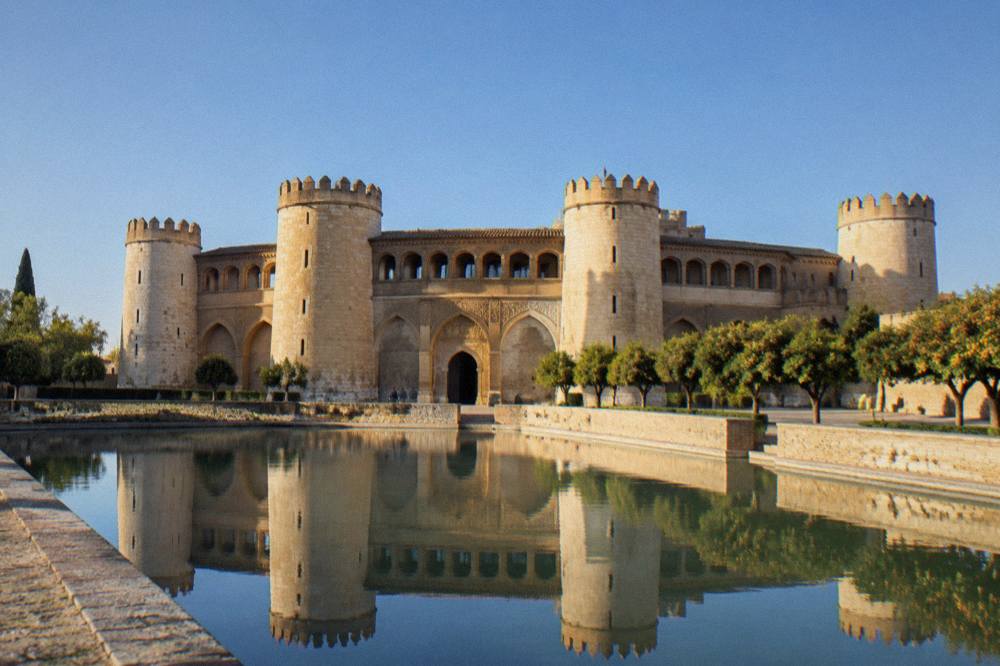
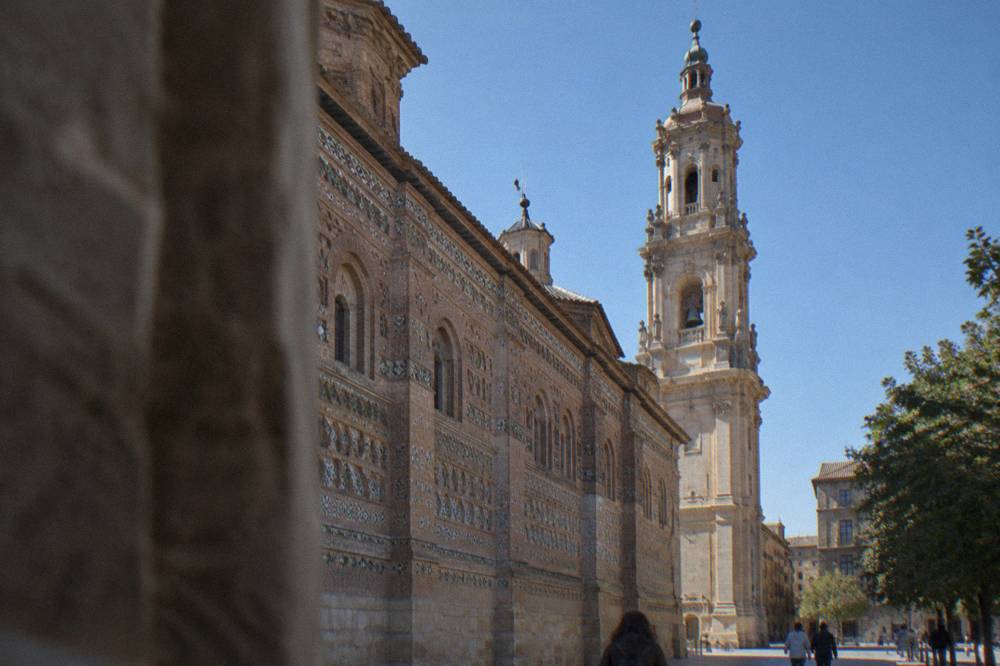
The city's location is written in four landmarks: the Basílica del Pilar beside the Ebro, free to enter, with a tower viewpoint at 6 EUR for adults; La Seo, the cathedral of San Salvador, at 10 EUR general admission including three museums; the Aljafería, the Islamic palace in the city, at 7 EUR general or 9 EUR with a guided tour; and the Roman Caesaraugusta museums under the streets, at 3 to 4 EUR each or 7 EUR for a four-museum bono.
The Basílica del Pilar is the emblem on every postcard, and its October hours run from 7:30 in the morning at the main altar zone, with the temple free to enter throughout. The tower viewpoint, the Torre Mirador, costs 6 EUR for an adult, 4 EUR for ages 13 to 18, students and groups of 20 or more, 5 EUR for over-65s and residents, and nothing for under-12s. One caveat for 2026: the dome known as Regina Patriarcharum is under a restoration agreed on 23 January 2026, funded with 600,000 EUR from Fundación Ibercaja, and its completion is not confirmed, so expect work in progress rather than a finished dome.
La Seo stands across the same square, and its 10 EUR general ticket includes the Museo de Tapices, the Museo Pilarista and the Rosario de Cristal, with a combined ticket with the Pilar tower at 12 EUR. Aragon residents enter free on the 6th, 12th, 23rd and 27th of each month. The Aljafería, a short walk or tram ride west of the centre, is open daily 10:00-18:00 in October, free on the first and third Sunday and Monday of the month, and its Spanish guided tours leave at 10:30, 12:30, 13:30, 15:00 and 16:00. The dedicated guides, Basílica del Pilar, La Seo cathedral and Aljafería palace, carry all of it.
| Sight | Admission | October hours |
|---|---|---|
| Basílica del Pilar, temple | Free | Main altar zone from 7:30, Sun evenings to 21:30 |
| Pilar tower viewpoint | 6 EUR adult | Mon-Thu 10:30-14:30 and 16:00-20:00, Fri-Sun 10:00-20:00 |
| La Seo, with three museums | 10 EUR general | Mon-Sat 10:00-14:30 and 16:00-20:00 |
| Aljafería palace | 7 EUR general, 9 EUR guided | Daily 10:00-18:00 |
| Caesaraugusta four-museum bono | 7 EUR, 5 EUR reduced | Tue-Sat 10:00-14:00 and 17:00-21:00 |
Free-entry days are worth planning around: the Caesaraugusta museums and the Museo del Fuego y los Bomberos are free the first Sunday of the month, the Aljafería the first and third Sunday and Monday, and the Museo del Origami the first Tuesday and Sunday. The free things to do in Zaragoza guide collects them all.
When Should You Visit This Spot On The Map?
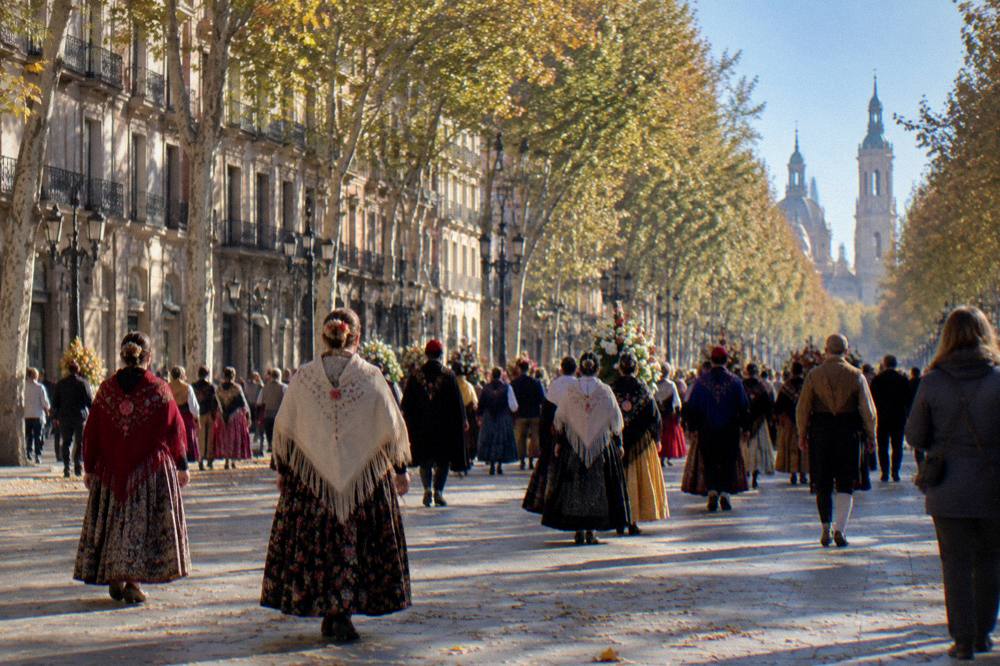
October is the month that owns Zaragoza, because the Fiestas del Pilar run from 10 to 18 October 2026, with the Ofrenda de Flores on 12 October bringing 994 registered groups in traditional dress to the route from Paseo de la Independencia to Plaza del Pilar. Outside the festival week, spring and early autumn suit the continental climate best, since July and August average 32.4 C and 31.7 C mean maximums respectively.
The Fiestas del Pilar are the reason the city's calendar is famous at all. The 2026 edition opens with the pregón from the Ayuntamiento balcony on Saturday 10 October at 21:00, and the programme includes jota competitions, concerts, Venezuela as guest country and an expanded fireworks schedule, with displays after the pregón, in Parque Pignatelli, in a new plaza San Francisco location and at the Ebro for the closing on 18 October.
One October caveat: the Palacio de Sastago is closed in October, and the Museo Pablo Gargallo is temporarily closed. The Museo Goya, meanwhile, reopens on 9 October 2026, so an October visit lands the reopening.
Where Should You Stay Once You Arrive?
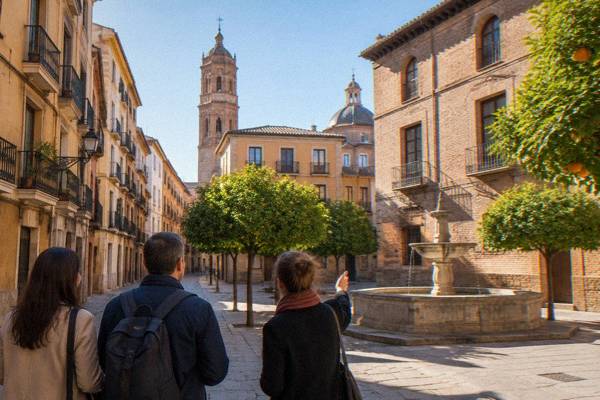
The sensible base is the Casco Histórico, the old town between the Ebro and the central boulevards, because the Pilar, La Seo, the Roman museums and the tapas streets all sit within a short walk of each other there. The Centro area around Paseo de la Independencia adds the shopping spine, while the Delicias district suits rail arrivals who want to be near the station.
The old town is compact, which is the practical payoff of the geography: the two cathedrals, the stone bridge, the Roman forum and the La Lonja market hall cluster inside a walkable loop. Staying there puts the evening tapas circuit on your doorstep, though the low-emission zone means arriving by car needs a DGT label check. The Centro and Paseo de la Independencia area is the grander, wider-streeted face of the city, with the tram running along its avenues.
For the detail, the where to stay in Zaragoza guide maps the districts, the best hotels in Zaragoza page ranks the stays, and the hostels and budget stays page covers the cheap end. The getting around Zaragoza guide handles the trams, buses and bikes once you have landed.
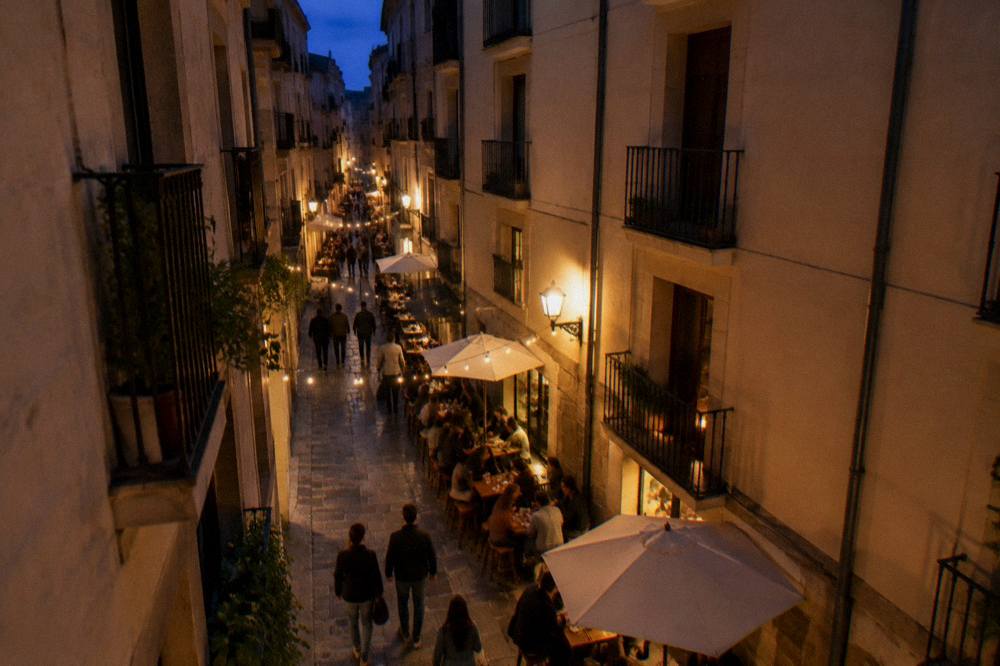
A private guide is a good way to anchor a stay in the old town, since the route can be tuned to where you are sleeping. The Private Custom Tour with a Local Guide, from $51.60 per person and rated 4.9 from 70 reviews on the operator's listing, runs from the Roman walls to the Expo site on whatever route you set.
What Day Trips Does The Location Unlock?
Zaragoza's position in Aragon puts the Pyrenees, the Moncayo massif, Mudéjar towns and desert badlands within day-trip range: guided excursions run from the city to Canfranc, Jaca and Sallent de Gállego in the mountains, to the Ordesa area via Aínsa and Torla, and to Tarazona and the Moncayo, each starting from Zaragoza itself.
That is the quiet advantage of the capital-of-Aragon position. The same city that sits between Madrid and Barcelona also sits south of the Pyrenees, and the excursion products reflect it: the Canfranc, Jaca and Sallent de Gállego tour from Zaragoza runs about 11 hours from $66.40 per person, and the Ordesa day sightseeing tour via Aínsa, Torla and the Sorrosal waterfall is a similar shape. The mountains, the wine country of Somontano around Alquézar and the badlands of the Bardenas Reales are all Aragon day trips, not detours into other regions.
Closer to home, the olive oil tours that visit the old town of Belchite, a ruined village from the Civil War that deserves a sober visit rather than a photogenic one, run about five hours from $106.92 per person. The dedicated day-trip pages, from Monasterio de Piedra to Albarracín and Tarazona, carry each destination in full.
For a first taste of the old town itself, the Free Tour through the Historical Center of Zaragoza runs about two hours, is free and tip-based, and carries a 4.15 rating from 122 reviews on its listing. The Indispensable Zaragoza Free Tour of the Old Town, on GuruWalk with its guru leading, is another tip-based option, rated 4.97 from 576 reviews, and GuruWalk is named here because a free walk is exactly the kind of product where the platform and the guide are the honest thing to tell you. Neither carries a price, because neither has one.
And if the location has convinced you but the planning has not started, the Zaragoza Travel Guide home page collects the full picture of the city, region and river in one place.
Common Questions About Where Zaragoza Is
Where is Zaragoza?
Zaragoza is the capital of Aragon, an autonomous community in north-east Spain. It lies inland on the Ebro river, roughly midway between Madrid and Barcelona, and it is also the capital of the province of the same name.
Is Zaragoza in Catalonia?
No. Zaragoza is in Aragon, a separate autonomous community. Catalonia lies to Aragon's east, and the two have distinct governments, languages and histories.
Is Zaragoza a Basque city?
No. The Basque Country is a separate community on Spain's northern coast, hundreds of kilometres from the Ebro valley where Zaragoza sits.
How far is Zaragoza from Madrid and Barcelona?
Roughly midway between the two. High-speed trains from either capital take about 1.5 to 2 hours to Zaragoza-Delicias, though exact times and fares vary by operator and date, so check before booking.
Does Zaragoza have a beach?
No. Zaragoza is an inland city on the Ebro with no coast. Its water is the river, and its big green space is the Parque del Agua in the Ranillas meander.
Why do searches for Zaragoza show a bridge in Texas?
Because the Zaragoza International Bridge between El Paso and Ciudad Juárez shares the name, as do Real Zaragoza, the football club, and the surname Zaragoza common in Mexico and Colombia. None of those is the Spanish city.