Zaragoza Vs Valencia: Which Spanish City Fits Your Trip?
Zaragoza and Valencia suit two different kinds of trip. This comparison lays out what each city does best, using verified Zaragoza figures, so you can match the city to your travel style.
Short answer
Choose Zaragoza for Mudéjar architecture, Roman ruins, tapas in the old town and a big-city feel without coastal crowds; choose Valencia for the sea. Zaragoza sits inland on the Ebro, about 1.5 to 2 hours from both Madrid and Barcelona by high-speed train.
Zaragoza, the capital of Aragon on the Ebro, and Valencia, the Mediterranean port three hours down the coast, are two of Spain's most compared mid-size cities, and the honest answer to "which one?" depends almost entirely on what you want a Spanish city break to do. Zaragoza is inland, dry and monumental, stacked with Roman ruins, Mudéjar brickwork and two cathedrals facing each other across one square. Valencia is a coastal city with a beach, a famous food market and a science-park skyline. Neither is a lesser version of the other, and travellers who try to rank them usually end up describing the holiday they wanted rather than the city they visited. If you are still building the trip, the Zaragoza travel planning guide covers the practical side in more depth.
Which City Should You Choose For A Spanish City Break?
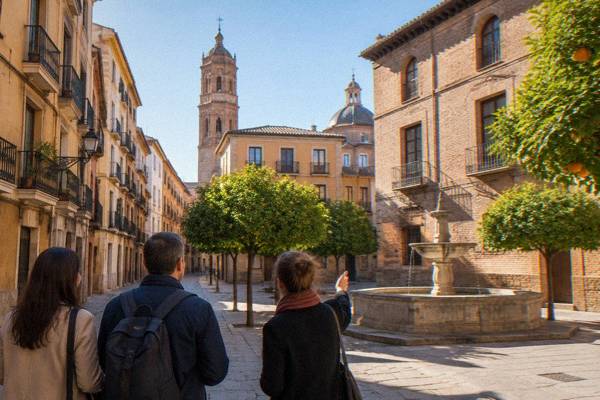
Choose Zaragoza if you want layered history in a walkable inland core: Roman forum ruins, a Moorish palace, Mudéjar towers and two working cathedrals, all within about twenty minutes on foot of each other, with tapas streets between them. Choose Valencia if the sea is the point of the trip, because Zaragoza has no coast at all: the Ebro is a river, the nearest beach is hours away, and the city's character, dry, windy, monumental, is built on that inland fact.
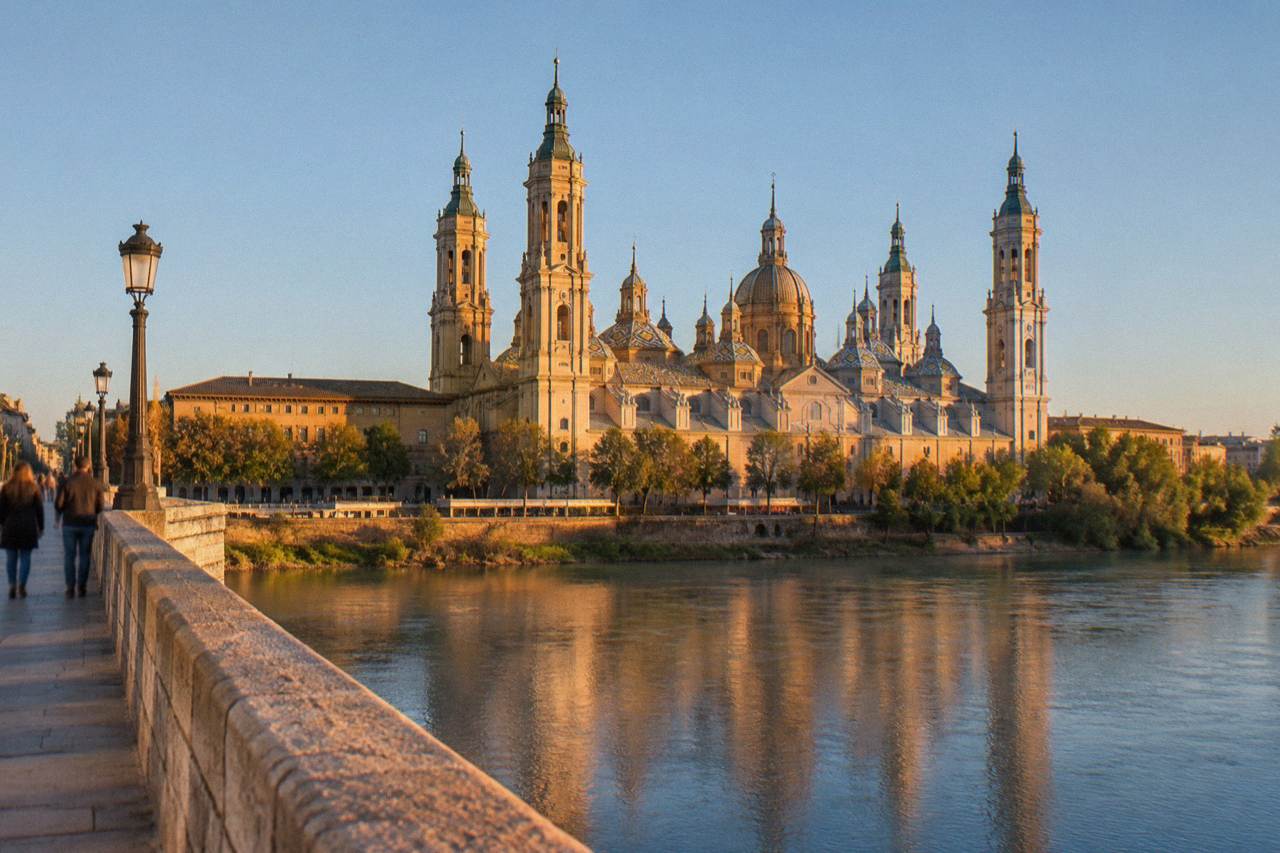
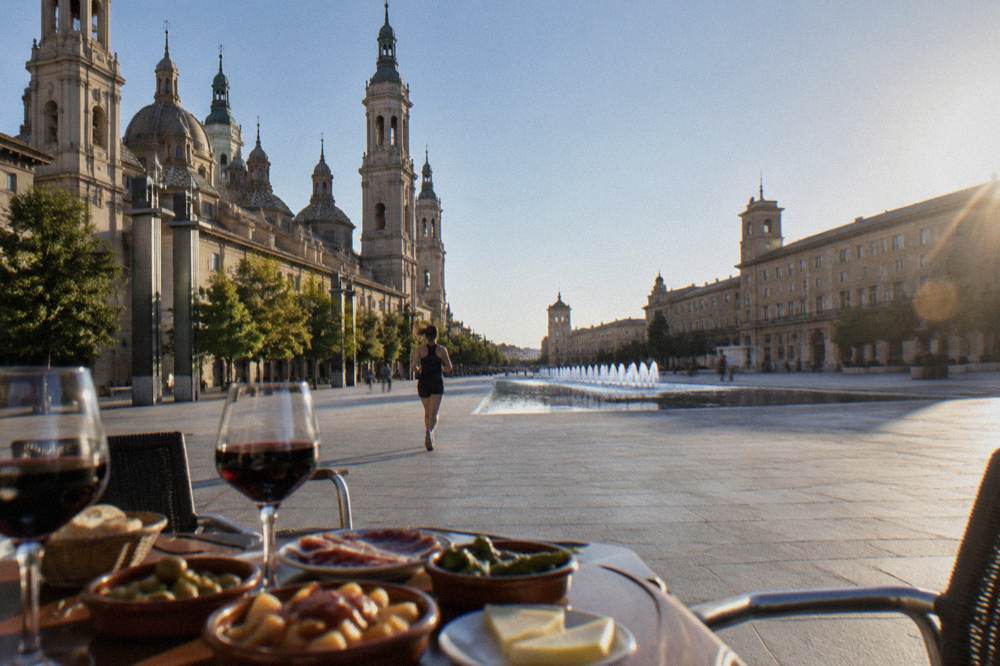
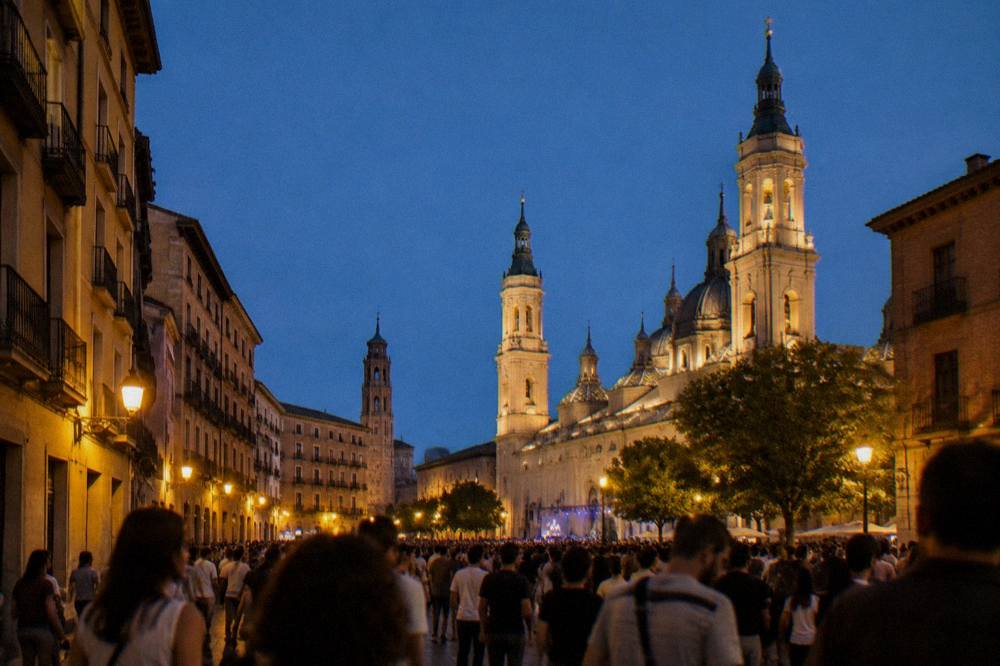
The real dividing line is not quality but geography. Valencia lives around its waterfront and its orange-blossom coast; Zaragoza lives around the Ebro and a stone bridge that has carried traffic since a Roman crossing stood near the same spot, with the current Puente de Piedra built from 1401 and opened in 1440, its four bronze lions added in 1991. The municipal tourism pages describe the bridge as the city's emblem, and it frames the skyline of the Basílica del Pilar exactly the way a seafront frames a coastal city's.
Zaragoza also rewards the traveller who likes a city that is not yet saturated. It is the fifth-largest city in Spain by common reckoning, yet its monuments are uncrowded for most of the year outside the Fiestas del Pilar, when the Ofrenda de Flores on 12 October brings close to a hundred thousand registered participants into the centre. Valencia, by contrast, hosts major international events and draws a steady year-round beach crowd. Neither profile is better; they are simply different products.
What Makes Zaragoza Different From Valencia As A Place?
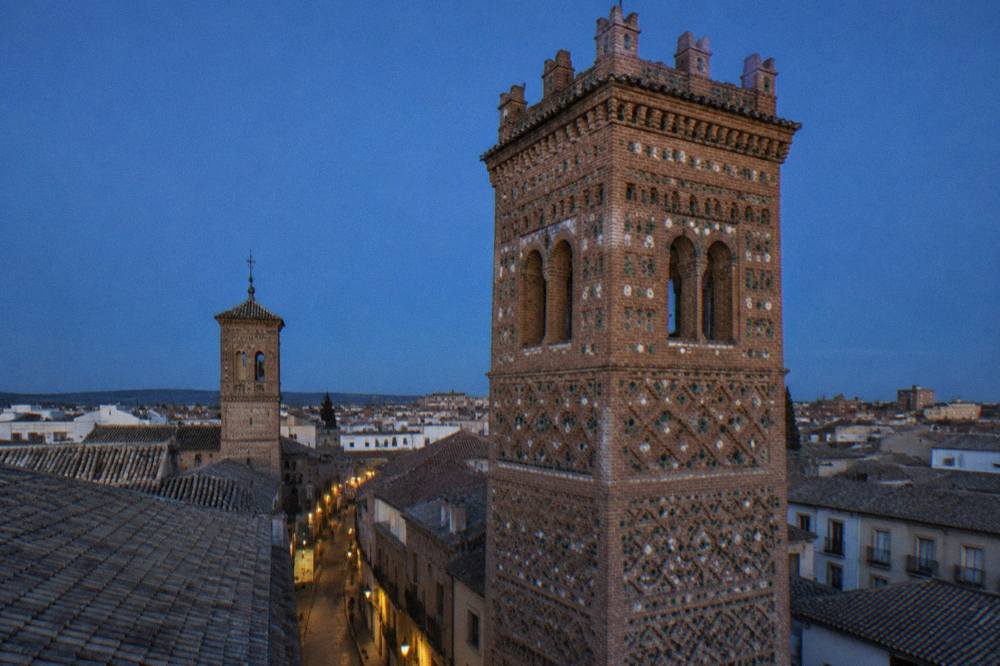
Zaragoza's identity is the layering of four cultures on one riverbank: Roman Caesaraugusta underneath, the Islamic Aljafería palace beside it, Mudéjar brick architecture rising above, and baroque painting by Goya, the city's most famous son, holding the whole story together. Valencia's identity is Mediterranean: a port city shaped by trade, the sea and the garden that feeds its famous market culture.
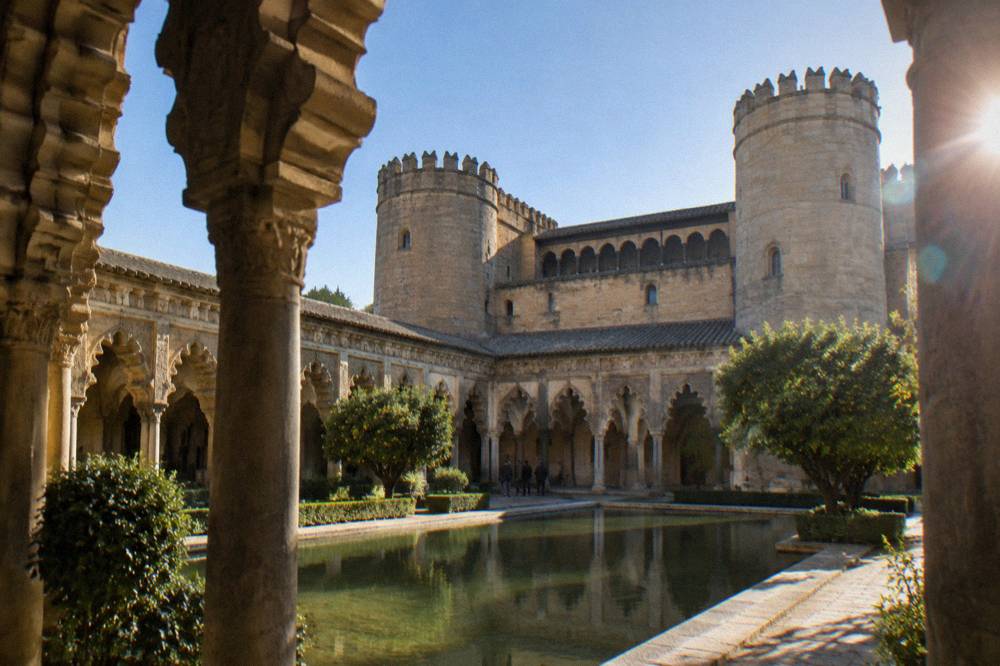
The four-cultures framing is not a marketing slogan; it is the city's own museum structure. The Caesaraugusta museums, the Forum, the River Port, the Baths and the Theatre, sit on top of actual Roman remains in the centre, and the Aljafería, the taifa-era palace, is a short tram ride away. Goya was born in the nearby village of Fuendetodos, and the Museo Goya run by Fundación Ibercaja reopens on 9 October 2026 after a renovation and expansion with new access and larger exhibition spaces, open Tuesday to Saturday 10:00 to 20:00 and Sunday 10:00 to 14:00, closed Mondays. The Goya in Zaragoza guide traces where his work actually hangs.
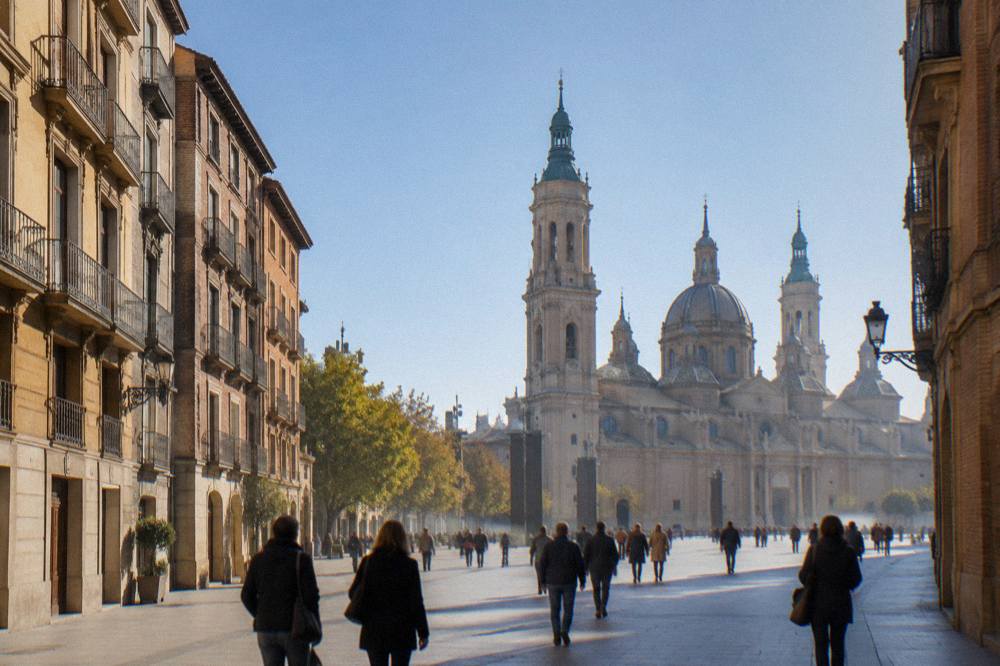
Valencia's counterpart strengths are real and worth saying: a celebrated central market, a garden bed reclaimed from a riverbed, and a coastline. What Zaragoza offers instead is density of the past. You can stand in the Plaza del Pilar and see a baroque basilica, a Gothic-Mudéjar cathedral and a Roman forum excavation within one turn of the head, then walk ten minutes to a Moorish palace. Very few European cities compress that range into so few streets.
The guided options above are one good way to absorb that density quickly. A two-hour walk with a guide, rated 5 from 3 reviews and priced from $44.72 per person, covers the must-see core, while the Free Monumental Tour of Zaragoza, tip-based and rated 4.65 from 64 reviews, does the same ground for whatever you choose to give the guide at the end. The Free Monumental Tour runs on the GuruWalk platform, so if the pay-what-you-want format appeals, that is where to look for it.
How Do The Sights Of Zaragoza Compare With Valencia'S?
Zaragoza's headline sights are the Basílica del Pilar, free to enter, with its tower viewpoint at 6 EUR for an adult, La Seo cathedral at 10 EUR general admission including three museums, and the Aljafería palace at 7 EUR general or 9 EUR with a guided tour, all confirmed on official October timetables. Valencia's headline sights are its city of arts and sciences complex and its central market, and this site has verified no prices for either, so check those before comparing budgets.
The Zaragoza entry prices are worth setting out in full, because they are unusually kind to a budget. The basilica itself costs nothing to enter: the municipal monument timetable lists the temple as free, with the Holy Chapel zone open 8:00 to 20:30 daily. The tower costs 6 EUR for an adult, 5 EUR for over-65s and residents, 4 EUR for ages 13 to 18, students and groups of 20 or more, and nothing for under-12s, with access Monday to Thursday 10:30 to 14:30 and 16:00 to 20:00, Friday to Sunday 10:00 to 20:00, last entry 30 minutes before closing.
| Zaragoza sight | Adult price | Concessions | Free options |
|---|---|---|---|
| Basílica del Pilar (temple) | Free | Free | Always free to enter |
| Basílica del Pilar tower viewpoint | 6 EUR | 5 EUR over 65 and residents, 4 EUR 13-18, students, groups 20+ | Under 12 free |
| La Seo cathedral (includes Museo de Tapices, Museo Pilarista, Rosario de Cristal) | 10 EUR | 9 EUR over 65, 7 EUR students and 13-18 | Under 12 free; Aragon residents free on the 6th, 12th, 23rd and 27th |
| Aljafería palace | 7 EUR | 2 EUR students, over 65, Carnet Joven | Under 12 free; free 1st and 3rd Sunday and Monday of each month |
| Caesaraugusta Forum museum | 4 EUR | Reduced rates on the museum site | Free 1st Sunday of the month |
| Caesaraugusta 4-museum bono | 7 EUR | 5 EUR reduced | Free 1st Sunday of the month |
One caution that applies in October 2026: the Museo de Zaragoza's central building at Plaza de los Sitios 6 is closed for Ministry of Culture works, with no reopening date announced, so do not build an itinerary around it. The Museo Goya reopening on 9 October 2026 is the city's big museum event of the season, and its admission price has not been published, so check the Fundación Ibercaja page before budgeting.
A guided walk solves the "where do I even start" problem that a dense old town creates. The Must-See Attractions Walking Tour With A Guide moves through the core in two hours with a guide who can point out which of the Caesaraugusta sites is worth your remaining time, and the listing carries live availability for the dates you are considering.
Is Zaragoza Or Valencia Better For Weather?
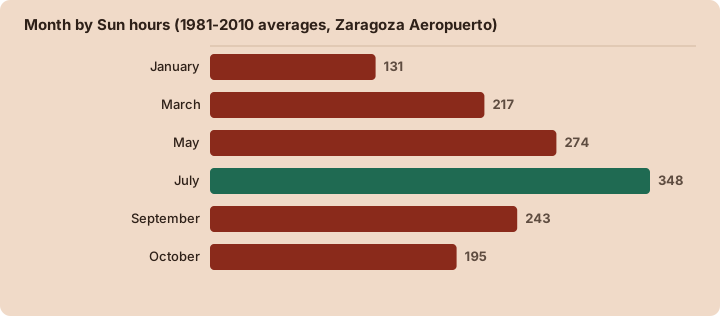
Zaragoza has a dry continental semi-arid climate: on AEMET's 1981 to 2010 normals for the Zaragoza Aeropuerto station, July is the hottest month with a mean maximum of 32.4 C and the sunniest at 348 hours, while May is the wettest at 44 mm and July and August the driest at 17 mm each. Valencia's coastal climate is milder and more humid, but this site has verified no Valencia figures, so compare the feel rather than the numbers.
The inland position is what shapes Zaragoza's year. The same AEMET 1981-2010 series gives the whole year 322 mm of rain across 51.1 days with at least 1 mm, which is genuinely dry, and the annual average mean sits at 15.5 C with 2,693 hours of sunshine in total. Winters are real winters by Spanish standards: January averages a mean minimum of 2.7 C, and the station records 23.1 frost days a year. The cierzo, the cold, dry north-west wind that runs down the Ebro valley, can make a bright March day feel far colder than the thermometer suggests, and AEMET issues regional wind warnings when it strengthens.
| Month | Mean max C | Mean C | Mean min C | Rain mm | Sun hours (1981-2010 averages, Zaragoza Aeropuerto) |
|---|---|---|---|---|---|
| January | 10.5 | 6.6 | 2.7 | 21 | 131 |
| March | 17.3 | 11.6 | 5.8 | 19 | 217 |
| May | 24.1 | 18.0 | 11.8 | 44 | 274 |
| July | 32.4 | 25.3 | 18.3 | 17 | 348 |
| September | 27.1 | 21.2 | 15.2 | 30 | 243 |
| October | 21.4 | 16.2 | 11.0 | 36 | 195 |
October deserves a special note because it is the month this page's data is anchored to: a mean maximum of 21.4 C over 36 mm of rain and 195 hours of sun, which is excellent walking weather, and it is also Fiestas del Pilar month, running 10 to 18 October 2026. If you want the city at its most alive, that is the window; the best time to visit Zaragoza guide works through the rest of the year in detail, and the Zaragoza weather guide covers month-by-month planning.
Valencia's counter-argument, stated fairly, is that a Mediterranean winter is softer and a Mediterranean summer comes with a sea to swim in. Zaragoza in July is hot and there is no beach. If your trip is a July heat-escape, that fact alone may settle the comparison.
How Do You Get To Zaragoza Compared With Valencia?
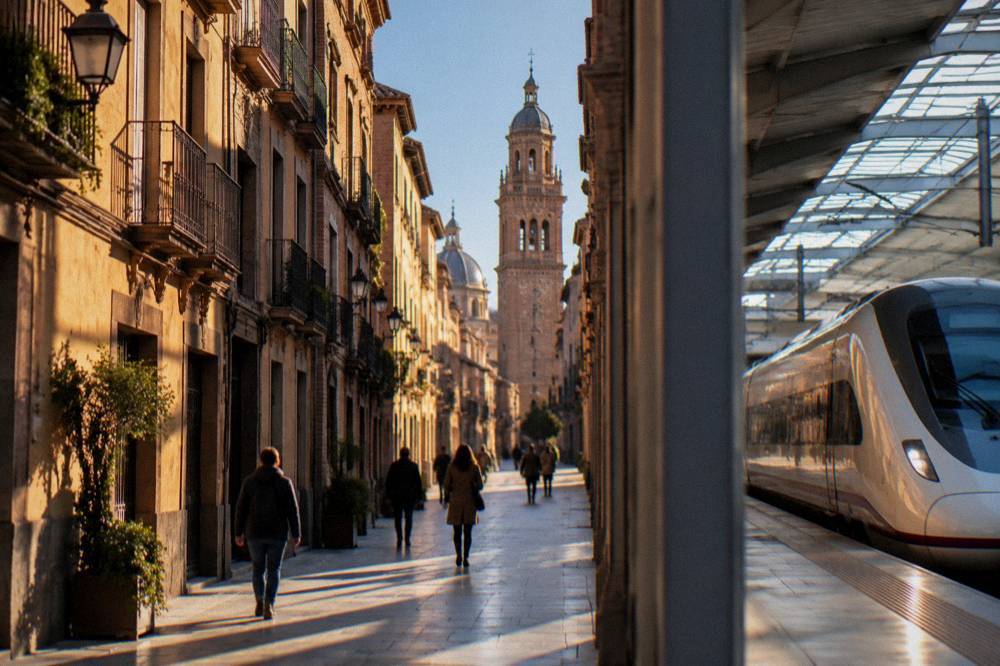
Zaragoza-Delicias station is about 1.5 to 2 hours from both Madrid and Barcelona by high-speed train, which makes it one of the best-connected inland cities in Spain, and the city's airport is served by Ryanair, Wizz Air, Binter, Volotea, Vueling and Alba Star with 13 destinations per the Aena listing. Valencia has its own airport and a coastal high-speed line, but this site has verified no Valencia timetables or fares, so check those separately.
The Madrid and Barcelona connections are the practical heart of a Zaragoza trip. Both run to Zaragoza-Delicias, and the Madrid to Zaragoza guide and Barcelona to Zaragoza guide cover the routes. Exact times and fares vary by operator and date, so treat "about 1.5 to 2 hours" as the planning range and price the ticket live. The Zaragoza-Delicias train station guide explains what to expect on arrival, and the how to get to Zaragoza guide pulls all the entry routes together.
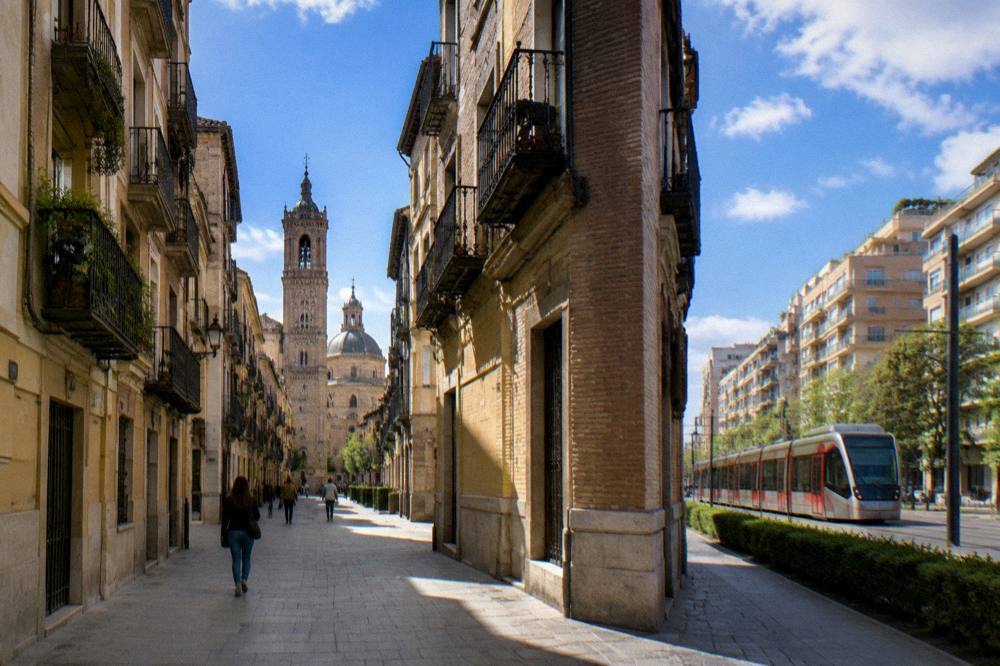
Once you are in the city, the transport figures are small and fixed. The 2026 Avanza fare table lists a single bus or tram ticket at 1.70 EUR, or 0.55 EUR with the Tarjeta Bus, which itself costs 7 EUR and works on both networks. The airport bus is line 505, at 4.65 EUR single or 2.25 EUR with a Lazo card, running 25 to 35 minutes and timed to flights. The Zaragoza Bus Turístico costs 10 EUR for a 24-hour hop-on hop-off ticket across 16 stops on a 90-minute loop, cash only on the bus.
| Zaragoza transport | 2026 price | Notes |
|---|---|---|
| Bus or tram single | 1.70 EUR | No transfer included |
| Bus or tram with Tarjeta Bus | 0.55 EUR | Card costs 7 EUR, valid on bus and tram |
| Night bus single | 1.00 EUR | Night lines |
| Airport bus, line 505 | 4.65 EUR single | 2.25 EUR with Lazo card, 25-35 min, timed to flights |
| Bus Turístico day ticket | 10 EUR | 24 h, 16 stops, 90-minute loop, cash on the bus |
| Bizi day pass | 1 EUR plus per-trip | First 30 min at 0.50 EUR per trip, deposit applies |
One driving note that matters if you are comparing a road trip: Zaragoza operates a low-emission zone, the ZBE Casco Histórico, active Monday to Friday 08:00 to 20:00 with sanctions since 12 December 2025, and vehicles without a DGT environmental label are restricted, with a 15-minute grace period if you enter by mistake. The Zaragoza car rental and parking guide explains the labels.
What Does A Trip To Zaragoza Cost Compared With Valencia?
A day of sightseeing in Zaragoza can be done almost free: the basilica costs nothing, the IAACC Pablo Serrano, the Centro de Historias and the Torreón de la Zuda are all free, the Caesaraugusta museums are free on the first Sunday of the month, and the Aljafería is free on the first and third Sunday and Monday. Add the 10 EUR La Seo ticket, the 6 EUR tower and 1.70 EUR transport singles and a full sightseeing day still costs under 20 EUR before food.
That arithmetic is the strongest budget argument Zaragoza has, and it is all verifiable on the municipal monument timetable. The free-entry rhythm is worth learning before you go: Caesaraugusta museums and the Museo del Fuego y los Bomberos on the first Sunday, the Aljafería on the first and third Sunday and Monday, the Museo del Origami on the first Tuesday and Sunday. If your dates are flexible, you can build an entire weekend around those days. The free things to do in Zaragoza guide lists them all, and the Zaragoza cost and budget guide does the full arithmetic including accommodation tiers.
| Budget item in Zaragoza | Typical figure | Where it comes from |
|---|---|---|
| Full sightseeing day, monuments only | Under 20 EUR | Basilica free, La Seo 10 EUR, tower 6 EUR, transport singles 1.70 EUR |
| Guided introduction walk | From $10.41 per person | The 105-minute monumental intro tour |
| Aljafería with guided tour | 9 EUR | Official monument timetable |
| Caesaraugusta 4-museum bono | 7 EUR | Official museum pricing |
| Acuario family pack online | 55 EUR | 2 adults plus 2 children, operator's own site |
| Tourist tax | None | No tourist tax exists in Aragon |
Valencia may or may not undercut those numbers; this site has not verified Valencia pricing and will not guess at it. What can be said is structural: Valencia's headline attraction complex is ticketed and its beach is free, while Zaragoza's headline basilica is free and its riverbank walks, the Ebro path and the Parque del Agua Luis Buñuel, more than 120 hectares in the Ranillas meander with 5 and 10 km running circuits, cost nothing at all.
Food tours are where a comparison stops being about monuments and becomes about the evening. The evening tapas walk above, from $106.92 per person and rated 4.9 from 62 reviews over three hours, moves through the old town's bar culture with a guide who orders as a local would.
Which City Has The Better Food Scene: Zaragoza Or Valencia?
Valencia is the birthplace of paella and its food reputation is built on rice, oranges and the sea, and that reputation is deserved. Zaragoza's food identity is different and equally specific: Aragonese lamb in the form of ternasco, migas aragonesas, river-cod baccalao, and a tapas culture centred on the old town's bar streets, best explored as a crawl rather than a single restaurant sitting.
Neither kitchen is a copy of the other, which is exactly why the comparison is worth making honestly. The Zaragoza food guide covers the regional dishes in full, and the ternasco de Aragón guide explains why the lamb carries its own protected status. What Valencia offers that Zaragoza cannot is seafood straight off a Mediterranean quay; what Zaragoza offers that Valencia does not is an inland cooking tradition built on lamb, breadcrumb dishes, river fish and the wines of Carinena, the region covered in the Carinena wine region guide.
The practical difference for a visitor is the format. Valencia's food culture centres on its great market and sit-down rice restaurants; Zaragoza's centres on standing at a bar counter, moving from one tapas stop to the next, and the Zaragoza tapas crawl guide maps that route. If your ideal evening is one long restaurant table, Valencia suits you. If it is five small bars and a different specialty in each, Zaragoza does.
When Is The Best Time To Visit Zaragoza Rather Than Valencia?
Mid-October is Zaragoza's peak for a reason: the Fiestas del Pilar run 10 to 18 October 2026, with the Ofrenda de Flores on 12 October filling the route from Paseo de la Independencia to Plaza del Pilar with flower-bearing groups, and AEMET's 1981-2010 averages give the month a 21.4 C mean maximum. Spring, with March at 17.3 C mean maximum and May the wettest month at 44 mm, is the quieter alternative.
The Fiestas deserve their own paragraph because they change the city completely. The 2026 programme includes the pregón from the Ayuntamiento balcony on 10 October at 21:00, jota competitions with finals on 10 and 11 October, concerts including Antonio Orozco on 10 October, Dani Fernández on 11 October and Malú on 17 October, Venezuela as guest country, and an expanded fireworks programme with shows after the pregón, in Parque Pignatelli, at the closing by the Ebro on 18 October and a new display in Plaza San Francisco. The Ofrenda de Frutos and the Rosario de Cristal are reported for 13 October. The Fiestas del Pilar guide covers what to expect, and the Ofrenda de Flores guide explains the flower offering itself.
Book early for those dates, because the whole city fills. Outside the festival fortnight, Zaragoza is a relaxed, low-queue destination for most of the year, and the trade-off against Valencia is simply that Valencia's calendar is anchored to the beach season and Las Fallas in March, which is an equally valid reason to pick different dates.
Which Is Better For A Weekend: Zaragoza Or Valencia?
For a two-night city break built around walking, monuments, tapas and a big festival if you time it, Zaragoza wins on density: the old town, both cathedrals, the Aljafería and the Roman museums fit inside a weekend without any internal travel beyond a 1.70 EUR tram ticket. For a weekend that must include swimming, a beach promenade and a celebrated market hall, Valencia wins by definition, because Zaragoza has no sea and does not pretend to.
The honest summary is that the cities are not competing for the same weekend. A Zaragoza weekend runs: day one, the Plaza del Pilar, La Seo and the old town, evening in the tapas bars; day two, the Aljafería in the morning, the Caesaraugusta museums in the afternoon, the Ebro bank and Puente de Piedra at sunset. The one day itinerary and two day itinerary lay this out hour by hour, and the where to stay in Zaragoza guide sorts the neighbourhoods, with the best hotels and hostels and budget stays guides covering the actual beds.
Where Zaragoza genuinely outperforms most comparisons is as a stop between two bigger trips. Because it sits about 1.5 to 2 hours from both Madrid and Barcelona by high-speed train, it earns its place in an itinerary that neither coastal city can: the inland pivot. The day trip from Madrid guide and day trip from Barcelona guide show how a single long day works, and the Zaragoza vs Barcelona guide extends this comparison to the larger neighbour.
Between the two bands of tours above, the pattern is clear: a paid guided walk for depth, a free GuruWalk tip-based tour for budget, and a private custom option if you want the route shaped around you. Whichever city you pick, decide on the basis of what the trip is for, a point this Zaragoza Travel Guide comparison has tried to make checkable rather than merely opinionated.
Common Questions About Zaragoza Vs Valencia
Is Zaragoza cheaper than Valencia?
Zaragoza's core sightseeing is unusually cheap: the Basílica del Pilar is free to enter, La Seo costs 10 EUR including three museums, the Aljafería is 7 EUR and free on the first and third Sunday and Monday of each month, and there is no tourist tax in Aragon. This site has not verified Valencia's prices and will not guess at them, so check the specific sights you care about before comparing totals.
Does Zaragoza have a beach like Valencia?
No. Zaragoza is an inland city on the Ebro river in Aragon, with a dry continental climate and no coast. Its water landscape is the Ebro bank, the Puente de Piedra and the Parque del Agua Luis Buñuel, more than 120 hectares in the Ranillas meander. If swimming in the sea is part of the trip, Valencia is the only one of the two that offers it.
Can you visit Zaragoza and Valencia on the same trip?
Yes, and the high-speed network makes it straightforward, though this site has verified no exact times or fares for the Zaragoza to Valencia leg. Zaragoza sits about 1.5 to 2 hours from both Madrid and Barcelona by high-speed train, so it works naturally as an inland stop on a route that ends on the coast. Price the specific leg live before committing to timings.
Is Zaragoza worth visiting if I have already seen Valencia?
Yes, because the two cities show different Spains. Zaragoza's core is Roman, Islamic, Mudéjar and baroque: the Caesaraugusta museums, the Aljafería palace, La Seo and the Basílica del Pilar, plus Goya, whose museum reopens on 9 October 2026. None of that duplicates a coastal port city's attractions.
Which city is better in October?
Zaragoza in mid-October is hard to beat for atmosphere: the Fiestas del Pilar run 10 to 18 October 2026, with the Ofrenda de Flores on 12 October, and the month averages a 21.4 C mean maximum on the 1981-2010 series. Valencia in October has its own late-season beach appeal; the choice depends on whether you want a festival or a shoreline.