Moncayo Natural Park: The Zaragoza Day Trip Into Aragon's Highest Mountains
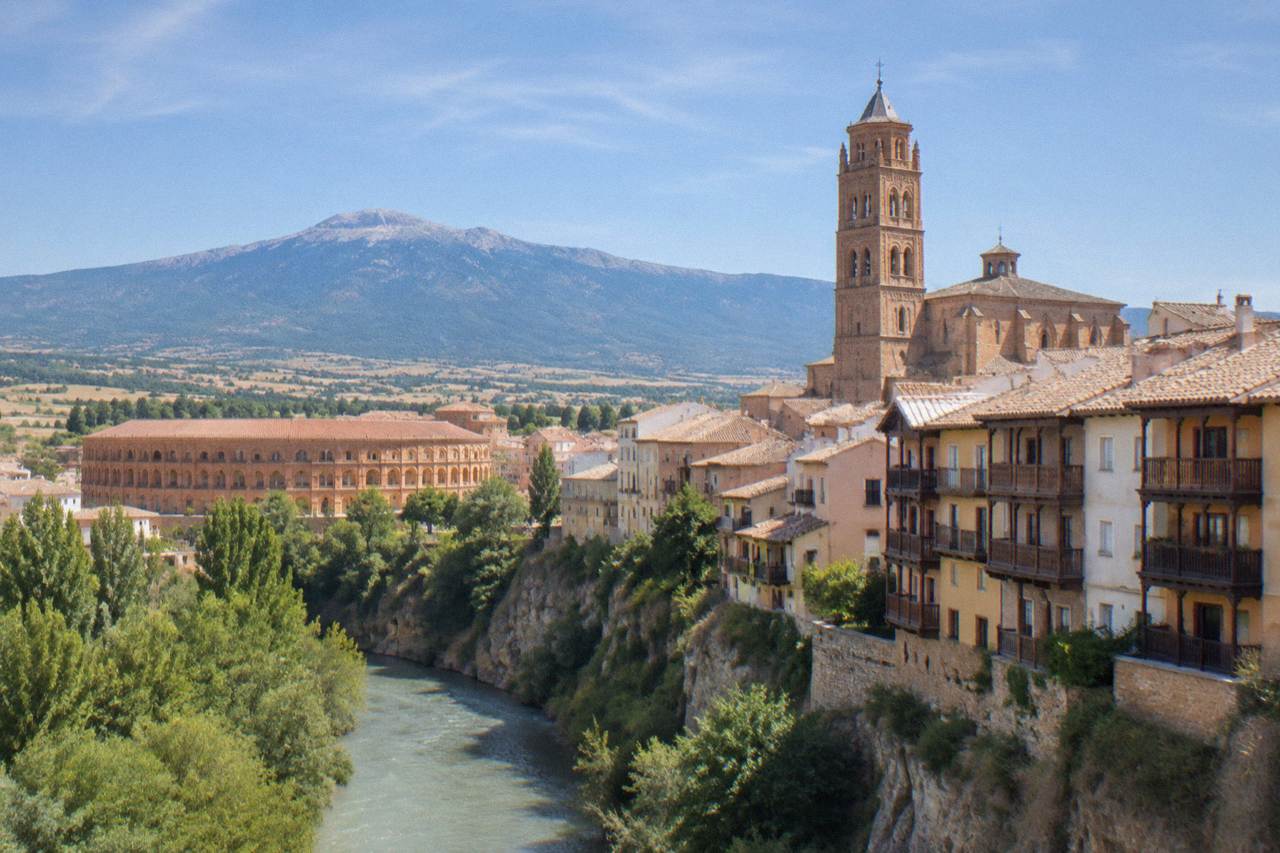
Moncayo Natural Park is the big green mountain wall that stands to the north-west of Zaragoza, Spain, the highest ground in Aragon and the city's most accessible high-country day trip.
Short answer
Moncayo Natural Park is a protected mountain massif in the Iberian System north-west of Zaragoza, the highest range in Aragon, covered in beech, pine and fir forests and ringed by stone villages such as Tarazona, Vera de Moncayo and Añón. No verified public-transport timetable or entry fee exists for the park itself, so most visitors from Zaragoza drive or take a guided excursion.
Moncayo Natural Park is the mountain wall that closes the north-western horizon of Zaragoza, Spain, the capital of Aragon on the Ebro. From parts of the city the massif is visible on clear days, a blue-green ridge that the locals know simply as el Moncayo, the highest ground in the whole region and the single most dramatic change of scenery available to anyone based in Zaragoza. The park protects a compact world of beech woods, black pine, fir plantations, glacial cirques and high pastures, and its footpaths run through country that feels closer to the Pyrenees than to the dry Ebro valley the city sits in. This guide lays out, in plain terms, what the park is, how a visitor based in Zaragoza reaches it, what a day there can hold, and how it compares with the other day trips described across Zaragoza Travel Guide.
What Is Moncayo Natural Park Near Zaragoza?
Moncayo Natural Park is a protected mountain massif in the Iberian System, the highest range in Aragon, standing to the north-west of Zaragoza, Spain. Its forests of beech, pine and fir, its glacial cirques and its high pastures are protected as a natural park, and its slopes are ringed by small stone towns including Tarazona, Vera de Moncayo, Añón de Moncayo and Calcena, with the Monastery of Veruela sitting at its foot.
The park exists because the Moncayo is a mountain island. The Ebro valley around Zaragoza is dry, continental and largely treeless, but the massif is high enough to force the prevailing westerly air upward, so it catches rain and snow that the plain never sees. The result is a vegetation ladder that is unusual this far south in Aragon: holm oak and scrub at the bottom, then Scots pine and beech, then black pine, and finally bare summit grassland on the tops. The beech woods in particular draw visitors from across northern Spain in autumn, when they turn copper and gold.
The Moncayo also carries a heavy cultural load. The Monastery of Santa María de Veruela, a Cistercian house of medieval foundation, sits inside a woodland estate on the northern slopes, and the poet Gustavo Adolfo Bécquer, one of the great names of Spanish Romanticism, set some of his legends there. Tarazona, the mudéjar town that guards the mountain's western approach, was a bishops' city with a flourishing Moorish population, and its architecture shows it. The mountain is not a wilderness in the American sense, it is a worked, lived-in landscape, and that is a large part of its appeal.
How Do You Get From Zaragoza To Moncayo Natural Park?
There is no verified public-transport timetable, driving time or entry fee for Moncayo Natural Park in the destination facts, so the honest answer is that visitors from Zaragoza either drive north-west towards Tarazona and the mountain towns, or book a guided excursion that starts in the city. The park lies to the north-west of Zaragoza, in the far west of Aragon close to the provincial boundary, and the approach towns are Tarazona, Vera de Moncayo and Añón de Moncayo.
Driving is the flexible option. The route leaves Zaragoza heading west and then turns north towards Tarazona, the largest town in the mountain's shadow, and from there a network of local roads climbs into the park's villages and trailheads. No kilometre count or minute count can be printed here because none was verified, so check a live mapping service before setting out. The mountain roads are real mountain roads, narrow in places and snow-affected in winter, and the parking areas at the popular trailheads fill early on autumn weekends, when the beech woods are at their best.
For anyone without a car, the guided route is the realistic one. The listing describes a day that combines the town, the mountain scenery and food, which suits the character of the region well: this is slow country, and a guided day that never hurries is the right shape for it.
Getting around Zaragoza on the day itself is straightforward and cheap, which matters if the excursion picks up in the centre. The 2026 Avanza fare table lists the urban bus and tram single at 1.70 EUR, or 0.55 EUR with a Tarjeta Bus, and the card itself costs 7 EUR and works on both networks.
| Transport in and around Zaragoza | Fare | Notes |
|---|---|---|
| Urban bus or tram single | 1.70 EUR | No transfer, per the 2026 Avanza fare table |
| Same trip with Tarjeta Bus | 0.55 EUR | Card costs 7 EUR, valid on bus and tram |
| Night bus single | 1.00 EUR | Night lines, per the same table |
| Airport bus, line 505 single | 4.65 EUR | About 2.25 EUR with a Lazo card, timed to flights |
| Tourist bus, 24-hour ticket | 10 EUR | Hop-on hop-off, 16 stops, cash only on board |
The guided Tarazona and Moncayo excursion is the natural companion to this page, and it can be checked alongside the city walks below.
What Can You Do Inside Moncayo Natural Park?
A day in Moncayo Natural Park is built on walking, forest roads, viewpoints and the villages on the mountain's flanks: hiking between beech and pine woods, visiting the Monastery of Veruela, photographing the summit cirques, eating in Tarazona or Vera de Moncayo, and driving the scenic loop that links the stone villages such as Calcena, Purujos and Añón de Moncayo. No trail length, elevation figure or opening hour was verified for the park, so plan from the official park information rather than from any number printed here.
Walking is the core activity, and the park's network of paths covers everything from short woodland loops to full-day routes that reach the high ground. The beech forests below the summit zone are the signature terrain, cool, quiet and deeply shaded even at the height of summer, and they are the reason many Zaragoza residents make the trip in October and November. The high pastures above the treeline are open country with long views back over the Ebro basin, and on a clear day the panorama reaches a very long way indeed across Aragon.
The Monastery of Veruela deserves a stop on any northern-slope itinerary. The monastery is a severe, beautiful complex of church, cloister and abbey buildings that entered Spanish literature through Gustavo Adolfo Bécquer's letters and legends. The town of Vera de Moncayo sits just below it, a small, serious stone place that lives from the monastery's visitors and from the forest.
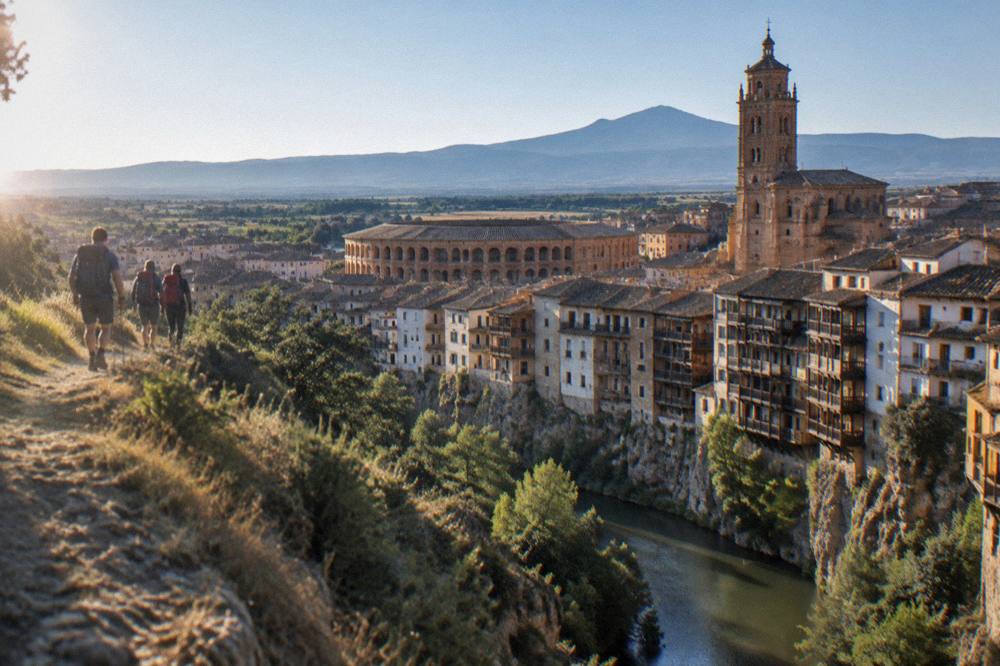
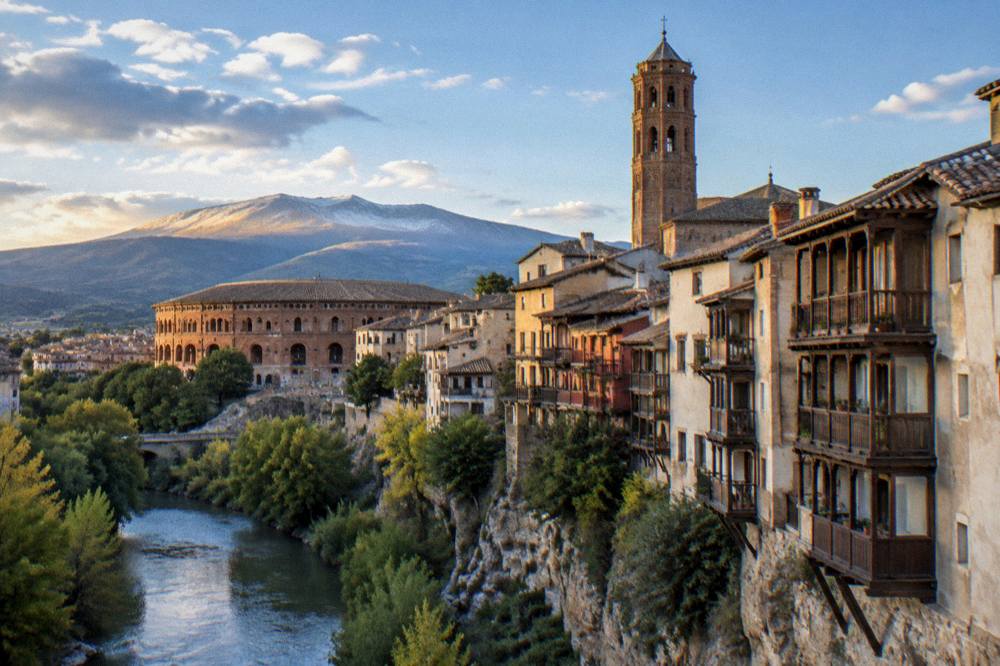
Tarazona, on the western flank, is the biggest draw of the mountain's ring and is described in full on the Tarazona day-trip page. Its cathedral, its mudéjar towers and its hanging houses make it one of the most distinctive towns in Aragon, and it works equally well as the lunch stop of a Moncayo day or as a destination in its own right. The neighbouring Monasterio de Veruela page covers the monastery in detail, and the Carinena wine region page describes the vineyards on the southern road out of Zaragoza, which lie on the way for drivers coming from the south-east of the city.
What Is The Weather Like Around Moncayo For A Day Trip From Zaragoza?
AEMET's 1981 to 2010 normals for the Zaragoza Aeropuerto station show the city side of the trip as dry continental: a July mean maximum of 32.4 C, a January mean maximum of 10.5 C, May the wettest month at 44 mm and July and August the driest at 17 mm. The Moncayo massif itself sits higher and runs cooler and wetter than the plain, so the mountain can hold snow and cloud while Zaragoza stays warm and clear, and no verified weather figure exists for the park itself.
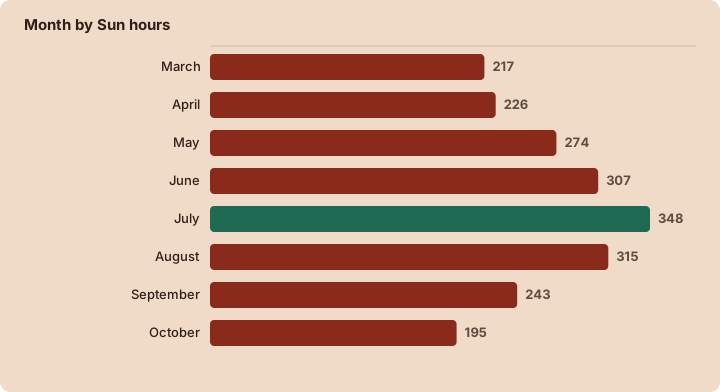
The gap between city and mountain is the planning point. Zaragoza's climate data, which is the only verified series available, describes a hot, dry plain: 322 mm of rain across the whole year, 51.1 days with a millimetre or more, and 348 sunshine hours in July alone. The Moncayo, by contrast, is the first high ground that the Atlantic weather meets coming down the Ebro corridor, and its forests exist precisely because it catches what the plain misses. A visitor who leaves Zaragoza in shirtsleeves in April can drive into fog, drizzle or snow on the mountain within the same morning.
Season by season, the practical pattern looks like this. Spring brings the waterfalls and the green lower woods, with Zaragoza's March mean maximum at 17.3 C and April at 19.6 C, comfortable walking weather on the plain but changeable up high. Summer is hot in the city, 32.4 C mean maximum in July, and the Moncayo's shaded beech paths are the classic escape, though the high open ground is exposed to the sun. Autumn is the peak season for the forests and the busiest time on the mountain roads. Winter turns the summit zone into genuine snow country, and the cierzo, the cold, dry north-west wind of the Ebro valley, can be bitter on the plain while the mountain holds its own much colder air.
| Month | Mean max C (Zaragoza Aeropuerto, 1981-2010) | Mean min C | Rain mm | Sun hours |
|---|---|---|---|---|
| March | 17.3 | 5.8 | 19 | 217 |
| April | 19.6 | 7.9 | 39 | 226 |
| May | 24.1 | 11.8 | 44 | 274 |
| June | 29.3 | 15.8 | 26 | 307 |
| July | 32.4 | 18.3 | 17 | 348 |
| August | 31.7 | 18.3 | 17 | 315 |
| September | 27.1 | 15.2 | 30 | 243 |
| October | 21.4 | 11.0 | 36 | 195 |
The Moncayo's own weather is not published in any verified series for this page, so the rule is simple: check the mountain forecast on the morning of the trip, dress for two climates, and treat the city figures as a floor, not a ceiling, for what the summit might be doing.
Which Towns And Villages Ring The Moncayo?
The Moncayo is ringed by a chain of small stone towns on its Aragonese flank: Tarazona the largest and most striking, then Vera de Moncayo with the Monastery of Veruela beside it, Añón de Moncayo, Calcena, Purujos and Litago in the forest belt, and Trasobares and other villages further east, each a short drive from the next and each with its own view of the massif. No distances or drive times between them were verified, so plan the loop from a map.
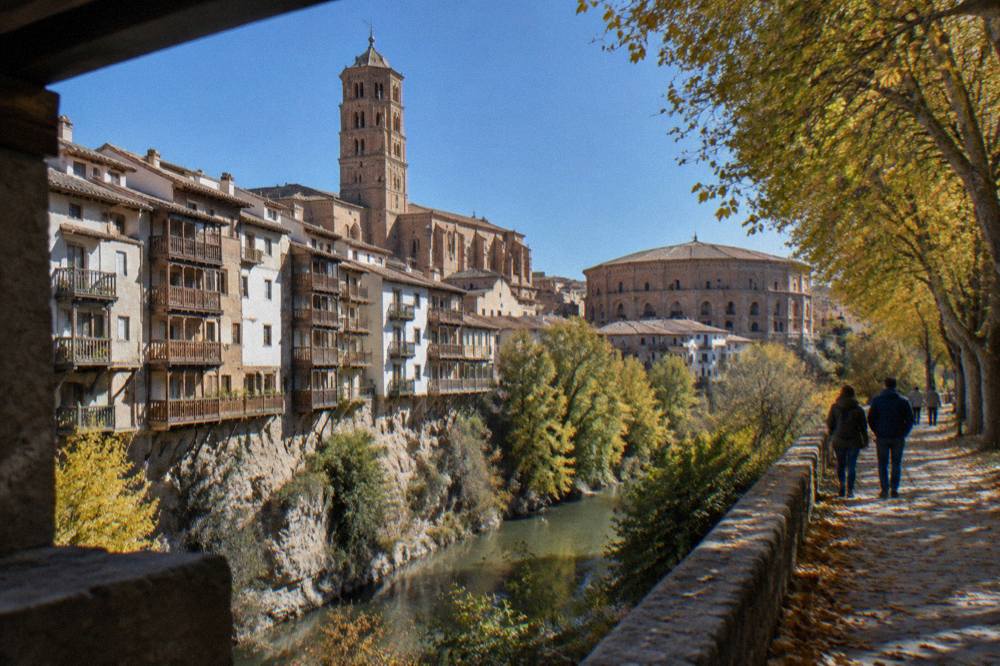
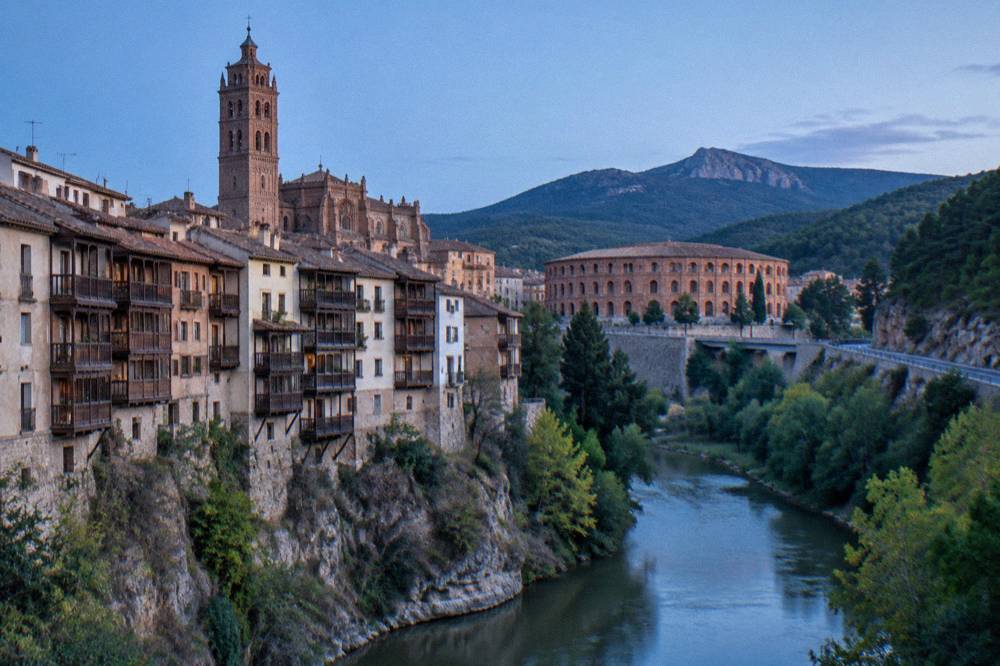
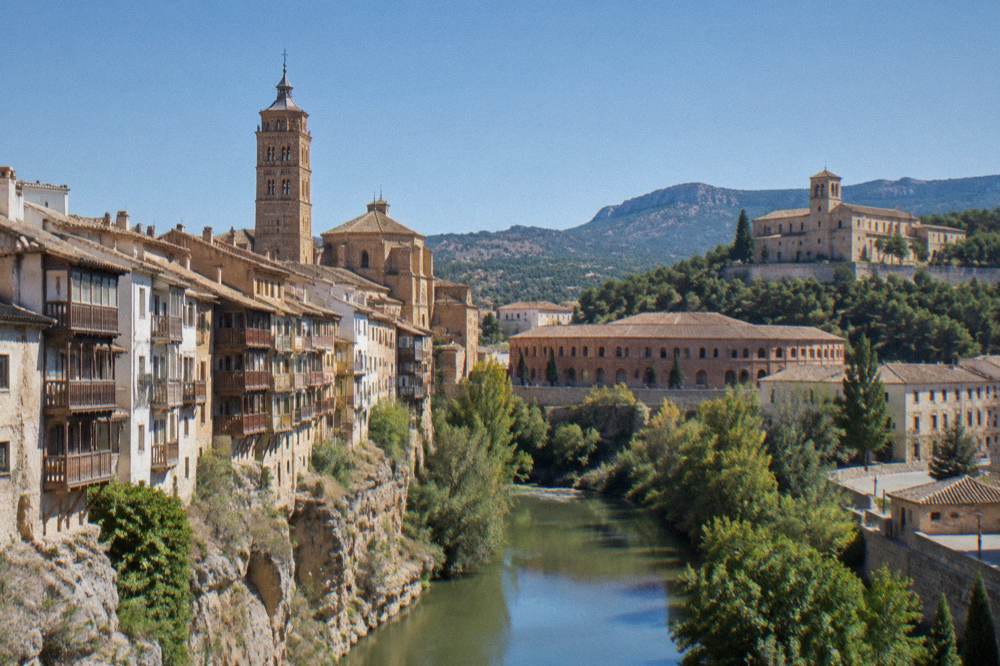
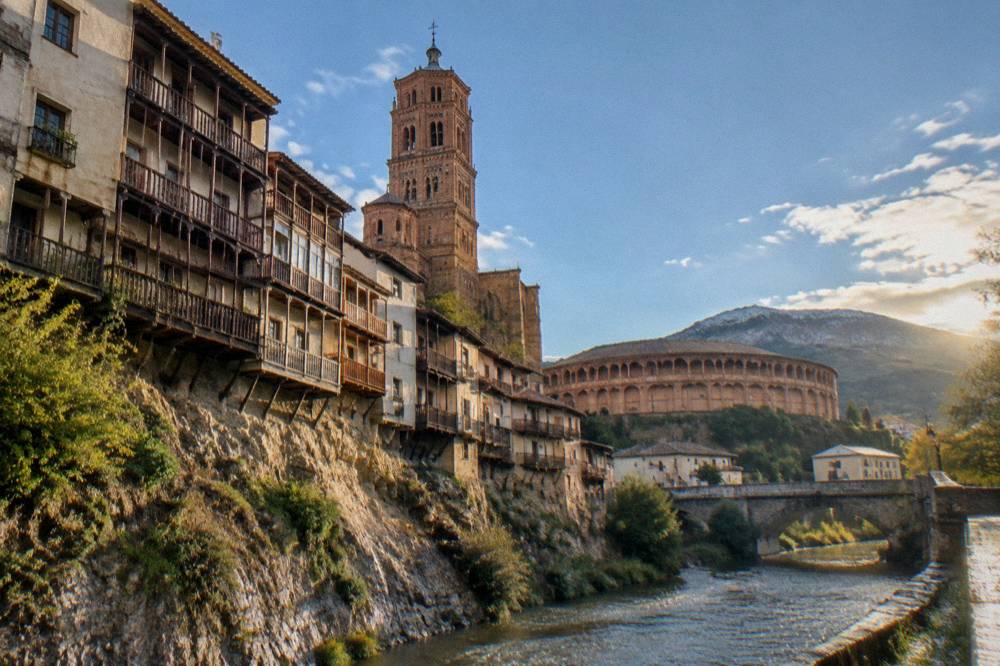
Tarazona is the gateway and the headline. Its cathedral, La Magdalena, is a Gothic building wrapped in scaffolding for years and now restored, and the town's mudéjar towers and overhanging houses above the Queiles river give it a profile unlike anywhere else in Aragon. It was a border city between Christian and Muslim kingdoms, and the layered architecture of its old quarter still shows that history plainly. The Tarazona page on this site covers the town in full.
Vera de Moncayo and the Veruela estate are the second stop for most visitors. The monastery is the dominant building of the northern slopes, and the village below it lives in its shadow in the most literal sense. Añón de Moncayo, higher up, is the classic base for the summit paths, a tight cluster of stone houses with the massif directly overhead. Calcena and Purujos, on the eastern side, are quieter, the villages people photograph from the road and stop in only when the light is right.
Further afield, the Moncayo country connects naturally with two other destinations covered on this site. Sos del Rey Catolico, the birthplace of King Ferdinand, lies north of the massif on the way towards Navarre, and Huesca and the Loarre Castle day trips head into the pre-Pyrenees to the east, a different kind of high country but the same Aragonese stone.
What Should You Pack For A Moncayo Day Trip From Zaragoza?
Pack for two climates in one day: sun protection and a hat for the Zaragoza plain, where AEMET's 1981 to 2010 normals show a July mean maximum of 32.4 C and 348 sunshine hours, plus layers, a waterproof and proper walking shoes for the mountain, where the same day can bring cloud, drizzle or snow regardless of the city forecast. Water, food for the trail and an offline map matter, because the villages are small and the mountain network is not the city network.
The layering rule is the one that catches people out. The temperature gap between Zaragoza and the Moncayo's upper woods is real in every season, and the weather on the massif changes faster than the plain's. A base layer, a warm mid layer and a shell work year-round up high. Footwear matters more than anything else on the forest paths, which hold mud after rain and patchy ice after winter storms.
| Season in Zaragoza | City conditions, 1981-2010 normals | What the Moncayo adds | Packing priority |
|---|---|---|---|
| Spring | 17.3 to 24.1 C mean max, 19 to 44 mm rain | Fast-changing cloud, wet paths | Waterproof, layers |
| Summer | 29.3 to 32.4 C mean max, 17 to 26 mm rain | Shade in the woods, sun above the treeline | Water, sun hat, boots |
| Autumn | 21.4 to 27.1 C mean max, 30 to 36 mm rain | Peak-season crowds, cold mornings | Warm layer, early start |
| Winter | 10.5 to 13.1 C mean max in the city | Snow and ice on the high ground | Full winter kit, tyres |
One more practical note for the drive out: Zaragoza operates a low-emission zone in the Casco Histórico, with sanctions active since 12 December 2025, Monday to Friday from 08:00 to 20:00, so a hire car without a DGT environmental label cannot enter that zone. The Moncayo roads themselves have no such restriction, but the car needs the label to be picked up and dropped off in the centre, and the rental desk will confirm what the vehicle carries.
Can You Visit Moncayo On A Guided Tour From Zaragoza?
One verified bookable excursion from Zaragoza covers the Tarazona and Moncayo country, a seven-hour guided day trip rated 4.7 from 6 reviews on its listing, from 209.33 USD per person, which combines the town, the mountain landscape and food. Beyond that product, the Moncayo is a self-guided destination: the park has no verified guided walking service from the city, and the free and paid walks that start in Zaragoza itself stay in the old town rather than leaving it.
That single excursion is worth understanding before booking. It is built around Tarazona and its surroundings, and the listing leans into the town's reputation for legends and folklore, which is genuine local colour rather than invention, the mountain country has always carried a heavy stock of stories. Seven hours is a full day, and the food element means the day does not depend on finding an open restaurant in a mountain village in the low season.
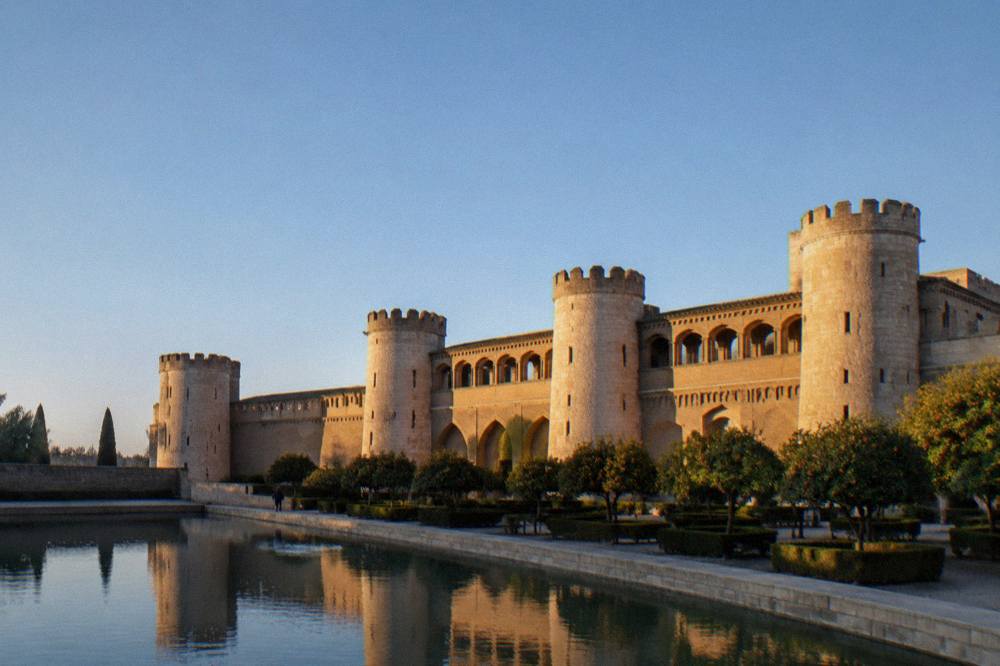
Inside Zaragoza, the guided options are city products, and they pair naturally with a Moncayo day as the evening or following-morning activity. The Aljafería Palace guided tour in Spanish with ticket included, from 24.76 USD per person and rated 4.8 from 103 reviews, is the most-booked monument experience in the city, and the palace's own October timetable lists daily opening from 10:00 to 18:00 with Spanish guided tours at 10:30, 12:30, 13:30, 15:00 and 16:00. The Aljafería is the greatest Islamic-era building in Aragon and the finest introduction to the culture that also shaped Tarazona's mudéjar towers, so it works well as the city half of a mountain-and-monument weekend.
| Aljafería Palace ticket, October timetable | Price |
|---|---|
| General admission | 7 EUR |
| Guided visit | 9 EUR |
| With tourist bus ticket | 4 EUR |
| Students, over 65, Carnet Joven | 2 EUR |
| Under 12 | Free |
| Free entry days | 1st and 3rd Sunday and Monday of the month |
The full range of city walks, from the free GuruWalk old town tour, free and tip-based, rated 4.97 from 576 reviews with the guru named on its own listing, to the private custom walks, is covered on the Zaragoza tours page.
How Does Moncayo Compare With Other Zaragoza Day Trips?
Moncayo Natural Park is the forest-and-mountain day trip from Zaragoza, standing against the dry badlands of the Bardenas Reales, the desert waterfalls of Monasterio de Piedra, the mudéjar towns of Teruel and Calatayud and the high Pyrenees excursions to Ordesa and Aínsa, and it is the closest of them all to genuine alpine scenery without a long drive.
Among the bookable excursions from the city, the Moncayo and Tarazona trip costs from 209.33 USD per person, while the Pyrenees day tours run from 66.4 USD per person.
The honest comparison is about what kind of day each destination makes. The Moncayo is a half-wild, half-cultural day: forests, a great monastery, a mudéjar town and stone villages, with walking as the thread. The Bardenas Reales is the opposite pole, eroded semi-desert with almost no tree in sight. Monasterio de Piedra trades the Moncayo's open mountain for a landscaped park of waterfalls in a canyon. Albarracin and Teruel are town-and-mudéjar days with their own dramatic settings, and Ordesa National Park is the full Pyrenean day, higher, longer and grander than the Moncayo but a much bigger commitment from Zaragoza.
| Day trip from Zaragoza | Character | Bookable excursion |
|---|---|---|
| Moncayo and Tarazona | Forest, monastery, mudéjar town | From 209.33 USD, 4.7 from 6 reviews, 7 hours |
| Ordesa, Aínsa, Torla | High Pyrenees, waterfall, stone town | From 66.4 USD, 5 from 3 reviews, 11 hours |
| Canfranc, Jaca, Sallent | Pyrenean valleys and the great station | From 66.4 USD, 4.7 from 10 reviews, 11 hours |
| Belchite and olive oil | Civil War ruin and olive country | From 106.92 USD, 5 from 35 reviews, 5 hours |
| Somontano wine and Alquezar | Wine region and a hilltop village | From 280.95 USD, 5 from 14 reviews, full day |
The Moncayo's niche in that table is clear: it is the shortest, softest entry into Aragon's high country, the day trip that fits a forest walk, a monastery and a remarkable town into one outing without the pre-dawn start that the Pyrenees excursions demand. For a first visit to the region, the pairing that works best is a Moncayo day for the mountain and a Zaragoza old town day for the city, and the one-day and two-day itineraries on this site show how the two halves combine.
Common Questions About Moncayo Natural Park
Is Moncayo Natural Park worth visiting from Zaragoza?
Yes, for anyone who wants forests and high country within reach of the city. The Moncayo is the highest massif in Aragon and the only day trip from Zaragoza that delivers beech woods, a Cistercian monastery and a mudéjar town in one outing.
How far is Moncayo Natural Park from Zaragoza?
The park lies to the north-west of Zaragoza, close to the western boundary of Aragon, but no verified distance or driving time can be printed here. Check a live mapping service for the route via Tarazona before setting out.
Do you need a car to visit the Moncayo?
Not necessarily. Driving gives full flexibility across the villages and trailheads, but a seven-hour guided excursion from Zaragoza covers Tarazona and the Moncayo country with food included, from 209.33 USD per person.
What is the best time of year for the Moncayo forests?
Autumn, when the beech woods turn, is the peak season, and October also brings the Fiestas del Pilar to Zaragoza from the 10th to the 18th. Spring suits the waterfalls and green lower paths, and summer is the classic escape from the Zaragoza heat, whose July mean maximum is 32.4 C on the 1981 to 2010 AEMET normals.
Can you combine the Moncayo with Tarazona in one day?
Yes, and most visitors do. Tarazona sits at the mountain's western foot, and a loop that takes in the town, the Monastery of Veruela and one forest walk makes a full, varied day without rushing between stops.
Is there an entrance fee for Moncayo Natural Park?
No verified entry fee for the park appears in the destination facts, and natural parks in Spain are generally open access. The Monastery of Veruela and any paid parking or visitor facility should be checked on official park information before the trip.
The Moncayo is the green answer to the dry plain, a mountain that Zaragoza can see on the horizon and reach on a day trip, and a day spent between its beech woods, Veruela's cloister and Tarazona's towers is a day that shows the full range of what Aragon can be.