Zaragoza Photography
Zaragoza, the capital of Aragon on the Ebro, is one of Spain's most photogenic inland cities: two cathedrals facing each other across one square, a Moorish palace, a Roman theatre and a river skyline that changes colour every hour.
Short answer
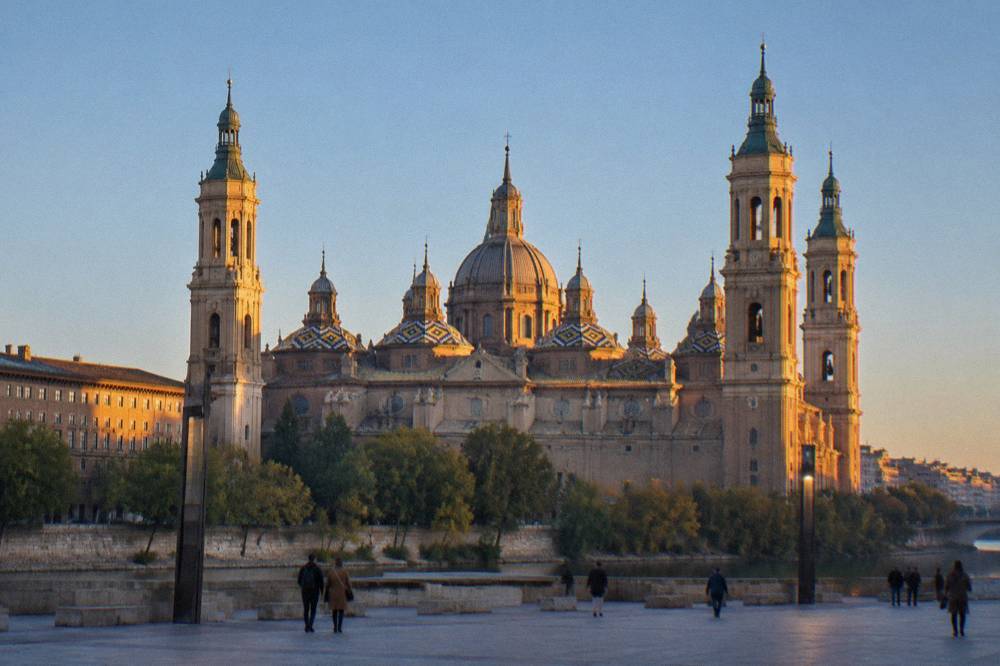
The best Zaragoza photo spots are the Puente de Piedra and the Ebro bank opposite the Basílica del Pilar, the Aljafería courtyard, La Seo's Mudéjar wall, the Caesaraugusta theatre, the Puerta del Carmen and the Parque del Agua meander, shot early or late in the day under the dry Aragonese light.
Zaragoza, the capital of Aragon on the Ebro, gives photographers an unusually concentrated set of subjects: the Basílica del Pilar and La Seo face each other across one square, the Aljafería's horseshoe arches sit ten minutes away by tram, and the Puente de Piedra frames the whole skyline from across the river. The city is inland and dry, with an AEMET 1981-2010 annual average of 2,693 sunshine hours at the Zaragoza Aeropuerto station, which means dependable golden light for most of the year. This guide walks through the best Zaragoza photo spots, the hours and seasons that flatter each one, and the practical details that decide whether a frame works.
What Are The Best Photo Spots In Zaragoza?
The six essential Zaragoza photo spots are the Puente de Piedra and the opposite Ebro bank for the Basílica del Pilar skyline, the Plaza del Pilar between the two cathedrals, the Aljafería courtyard and arcades, the Mudéjar apse wall of La Seo, the Roman theatre of Caesaraugusta, and the Puerta del Carmen at the top of Paseo de Independencia. Each one rewards a different hour, and all six sit within a compact, walkable centre.
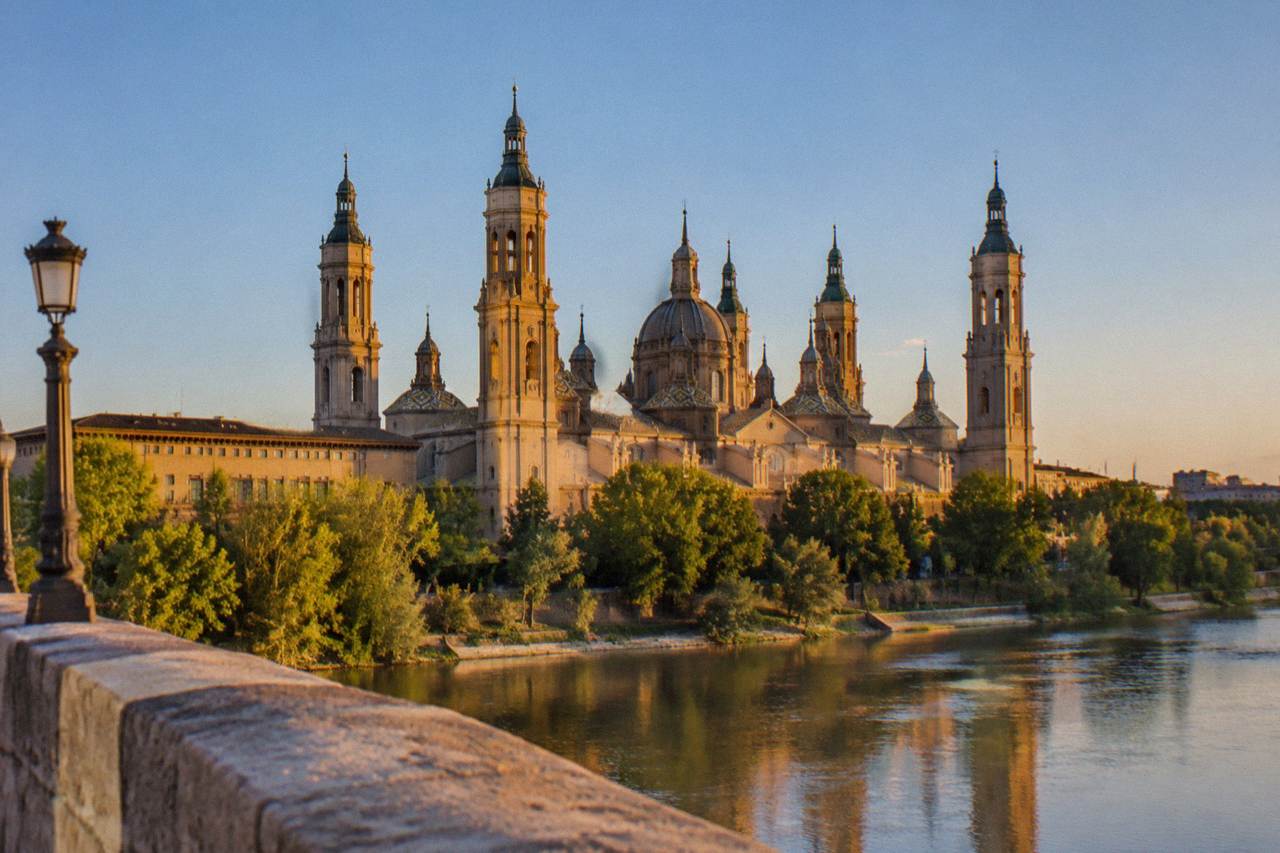
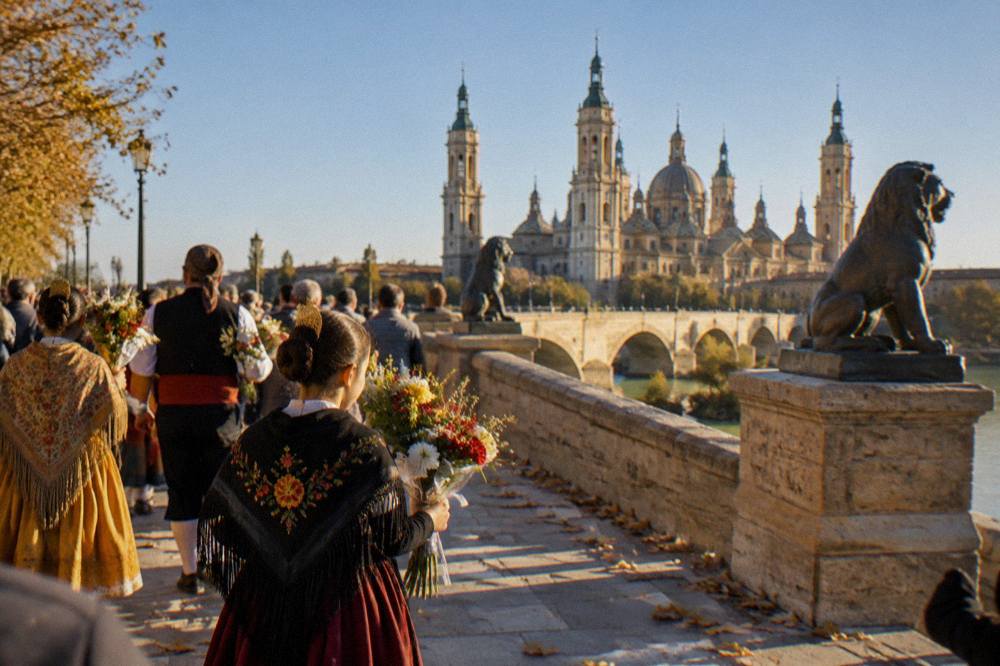
The Puente de Piedra is the classic shot and the reason most photographers book a sunrise. The current bridge was built from 1401 and opened in 1440, on the line of a Roman-era crossing, and its four bronze lions have watched the water since 1991. From the bridge itself you get the Pilar's eleven domes and four towers stacked against the sky; from the opposite bank, the stone bridge becomes the foreground of the same composition. The Basílica del Pilar is free to enter, and its tower viewpoint, the Torre Mirador, costs EUR 6 for an adult, which buys the raised angle over the Ebro meander that no street-level position can match.
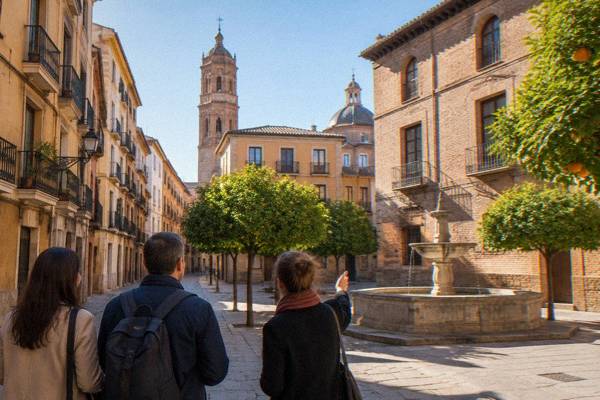
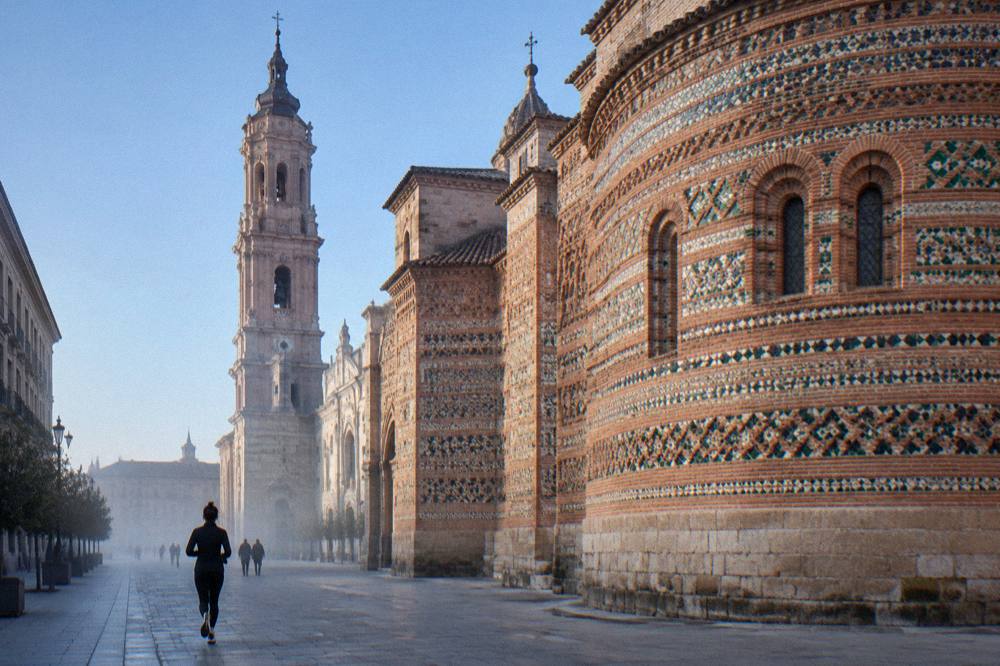
The Plaza del Pilar is the second must-shoot. Two cathedrals, the Basílica del Pilar and La Seo, plus the Lonja and the fountain, share one enormous stone space, and the gap between their styles is the photograph: baroque volume against Mudéjar brick. La Seo's eastern apse wall, with its layered brick, tile and stone patterning, is the single most detailed surface in the city, and it is best lit from early afternoon.
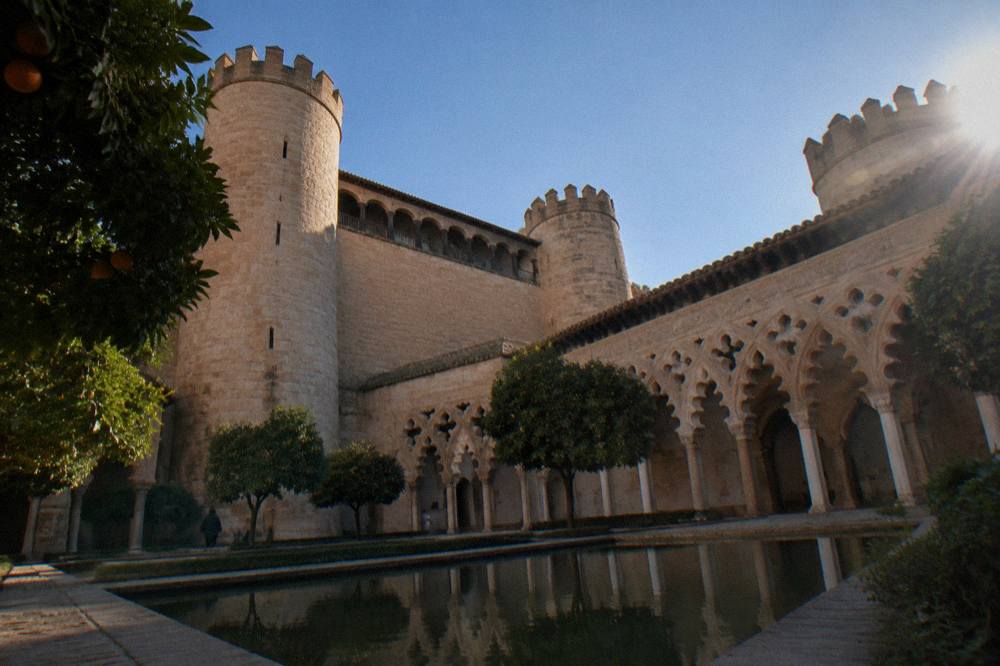
The Aljafería is the third. Its courtyard, with its interlacing polylobed arches and the carved plaster of the oratory niche, is the most complete Islamic palace interior in Spain north of Córdoba, and its skylit arcade gives clean, even light at almost any hour. Admission is EUR 7 general or EUR 9 with a guided tour, and the building opens daily from 10:00 to 18:00 in October, with last access 45 minutes before closing.
For a first pass over the whole set, a guided walk saves time and finds the angles quickly. The Zaragoza Must-See Attractions Walking Tour covers the essential monuments in two hours, and Check availability if you want a local to sequence the frames for you.
When Is The Best Light For Photographing Zaragoza?
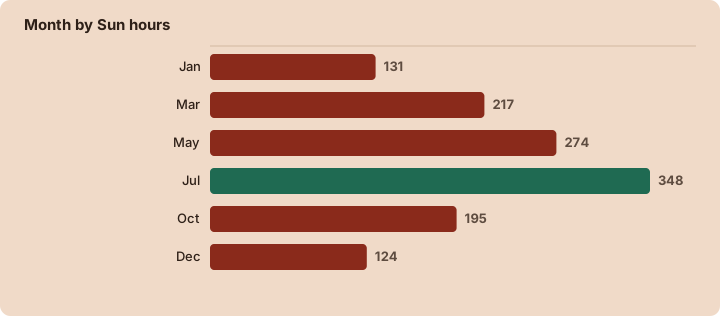
Golden hour in Zaragoza falls in the first and last two hours of daylight, and the two shots that depend on it are the Pilar skyline from the Puente de Piedra, which needs the low western sun behind the photographer in the evening, and the Aljafería courtyard, which stays even and soft all day. AEMET's 1981-2010 normals for the Zaragoza Aeropuerto station put July at 348 sunshine hours and December at 124, so summer gives long shooting evenings and winter short, low light.
The city's dry continental semi-arid climate is a photographer's asset. The annual average is 322 mm of rain spread over just 51.1 days of 1 mm or more, with July and August the driest months at 17 mm each and May the wettest at 44 mm. Translated: most days you shoot, and the odds of a cloudless sky are high, which is exactly why you should chase the exceptions. A broken-cloud evening over the Pilar domes is worth more than a hundred blue-sky frames.
The one local weather factor with no number attached is the cierzo, the cold, dry north-west wind that funnels down the Ebro valley. It is a real presence in Zaragoza, strong enough that AEMET issues wind warnings for Aragon, but no speed or frequency figure exists for it, so treat it as a qualitative factor: on a cierzo day the sky is scrubbed clean, the light is hard, and a tripod on the Puente de Piedra will shake. It is also the reason the evening riverbank shots are often better than the morning ones, since the wind typically eases as the day closes.
The monthly averages from AEMET's 1981-2010 series for the Zaragoza Aeropuerto station shape a shooting year like this:
| Month | Mean max C | Mean min C | Rain mm | Sun hours | What it means for photographers |
|---|---|---|---|---|---|
| Jan | 10.5 | 2.7 | 21 | 131 | Low winter sun, long shadows on the Puente de Piedra |
| Mar | 17.3 | 5.8 | 19 | 217 | Comfortable walking light, almond blossom inland |
| May | 24.1 | 11.8 | 44 | 274 | Wettest month, best odds of dramatic skies |
| Jul | 32.4 | 18.3 | 17 | 348 | Sunniest month, shoot at dawn to avoid harsh midday |
| Oct | 21.4 | 11.0 | 36 | 195 | Fiestas del Pilar light plus autumn colour on the Ebro |
| Dec | 10.8 | 3.2 | 21 | 124 | Short days, 23.1 annual frost days mean possible hoar frost |
For planning a whole trip around the light, the best time to visit Zaragoza and Zaragoza weather guides carry the full monthly breakdown.
Which Viewpoints Give The Best Skyline Photos Of Zaragoza?
The four working skyline viewpoints are the Puente de Piedra and the Ebro bank opposite it for the Pilar's domes, the Torre Mirador of the Basílica del Pilar at EUR 6 adult for the raised river view, the Torreon de la Zuda, which is free and carries a fifth-floor mirador of the four cultures, and the stone banks of the Ranillas meander in Parque del Agua for a modern counterpoint of bridges and towers.
The Torre Mirador is the only paid one, and its hours matter: Monday to Thursday 10:30-14:30 and 16:00-20:00, Friday to Sunday 10:00-20:00, with last access 30 minutes before closing. Reduced rates exist, EUR 5 for over 65s and residents, EUR 4 for ages 13 to 18, students and groups of 20 or more, and free for under 12s. The climb is the trade for the only angle where the Ebro's curve reads as a composition rather than a backdrop.
The Torreon de la Zuda is the budget alternative. It opens Monday to Saturday 10:00-14:00 and 16:30-20:00, Sunday 10:00-14:00, entry is free, and its fifth floor is billed as the mirador of the four cultures, the Roman, Moorish, Jewish and Christian layers of the city. It sits right on the river, so it delivers the stone-bank foreground that the Pilar towers need.
Parque del Agua Luis Bunuel is the modern skyline. The park covers more than 120 hectares in the Ranillas meander beside the Expo 2008 site, holds two running circuits of 5 and 10 km, and was the first European green space to carry the Green Globe certification. From its banks you shoot the Third Millennium Bridge and the Expo-era architecture against open sky, a completely different Zaragoza from the Pilar's baroque mass. The Expo 2008 site and Parque del Agua guides detail the ground.
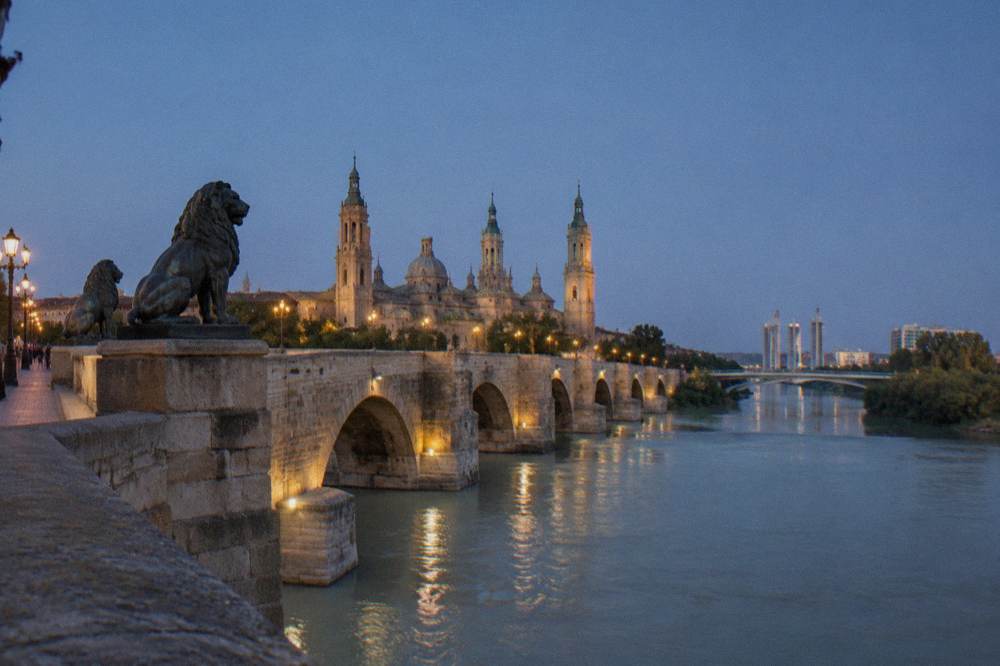
A private guide is a reasonable investment for photographers because the route can be built around light rather than monuments: a private custom tour with a local guide runs from $51.60 per person and can start at dawn.
What Should You Photograph Inside The Aljafería Palace?
The three frames that matter inside the Aljafería are the interlacing polylobed arches of the courtyard arcade, the carved plaster mihrab niche of the oratory, and the ceiling of the throne room upstairs, and all three survive best in soft, even light. The palace opens daily 10:00-18:00 in October, admission EUR 7 general, EUR 9 guided, EUR 4 with the tourist bus ticket, and it is free on the first and third Sunday and Monday of each month.
The Aljafería is the hardest interior in the city to expose correctly. The courtyard is open to the sky while the arcades sit in deep shade, so the dynamic range defeats most single frames: bracket your exposures or shoot in the first and last two hours, when the contrast drops. Spanish guided tours run at 10:30, 12:30, 13:30, 15:00 and 16:00, and an exhibition tour, "Goya, del Museo al Palacio", runs at 11:30, so the courtyard has quiet windows between those slots.
Photograph it as what it is, a taifa palace later absorbed into the monastery and fortress of the Catholic Monarchs, with the later Christian layers visible in the upper rooms.
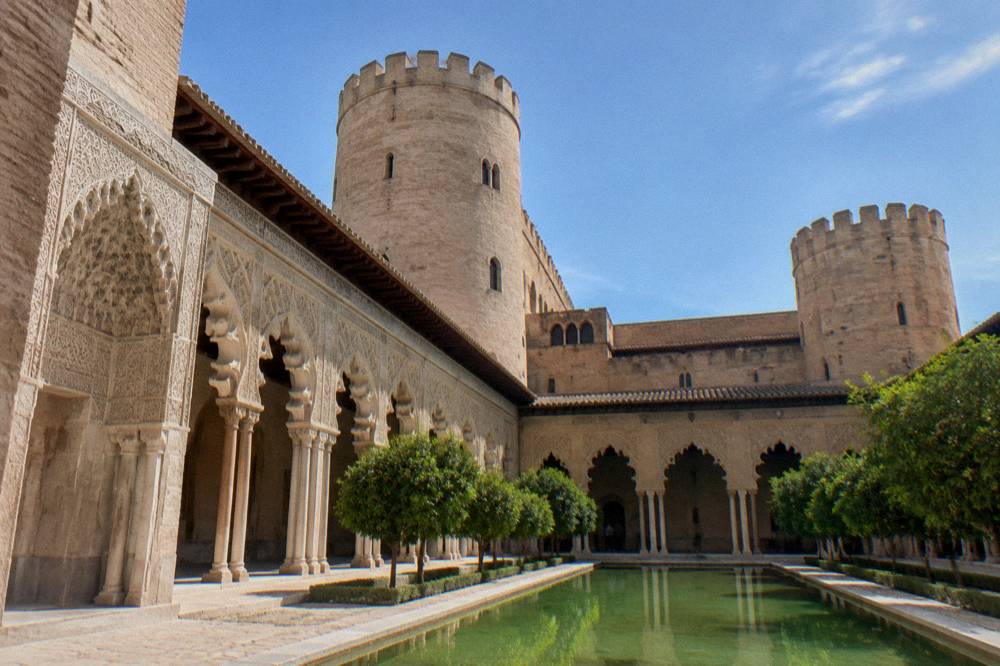
A ticketed guided visit is the practical way to shoot the palace without routing problems: the Aljafería Palace ticket and guided visit starts from $24.76 per person, rated 4.7 from 82 reviews.
What Roman And Mudéjar Details Are Worth Photographing In Zaragoza?
The Roman subjects are the Caesaraugusta theatre, forum, river port museum and baths, of which the theatre is the most photogenic, and the Mudéjar subjects are La Seo's brick apse wall, the San Pablo tower and the details of the La Magdalena church.
The Caesaraugusta museums open Tuesday to Saturday 10:00-14:00 and 17:00-21:00, Sunday and holidays 10:00-14:30, admission EUR 4 for the forum and EUR 3 for the baths and river port, with a four-museum bono at EUR 7 and free entry on the first Sunday of the month.
The Roman theatre is the deepest interior shot in the old town: a carved stone cavea below street level, where the light falls in shafts through the modern canopy. The forum's Augustan marble columns and the river port's preserved quay wall are quieter but cleaner compositions, and the combined bono at EUR 7, EUR 5 reduced, makes the circuit cheap. Free on the first Sunday of the month, which is also, not coincidentally, the most crowded day to shoot them.
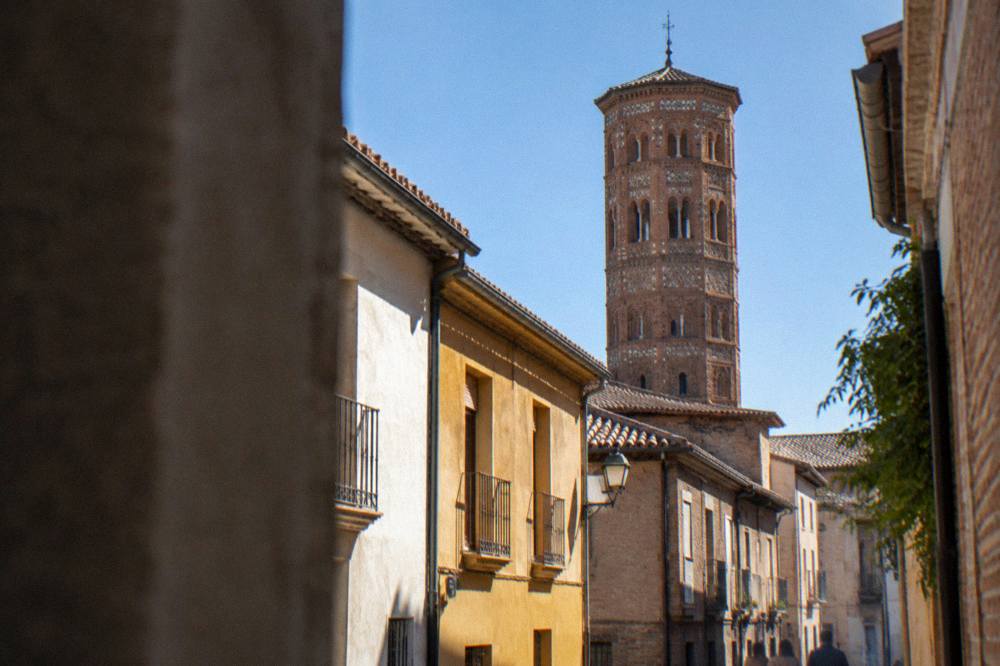
Mudéjar is Zaragoza's signature texture and it costs nothing to photograph. La Seo's apse wall, the so-called Parroquieta, mixes brick, glazed tile and carved stone in horizontal bands, and it is the finest single example of Aragonese Mudéjar in the city. The San Pablo tower, with its brick-and-tile geometric shaft, and the church of La Magdalena give the same language in quieter streets. The Mudéjar architecture and Roman Caesaraugusta guides carry the full inventory.
Here is the price and access table for the monument interiors a photographer will actually enter:
| Subject | Admission | Hours (October) | Free entry |
|---|---|---|---|
| Basílica del Pilar, temple | Free | Main altar zone Mon-Sat 7:30-13:30 / 16:30-20:15, Sun 7:30-13:30 / 16:30-21:30 | Always |
| Pilar Torre Mirador | EUR 6 adult | Mon-Thu 10:30-14:30 / 16:00-20:00, Fri-Sun 10:00-20:00 | Under 12 |
| La Seo + Museo de Tapices | EUR 10 general | Mon-Sat 10:00-14:30 / 16:00-20:00, Sun 10:00-12:00 / 16:00-20:00 | Aragon residents on the 6th, 12th, 23rd, 27th |
| Aljafería | EUR 7 general, EUR 9 guided | Daily 10:00-18:00 | 1st and 3rd Sunday and Monday |
| Caesaraugusta theatre | In 4-museum bono EUR 7 | Tue-Sat 10:00-14:00 / 17:00-21:00, Sun 10:00-14:30 | 1st Sunday of month |
| Museo del Origami | EUR 3 | Tue-Sat 10:00-19:00, Sun 10:00-14:00 | 1st Tuesday and Sunday |
One standing fact to plan around: the Museo de Zaragoza's central building at Plaza de los Sitios 6 is closed for Ministry of Culture works with no reopening date, and the Museo Pablo Gargallo and Palacio de Sastago are also shut at present, so none of the three belongs in a photography itinerary this season. The Museo Goya, by contrast, reopens on 9 October 2026, open Tuesday to Saturday 10:00-20:00 and Sunday 10:00-14:00, closed Mondays, with its admission price not yet published.
How Do You Photograph The Fiestas Del Pilar And Zaragoza'S Big Events?
The Fiestas del Pilar, held 10 to 18 October 2026, offer the year's richest street photography: the pregón from the Ayuntamiento balcony at 21:00 on 10 October, the Ofrenda de Flores on 12 October from about 06:30 with its route along Paseo de la Independencia to Plaza del Pilar, the reported Ofrenda de Frutos and Rosario de Cristal on 13 October, and fireworks after the pregón, in Parque Pignatelli, at the Ebro closing on 18 October and in Plaza San Francisco.
The Ofrenda is the headline shoot. The 2026 edition has 994 registered groups filing past in regional dress, and the mass of flowers builds a mountain of blooms around the Pilar's base over the course of the day. Arrive before 06:30 for the empty-street frames, then work the route as the density builds. A long lens for faces and costume detail beats a wide lens here; the crowds defeat wide compositions by mid-morning.
The Rosario de Cristal, a reported event for 13 October beginning around 19:00, is a night procession of glass lanterns, and it is the one event that rewards a tripod and slow shutter. The fireworks program, extended for 2026, gives four separate pyrotechnic displays, and the Ebro closing on 18 October doubles as a skyline shoot with the Pilar lit behind the bursts. Semana Santa, 21 to 28 March 2027, is the other calendar peak: hooded procesiones through the old town in low spring light. The Fiestas del Pilar, Ofrenda de Flores and Semana Santa in Zaragoza guides cover the logistics.
What Camera Gear And Settings Work For Zaragoza'S Streets And Interiors?
A workable Zaragoza kit is one wide lens for the Pilar's tight plaza, one standard zoom for street work, and a fast prime for the dark interiors of La Seo and the Aljafería, with a travel tripod reserved for the riverbank night shots, since the city's 2,693 annual sunshine hours mean most daytime work needs nothing exotic and the interiors need aperture more than ISO range.
The practical constraints are specific. The Basílica del Pilar's interior is a working church with free entry, so shoot quietly and without flash. La Seo's Museo de Tapices, included in the EUR 10 general ticket, is a low-light textile environment where flash is out of the question. The Aljafería courtyard is the one place where a polariser earns its slot in the bag, cutting the skylight glare on the plaster. On the riverbank at night, the stone banks of the Ebro give stable tripod positions for the lit Pilar, and the cierzo, when it blows, is the reason to hang the camera bag off the tripod legs.
For moving between spots, the urban bus and tram single fare is EUR 1.70, or EUR 0.55 with a Tarjeta Bus, and the Zaragoza Bus Turístico costs EUR 10 for a 24-hour hop-on hop-off ticket covering 16 stops on a 90-minute loop, cash only on the bus, a genuine option for a dawn-to-dusk monument circuit. The getting around Zaragoza guide has the full transport picture.
| Photo situation | Recommended approach | Constraint to respect |
|---|---|---|
| Pilar skyline at dusk | Tripod on the Puente de Piedra or opposite bank | Cierzo wind can shake long exposures |
| Aljafería courtyard | Bracket exposures, polariser on the plaster | Deep shade against skylight, high dynamic range |
| La Seo interior and tapestries | Fast prime, no flash, raise ISO | Working cathedral, EUR 10 ticket includes tapestries |
| Ofrenda de Flores crowd | Long lens, early arrival before 06:30 | 994 registered groups, dense crowds by midday |
| Roman theatre | Wide lens, first Sunday avoided if you want emptiness | Free first Sunday is also the busiest |
| Ebro night shots | Tripod, remote release | Stone banks give legal, stable positions |
Where Can You Shoot Away From The Crowds In Zaragoza?
The quiet alternatives are the San Pablo barrio around its Mudéjar tower, the La Magdalena church and its small square, the stone banks of the Ebro upstream of the Puente de Piedra, and the Parque del Agua meander at Ranillas, all of which deliver the city's characteristic brick and river textures without the Plaza del Pilar's constant foot traffic, and all of which are free to shoot.
San Pablo is the most rewarding of these. The barrio clusters around the Mudéjar tower of the church of San Pablo, and its narrow streets give the brick-and-tile geometry that made Aragonese Mudéjar a UNESCO-listed style, in an ordinary working neighbourhood rather than a monument precinct. La Magdalena, a few minutes north, is the same language on a smaller scale, and its square has genuine café life in the foreground.
The Ebro upstream of the bridge, along the Ebro river walk, is where the riverbank photographers who want water reflections without the bridge crowds set up. The stone embankments hold their line for a long stretch, and the light from the west in the evening puts warm colour on the water. For the complete inventory of lesser-known subjects, the hidden gems of Zaragoza and old town guides go further, and the free GuruWalk Indispensable Zaragoza Free Tour of the Old Town, tip-based and rated 4.97 from 576 reviews, is a zero-cost way to scout angles with a local guru before committing hours to any one spot.
How Do You Plan A Photography Day In Zaragoza?
A realistic one-day photography plan opens at dawn on the Puente de Piedra for the Pilar skyline, moves to the Plaza del Pilar and La Seo's apse wall in the morning light, spends the midday hours inside the Aljafería and the Caesaraugusta theatre where interiors work in flat light, and returns to the Ebro bank for the evening skyline, with the Torre Mirador at EUR 6 as an optional raised finale before its last access 30 minutes before closing.
The sequencing matters because the light does. The Pilar's western facade, the one the bridge frames, takes the evening sun; the Plaza del Pilar between the two cathedrals is workable all day; La Seo's Parroquieta apse reads best from early afternoon; and the Aljafería is an interior that does not care what the sun is doing. Build the day around those four light windows and the walking distances, which are short: the Pilar to La Seo is one square, the Pilar to the Aljafería is a tram ride at EUR 1.70 a single.
For a longer stay, the one day, two day and three day itineraries give the full sequencing, and the Zaragoza Travel Guide planning page covers where to sleep and how to arrive, including the Zaragoza-Delicias train station approach, about 1.5 to 2 hours by high-speed train from both Madrid and Barcelona.
| Time of day | Subject | Why it works then |
|---|---|---|
| Dawn | Puente de Piedra and Ebro bank | Empty bridge, low western light on the Pilar's facade |
| Morning | Plaza del Pilar, La Seo exterior | Square still quiet before tourist peak |
| Midday | Aljafería courtyard, Caesaraugusta theatre | Interiors, flat skylight, no harsh shadows |
| Early afternoon | La Seo Parroquieta apse | Sun strikes the banded brick wall |
| Evening | Ebro bank opposite the Pilar | Golden hour on the skyline, wind typically easing |
| After dark | Puente de Piedra, lit Pilar | Tripod work from the stone banks |
Common Questions About Zaragoza Photography
Can you photograph inside the Basílica del Pilar?
Yes. Entering the temple is free and photography is normal practice, but it is a working church: shoot quietly, without flash, and away from the altar zones during services. The Torre Mirador viewpoint costs EUR 6 for an adult and gives the raised river view, with last access 30 minutes before closing.
What is the best month for photography in Zaragoza?
October, if the Fiestas del Pilar interest you: the 2026 edition runs 10 to 18 October with the Ofrenda de Flores on 12 October, and AEMET's 1981-2010 normals for the Zaragoza Aeropuerto station give October a 21.4 C mean maximum and 195 sunshine hours. Otherwise May offers the most dramatic skies, as the wettest month at 44 mm, and July the most sun at 348 hours.
Is a tripod allowed on the Puente de Piedra?
The stone bridge is a public crossing and tripods are a normal sight at dusk, particularly on the riverbanks beside it. The practical caution is the cierzo, the dry north-west Ebro-valley wind: no speed figure exists for it, but on strong days long exposures on the bridge itself will shake, so use the stone banks for stability.
Do you need a ticket to photograph the Aljafería?
Yes, admission is EUR 7 general or EUR 9 with a guided tour, EUR 4 with the tourist bus ticket and EUR 2 for students, over 65s and Carnet Joven holders, with under 12s free. Entry is free on the first and third Sunday and Monday of each month, which is also when the courtyard is busiest.
Where is the classic Zaragoza skyline photo taken from?
From the Puente de Piedra or the stone Ebro bank opposite it, with the Basílica del Pilar's domes and towers behind. The bridge itself dates from 1401, opened in 1440 and carries four bronze lions from 1991, and the raised alternative is the Torre Mirador at EUR 6 adult.
Are the Zaragoza museums good for interior photography?
Several are: the Caesaraugusta theatre and forum, La Seo's Museo de Tapices and the Aljafería all offer strong interiors, and the Museo Goya reopens on 9 October 2026 with Tuesday to Saturday 10:00-20:00 hours. Note that the Museo de Zaragoza's central building, the Palacio de Sastago and the Museo Pablo Gargallo are currently closed, so none of the three should be on an interior list this season.
Zaragoza rewards photographers who plan around light rather than a list of monuments: the same skyline that is flat at noon becomes the frame of the day at 20:00, and the same palace courtyard that defeats a midday sensor is effortless before noon. Shoot the river at both ends of the day, keep the interiors for the middle, and let the dry Aragonese sky do the rest.